CCSD code H4430: Examination of rectum under anaesthetic
CCSD code H4430 pays for the examination alone CCSD code H4430 is the UK private...

Last Updated: Oct 20, 2026
J0594 is the HCPCS Level II code for injection, busulfan, 1 mg.
You bill one unit for every milligram administered, so a 150 mg dose is 150 units, not one vial. On a drug this expensive, a unit error moves thousands of dollars in either direction.
Add the waste modifiers, the NDC on every line, and a diagnosis the payer will accept, and one claim has four ways to fail. We'll take them in the order a biller works through the claim.
Let Pabau's smart automation suggest the right codes, reduce claim denials, and keep your practice compliant—effortlessly.
Automate repetitive tasks and focus on what matters most—your patients.
Reduce coding errors and ensure compliance with the latest regulations.
Clean claims, fewer denials, and faster reimbursements.
Powerful insights and reporting to help your practice thrive.
HIPAA compliant SOC 2 certified GDPR-compliant Trusted by 4,000+ clinics worldwide

HCPCS code J0594 covers injection, busulfan, 1 mg, and you bill one unit for every milligram administered.
Medicare Part B pays J0594 at ASP+6% in the physician office, and CMS refreshes that rate every quarter.
A partial vial needs two claim lines: the milligrams administered, then the discarded milligrams with modifier JW.
When nothing is discarded, append JZ instead. A single-dose vial line carrying neither modifier is the most common miss.
Oral busulfan does not belong here. Myleran tablets have their own code, J8510, at 2 mg per unit.
J0594 describes injection, busulfan, 1 mg. It is a Level II HCPCS J-code maintained by the Centers for Medicare and Medicaid Services (CMS).
J-codes cover drugs a provider injects or infuses. They are billed separately from the service that delivers them, which is why the drug and the infusion appear on different lines.
J0594 sits in the drug section of the Level II set. It follows the same annual update cycle as the rest of the HCPCS codes, and the descriptor has been stable for years. The unit, however, is where claims come apart.
The unit rule that matters most: J0594 is billed per milligram, never per vial. A patient who receives 150 mg generates 150 units on the claim line. Enter one unit per vial and you get paid for a single milligram. Enter the full vial’s 60 units with no waste line, and you get paid for drug the patient never received.
Busulfan is an alkylating agent. It cross-links DNA strands and stops rapidly dividing cells from replicating. Two formulations reach patients, and only one of them belongs on a J0594 claim.
The IV formulation, Busulfex, is the one J0594 describes. It is used as myeloablative conditioning before hematopoietic stem cell transplantation (HSCT). Most of those patients have chronic myelogenous leukemia (CML) or acute myeloid leukemia (AML), and some have aplastic anemia.
Oral busulfan is a different code entirely. Myleran tablets bill under J8510 at 2 mg per unit, and Medicare handles them through its oral anticancer drug benefit. Coverage there still turns on the indication, so read the payer’s policy rather than assume. What is certain is that oral busulfan never belongs on a J0594 line.
Medicare Part B pays provider-administered drugs off the Average Sales Price (ASP). For J0594 in the physician office, that means ASP+6%.
CMS republishes the ASP drug pricing file every quarter, so a figure you noted last quarter may already be stale. Pull the current rate from the CMS Physician Fee Schedule lookup or the quarterly ASP file before the claim goes out.
Buy-and-bill is the model in office and outpatient settings. The practice buys Busulfex, administers it, and bills J0594 to recover the acquisition cost plus the 6% add-on. That margin is thin, and it thins further every day a finished claim sits unfiled.
Medicare wants a National Drug Code (NDC) on most Part B drug claims, on both the CMS-1500 and the 837P.
It has to be the NDC of the product you administered, not a generic equivalent or a similar package. NDCs change with manufacturing updates, so check the CMS NDC-to-HCPCS crosswalk file each billing cycle.
Reporting format: report the NDC in 11-digit 5-4-2 form, preceded by the N4 qualifier. Follow it with the unit-of-measure qualifier and the quantity administered. Busulfex is a solution, so that quantity is reported in milliliters, even though the claim line units are milligrams. Mixing those two measures up is a quick way to fail a front-end edit.
Because dosing is weight-based, the quantity changes from patient to patient. It has to agree with the dose calculation in the chart. Submit through a clearinghouse that carries the NDC fields on the 837P, then read the acknowledgment rather than assuming the file landed.
Every J0594 line needs at least one ICD-10-CM code that supports medical necessity. Busulfan has a narrow set of approved indications, and a diagnosis outside them denies on sight.
The pairings below cover most transplant conditioning claims.
Check the payer’s coverage policy before you finalize the pairing. Some Medicare Administrative Contractors (MACs) publish Local Coverage Determinations that narrow the list further.
Keep the oncologist’s order, the transplant protocol, and the diagnosis confirmation in the record, because a post-payment audit will ask for all three.
Four modifiers show up on J0594 claims, and two of them decide whether the line reads as complete.
CMS opened voluntary JZ reporting on January 1, 2023, then made it mandatory on July 1, 2023. Since that date, a single-dose vial line carrying neither JW nor JZ looks unfinished to a MAC.
Busulfan dosing is weight-based, so a partial vial is the normal case rather than the exception. Say the order is 150 mg and the pharmacy opens three 60 mg vials. That is 180 mg drawn and 30 mg left over.
Two lines go on the claim. The first carries J0594 with 150 units and no waste modifier. The second carries J0594 with modifier JW and 30 units for the discarded milligrams.
JW belongs only on that second line, and both lines carry a charge. Medicare pays for documented waste from a single-dose container, up to the amount on the vial label.
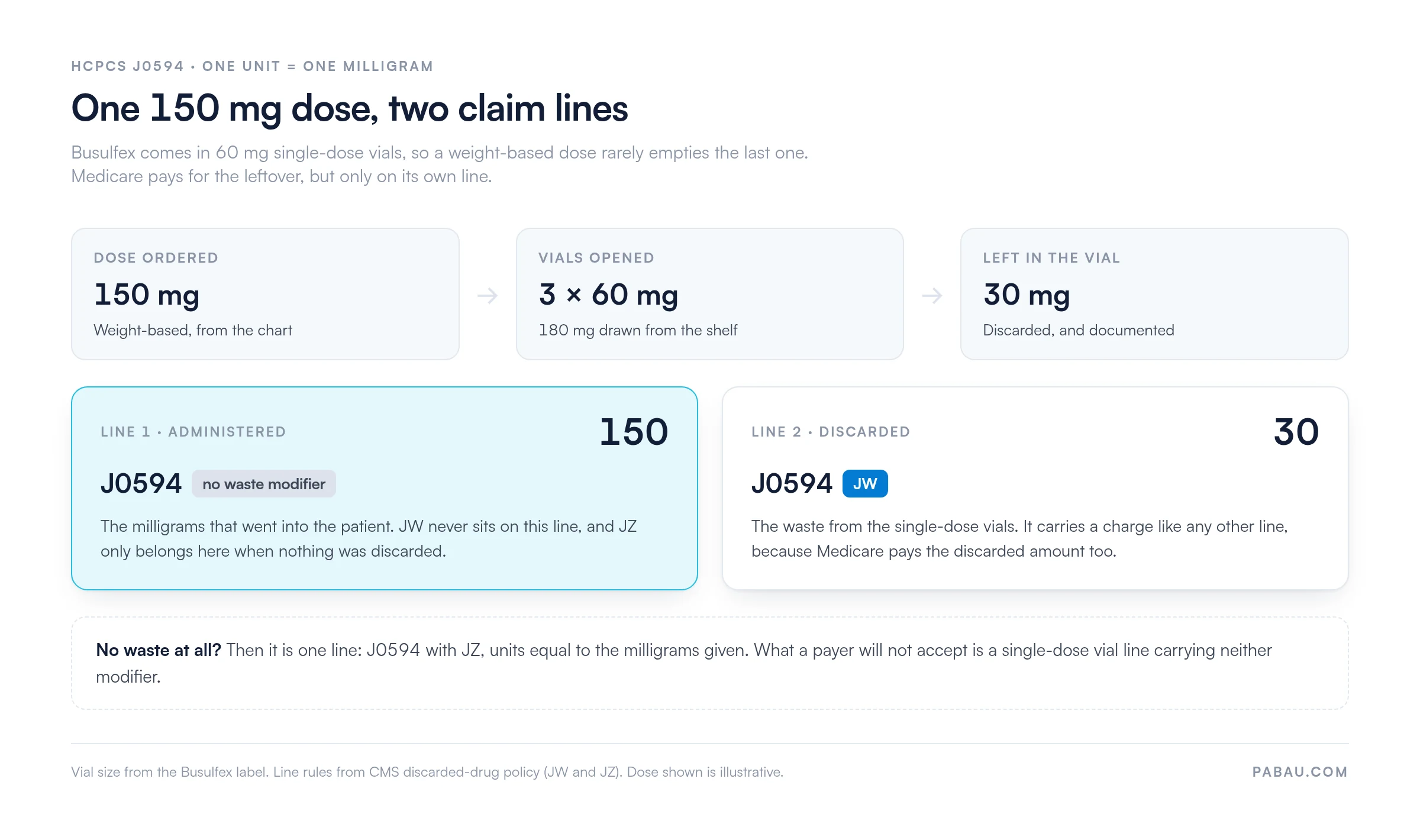
When the whole vial goes into the patient, there is no second line. One line, J0594 with JZ, units equal to the milligrams given. The two modifiers never appear on the same line.
Ask the transplant pharmacy for the vial count as well as the dose. The dose tells you the administered units. Only the vial count tells you how much waste there was to report. Billers working from the dose alone tend to miss the JW line completely, and nobody notices until the margin on that regimen comes up short.
Traditional Medicare Part B does not normally require prior authorization for J0594 in the physician office.
Commercial plans are another matter. Most large ones, Blue Cross Blue Shield and UnitedHealthcare included, require authorization for Busulfex because of its cost and the regimen it supports.
Start the authorization before the conditioning regimen does. Retroactive appeals on high-cost oncology drugs succeed far less often than a request filed in advance.
Send the transplant protocol, the oncologist’s order naming busulfan as the conditioning agent, the confirmed diagnosis, and the weight-based dose calculation.
Authorization numbers also expire. A conditioning course running across several days can outlive the approval covering it. Put that expiry date somewhere the billing team will see it.
Here is the sequence that keeps a busulfan claim moving. Each step produces something a payer can ask you to hand over later, which is the point of doing them in order.
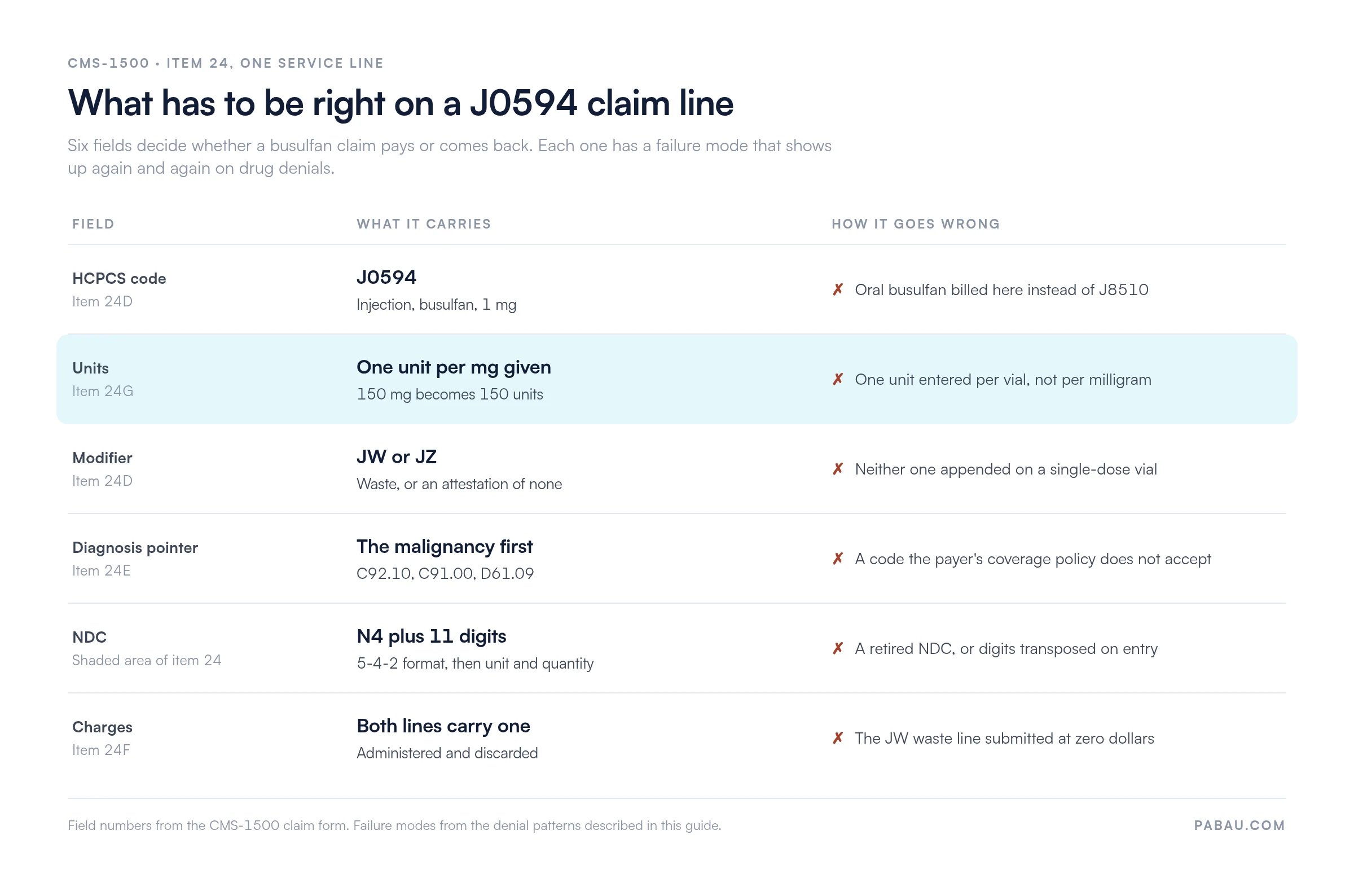
Those eight steps all end up in the same place: one service line. This is what has to be right on it.
Practices reach Busulfex two ways, and the choice decides who fronts the money.
Busulfan is almost always given in a hospital-adjacent or specialized outpatient setting, because the conditioning regimen needs close monitoring. Practices with their own infusion suite tend to buy and bill. That puts the drug on the balance sheet until the claim pays, so the billing calendar and the transplant calendar have to line up.
Conditioning regimens combine drugs, and each one gets its own J-code line. Knowing what else belongs on the claim stops reimbursable work from going unbilled.
Standard busulfan regimens pair it with cyclophosphamide (Bu/Cy) or fludarabine (Bu/Flu). Cyclophosphamide bills under J9071 through J9075, per milligram, following the April 2024 code changes. Fludarabine bills under J9185. J9062 still turns up in older references, but it is a deleted cisplatin code and does not describe either drug.
The infusion itself is a separate service. Busulfan is an antineoplastic, so administration bills with the chemotherapy codes. That means CPT 96413 for the first hour, 96415 for each additional hour, and 96417 for a sequential infusion of a different drug. The therapeutic infusion codes in the 96365 range are the wrong family here.
Sequencing: on a professional claim, list J0594 against the malignancy as the primary diagnosis. Z94.81 (bone marrow transplant status) or Z51.11 (encounter for antineoplastic chemotherapy) follow as secondary codes. If the transplant admission is inpatient, the conditioning drugs sit inside the MS-DRG and are not billed separately.
Busulfan claims attract attention because they are expensive. These are the denials that show up most often, and each one has a fix that costs less than the appeal would.
When a high-dollar line denies anyway, appeal with the transplant protocol, the administration record, and a letter of medical necessity from the treating oncologist.
That package clears most first-level denials on this code. A repeatable approach to denial management matters more here than on a routine claim. One busulfan line can be worth more than a week of office visits.
Most of what goes wrong on a J0594 claim happens between the infusion suite and the billing queue. The dose lives in the administration record. The code lives in a lookup sheet. Someone retypes one into the other, and the transcription is where the units go astray.
Practice management software like Pabau shortens that trip. Pabau’s claims management software pre-fills the CMS-1500 from the record itself. The code already attached to the service lands on the charge line, and the diagnosis slots are seeded from the patient’s problem list.
ICD-10 and HCPCS lookup libraries sit next to the claim and refresh with each official release, so nobody leaves the screen to confirm a descriptor.
Before a claim can be sent, Pabau checks that the fields the payer requires are complete. On the US pipeline it also runs eligibility checks, tracks claim status, and posts remittances back against the invoice as they return. You still decide which modifier the case calls for. What changes is the number of days a finished claim spends waiting for someone to notice it.

Pabau pulls the codes and diagnoses already on the patient record straight onto the claim form. Required fields get checked before it can be sent. Your billing team spends less time retyping and more time on the lines that need a decision.

J0594 stops being difficult once the unit logic and the waste rules live in a checklist rather than in one person’s head. The two errors that cost the most, units counted by vial and a missing waste modifier, are both caught before submission or not at all.
The habit worth building is a pre-bill check on every busulfan line, rather than a stronger appeals process. Appeals on this code are winnable. They also tie up weeks of someone’s time chasing money you had already earned.
If your administration records and your claim lines currently sit in different systems, that distance is where the errors come from. Book a demo to see how Pabau builds the claim out of the record your infusion team has already completed.

Need the EDI detail behind a drug claim? 837 electronic claim file walks through the transaction structure that carries NDC and unit data to the payer.
Wondering what your clearinghouse checks first? Medical claims clearinghouse explains the front-end edits that catch a malformed drug line before a payer ever sees it.
Building the charge capture behind the claim? Superbill covers what belongs on the document your billers work from, and what tends to get left off.
Reading remittances line by line? Electronic remittance advice breaks down the 835 and the adjustment reason codes you meet on denied drug lines.
Worried about the audit side of high-value drug claims? Medical billing compliance sets out the documentation habits that hold up in a post-payment review.
No. J0594 is intravenous busulfan at 1 mg per unit, billed by the provider who infuses it. J8510 is oral busulfan at 2 mg per unit. Same drug, different route, different unit size, different benefit. Check the route on the order before you pick the code.
Hospital outpatient claims report J0594 under revenue code 0636, drugs requiring detailed coding. That revenue code cannot stand on its own. The line still needs the HCPCS code, the units, and the 11-digit NDC beside it, or the claim rejects.
Medicare allows 12 months from the date of service. Commercial windows are often far shorter, sometimes 90 days. Each date in a conditioning course starts its own clock, so file as the regimen runs instead of batching it at the end.
Bill each date of service on its own line, with the milligrams given that day. Never total the regimen and submit it once. A four-day course produces four sets of units, and each one carries its own waste decision.
Not separately. Once the patient is admitted, the conditioning drugs fall inside the hospital’s MS-DRG payment. J0594 is a Part B line for office and outpatient settings only. Billing it during an inpatient stay duplicates payment.