HCPCS code G0143: Thin-layer Pap screening with rescreening
HCPCS code G0143 means two manual reads of one liquid-based slide HCPCS code G01...

Last Updated: Oct 19, 2026
H0048 is the HCPCS Level II code for alcohol and/or other drug testing: collection and handling only, specimens other than blood. It pays for collecting, sealing, and sending a urine, oral fluid, or other non-blood specimen to the lab. The lab bills the analysis separately.
Medicare does not pay H0048, so state Medicaid programs are the main payers. Each state sets the unit, any modifier, and any authorization rule. H0048 is often confused with H0047 and H0049, which describe substance use services and screening rather than collection.
Let Pabau's smart automation suggest the right codes, reduce claim denials, and keep your practice compliant—effortlessly.
Automate repetitive tasks and focus on what matters most—your patients.
Reduce coding errors and ensure compliance with the latest regulations.
Clean claims, fewer denials, and faster reimbursements.
Powerful insights and reporting to help your practice thrive.
HIPAA compliant SOC 2 certified GDPR-compliant Trusted by 4,000+ clinics worldwide

H0048 reports collecting and handling a urine, oral fluid, or other non-blood specimen for alcohol or drug testing, not the lab analysis itself.
Blood specimens fall outside H0048, and the lab that analyzes the specimen bills its own testing code separately.
Medicare lists H0048 with coverage code I (not payable), so the code is billed to state Medicaid programs and the plans that accept H-codes.
Units, modifiers, and prior authorization rules for H0048 are set by each state Medicaid program, so the state billing manual is the authority.
A clean H0048 claim rests on the collection record: who collected which specimen, when, and how it was sealed and sent to the lab.
HCPCS code H0048 reports the collection and handling of a non-blood specimen for alcohol and/or drug testing. The official CMS descriptor reads: Alcohol and/or other drug testing: collection and handling only, specimens other than blood.
The word “only” carries the meaning of the code. H0048 pays the provider who obtains, labels, and sends the specimen. The laboratory that runs the test bills the analysis under its own code.
H0048 sits in the H-series of HCPCS Level II, maintained by the Centers for Medicare and Medicaid Services (CMS). CMS created H-codes for state Medicaid agencies that need separate codes for mental health and substance use services. H0048 was added on January 1, 2003, and remains active in the October 2026 HCPCS file.
H0048 covers the work of getting a testable non-blood specimen from the patient to the lab in a usable, traceable state. That includes observing or supervising the collection, labeling, sealing, completing the requisition, and packaging the specimen for transport.
Specimen types that fit H0048:
What H0048 does not cover:
Whether the specimen is screened on site with a point-of-care cup or sent to a lab, H0048 describes only the collection side. Some state programs allow it only when the collecting provider does not also perform the test, so check the state manual before billing both.
H0048 is a collection code, while its neighbors describe services or analysis. Confusing it with H0047 or H0049 is the most frequent coding error for this code. The table below uses the descriptors in the CMS HCPCS file.
The pairing that matters most is H0048 with the analysis code. A practice that collects urine and sends it out bills H0048, and the reference lab bills the test. Instead of H0003, commercial labs often bill presumptive testing under CPT 80305 to 80307. Definitive testing goes under G0480 to G0483. The flow below shows which party reports each code as the specimen moves to the lab.
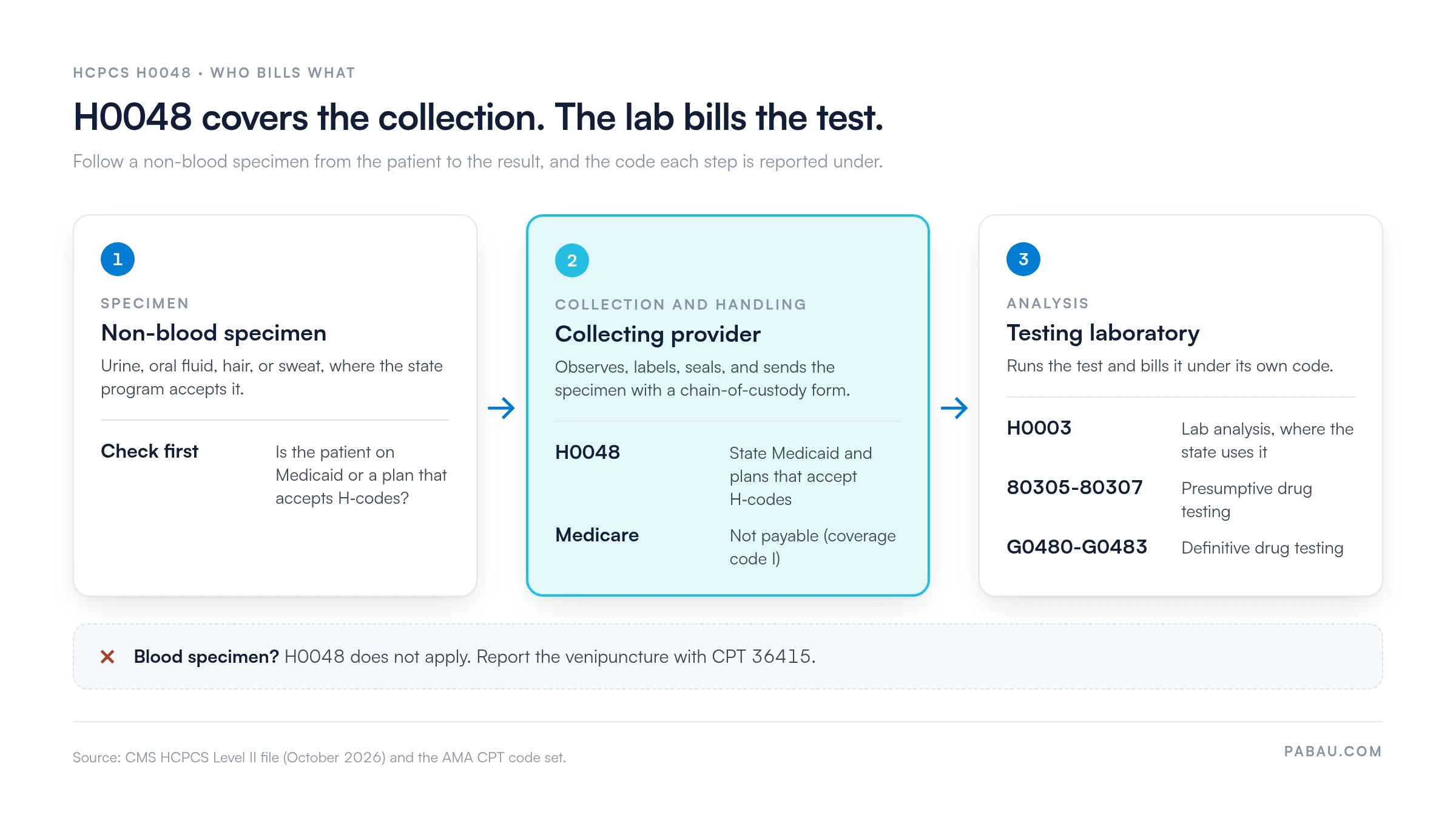
H0048 is not a per diem code either. A treatment program day is reported under the state’s program code, such as H2036 or H0015.
State Medicaid programs and their managed care plans are the payers for H0048. CMS lists the code with Medicare coverage code I, which means it is not payable by Medicare, and pricing indicator 00. A Medicare claim with H0048 will deny.
For Medicare patients, the collection is bundled into the lab test codes rather than billed on its own. Commercial plans vary, and some accept H-codes under behavioral health contracts while others do not.
There is no national rate for H0048. Each state publishes its Medicaid fee schedule, usually on the Medicaid agency website. Keep each state’s current schedule with your billing notes, so staff confirm the rate and unit before the claim goes out.
No national modifier is required on H0048. Any modifier requirement comes from the state Medicaid program or the managed care plan, and it differs from state to state.
Prior authorization follows the same pattern. A state may cover H0048 under the existing authorization for the treatment episode. It may also cap collections per month or require testing to appear in the treatment plan. The state billing manual decides each of these points, so keep a per-payer reference that staff check before the claim goes out.
Because H0048 pays for collection and handling, the record has to prove the collection happened and the specimen reached the lab intact. Payers and auditors look for the following in the chart for each billed collection.
A complete chain of custody does two jobs. It supports the H0048 claim, and it makes a positive result defensible if the patient disputes it.
Drug test results from a federally assisted SUD program are also covered by 42 CFR Part 2. That rule restricts how SUD records are shared, including with billing vendors and clearinghouses. Make sure your HIPAA compliance program covers Part 2 consent as well.
Most H0048 denials trace back to the wrong payer, the wrong code, or a thin collection record. The denial management approach you use for other codes applies here, with the fixes below.
Tracking denials by root cause shows which of these keeps coming back. Most fixes belong in the collection workflow rather than at the billing desk.
A clean HCPCS code H0048 claim follows these steps in order.
Payers expect a diagnosis that explains why the specimen was collected. In SUD treatment, that is usually a code from F10-F19 in Chapter 5 of ICD-10-CM. Code the substance and the level of use the clinician documented.
Choose the code the clinical note supports. A diagnosis that does not match the documented reason for testing invites a medical necessity denial.
Many SUD programs record collections on paper chain-of-custody forms and re-key the details into a billing system later. Missing signatures, unmatched specimen IDs, and claims sent without a collection note all start there.
Pabau keeps the collection record and the claim in one patient file. A custom digital form captures the specimen type, collector, time, seal, and both signatures at the point of collection. Treatment notes record why the test was ordered. The claim then goes out from the same record, and staff can follow its status in Pabau.
The result is fewer claims released without the documentation a Medicaid auditor asks for, and a complete record when a patient disputes a result.

Pabau keeps signed chain-of-custody forms in the patient record and sends the H0048 claim from that same file. Each collection is documented before it is billed.

H0048 is a collection fee, so bill it for the collection alone. If the specimen is not blood, your team collected it, and the state Medicaid program pays the code, H0048 fits. The lab still bills the analysis separately.
Start with the state billing manual, because it sets the unit, the caps, and any modifier. Then make the chain-of-custody record part of every collection, since that record is what holds the claim up on audit. Book a demo to see how Pabau keeps collection records and Medicaid claims in one place for SUD programs.

Need a full medical billing compliance framework? Medical billing compliance requirements covers the documentation, HIPAA, and audit readiness standards that apply to behavioral health billing.
Billing group sessions alongside testing? HCPCS code H0005 explains how alcohol and drug group counseling is coded for Medicaid.
Want to understand the clearinghouse side of Medicaid claim submission? Medical billing fundamentals explains how claims move from your system to a payer and where H-code claims commonly get rejected.
HCPCS code H0048 reports the collection and handling of a non-blood specimen, such as urine or oral fluid, for alcohol and/or drug testing. It covers the collection only. The lab that analyzes the specimen bills the test under its own code. H0048 is an H-series HCPCS Level II code used mainly by state Medicaid programs.
No. CMS lists H0048 with Medicare coverage code I, which means it is not payable by Medicare. For Medicare patients, specimen collection is part of the lab testing codes. Bill H0048 only to state Medicaid programs or plans that accept H-codes.
No. The descriptor limits H0048 to specimens other than blood, such as urine, oral fluid, hair, or sweat. A blood draw for drug testing is reported with CPT 36415, collection of venous blood by venipuncture.
H0047 is alcohol and/or other drug abuse services, not otherwise specified. H0048 is the collection and handling of a non-blood specimen for drug testing. H0049 is alcohol and/or drug screening. Only H0048 describes specimen collection.
No national modifier or authorization rule applies to H0048. Each state Medicaid program or managed care plan sets its own requirements. Some require the HF modifier or a state-defined U modifier, and some cap collections per month. Check the state billing manual before you submit.
The record should show the clinical reason for the test, the specimen type, and the date and time of collection. It should also name the collector and record the specimen ID and seal. A signed chain-of-custody form and the lab requisition complete the record.