CPT code 63081: Vertebral corpectomy, cervical spine
CPT code 63081: official descriptor and procedure overview CPT code 63081 descri...

Last Updated: Oct 6, 2026
H0005 is the HCPCS Level II code for alcohol and/or drug services; group counseling by a clinician. It covers a licensed clinician leading a counseling session for a group of patients with a substance use disorder diagnosis.
The code sits in the H-code series for behavioral health and substance abuse treatment. State Medicaid programs pay for it, not Medicare, and each payer sets its own unit, modifier and telehealth rules.
Let Pabau's smart automation suggest the right codes, reduce claim denials, and keep your practice compliant—effortlessly.
Automate repetitive tasks and focus on what matters most—your patients.
Reduce coding errors and ensure compliance with the latest regulations.
Clean claims, fewer denials, and faster reimbursements.
Powerful insights and reporting to help your practice thrive.
HIPAA compliant SOC 2 certified GDPR-compliant Trusted by 4,000+ clinics worldwide

HCPCS code H0005 covers group counseling by a licensed clinician for substance use disorder, not general mental health group therapy.
Unit structure varies by state Medicaid plan, so some payers pay per session and others per 15-minute increment.
Most Medicaid plans require the HQ modifier for the group setting, and leaving it off is one of the top H0005 denial reasons.
Medicare Fee-for-Service does not pay H0005, so coverage runs through state Medicaid, managed care plans and some commercial contracts.
Pabau, the practice management platform we build, pre-fills claims from the invoice and runs validation checks before an H0005 claim goes out.
HCPCS code H0005 is a Level II HCPCS code maintained by the Centers for Medicare and Medicaid Services (CMS). Its official descriptor is “Alcohol and/or drug services; group counseling by a clinician.” It belongs to the H-code series, which covers behavioral health and substance use disorder services funded primarily through state Medicaid programs.
H0005 is not a Medicare code. H-codes are excluded from the Medicare Physician Fee Schedule, and Medicare Fee-for-Service does not reimburse H0005 directly. Coverage is Medicaid-driven, with some managed care organizations and commercial payers adopting the code by contract.
H0004 is the individual counseling counterpart to H0005. Its official descriptor is “Alcohol and/or drug services; individual counseling by a clinician.” The two codes share the same payer base and credentialing requirements. They differ in session structure, group size, unit counts and reimbursement rates.
Billing H0004 and H0005 for the same patient on the same day is not automatically prohibited. Many Medicaid managed care organizations still treat it as a bundling conflict. Some states require separate documentation demonstrating medical necessity for both services. Confirm your specific payer’s policy before submitting both codes on a single date of service.
HCPCS code H0005 is billed most often in Intensive Outpatient Programs (IOP) and Partial Hospitalization Programs (PHP). In these structured settings, group counseling is the main form of treatment.
One patient may attend several group sessions in a single program day, so programs have to track sessions, rosters and clinician credentials across service lines.
The place of service (POS) code on the claim must match the physical location where group counseling is delivered. Common POS codes used with H0005 include:
POS mismatches are a common denial trigger. Check that the POS on the claim matches the program’s enrollment status with the payer. A program enrolled as POS 57 that bills POS 11 will routinely see rejections.
Unit structure for HCPCS code H0005 is one of the most misunderstood elements in behavioral health billing. Unlike many CPT codes that use strict 15-minute increments, H0005 unit rules vary by state Medicaid program.
Always verify the unit definition in your state Medicaid provider manual before submitting. Billing 6 units of H0005 for a payer that reimburses per session will result in an overpayment and potential audit exposure. Understanding medical billing fundamentals helps programs avoid these structural errors.
Run a unit-structure audit across your active Medicaid contracts before the new fiscal year. Pull the H0005 fee schedule from each payer’s provider portal and confirm whether the unit is per session or time-based. Then document the rule in your billing system’s code configuration. Flag any payer where the contract language differs from your state’s published Medicaid fee schedule.
A compliant H0005 claim needs more documentation than most outpatient behavioral health codes, because one session covers several patients. Each element below is audited on its own, and missing any one is grounds for denial or recoupment. Good medical billing compliance builds these into the clinical workflow, so nobody chases them at claim submission.
The group roster is the element most often missing in H0005 audits. Many programs collect it on paper and never scan it into the patient record before the claim goes out. When patients sign the roster digitally at the session, it is already on file by the time the claim is built.
Modifiers signal additional clinical or administrative context to the payer. For HCPCS code H0005, the right modifier set is determined by the delivery mode, the program type, and the specific payer’s billing manual.
HQ is the modifier that generates the most denials when missing. Some payers have configured their systems to default-deny any H0005 claim without HQ, on the assumption that group services must be distinguished from individual. Even in states where the group setting is “obvious” from the code context, append HQ as standard practice.
Payer coverage for HCPCS code H0005 is primarily through state Medicaid fee-for-service and Medicaid managed care organizations.
Coverage rules, prior authorization requirements, and session limits vary substantially by state. Understanding the payer landscape is the foundation of a clean behavioral health claims management process.
Prior authorization requirements are the most variable element across payers. Some state Medicaid programs require authorization only after a defined session threshold. Others require it from the first group session in a PHP or IOP setting. When authorization is required, track the authorized session count closely. A claim billed beyond the authorized number is a denial that is hard to appeal retroactively.
Reimbursement rates for H0005 are set by each state’s Medicaid fee schedule and are not published in a single national table. Rates typically range from about $8 to $30 per unit. The figure depends on the state, the program type, and whether payment is per session or per time increment.
These figures are general industry ranges, so verify current rates in your state’s Medicaid provider portal. For Medicare Advantage plans that may crosswalk the code, check the CMS Physician Fee Schedule lookup tool.
H0005 delivered within a bundled IOP or PHP day rate may not be reimbursed separately. Some states pay a single encounter rate that covers every H-code billed in the program day. Confirm whether H0005 is carved out or bundled before billing it as a standalone line item.
Denial patterns for HCPCS code H0005 are predictable. Most come from the same handful of errors, and each has a straightforward fix. Strong denial management workflows turn them into pre-submission checks, so they are caught before the payer sees them. The checklist below maps each part of the claim to the denial it prevents.
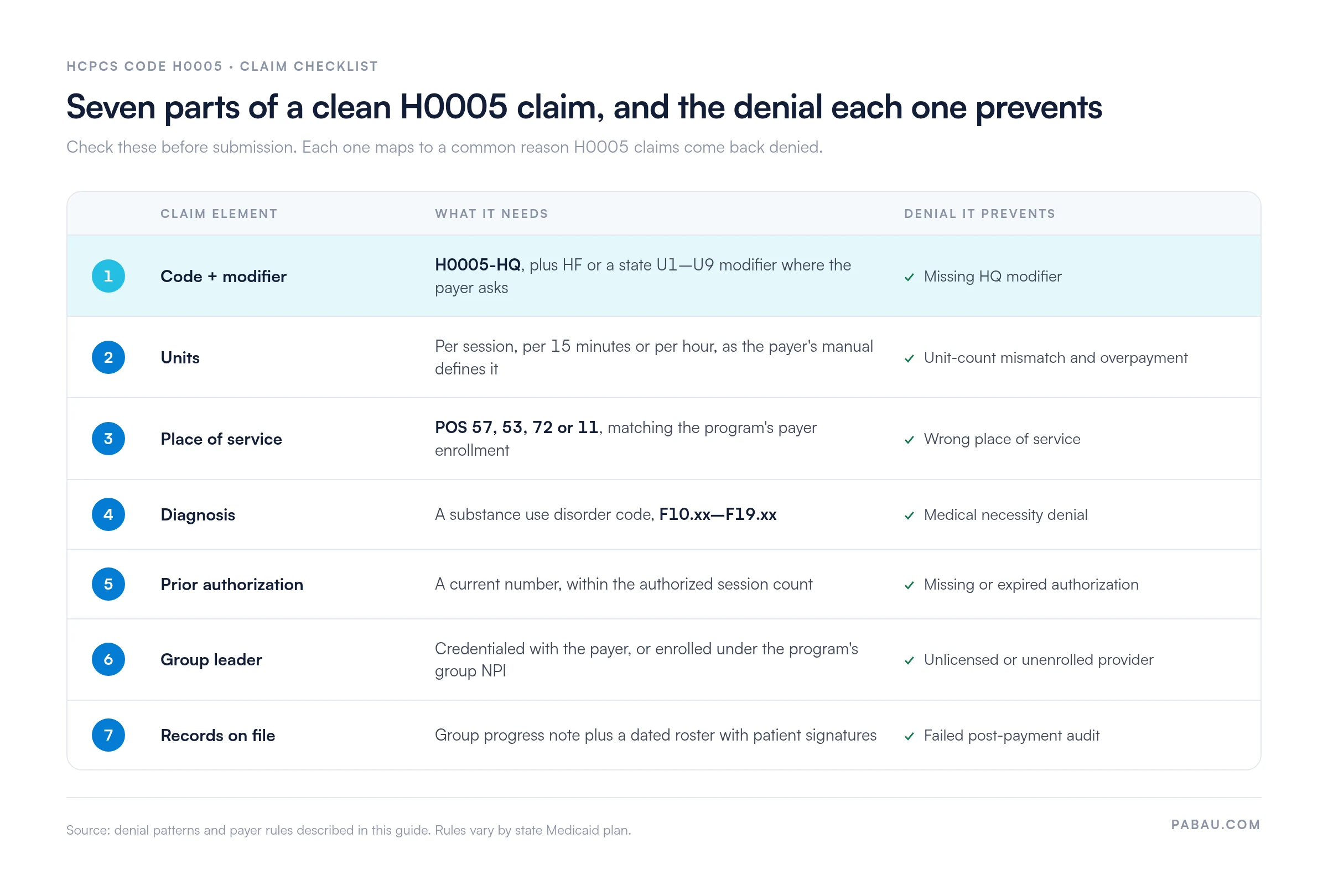
Yes, HCPCS code H0005 can be billed for telehealth group counseling in many states. Eligibility varies by state Medicaid policy and payer contract. The rules keep shifting as pandemic-era public health emergency (PHE) flexibilities expire or become permanent.
Key telehealth billing rules for H0005 to verify before submitting:
Telehealth rules for H0005 depend on the payer and change with annual policy reviews. Confirm telehealth eligibility with each payer at the start of every contract year.
HCPCS code H0005 sits within a broader cluster of substance use disorder billing codes. Providers in IOP and PHP settings commonly bill several of these alongside H0005 within the same program day or treatment episode. The AAPC HCPCS code lookup tool provides descriptor and coverage details for each.
H0015 deserves particular attention in IOP settings. Some states pay H0015 as a bundled IOP day rate that covers every group counseling H-code in the program day. Billing H0005 separately on top of H0015 in those states will generate a bundling denial. Confirm your state’s IOP reimbursement structure before choosing between unbundled H0005 claims and the H0015 day rate.
Check your state Medicaid provider manual for a section on SUD program billing. Most states publish separate IOP and PHP guidance that says whether H0005 is billed per session or folded into a daily rate. The NLM Clinical Tables API also offers searchable HCPCS descriptor data for building internal code crosswalk tables.
In many SUD programs, an H0005 claim is pieced together from three places. The roster is on paper, the progress note sits in one system, and the claim form lives in another. Each handoff is a chance to lose the HQ modifier, the authorization number or the signed attendance list.
Pabau’s claims management software builds the claim from the invoice, so session details pre-fill instead of being retyped. Validation checks flag missing details, such as authorization codes, before the claim is submitted. In the US, claims go out through Claim.MD, with real-time eligibility checks and ERA posting in the same dashboard.
Group notes and digital forms sit in the same patient record as the claim. When an auditor asks for the roster behind a paid H0005 line, your team pulls it from the record in seconds.
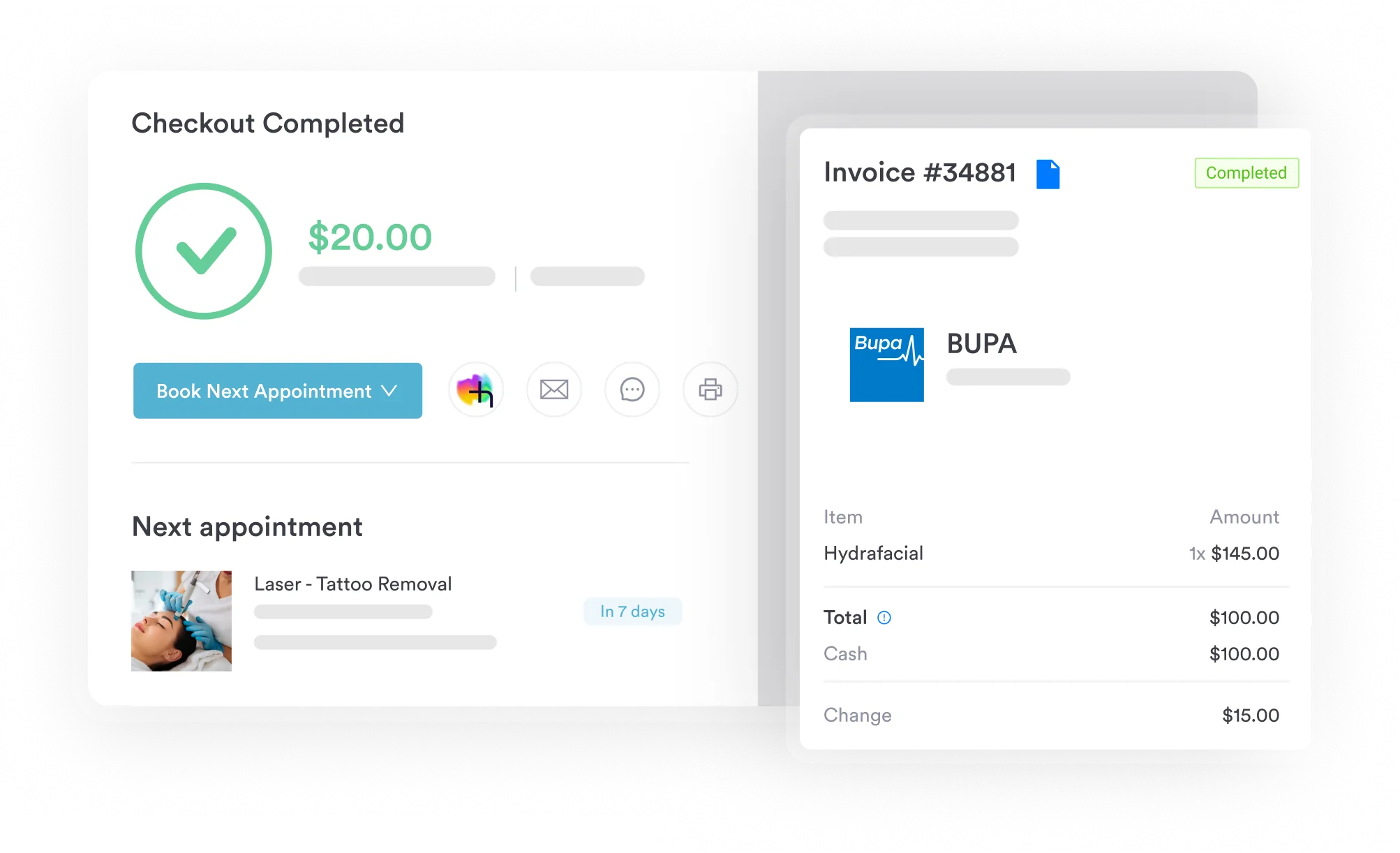

Pabau pre-fills claims from the invoice, runs validation checks before submission, and keeps group notes and signed rosters in the patient record.

H0005 itself is unambiguous. The work is in the payer rules around it, and those differ by state, by plan and by contract year. Programs that bill it cleanly settle those rules once per payer and build them into the claim, rather than rediscovering them through denials.
Start with the two checks that cause the most rework: the HQ modifier and the unit definition. Then make the signed roster part of the session itself, so it is on file before the claim exists. Book a demo to see how Pabau keeps group session records and H0005 claims in one place for your SUD program.

Need guidance on managing insurance claim rejections? Denial codes in medical billing covers the most common CARC denial codes and how to respond to each one.
Looking to understand the full revenue cycle for behavioral health programs? Revenue cycle management explained walks through every stage from eligibility verification to payment posting.
Want a deeper look at clean claim submission standards? What makes a clean claim breaks down the fields, modifiers, and documentation that keep claims from bouncing at the clearinghouse.
Billing peer recovery support alongside group counseling? HCPCS code H0038 covers self-help and peer services billed in 15-minute units.
Need the diagnosis that supports medical necessity? ICD-10 code F10.20 explains when to assign the code for uncomplicated alcohol dependence.
HCPCS code H0005 is the billing code for alcohol and/or drug group counseling led by a licensed clinician. It applies to patients with a substance use disorder diagnosis. It is a Medicaid-funded HCPCS Level II code and is not reimbursed under Medicare Fee-for-Service.
H0004 covers individual alcohol and drug counseling, with one clinician and one patient per session. H0005 covers group counseling, with one clinician and several patients. Both codes share the same payer base. H0005 needs the HQ modifier to show a group setting, and its documentation must include a signed patient roster as well as a progress note.
Units per session depend on the state Medicaid plan’s unit structure. Some states pay H0005 as one unit per session regardless of duration. Others use 15-minute increments, which makes a 90-minute group worth six units. Always verify the unit definition in your payer’s provider manual before submitting.
Prior authorization requirements vary by payer. Many state Medicaid programs require authorization after a set session threshold, commonly 8-12 sessions. Medicaid managed care organizations often require it from the first session in an IOP or PHP setting. Commercial payers that cover H0005 by contract almost always require prior authorization.
H0005 claims must include a substance use disorder ICD-10-CM F-code as the primary or co-occurring diagnosis. Appropriate codes include F10.xx (alcohol-related disorders), F11.xx (opioid-related disorders), F12.xx (cannabis-related disorders), and related SUD codes through F19.xx. Mental health-only diagnoses without a co-occurring SUD F-code are likely to trigger a medical necessity denial.
The most common place of service codes for H0005 are POS 57 (non-residential substance abuse treatment facility) and POS 53 (community mental health center). POS 72 (rural health clinic) also applies, and independent outpatient providers use POS 11 (office). The POS on the claim must match the location where services were delivered and the program’s enrollment status with each payer.