HCPCS Code E0272: Foam rubber mattress billing guide
HCPCS Code E0272: official descriptor and code overview HCPCS Code E0272 is the ...

Last Updated: Nov 6, 2026
H0016 is the HCPCS Level II code for alcohol and/or drug services; medical/somatic (medical intervention in ambulatory setting). It covers the medical side of substance use disorder treatment, such as physician assessment, medication management and nursing oversight.
Coders often confuse it with H0015, the intensive outpatient program code, but the two describe different services. State Medicaid programs are the main payers, and each one sets the unit, modifiers and prior authorization rules in its provider manual. Medicare does not pay H0016.
Let Pabau's smart automation suggest the right codes, reduce claim denials, and keep your practice compliant—effortlessly.
Automate repetitive tasks and focus on what matters most—your patients.
Reduce coding errors and ensure compliance with the latest regulations.
Clean claims, fewer denials, and faster reimbursements.
Powerful insights and reporting to help your practice thrive.
HIPAA compliant SOC 2 certified GDPR-compliant Trusted by 4,000+ clinics worldwide

HCPCS code H0016 covers medical/somatic alcohol and drug services, meaning medical intervention for a substance use disorder in an ambulatory setting.
H0015 is the intensive outpatient program code, so swapping H0016 for H0015 bills a different service rather than a shorter one.
H0016 is a Medicaid code: Medicare does not pay it, and Medicare opioid treatment program billing uses the G2067-G2080 bundle instead.
Units, modifiers and prior authorization rules for H0016 are set by each state Medicaid program, so the provider manual decides how you bill.
Pabau’s claims management software lets SUD billing teams track prior authorizations and validate claims for missing or invalid details before they go out.
HCPCS code H0016 is officially described by CMS as “alcohol and/or drug services; medical/somatic (medical intervention in ambulatory setting).” It sits in the HCPCS Level II H code section, which the Centers for Medicare & Medicaid Services maintains for behavioral health and substance use services.
“Medical/somatic” means the medical side of substance use disorder (SUD) care. Typical H0016 services include a physician or nurse practitioner assessment, medication management, withdrawal and side-effect monitoring, and nursing oversight. The descriptor names no duration, so H0016 describes the type of service rather than how long it lasts.
H0016 does not cover counseling-led program days, residential care, or detoxification, which each have their own H codes. Acute withdrawal management for a patient admitted overnight to a residential addiction program is billed under H0011 instead. Methadone administration in an opioid treatment program is also billed separately, under H0020.
H0015 is the intensive outpatient program (IOP) code, and H0016 is the medical/somatic code. The two describe different services, so neither is a shorter or longer version of the other. Replacing H0016 with H0015 on a claim bills a different service, which makes it a coding error rather than a downcode.
The CMS descriptor for H0015 defines a treatment program that runs at least 3 hours a day and at least 3 days a week. It is based on an individualized treatment plan and includes assessment, counseling, crisis intervention, and activity therapies or education. H0016 carries no time threshold, because it describes a medical intervention rather than a program.
The IOP session and the medical visit are separate services. Some payers therefore allow both codes for one patient on the same date. Others bundle medical services into the IOP or per diem rate. Check the state manual before you bill H0016 alongside H0015 or H2036.
The alcohol and drug codes around H0016 are easy to confuse, because most share the same opening words. The descriptors below come from the CMS HCPCS file.
To route a service, start from what the visit note documents and who pays. The chart below matches each common SUD encounter to its code.
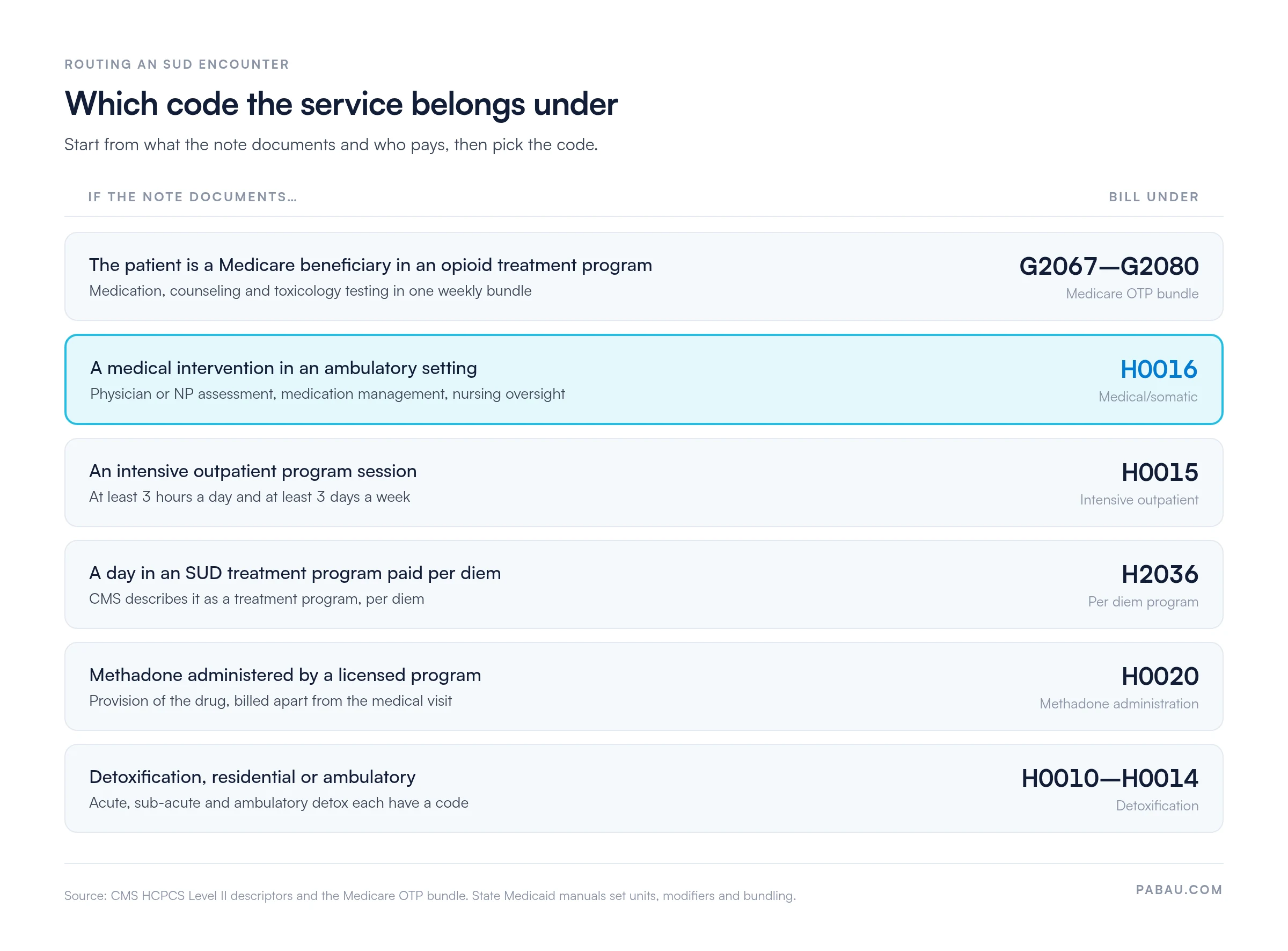
State-licensed SUD treatment providers enrolled in their state’s Medicaid program bill H0016, and opioid treatment programs (OTPs) certified by SAMHSA are among the most common. Enrollment is checked at the claim level. A program can hold every license and still be denied if its Medicaid enrollment has lapsed or the billing NPI does not match.
Because H0016 is a medical service, many states limit it to medical staff and exclude counselors as rendering providers. Scope-of-practice rules vary, so confirm the allowed credentials in your state’s Medicaid provider manual before you bill.
H0016 is a Medicaid code for most billing purposes, and it does not appear on the Medicare physician fee schedule. Medicare pays for OTP care through a weekly bundle billed with G-codes (G2067-G2080). That bundle covers medication, counseling and toxicology testing, which makes it a separate billing structure from H0016.
CMS does not define a unit for H0016, so each state Medicaid program sets its own. Some states pay per encounter or visit, some pay per 15 minutes, and some fold H0016 into a weekly or daily OTP rate. The state provider manual and fee schedule are the only reliable source for your unit.
The most common unit errors are billing more units than the state allows per date and missing time documentation on a time-based payer. A third is billing H0016 for a program day that belongs under H0015 or H2036. Map each payer’s unit rule in your billing system once, then check every claim against it.
Modifier requirements for H0016 vary by state Medicaid program. The table below lists modifiers that often appear on H0016 claims. Check your current state provider manual, since a wrong or missing modifier is a top denial trigger for this code.
Before you submit an H0016 claim, pull your state Medicaid behavioral health billing manual and cross-check the modifier grid. A modifier required in one state may trigger an audit flag in another. Build a state-specific modifier checklist into your claim scrubber so it catches the mismatch before submission.
Every H0016 claim needs an ICD-10-CM diagnosis code that supports the medical service. The primary diagnosis comes from the F10-F19 range (mental and behavioral disorders due to psychoactive substance use). Coders can confirm each full descriptor in our ICD-10-CM code library. Payers reject H0016 paired with a diagnosis that does not establish a substance use disorder.
An incomplete code, such as F11.2 without its final character, is a common reason for medical necessity denials. Code to the full specificity the notes support, such as F11.20 for uncomplicated opioid dependence. Billing managers at behavioral health and mental health practices should build ICD-10 pairing checks into their claim scrubbing workflow.
Prior authorization rules for H0016 vary by state and plan. Many Medicaid managed care plans require authorization for SUD services, while some states exempt medical visits or cap them per authorization period. Where a request is needed, it usually includes the ASAM level-of-care assessment, the units requested, and the treating provider’s credentials and NPI.
Records supporting H0016 claims are SUD treatment records, so 42 CFR Part 2 applies on top of HIPAA. The 2024 final rule, with compliance required from February 16, 2026, aligned Part 2 more closely with HIPAA. A patient can now sign one consent covering treatment, payment and health care operations, but disclosures outside that consent still need specific authorization.
H0016 denials cluster around a predictable set of errors, and most can be caught with a structured pre-bill review. The denial management process for SUD claims needs specific attention to authorization status, code selection, modifiers and ICD-10 specificity.
Timely filing is the first hurdle: Most Medicaid programs require a first-level appeal within 60-120 days of the denial date on the remittance advice. A late appeal is dismissed on procedural grounds, whatever its clinical merit.
Keep a denial log that records the CARC code, denial date, appeal date and outcome for every H0016 denial. After three months, patterns become visible. If 60% of denials share one CARC code, fix the workflow that produces them. Review the log with your billing team every quarter.
Some state Medicaid programs use H0016 for the medical/somatic visits in SAMHSA-certified OTPs, such as a physician assessment, dose review or nursing check. Methadone administration itself is billed under H0020, and states that pay OTPs a bundled rate may not allow a separate H0016 line.
Dual-eligible patients split the billing. Medicare covers OTP services through the G2067-G2080 weekly bundle, while Medicaid may cover services outside that bundle or the patient’s cost-sharing. Billing H0016 to Medicare for an OTP patient is a systematic error that leads to a denial every time.
Most H0016 denials start before the claim is built. The usual causes are a lapsed authorization, a unit count the state does not allow, or a medical visit coded as an IOP day. Billing teams usually catch these by hand, checking spreadsheets of authorization dates and state manuals claim by claim.
Pabau, the practice management platform we build, moves those checks into the billing workflow. Its claims management software scrubs each claim for missing or invalid details before submission and keeps prior-authorization cases on file. It also tracks claim status and runs eligibility checks through Claim.MD.
The outcome is fewer preventable denials and a shorter appeal queue, because each claim is validated and its authorization tracked before it leaves the practice.

Pabau helps substance use disorder practices track prior authorizations and validate claims for missing or invalid details before submission. That means fewer preventable H0016 denials and less appeal work.

Bill H0016 only when the note documents a medical intervention for a substance use disorder, delivered by a provider the state allows. If the service was an IOP session, it belongs under H0015, and a per diem program day usually belongs under H2036. Treating these codes as a ladder of hours is the error that causes the most avoidable denials.
The rest of H0016 billing lives in your state manual, so build each payer’s unit, modifier and authorization rules into the workflow once. Book a demo to see how Pabau validates claims and tracks prior authorizations before submission.

Need to understand SUD denial patterns in depth? Denial management in healthcare covers the full workflow for identifying, appealing, and preventing common claim denials across behavioral health billing.
Looking for a broader billing compliance framework? Medical billing compliance explains the regulatory requirements that apply to behavioral health and SUD treatment facility billing, including HIPAA and payer audit readiness.
Want to understand how revenue cycle management applies to SUD facilities? What is revenue cycle management explains the end-to-end claim lifecycle from eligibility check to payment posting, which applies directly to high-volume H0016 billing environments.
HCPCS code H0016 is the Level II code for alcohol and/or drug services; medical/somatic (medical intervention in ambulatory setting). It covers medical care for a substance use disorder, such as physician assessment, medication management and nursing oversight. State Medicaid programs are the main payers, and Medicare Part B does not cover it.
H0015 is the intensive outpatient program code. It covers a program of at least 3 hours a day and 3 days a week, with counseling and related services. H0016 covers medical/somatic services, meaning medical intervention in an ambulatory setting. They are different services, so swapping one for the other is a coding error rather than a downcode.
H0016 is covered by Medicaid, not Medicare Part B. Medicare uses a separate bundled OTP payment model with G-codes (G2067-G2080) for opioid treatment program services. Billing H0016 to Medicare is a systematic coding error that will result in denial.
The HF modifier (substance abuse program) is the most widely required modifier for H0016. HH applies when the service addresses co-occurring mental health and substance use disorders. State-specific modifiers (U1-U9) may also be required depending on your Medicaid program. Always verify against your state’s current behavioral health provider manual.
The most common reasons are an expired or missing prior authorization, a unit count the state does not allow, and the wrong code. Missing modifiers, incomplete ICD-10-CM codes, lapsed provider enrollment and unsigned visit notes follow close behind. Most are preventable with a structured pre-bill review checklist.
Primary diagnosis codes should come from the ICD-10-CM F10-F19 range. Use F10.x for alcohol use disorder, F11.x for opioid use disorder, and F12.x-F16.x, F18.x or F19.x for other substances. Secondary codes for co-occurring mental health conditions (F31.x, F32.x, F33.x) may be added when the HH modifier is used for integrated dual-diagnosis programming.