HCPCS Code Q4185: Cellesta flowable amnion billing guide
HCPCS Code Q4185: definition and official descriptor HCPCS Code Q4185 is the Lev...

Last Updated: Nov 20, 2026
H0011 is the HCPCS Level II code for alcohol and/or drug services; acute detoxification (residential addiction program inpatient). It reports medically supervised withdrawal management for a patient in acute withdrawal who stays overnight in a non-hospital residential program.
H0011 sits beside H0010, its sub-acute counterpart, and H0013, which covers acute detox delivered on an outpatient basis. The descriptor names no unit, so each state sets one, most often a day.
Let Pabau's smart automation suggest the right codes, reduce claim denials, and keep your practice compliant—effortlessly.
Automate repetitive tasks and focus on what matters most—your patients.
Reduce coding errors and ensure compliance with the latest regulations.
Clean claims, fewer denials, and faster reimbursements.
Powerful insights and reporting to help your practice thrive.
HIPAA compliant SOC 2 certified GDPR-compliant Trusted by 4,000+ clinics worldwide

HCPCS code H0011 reports acute detoxification in an inpatient residential addiction program, not the residential treatment that follows detox.
H0010 is the sub-acute version of the same inpatient service, and H0013 is acute detox delivered by a residential program on an outpatient basis.
The national descriptor names no unit, so each state sets it, and most Medicaid programs pay H0011 per day.
Every billed day needs prescriber orders, nursing notes and scored withdrawal scales such as CIWA-Ar or COWS.
Medicare does not pay H0011, so the claim goes to Medicaid or a commercial plan under that payer’s own crosswalk.
HCPCS code H0011 is the Level II code for acute detoxification delivered in an inpatient residential addiction program. Its official descriptor reads: Alcohol and/or drug services; acute detoxification (residential addiction program inpatient).
In plain terms, H0011 bills medically supervised withdrawal management for a patient who stays overnight in a non-hospital residential program. The patient is in acute withdrawal and needs round-the-clock monitoring and medication to get through it safely.
The Centers for Medicare & Medicaid Services (CMS) maintains the code, which has been part of the HCPCS set since January 1, 2001. It is not a CPT code, carries no RVUs, and does not appear on the Medicare Physician Fee Schedule.
Two words in the descriptor decide whether H0011 fits. “Acute” separates it from H0010, the sub-acute inpatient code. “Inpatient” separates it from H0013, which covers acute detox delivered by a residential program on an outpatient basis.
H0011 covers the clinical work of getting a patient through acute alcohol or drug withdrawal in a residential bed. The program supervises the patient around the clock while symptoms peak.
Services a state usually expects inside an H0011 day include:
Whether room and board, labs, physician visits and pharmacy sit inside the H0011 rate is a state decision. Check the bundling rules in your manual before billing any of them separately.
H0011 stops fitting once acute withdrawal is over. A medically stable patient who stays on for treatment moves to the residential code the state assigns, often H0018 or H0019.
H0011 is billed by residential addiction programs licensed by their state to deliver medically monitored withdrawal management. The program must be enrolled with the payer for that level of care, not only as a general SUD provider.
Staffing is the usual gatekeeper. Acute detox needs a prescriber available around the clock and nurses on site, so a program licensed only for clinically managed care cannot report it.
Place of service (POS) rules for H0011 are short:
Programs enrolled as professional providers bill on the CMS-1500. Facilities enrolled as institutional providers bill on the UB-04 and pair H0011 with the revenue code their state lists.
The H0011 descriptor names no unit of service. Compare H0018 and H0019, whose descriptors end in “per diem.” For H0011, the payer sets the unit in its fee schedule or billing manual.
In practice, most states pay H0011 as one unit per day. Montana Medicaid’s SUD fee schedule, effective July 1, 2025, lists H0011 per day at $262.93.
Confirm two rules in your manual before you build the claim. Check whether the discharge day counts as a unit, and whether the stay has a day limit.
Day limits matter more for detox than for most H codes. Acute withdrawal usually resolves within days, so payers often authorize short blocks and review each extension.
The ASAM Criteria describe withdrawal management by level, and state manuals use those levels to assign codes. The acute, inpatient wording of H0011 lines up most closely with Level 3.7-WM, medically monitored inpatient withdrawal management.
Level 4-WM, medically managed intensive inpatient withdrawal management, takes place in a hospital. Hospitals usually bill that care on an inpatient hospital claim, so it rarely reaches H0011.
The national descriptor does not bind the state, though. Montana Medicaid’s SUD fee schedule assigns H0011 to clinically managed residential withdrawal management (ASAM 3.2-WM). It puts its ASAM 3.7 service on H0010 instead.
So read your state’s crosswalk before the descriptor. If the state ties H0011 to a different ASAM level, the documentation has to prove that level, whatever the national wording says.
Auditors test H0011 claims against one question: Was the patient in acute withdrawal on each billed day? The record has to answer it day by day, written at the time of care.
Falling CIWA-Ar or COWS scores also signal that acute detox is ending. When scores stay low for several days, the record supports a step down rather than more H0011 days.
Chart the last day the withdrawal score met your protocol’s threshold for medical monitoring. That date shows the utilization reviewer where H0011 billing ends and the next level of care begins.
No national modifier is required on H0011. States and managed care plans add their own, so the table lists the modifiers most often seen in state SUD billing guides.
A modifier the payer does not recognize for H0011 triggers a CO-4 denial. Copy the exact modifier string from your state’s current manual into your fee schedule setup.
Medicaid is the main payer for H0011, and each state decides whether it uses the code at all. Some states report detox with other H codes or revenue codes, so check the state manual first.
Larger residential programs face one more Medicaid rule. The institution for mental diseases (IMD) exclusion limits Medicaid payment for adults aged 21 to 64 in facilities with more than 16 beds. Many states lift it for SUD care through a Section 1115 waiver.
The H0010 to H0019 range splits detox by acuity and setting, then moves on to residential treatment. Three questions pick the right code: Is the patient in withdrawal, how acute is it, and is the care inpatient?
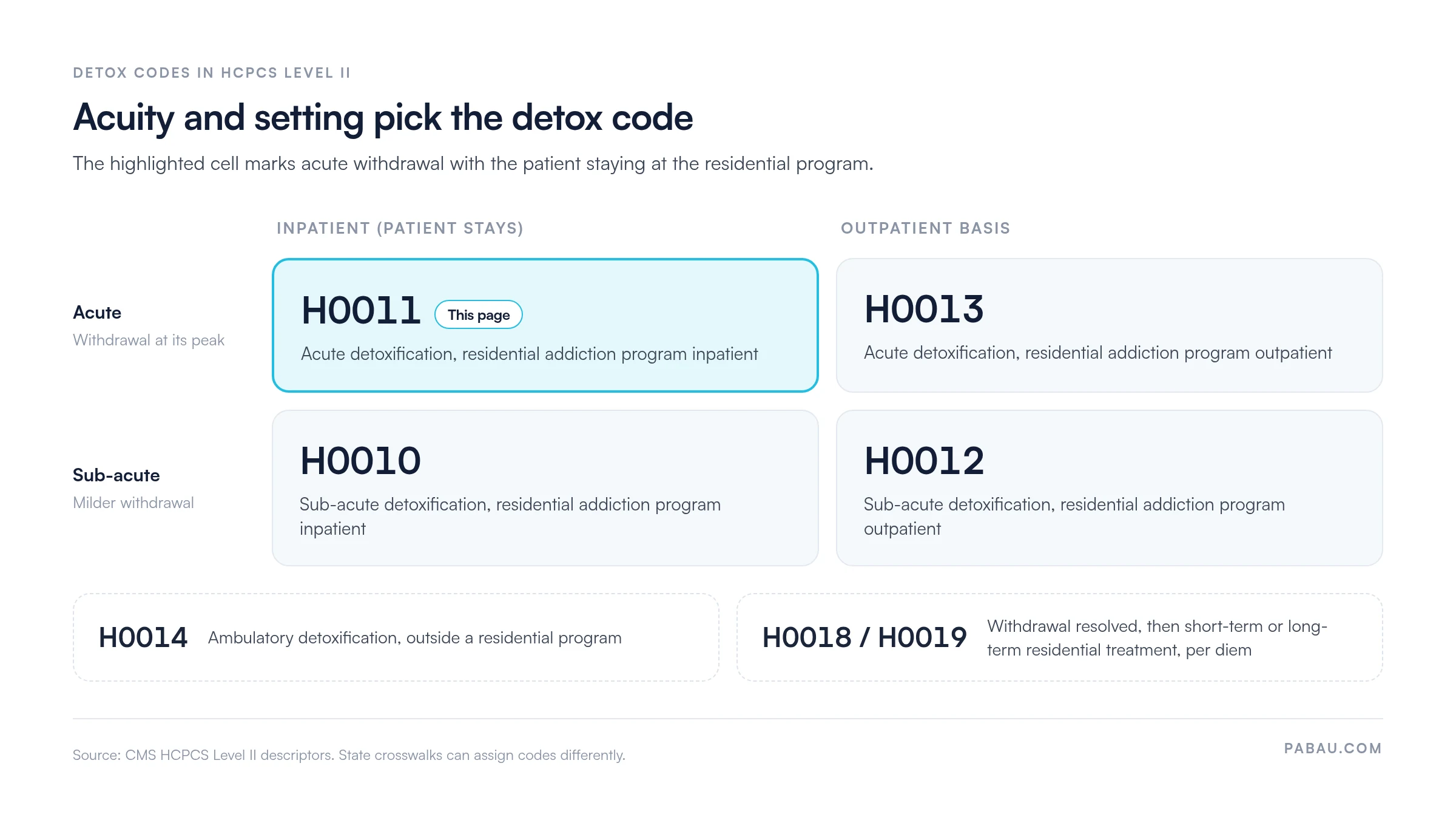
The practical rule: If the patient is in acute withdrawal and stays at the program, bill H0011. If the withdrawal is milder, bill H0010. Once withdrawal has resolved, move to the residential code your state assigns, unless its crosswalk says otherwise.
The diagnosis in step 5 comes from the ICD-10-CM code set, which has its own withdrawal codes. F10.230, for example, reports alcohol dependence with uncomplicated withdrawal.
Submitting a clean claim the first time matters on detox stays. A denied block of days can take longer to appeal than the stay itself lasted.
Logging each denial against its root cause shows where the process breaks. With denial management workflows in place, teams fix the cause once instead of appealing it every month.
Billing days without documentation draws the most audit attention on detox claims. The fundamentals of medical billing compliance apply in full, including periodic internal audits of H0011 lines.
Many detox programs run on paper withdrawal flowsheets, a separate medication log and a billing spreadsheet. When those disagree, a billed detox day has no record behind it.
Pabau, the practice management platform we build, keeps the record and the claim in one system. Digital forms can hold your CIWA-Ar or COWS flowsheet, and each completed score saves to the patient’s file with a timestamp.
Treatment notes and invoices sit on the same patient record, so billing staff check the documented days before a claim goes out. Pabau’s claims management software then tracks each claim through to payment or denial.
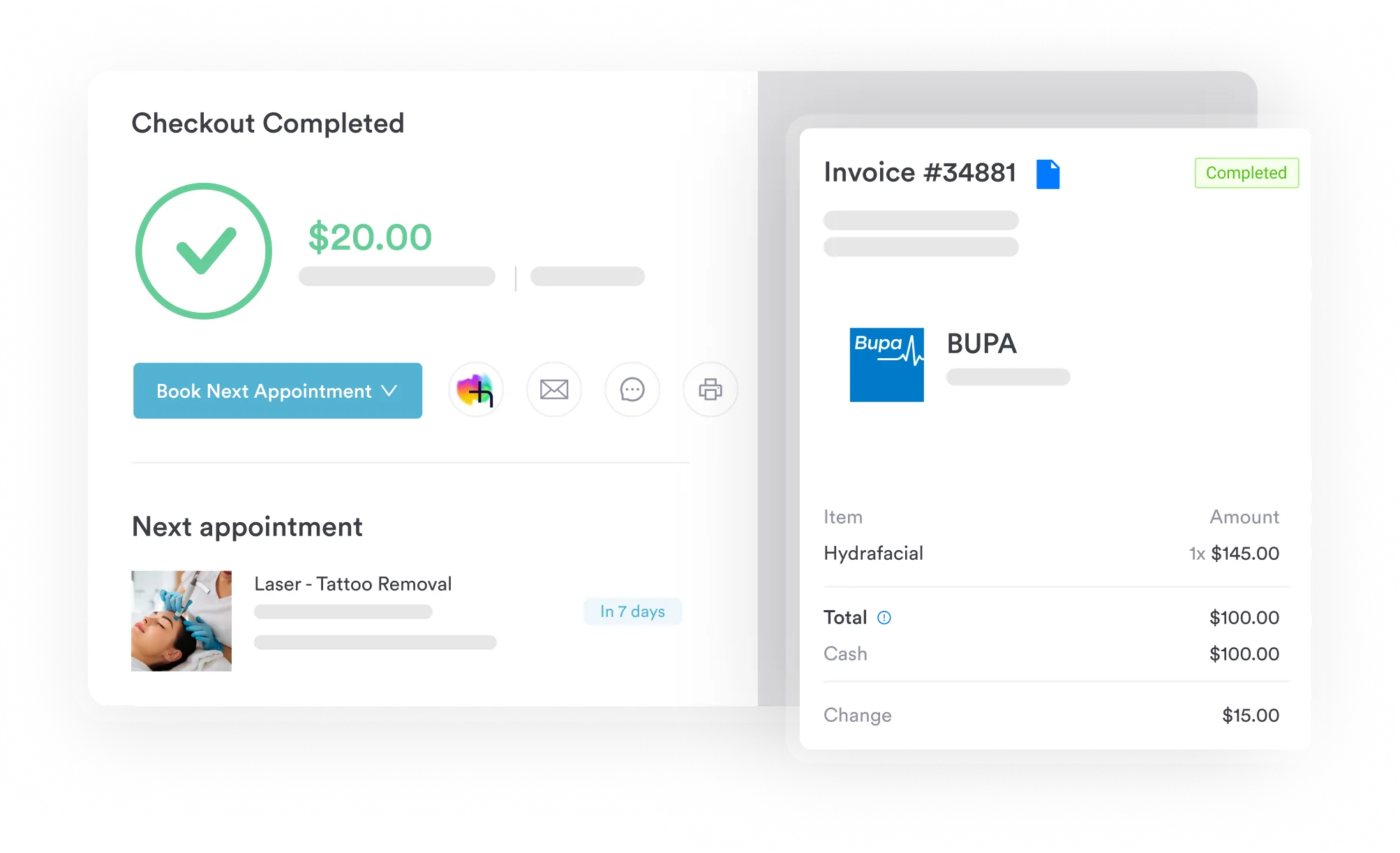

Pabau keeps withdrawal flowsheets, treatment notes and claims on one patient record. Your team can confirm each H0011 day is documented before the claim goes out.

H0011 pays for one narrow window of care: The days a patient spends in acute withdrawal inside an inpatient residential program. Bill it for that window, and step down when the scores show withdrawal is over.
Your state’s crosswalk outranks the national descriptor, as Montana’s 3.2-WM assignment shows. Read it first, then build documentation that proves the level it names.
Book a demo to see how Pabau keeps withdrawal scores, treatment notes and H0011 claims on one patient record.

Need to understand denial patterns across your H-code claims? Denial management in healthcare covers the systematic approach to tracking, categorizing, and resolving claim rejections across behavioral health billing.
Want a structured billing compliance framework? Medical billing compliance outlines the audit controls, policy requirements, and documentation standards that protect SUD programs from OIG and OMIG review.
Building a claims management process from the ground up? Pabau’s claims management software brings HCPCS code tracking and claim follow-up into a single billing workflow.
Is the withdrawal milder and managed on an outpatient basis? HCPCS code H0012 covers sub-acute detoxification delivered by a residential program on an outpatient basis.
Does the patient go home between detox visits? HCPCS code H0014 explains ambulatory detoxification billed outside a residential program.
HCPCS code H0011 covers acute detoxification in an inpatient residential addiction program. It bills medically supervised withdrawal management for a patient in acute withdrawal who stays overnight in a non-hospital program.
The difference is acuity. H0011 is acute detoxification and H0010 is sub-acute detoxification, both in an inpatient residential addiction program. Your state’s crosswalk decides which ASAM level each code reports, so check it before choosing.
The H0011 descriptor names no unit, so the payer sets one. Most state Medicaid programs pay it per day, and Montana’s 2025 SUD fee schedule is one example.
No. H0011 carries CMS coverage code I, which means Medicare does not pay it. Medicare covers medically necessary inpatient detox as a hospital stay, so H0011 claims go to Medicaid or commercial plans.
Each billed day needs prescriber orders, medication records, nursing notes and scored withdrawal scales such as CIWA-Ar or COWS. The admission record also needs the ASAM findings that justify the withdrawal management level.
The national descriptor fits ASAM Level 3.7-WM, medically monitored inpatient withdrawal management. States set their own crosswalks, though, and Montana assigns H0011 to Level 3.2-WM.