CCSD code H4430: Examination of rectum under anaesthetic
CCSD code H4430 pays for the examination alone CCSD code H4430 is the UK private...

Last Updated: Oct 20, 2026
G0250 is the HCPCS Level II code for physician review, interpretation, and patient management of home inr testing for patient with either mechanical heart valve(s), chronic atrial fibrillation, or venous thromboembolism who meets medicare coverage criteria; testing not occurring more frequently than once a week; billing units of service include 4 tests.
Let Pabau's smart automation suggest the right codes, reduce claim denials, and keep your practice compliant—effortlessly.
Automate repetitive tasks and focus on what matters most—your patients.
Reduce coding errors and ensure compliance with the latest regulations.
Clean claims, fewer denials, and faster reimbursements.
Powerful insights and reporting to help your practice thrive.
HIPAA compliant SOC 2 certified GDPR-compliant Trusted by 4,000+ clinics worldwide

In short, HCPCS code G0250 covers physician review, interpretation, and patient management of home INR testing for qualifying Medicare beneficiaries.
Only three diagnoses qualify: mechanical heart valves, chronic atrial fibrillation, and venous thromboembolism. As a result, billing without a linked qualifying ICD-10 code causes automatic denial.
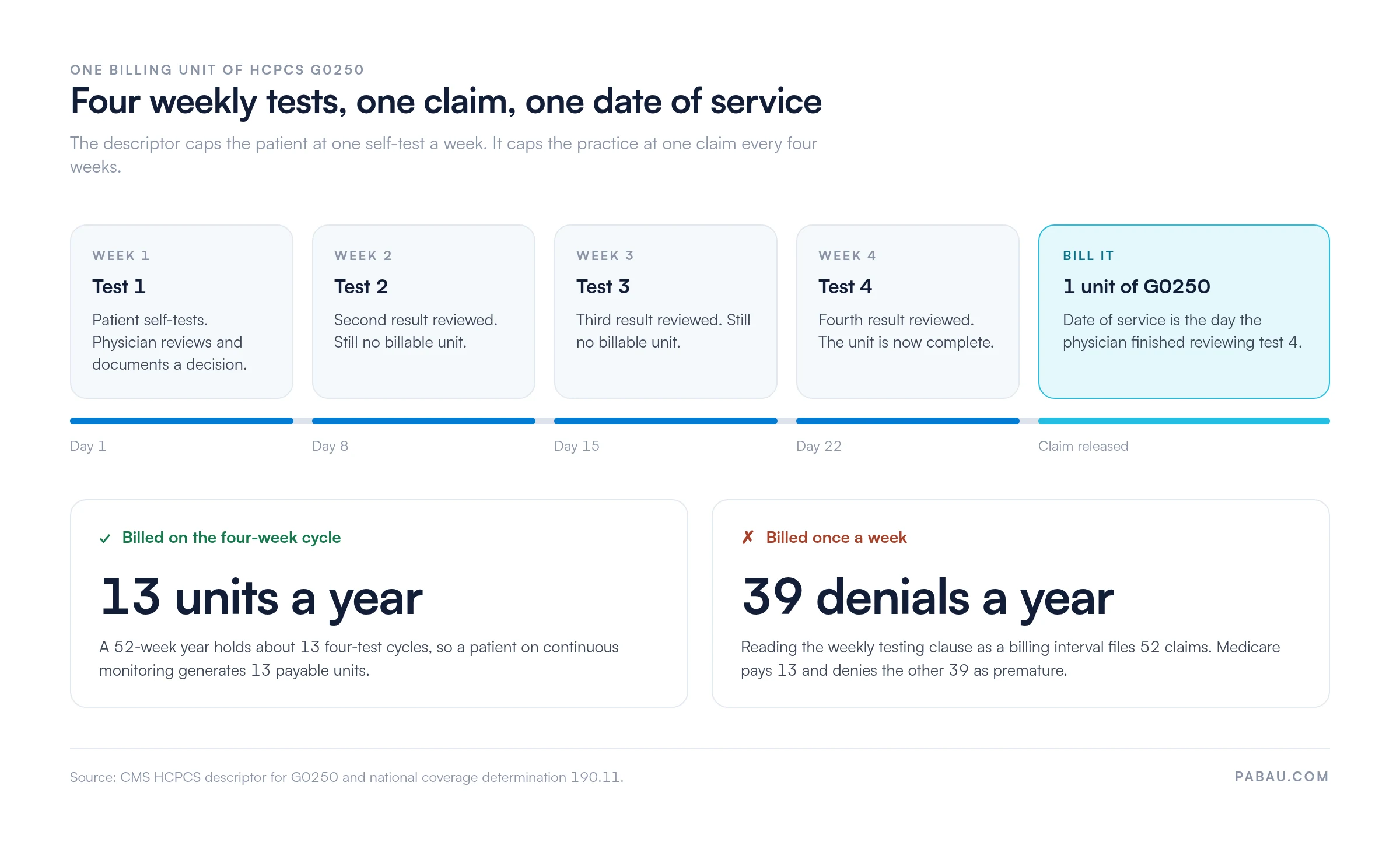
One billing unit of G0250 covers four tests. Consequently, the code is billed no more often than once every four weeks, which caps a patient at roughly 13 units a year.
The once-a-week clause in the descriptor limits how often the patient self-tests. It does not license weekly billing, and reading it that way is the most common cause of G0250 denials.
The date of service is the day the physician finished reviewing the fourth test in the cycle, not the day any single test was run.
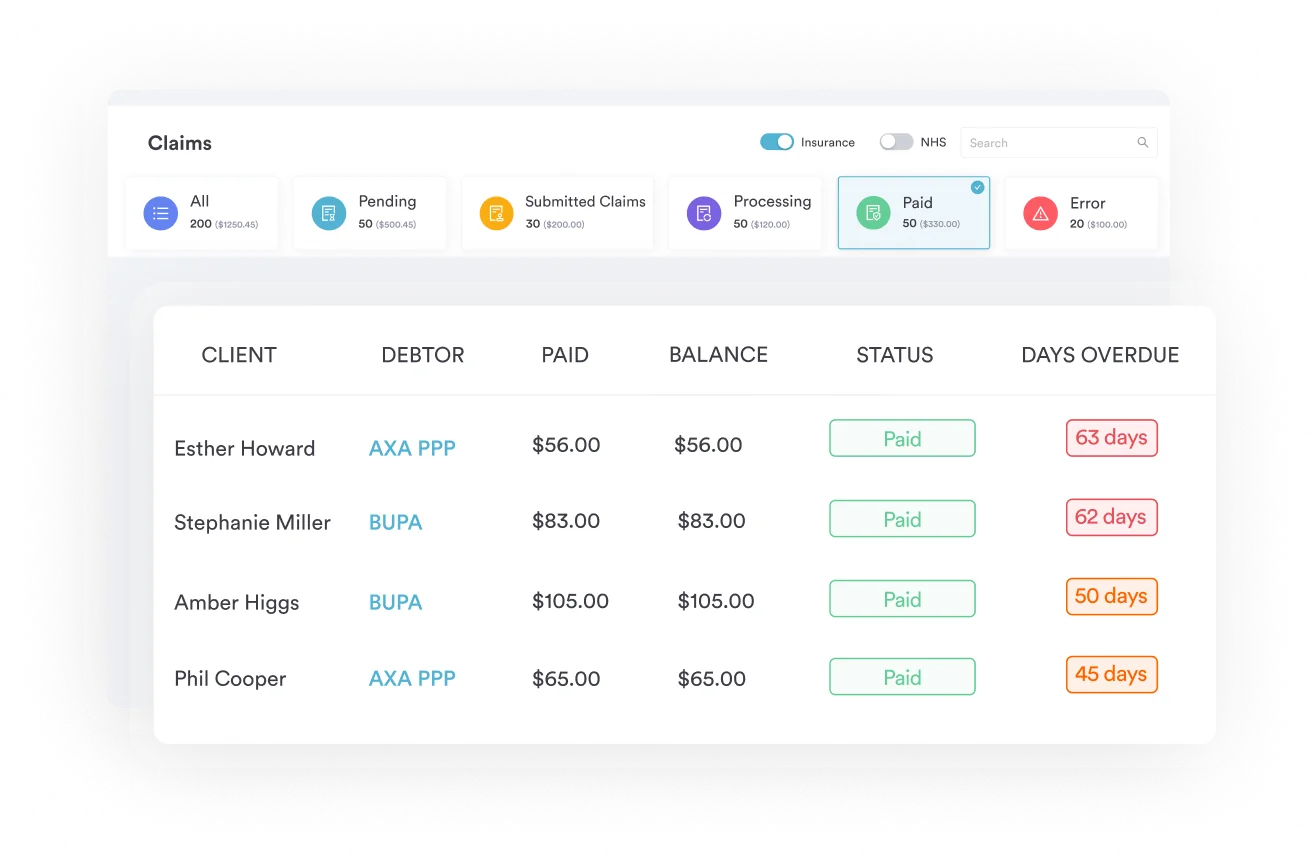
In practice, claims management software like Pabau shows every claim’s live status, routes invoices to the right insurer, and runs validation checks before submission.
HCPCS code G0250 covers physician review, interpretation, and patient management of home INR testing for Medicare patients on warfarin. One billing unit covers four tests, so practices report the code no more often than once every four weeks. Coverage runs to three diagnoses only: mechanical heart valves, chronic atrial fibrillation, and venous thromboembolism.
The official CMS descriptor packs four separate rules into one sentence. In fact, Medicare audits every one of them.
Read the last two clauses separately, because they are not the same rule. The once-a-week clause caps how often the patient self-tests at home. The billing-unit clause governs the claim.
Practices that read the weekly clause as a billing frequency file four claims where Medicare pays one. The three extra claims deny for arriving too early. The timeline below maps a single unit across the four weeks it actually spans.
Coverage sits under CMS national coverage determination 190.11. Each Medicare Administrative Contractor (MAC) publishes its own billing article on top of it, so jurisdiction rules still apply on every claim.
G0250 sits within the HCPCS Level II G-code series. The Centers for Medicare and Medicaid Services (CMS) maintains these temporary codes to describe services that CPT codes do not adequately cover. G0250 takes its rules from Medicare, while HCPCS Code H0001 opens the behavioral health H series, where state Medicaid manuals set the modifiers. The table below consolidates the key attributes billing teams need before building a claim.
CMS sets reimbursement amounts annually through the Medicare Physician Fee Schedule, and they vary by geographic locality. Check the CMS Physician Fee Schedule lookup tool for current non-facility and facility rates in your MAC jurisdiction. Do that before quoting a patient or projecting revenue.
Medicare coverage for G0250 is narrow by design. Three qualifying diagnoses exist, and the patient must be an eligible Medicare beneficiary whom a physician has ordered for home INR testing.
NCD 190.11 adds two prerequisites before self-testing can begin. The patient must have received anticoagulation therapy for at least three months. In addition, the patient must have completed face-to-face training and demonstrated correct use of the monitor. Coverage details differ between MAC jurisdictions, so verify against the Local Coverage Determination for your region.
The code descriptor limits coverage to exactly three clinical scenarios. Each carries a distinct clinical rationale for why home INR monitoring is medically necessary.
Coverage does not extend to patients on direct oral anticoagulants (DOACs) such as apixaban or rivaroxaban, as those drugs do not require INR monitoring. Billing G0250 for a DOAC patient constitutes a coverage mismatch and will result in denial.
Before submitting G0250 claims, confirm the patient’s anticoagulant is warfarin or another vitamin K antagonist requiring INR monitoring. DOACs do not produce an INR that reflects anticoagulation intensity, and Medicare will not reimburse G0250 for those patients regardless of diagnosis.
Three codes describe one home INR monitoring episode. G0248 pays for the training the patient receives before monitoring starts. G0249 pays for the monitor and the test materials. In turn, G0250 pays the physician for reviewing the results and managing the patient.
Wider physician oversight of a patient’s home care is billed separately, as a 30-day case rate under S0271. Traditional Medicare does not cover that S-code, so Medicaid and some commercial plans pay it instead. S0271 covers hospice patients, while the standard monthly case rate outside hospice is S0270.
Practices confuse them because the services bind together clinically, yet different entities usually bill them on separate claims. Understanding the split therefore prevents both underbilling and claim rejection.
A physician practice billing G0250 does not need to coordinate the G0249 claim. Instead, the supplying entity handles that billing separately under its own Medicare enrollment.
Confusion arises when a practice supplies the monitor and delivers the training itself. It then bills all three codes and has to keep each one on its own clock. Confirm the billing split with your MAC if your practice falls into that scenario.
Every G0250 claim submitted to Medicare must carry at least one ICD-10-CM code that supports medical necessity. Specifically, the code must match one of the three qualifying diagnoses in the code descriptor. Submitting an unspecified code when a more specific one exists increases audit risk.
Note that I48.0 (paroxysmal atrial fibrillation) is not on this list. Paroxysmal AF is intermittent by definition, so it does not satisfy the descriptor’s chronic atrial fibrillation requirement on its own.
This table covers common examples, and CMS updates the code set every fiscal year. Even so, verify current codes against the CDC/NCHS ICD-10-CM web tool, and use the highest specificity your documentation supports. Our ICD-10-CM codes archive carries the full descriptors if you are building a crosswalk for the whole anticoagulation panel.
Building the claim correctly requires attention to six billing elements. Miss any one of them, however, and the claim will either deny on submission or flag during a post-payment audit.
Practices managing anticoagulation panels for multiple patients need a per-patient billing calendar. Every patient sits on their own four-week clock, and those clocks start on different dates. Indeed, counting reviewed tests and holding the claim until the fourth one prevents most frequency denials before they occur.
A claims dashboard that shows each submission’s live status at least tells you which G0250 claims went out, when, and what happened to them.
Medicare auditors reviewing G0250 claims look for evidence that the physician performed the three services named in the code: review, interpretation, and patient management. A note that records the INR result without the clinical decision made is insufficient. Therefore, use this checklist to structure your chart notes before billing.
Structured clinical notes remove the most common documentation failure, which is a result recorded with no management decision attached. In turn, a templated G0250 review note that prompts the clinician to record the decision at the time of review cuts audit exposure.
CMS sets Medicare reimbursement for G0250 through the annual Physician Fee Schedule update, and it varies by geographic locality using the Geographic Practice Cost Index (GPCI). As a result, rates differ between facility and non-facility settings.
This guide does not publish specific dollar amounts, because they change annually and vary by locality. Instead, use the AAPC HCPCS code lookup or the CMS fee schedule search to retrieve the current year rate for your MAC jurisdiction.
For practices building revenue projections, model the four-week billing cycle rather than the weekly testing schedule. A patient on continuous home monitoring generates roughly 13 units of G0250 a year, since a 52-week year holds about 13 four-test cycles. By contrast, projecting on a weekly basis overstates the annual figure by almost four times.
G0250 denials follow predictable patterns, and six of them account for most of the volume. A denial management process that catches them before submission costs far less than working each one through appeals.
Appeals for G0250 denials are winnable when documentation is solid. The chart note has to be ready before you file the appeal. Practices without a structured documentation workflow often win the initial appeal. Even so, the same denial then lands on the next billing cycle, because they never addressed the root cause.
Audit your G0250 panel quarterly. Pull the last 90 days of claims and confirm no patient carries more than one unit in any four-week window. Check that each claim is dated to the fourth review in its cycle. Confirm that four documented clinical decisions sit behind every unit. This takes under an hour and finds billing errors before Medicare does.
G0250 does not operate in isolation. In fact, anticoagulation management for the three qualifying diagnoses often involves additional codes, and understanding how they interact prevents undercoding and overbilling.
High-volume anticoagulation practices should build a crosswalk into the EHR. Map each patient’s diagnosis to their qualifying ICD-10 code and their current anticoagulant regimen. Pair that with structured documentation and per-patient cycle tracking, and your team then assembles each claim from the record rather than reconstructing it at month end.
Anticoagulation monitoring panels create a recurring billing challenge. Patient volume is high, the four-week billing cycle starts on a different date for every patient, and documentation requirements apply to every claim. As a result, manual tracking breaks down once the panel exceeds 20 to 30 patients.
Three controls keep a panel that size billable.
Practice management software like Pabau covers the submission end of that workflow. Pabau’s claims management software puts every claim on one dashboard, filtered by date, insurer, or invoice ID. The dashboard marks each one pending, submitted, processing, paid, or error, so an unresolved claim is visible on the same screen as a paid one.
Insurer details sit on the patient record, so an invoice routes to the correct payer without anyone re-keying it. In the background, validation checks run before a claim goes out and flag missing details such as a membership number. Claims then go out electronically from the dashboard, or by email where the payer has no direct connection.
The diagnosis and the billing calendar stay with your team. Clinicians document the condition, coders attach the ICD-10 code, and your clinical workflow tracks the four-week clock. Instead, what the software removes is the manual chase for where a submitted claim got to.

Pabau puts every claim on one dashboard, from pending through to paid, and runs validation checks before submission. See how it fits your billing workflow.

The billing unit is what decides whether Medicare pays a G0250 claim. Four reviewed tests make one unit, the fourth review sets the date of service, and the qualifying diagnosis has to be on the claim. Get those three right and the coverage rules take care of themselves.
The trade-off worth remembering is volume against timing. An anticoagulation panel is steady revenue at roughly 13 units per patient per year. That revenue only lands, though, if you track every patient’s four-week clock separately. A spreadsheet stops doing that well at about 30 patients.
Pabau keeps the submission side of that work in one place. Live claim status, insurer routing, and background validation checks all sit on the same dashboard. Book a demo to see how it fits an anticoagulation billing workflow.

Need the whole claims lifecycle in one place? What is medical billing walks the process from charge capture through to remittance.
Working a G0250 denial? Denial codes in medical billing explains how to read and answer a Medicare reason code.
Want the claim to pay first time? Clean claim sets out what a payer checks before it accepts a submission.
Building charge capture for an anticoagulation panel? Superbill shows how diagnosis and procedure codes travel together on one document.
Looking beyond a single code? Revenue cycle management connects documentation, coding, and collections into one process.
HCPCS code G0250 bills the physician review, interpretation of home INR test results, and patient management for qualifying Medicare beneficiaries. Specifically, those are patients with mechanical heart valves, chronic atrial fibrillation, or venous thromboembolism. One billing unit covers a cycle of four home INR tests the physician has reviewed.
Medicare covers G0250 for patients with one of three qualifying diagnoses: mechanical heart valves, chronic atrial fibrillation, or venous thromboembolism. The patient must be an eligible Medicare beneficiary on warfarin or another vitamin K antagonist that requires INR monitoring. NCD 190.11 also requires at least three months of anticoagulation beforehand, plus face-to-face training and a demonstration of correct device use. Specific coverage rules vary by MAC jurisdiction.
No more often than once every four weeks. One billing unit of G0250 covers four tests, so the claim is filed only after the physician has reviewed the fourth test in the cycle. The once-a-week clause in the descriptor limits how often the patient self-tests, not how often the code is billed. Medicare will not pay for more than four tests, or one unit, in any four-week period. As a result, that works out to roughly 13 units per patient per year.
Use the date the physician completed review of the fourth test in the cycle. It is not the date the patient ran any individual test, and it is not the date the first result was reviewed. Claims dated to the start of the cycle reach Medicare about three weeks early, which is one of the most common reasons G0250 denies.
No. CMS and MAC guidance treat the INR calculation from a home self-test as bundled into G0249 and G0250. CPT 85610 describes a prothrombin time performed by a laboratory, which is a separate service from a patient reading their own home monitor. Billing 85610 for a home INR result invites a denial or a post-payment recovery.
G0248 covers the one-time face-to-face demonstration and training the patient receives before home monitoring starts. G0249 covers the monitor and test materials supplied for home use, billed in units of four tests. G0250 covers the physician review, interpretation, and patient management, also billed in units of four tests. Different entities usually bill them, and they do not need to appear on the same claim.
Required documentation includes a physician order for home INR monitoring and the patient’s qualifying diagnosis in the chart. You also need each of the four INR results in the cycle, with the date the physician reviewed each one. Every review needs a documented clinical decision, plus a note of any patient communication it triggered. In short, a result recorded without a management decision does not meet Medicare’s documentation standard.
No. G0250 is limited to patients on warfarin or other vitamin K antagonists that require INR monitoring to measure anticoagulation intensity. Direct oral anticoagulants such as apixaban, rivaroxaban, and dabigatran do not produce a meaningful INR. Medicare will not cover G0250 for those patients regardless of diagnosis.