CPT Code 31653: EBUS With 3+ Mediastinal Stations
CPT code 31653: Official descriptor and clinical scope CPT code 31653 is the pro...

Last Updated: Oct 20, 2026
G0239 is the HCPCS Level II code for group respiratory therapy. Its official descriptor reads: therapeutic procedures to improve respiratory function or increase strength or endurance of respiratory muscles, two or more individuals (includes monitoring).
The code covers breathing retraining, airway clearance and respiratory muscle work delivered to two or more patients at the same time. G0239 is untimed, so each patient is reported once for the session, not per 15 minutes. One-on-one sessions go to G0237 or G0238 instead.
Let Pabau's smart automation suggest the right codes, reduce claim denials, and keep your practice compliant—effortlessly.
Automate repetitive tasks and focus on what matters most—your patients.
Reduce coding errors and ensure compliance with the latest regulations.
Clean claims, fewer denials, and faster reimbursements.
Powerful insights and reporting to help your practice thrive.
HIPAA compliant SOC 2 certified GDPR-compliant Trusted by 4,000+ clinics worldwide

HCPCS Code G0239 reports group respiratory therapy, delivered to two or more patients at once, to improve breathing or build respiratory muscle strength.
G0239 is untimed, so each patient gets one unit for the group session rather than 15-minute units.
One-on-one respiratory therapy goes to G0237 for muscle strength or endurance work and to G0238 for other breathing procedures.
Physiological monitoring such as pulse oximetry is bundled into G0239 and is never billed on its own line.
The 36-session limit and KX modifier belong to the pulmonary rehabilitation program codes 94625 and 94626, not to G0239.
HCPCS Code G0239 is a Level II G-code maintained by the Centers for Medicare & Medicaid Services (CMS). Its official descriptor reads: Therapeutic procedures to improve respiratory function or increase strength or endurance of respiratory muscles, two or more individuals (includes monitoring).
The CMS short descriptor is “Oth resp proc, group,” and the code has been effective since October 1, 2004. G0239 is the group counterpart to G0237 and G0238, which are both one-on-one codes.
Payment amounts change each year and are adjusted for your geographic locality. Confirm the current figure in the fee schedule lookup before you quote it to a patient or a payer.
G0239 covers respiratory therapy delivered to two or more patients at the same time, under a respiratory therapy plan of treatment. Its descriptor joins both halves of the code family, so one group session can mix breathing technique work and respiratory muscle training. Typical group content includes:
Physiological monitoring during the session is part of the code. The Medicare Benefit Policy Manual, chapter 12, section 40.5 names oxygen saturation and peak flow checks as monitoring bundled into G0237, G0238 and G0239. Patient education given during treatment is bundled the same way.
The three codes split on two questions: how many patients the therapist treated at once, and what the session worked on. The table sets out the official differences.
Group size decides the code first. A session with one patient goes to G0237 or G0238, chosen by what the session worked on. A session with two or more patients treated together goes to G0239, whatever mix of breathing and muscle work the group did. The decision path below starts one step earlier, with the pulmonary rehabilitation program check.
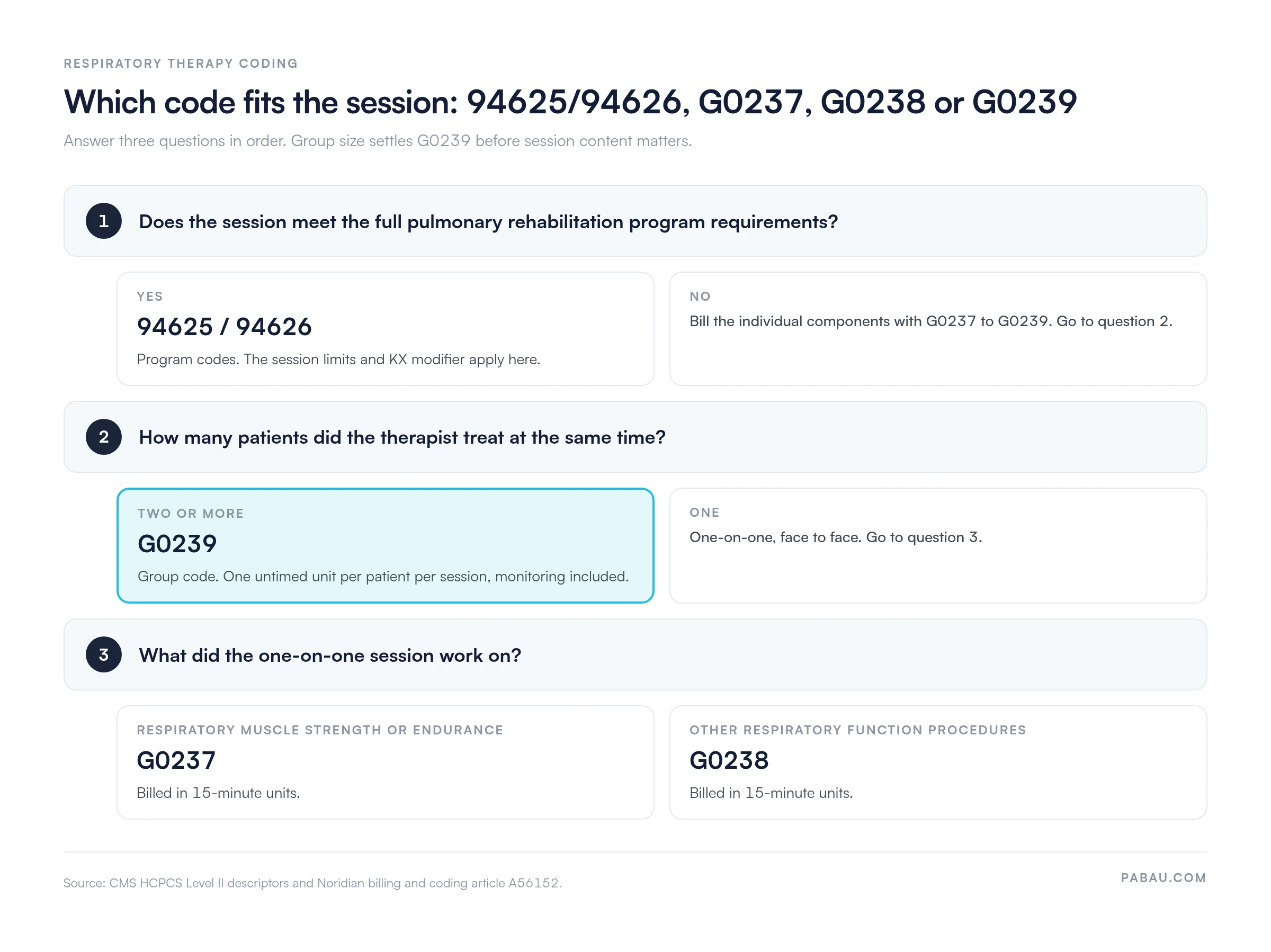
Billing G0239 alongside G0237 or G0238 for the same patient on the same date is governed by the CMS National Correct Coding Initiative (NCCI) edits. Check the current quarter’s NCCI tables before you bill both, because edit status can change each quarter.
Medicare pays for G0239 as an outpatient respiratory therapy service when the session is reasonable and necessary for the individual patient. Your Medicare Administrative Contractor (MAC) makes that decision claim by claim. Coverage depends on these conditions:
CMS states that G0237, G0238 and G0239 are not subject to the therapy caps, because they belong to the respiratory therapy plan of treatment. They also sit outside Medicare’s pulmonary rehabilitation program benefit, which is billed with CPT 94625 and 94626.
Noridian’s billing article A56152 uses G0237 through G0239 to bill the individual components of respiratory care when the full program requirements are not met. The program’s limits apply to 94625 and 94626 instead. Those limits are up to 36 sessions over 36 weeks and two one-hour sessions a day. A further 36 sessions are allowed for the second qualifying condition (COVID-19 or COPD), billed with KX.
Medicare Advantage (Part C) plans can set stricter requirements than Original Medicare. Verify plan-specific coverage rules before you start services for a Medicare Advantage patient.
No national list of covered diagnosis codes exists for G0239. CMS leaves medical necessity to the local contractor on a claim-by-claim basis. The ICD-10-CM list in Noridian’s pulmonary rehabilitation article applies only to the program codes 94625 and 94626, not to G0239.
The American Thoracic Society notes that MACs may cover G0237 to G0239 regionally for select non-COPD diagnoses. Some MACs list covered diagnoses in a local coverage determination (LCD), but these are not uniformly available. Check your own MAC’s policies before the first session.
Code the diagnosis to the highest specificity the record supports. An unspecified code on a claim from a practice with detailed clinical notes suggests that the coding and the documentation don’t match.
Report one unit of G0239 per patient for each group session. The code is untimed, so session length does not change the unit count. Each patient in the group gets their own claim line, supported by their own plan of treatment.
ICD10monitor reports coding guidance limiting groups to one professional per four patients. Keep the group size in each session note so the ratio can be shown on review.
Modifier requirements can differ between MACs. Review the policies published by the MAC for your jurisdiction before you bill the first group session.
The record has to show two things: that the session was necessary for this patient, and that it was a group service. Reviewers look for the following elements.
A session note template that asks for group size and patient response keeps these elements consistent across therapists. Applying the same billing compliance requirements across the program also lowers audit exposure.
Check four items before each G0239 claim goes out. The plan of treatment was signed before the first session. The note records a group of two or more patients. The claim carries one unit, not timed units. No monitoring service sits on its own claim line.
G0239 denials tend to come from a short list of coding and documentation errors. Each one has a fix that belongs in the session workflow. Reading the claim denial codes on each remittance shows which error you’re dealing with.
Structured denial management workflows that sort denials by reason code show whether G0239 rejections are systemic or one-off. A systemic problem points to the note template, while a one-off points to a single coding decision. The fix is different in each case.
Original Medicare does not use prior authorization for G0239. Your MAC reviews medical necessity when the claim is processed, so the record has to support each session on its own. Where you expect a denial, give the patient an ABN before the session.
Medicare Advantage plans operate independently of Original Medicare coverage rules. Some require prior authorization from the first session, and some restrict coverage to contracted facilities. Verify plan-specific requirements through each payer’s provider portal before services begin.
Group respiratory therapy multiplies the paperwork. One session produces a claim line for every patient in the room, and each line needs its own plan of treatment and progress note. Programs often rebuild that trail at month end from sign-in sheets.
Pabau, the practice management and EHR platform we build, keeps each patient’s plan of treatment, session notes and appointments in one record. Its digital forms can be set up to ask for group size and patient response during the session. Your team still chooses the code.
When a claim is ready, Pabau’s claims management pulls the details already on the patient record into it. In the US, it submits the claim through Claim.MD and tracks its status until the remittance posts.
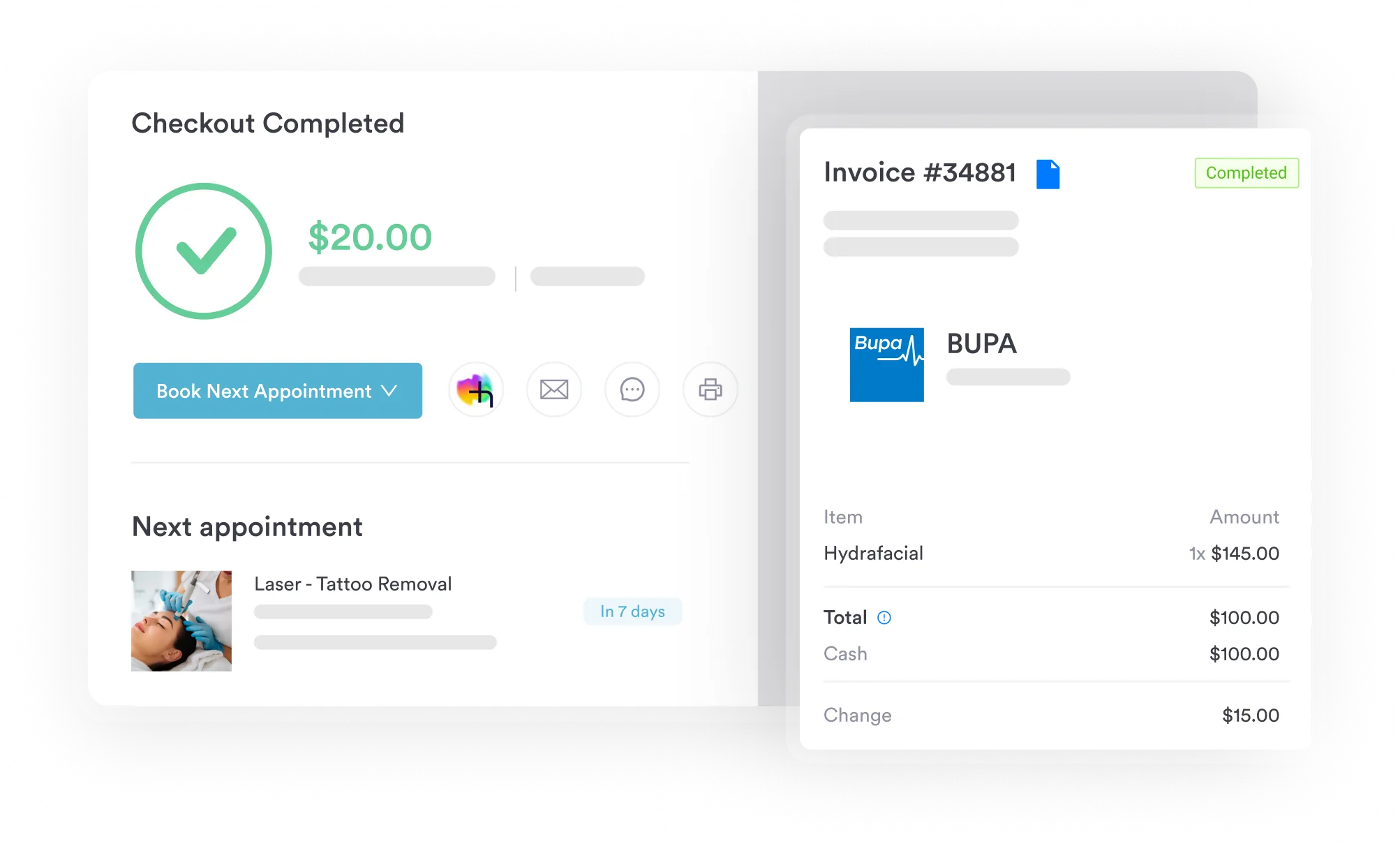
The result is a complete record behind each G0239 line before the claim leaves your practice.

Pabau keeps plans of treatment, group session notes and claims in one patient record. Each claim goes out with the documentation reviewers ask for already on file.

G0239 is the group code in its family, and most of its billing rules follow from that. Each patient gets one unit per session, with no timed units and no separate charge for monitoring. One-on-one work in the same program belongs to G0237 and G0238.
G0239 also sits outside the pulmonary rehabilitation program, so the program’s session limit and KX modifier don’t apply to it. Your MAC’s policies and a signed plan of treatment carry that weight instead. Book a demo to see how Pabau keeps group session notes and claims in one record for respiratory therapy programs.

Need to understand how claim denials are categorized and appealed? Denial management in healthcare covers the full workflow from denial code analysis to appeal submission.
Looking for a clean claim checklist before submission? What makes a clean claim explains the validation steps that prevent the most common payer rejections.
Want to understand the broader billing compliance framework? Medical billing fundamentals covers the end-to-end revenue cycle from charge capture through payment posting.
HCPCS Code G0239 covers therapeutic procedures to improve respiratory function or increase respiratory muscle strength or endurance, delivered to two or more patients at once. The monitoring done during the session is included. Typical content is breathing retraining, respiratory muscle exercises and airway clearance practice under a respiratory therapy plan of treatment.
G0238 is a one-on-one, face-to-face code billed in 15-minute units for respiratory function procedures other than those described by G0237. G0239 is the untimed group code for two or more patients treated together. Billing G0239 for a one-on-one session, or G0238 for a group, is a coding error.
Bill one unit of G0239 per patient for each group session. The code is untimed, so the 15-minute unit rules that apply to G0237 and G0238 don’t apply here. A longer group session still counts as one unit for each patient.
No national list of covered diagnoses exists for G0239. Your MAC decides medical necessity claim by claim, and some MACs publish covered diagnoses in local policies. The diagnosis list in Noridian’s pulmonary rehabilitation billing article applies to CPT 94625 and 94626, not to G0239.
Original Medicare does not use prior authorization for G0239. Your MAC reviews medical necessity when the claim is processed. The 36-session limit and KX modifier apply to the pulmonary rehabilitation program codes 94625 and 94626, not to G0239. Medicare Advantage plans set their own rules and may require prior authorization.
G0239 is an outpatient respiratory therapy code. A CORF bills it with revenue code 0410, 0412 or 0419. Hospital outpatient departments and physician offices also report it, so confirm the setting-specific rules with your MAC.