

CCSD code G5100: Bypass of duodenum billing guide
CCSD code G5100 bills a bypass that leaves the duodenum in place CCSD code G5100...

Last Updated: Oct 16, 2026
E0748 is the HCPCS Level II code for osteogenesis stimulator, electrical, non-invasive, spinal applications.
One change dominates E0748 billing in 2026. For dates of service on or after May 18, the FDA reclassified the device from Class III to Class II, so the KF modifier no longer applies. Suppliers who submit through claims management software should update their modifier logic to avoid rejected DMEPOS claims.
Some billers search for this as a "CPT code," but E0748 is a HCPCS Level II code, not a CPT code. CPT codes are five-digit numeric codes covering physician services and procedures. HCPCS Level II codes, like E0748, use a letter followed by four digits and cover items outside CPT's scope, including DME such as osteogenesis stimulators.
Let Pabau's smart automation suggest the right codes, reduce claim denials, and keep your practice compliant—effortlessly.
Automate repetitive tasks and focus on what matters most—your patients.
Reduce coding errors and ensure compliance with the latest regulations.
Clean claims, fewer denials, and faster reimbursements.
Powerful insights and reporting to help your practice thrive.
HIPAA compliant SOC 2 certified GDPR-compliant Trusted by 4,000+ clinics worldwide

HCPCS code E0748 identifies an electrical, non-invasive osteogenesis stimulator for spinal applications. DME suppliers bill it once per course of treatment.
The FDA reclassified E0748 from a Class III to a Class II device for dates of service on or after May 18, 2026. Suppliers no longer append the KF modifier, and claims that still include KF are rejected as incorrectly coded.
Medicare covers E0748 under LCD L33796 only when the ordering physician documents a qualifying spinal fusion indication before the device is dispensed. Billing before the criteria are met is the leading cause of denials.
Pabau’s claims management software helps DME suppliers and ordering clinicians track modifier changes, maintain documentation checklists, and reduce preventable E0748 denials.
HCPCS code E0748 is the Level II Healthcare Common Procedure Coding System code maintained by CMS for: Osteogenesis stimulator, electrical, non-invasive, spinal applications. This code covers devices that deliver pulsed electromagnetic fields (PEMF) or combined magnetic field (CMF) therapy to stimulate bone growth in the spine without surgical implantation.
E0748 applies to all anatomical levels of the spine. UnitedHealthcare’s provider policy confirms it covers bone growth stimulation at any spinal level. That makes it the single code for cervical, thoracic, and lumbar non-invasive electrical stimulation. Suppliers bill it once per course of treatment for the device rental or purchase, not per session.
E0748 falls under the Stimulation Devices category in the HCPCS Level II code set maintained by CMS. It has been active since 1996 and carries no planned retirement date as of the 2026 code year. Suppliers managing similar device codes may also reference the HCPCS code E2607 wheelchair cushion billing guide for parallel DMEPOS documentation patterns.
Local Coverage Determination L33796 (Osteogenesis Stimulators) governs Medicare coverage for E0748. Medicare covers a spinal electrical osteogenesis stimulator only when the patient meets at least one of these documented criteria before the device is dispensed:
LCD L33796 requires suppliers to determine coverage at the time of the initial order, not retrospectively. A supplier who dispenses the device before verifying one of these criteria carries the full repayment risk in a post-pay review. The ordering physician’s records must substantiate the indication, not a supplier-generated form.
E0748 does not cover acute fracture healing at spinal sites, routine post-operative bone growth support without a qualifying LCD indication, or degenerative disc disease without fusion. Coding outside the covered indications is a leading audit trigger.
Coders should confirm that the ordering physician’s clinical notes address one of the three LCD criteria directly. A diagnosis code alone, without the supporting rationale, is not enough.
Audit your ordering physician documentation before shipping any E0748 device. The physician’s office record, not the DME supplier intake form, is what CMS reviews in a post-pay audit. If the physician note does not explicitly address the LCD L33796 criterion being claimed, request an addendum before billing.
The biggest 2026 change to E0748 billing concerns the KF modifier, which identifies an FDA Class III device. Through May 17, 2026, CMS Policy Article A52513 classified E0747, E0748, and E0760 as Class III devices, so every claim needed KF.
The FDA then reclassified these three codes as Class II devices, effective for dates of service on or after May 18, 2026. For those claims, suppliers do not append KF. Medicare rejects E0748 lines that still carry the KF modifier as incorrectly coded.
Suppliers reconciling older claims should keep the cutoff clear: KF was required before May 18, 2026, and is rejected on or after that date.
Getting the modifier right at order entry matters more than catching it at billing.
Practices that also handle HCPCS code L1843 knee orthosis billing apply similar modifier discipline across prefabricated DME categories.
Suppliers append the EY modifier when the device was provided without a valid physician order. It tells Medicare the claim does not meet the standard order requirement, which typically results in denial. Never dispense an E0748 device without a written order from the treating physician. Doing so creates both a coverage and a compliance problem.
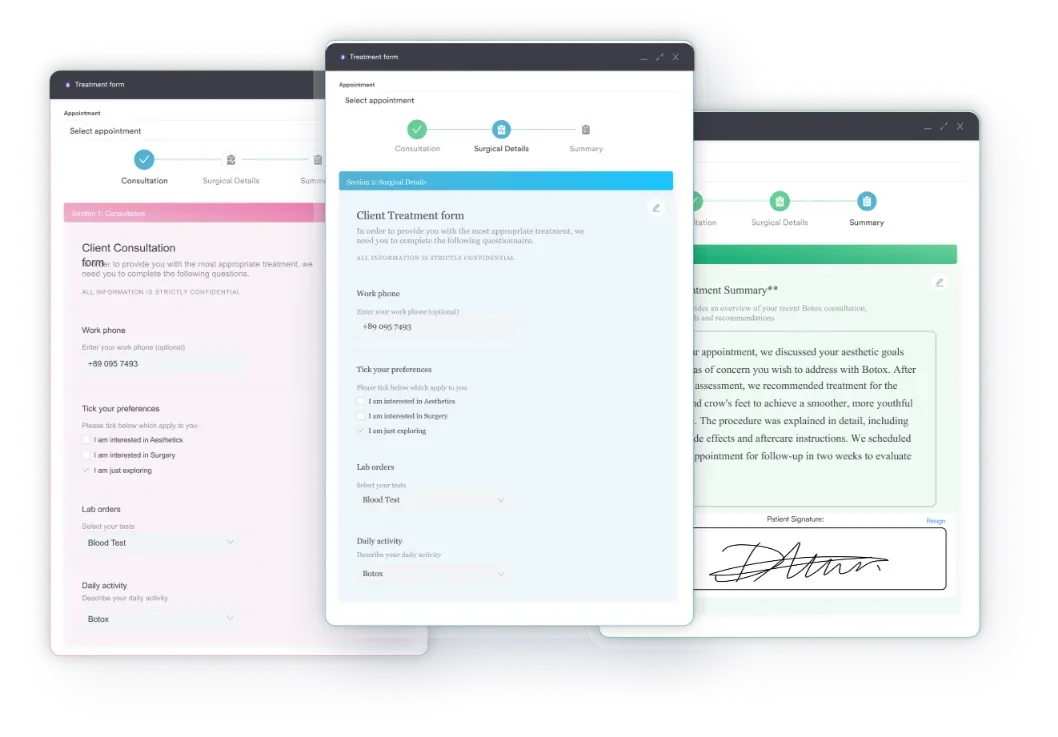
Maintaining organized medical forms at your practice ensures order documentation is captured and retained before equipment is released. Clinicians ordering bone-growth devices alongside post-surgical protocols may also find the Achilles tendon rupture treatment guidelines handout a useful reference for musculoskeletal aftercare documentation.
With built-in stock tracking, every brace or device billed under these codes is deducted from inventory automatically.
The 2026 Medicare non-facility rate for E0748 is approximately $3,437.99, effective January 1, 2026. The allowed amount adjusts by locality.
Expect this figure to change. CMS has said it will recalculate the fees for E0747, E0748, and E0760 in the July 2026 DMEPOS update to reflect the Class II reclassification. Verify the current rate against the official CMS fee schedule before you submit.
Commercial reimbursement varies widely. Independence Blue Cross (IBX) and other regional plans set their own medical policies for osteogenesis stimulators. Those policies may differ from Medicare LCD L33796 on coverage criteria and prior authorization. Check the individual payer policy before dispensing.
For providers managing multiple payers.
Selecting the wrong code between E0748 and its close relatives is the most common coding error in this category. The distinction turns entirely on the site of application and device mechanism.
The practical test: if the device is non-invasive, electrical (PEMF or CMF technology), and applied to the spine, E0748 is the correct code. If the patient has a lumbar fusion and the device uses ultrasound, E0760 applies instead. Submitting E0748 when the clinical record indicates an ultrasound device is an unbundling and accuracy issue that payers audit actively.
For practices managing physical therapy documentation and DME ordering together, maintaining clear device-type fields in patient records prevents miscoding at the point of care. Related non-invasive device billing such as the HCPCS code E2510 speech generating device guide and the HCPCS Code E0271 innerspring mattress guide illustrate how device classification drives code selection across DME categories. The Medicare Benefits Schedule sets its own item structure, so a US code has no direct Australian counterpart.

Pabau’s claims management tools help DME suppliers and ordering clinicians track modifier requirements, maintain documentation checklists, and flag missing physician orders before submission.

CMS documentation requirements for E0748 are detailed in the CGS Medicare Osteogenesis Stimulators Documentation Checklist. Both the ordering physician’s record and the supplier’s file must be complete before billing. Missing documentation discovered in a post-pay audit triggers full repayment of the allowed amount.
The physician’s office file must contain all of the following for a clean E0748 claim:
The DME supplier’s own file must separately retain:
Both the physician and supplier files must follow HIPAA-compliant documentation practices. Coders managing concurrent injection drug claims can also consult the HCPCS code A4211 supplies for self-administered injections guide for a related DME documentation parallel.
CMS requests records from both parties in an E0748 audit. Missing documentation in either file can trigger a denial, even when the clinical indication was legitimate.
Using structured capture forms for intake documentation helps ensure all required fields are collected at the time of order. Teams also billing for non-chemo oral medications alongside DME should reference the HCPCS code J8499 non-chemo oral drug billing guide for documentation parallels across unclassified categories.
The Pricing, Data, Analysis and Coding (PDAC) Contractor, administered on behalf of CMS, maintains the Product Classification List for DMEPOS items including E0748. Suppliers must confirm that the specific brand and model of device they are dispensing has been classified by PDAC under E0748 before billing Medicare.
Suppliers cannot bill a device under E0748 unless it appears on the PDAC Product Classification List, regardless of the clinical indication. A PDAC advisory article once covered E0747, E0748, and E0760. That advisory has been retired, but CMS still requires PDAC verification as a condition of coverage.
Check the current PDAC Product Classification List at dmepdac.com before stocking any new device model.
Products already assigned and published on the PDAC Product Classification List for E0748 do not require re-verification unless the device model changes. Suppliers who switch device vendors or introduce a new manufacturer’s product mid-contract should treat that as a new PDAC verification requirement.
Building this check into practice inventory management workflows keeps suppliers from stocking non-classified devices by mistake. Suppliers who also dispense injectable or infusible products may reference the HCPCS code J1642 heparin sodium lock flush billing guide for a contrast between per-unit and per-course billing.
Before adding any new osteogenesis stimulator model to your DME inventory, verify the device against the current PDAC Product Classification List at dmepdac.com. A device that worked under E0748 for a previous supplier may not be classified if the manufacturer updated the model number. Confirm before stocking, not after billing.
Traditional Medicare fee-for-service does not require prior authorization for E0748. CMS suspended a prior-authorization requirement for these codes on August 28, 2024. Medicare Advantage plans and commercial payers, however, often impose their own prior-authorization rules that go beyond the Medicare LCD criteria.
Priority Health, for example, publishes a billing policy for osteogenesis stimulators that requires prior authorization. It also requires the anatomical site in the clinical documentation to match the HCPCS code billed. Independence Blue Cross (IBX) maintains a separate policy that covers E0748 as medically necessary under defined conditions.
Suppliers billing commercial plans should check each payer’s current policy, since payers update these independently of Medicare LCDs. Some commercial payers also require ongoing use documentation before they approve continued coverage, so track patient compliance with the prescribed protocol.
Providers who want to grow the patient base for these devices can review 7 strategies that fill schedules for referral and outreach approaches.
Payer-specific notes and crosswalk references help suppliers spot which commercial plans set their own E0748 policies before they submit a claim.
Practices that also handle principal care management can review the CPT code 99424 principal care management billing guide to see how authorization interacts with ongoing chronic-condition coding.
CMS announced a widespread post-pay, service-specific review of HCPCS codes E0747, E0748, and E0760 in April 2021. High error rates in documentation and modifier compliance across the osteogenesis stimulator category triggered it.
The review put flagged claims through full medical review. Suppliers with high denial rates faced extrapolation, where CMS applies a sample denial rate to a broader universe of claims.
The most common denial reasons in E0748 post-pay reviews fall into four categories:
Suppliers can address all four with a pre-dispensing checklist that is completed and signed before any E0748 device leaves the warehouse. Building that checklist into your documentation workflow ensures it becomes a required step in the order process rather than an afterthought.
Three requirements drive clean E0748 claims. First, match the modifier to the date of service: For dates of service on or after May 18, 2026, omit KF, because the device is now Class II. Second, document an LCD L33796 spinal indication in the ordering physician’s records before the device ships. Third, confirm the dispensed product appears on the current PDAC Product Classification List.
Meeting those three requirements consistently eliminates the vast majority of E0748 denials.
Pabau’s claims management software helps DME suppliers and ordering clinicians build these checks into their pre-submission workflow, flagging missing modifiers and incomplete documentation before claims reach the payer. To see how Pabau handles DMEPOS billing workflows, book a demo.

Billing anesthesia for cataract surgery? CPT code 00142 covers anesthesia for lens surgery and the modifier errors that most often cause denials.
Billing anesthesia for an iridectomy? CPT code 00147 covers base units, 2026 Medicare rates, modifiers, and ICD-10 pairings for iridectomy anesthesia.
HCPCS code E0748 is the billing code for an electrical, non-invasive osteogenesis stimulator used for spinal applications. Suppliers use it when dispensing a PEMF or CMF device prescribed for spinal fusion non-union, a multilevel fusion, or a fusion at a site with a prior failed fusion. The code covers all spinal levels (cervical, thoracic, lumbar) and is billed once per course of treatment.
This changed in 2026. Through May 17, 2026, the KF modifier was mandatory because CMS classified E0748 as an FDA Class III device. For dates of service on or after May 18, 2026, the FDA reclassified E0748 as Class II. Suppliers no longer append KF, and claims that still include it are rejected as incorrectly coded.
Medicare covers E0748 under LCD L33796 in three situations:
The ordering physician’s notes must document which criterion applies before the device is dispensed.
E0748 covers electrical non-invasive osteogenesis stimulators for spinal applications only. E0747 covers electrical non-invasive stimulators for all other (non-spinal) sites, such as long bone fracture non-union and congenital pseudarthrosis. Neither code uses the KF modifier for dates of service on or after May 18, 2026, since both were reclassified as Class II. They are never interchangeable based on the site of application.
Traditional Medicare fee-for-service does not require prior authorization for E0748. Medicare Advantage plans and commercial payers such as Independence Blue Cross and Priority Health typically require prior authorization under their own medical policies. Always verify the individual payer’s current requirements before dispensing the device.
A clean E0748 claim requires a signed written physician order, clinical notes documenting the specific LCD L33796 criterion met, supporting radiographic evidence, PDAC product classification verification for the dispensed device model, and signed delivery documentation. Use the correct modifier for the date of service. KF is no longer used for dates of service on or after May 18, 2026. Both the physician’s file and the supplier’s file must independently contain the required documentation.
E0748 isn’t a CPT code. It’s billed as a HCPCS Level II code for an electrical, non-invasive osteogenesis stimulator used for spinal applications. CPT codes are Level I of the coding system and cover physician services and procedures. HCPCS Level II covers equipment and supplies, including DME, which is why E0748 falls under HCPCS rather than CPT. Bill it as E0748 regardless of which term you used to search for it.
Yes. E0748 is a durable medical equipment code within HCPCS Level II, covering an electrical, non-invasive osteogenesis stimulator for spinal applications. DME suppliers, not physician offices, typically bill it, and the specific device dispensed must appear on the PDAC Product Classification List before a supplier submits the claim.
Yes, but only when specific conditions are met. Medicare covers a non-invasive spinal osteogenesis stimulator billed as E0748 when LCD L33796’s criteria are documented before the device ships, such as a failed fusion with at least nine months of non-union or a fusion spanning three or more vertebrae. A physician’s prescription alone does not guarantee coverage.
The 2026 Medicare non-facility rate for E0748 is approximately $3,437.99, though the allowed amount adjusts by locality. CMS is expected to update this figure in the July 2026 DMEPOS fee schedule following the Class II reclassification, and commercial payers such as Independence Blue Cross and Priority Health set their own reimbursement rates that can differ from Medicare’s.



