

HCPCS code E0198: Water pressure pad billing guide
HCPCS code E0198 is a water pad for a standard mattress HCPCS code E0198 is the ...

Last Updated: Oct 13, 2026
E0784 is the HCPCS Level II code for external ambulatory infusion pump, insulin.
For DME suppliers and the practices that refer these patients, most E0784 denials trace back to documentation that arrives incomplete or late: a missing written order prior to delivery (WOPD), or records that don't establish medical necessity. That means delayed reimbursement, time-consuming appeals, and patients caught in the middle.
Let Pabau's smart automation suggest the right codes, reduce claim denials, and keep your practice compliant—effortlessly.
Automate repetitive tasks and focus on what matters most—your patients.
Reduce coding errors and ensure compliance with the latest regulations.
Clean claims, fewer denials, and faster reimbursements.
Powerful insights and reporting to help your practice thrive.
HIPAA compliant SOC 2 certified GDPR-compliant Trusted by 4,000+ clinics worldwide

HCPCS Code E0784 describes an external ambulatory insulin infusion pump. It is a HCPCS Level II code (not a CPT code), covered under Medicare Part B and governed by LCD L33794
Medicare Part B covers E0784 when strict medical necessity criteria are met, including documented failure of multiple daily injections to control blood glucose
JK and JL modifiers indicate insulin supply duration (one month vs. three months) on the insulin drug lines J1817, J1811, and J1813 — not on E0784 itself — effective April 1, 2023 for J1817 and July 1, 2023 for J1811 and J1813
Pabau’s claims management software helps DME suppliers and integrated practices organize documentation, track WOPD compliance, and reduce claim denials
When billers ask which HCPCS code applies to an insulin infusion pump, E0784 is the answer for a standard external pump. It is often searched as a “CPT code,” but E0784 is a HCPCS Level II code. CPT codes describe procedures, while HCPCS Level II codes like this one describe the device itself. When your practice also sells self-pay cosmetic treatments, our roundup of software for med spas compares the checkout tools they need.
Medicare’s national coverage framework for these pumps sits in NCD 280.14, with day-to-day coverage administered through LCD L33794 (External Infusion Pumps). LCD L33794 superseded the older LCD L11570, which is now retired. Modifier and coding detail under this policy are addressed in the companion Policy Article A52507.
The device is a small, wearable pump worn externally on the body. It delivers insulin continuously through a subcutaneous infusion set rather than through multiple daily injections. Clinicians most commonly prescribe it for patients with Type 1 diabetes and, in select cases, Type 2 diabetes when standard injection regimens fail to maintain adequate glycemic control.
The code is maintained in the Palmetto GBA DMECS database and verified annually by CMS. Suppliers billing this code must hold active DMEPOS accreditation and meet all supplier standards.
Coverage for HCPCS Code E0784 falls under LCD L33794 (External Infusion Pumps), which replaced the now-retired LCD L11570. The DME Medicare Administrative Contractors (DME MACs) administer this policy, with modifier and coding detail addressed in the companion Policy Article A52507.
Meeting the medical necessity criteria is not optional. Without documented evidence of each criterion in the beneficiary’s file, the claim will be denied on audit even if the device was appropriately prescribed.
Medicare Part B will cover E0784 when a beneficiary with diabetes mellitus meets all of the following conditions:
The treating physician’s documentation must reflect all of the above. LCD L33794 specifies what records must be present in the file before the supplier delivers the device. This is where HIPAA-compliant documentation practices matter: the clinical record must support the prescription, not just accompany it.
Coverage for Type 2 diabetes patients is more restrictive. The supplier must show that the patient has been unresponsive to subcutaneous insulin injections at a frequency and dose that would reasonably be expected to achieve control. Documentation must include HbA1c values, glucose logs, and the prescribing clinician’s clinical rationale for transitioning to pump therapy.
Under ACA Section 6407, a written order prior to delivery (WOPD) is required for HCPCS Code E0784. The LCD L33794 Policy Specific Documentation Requirements table designates E0784 as a WOPD item. The supplier cannot deliver the pump and bill afterward. The signed written order must exist before delivery takes place. Missing or backdated WOPDs are among the most common triggers for post-payment audit recoupment. Compliance risk rises where one person codes, bills and reconciles without a second review.
Request the WOPD before scheduling pump delivery. Build a checklist that includes the order date, prescribing physician signature, diagnosis codes, and the supplier’s acknowledgment date. A delivery log that precedes the WOPD date creates an automatic compliance failure on audit.
Incomplete documentation is the leading reason HCPCS Code E0784 claims fail on review. The following records must be in the supplier’s file and available upon request by the DME MAC. Use digital forms workflows to capture and store this documentation in a structured, auditable format.
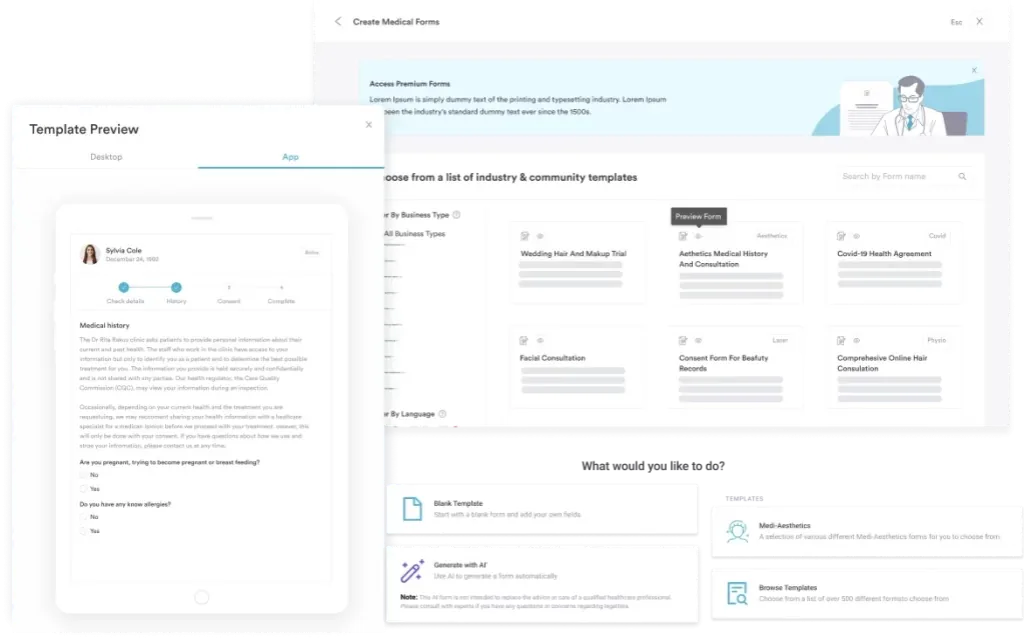
Practices that refer patients for insulin pump therapy should provide the DME supplier with physician notes, lab values, and the signed prescription at the time of referral. Delays in getting these records to the supplier are a significant cause of billing backlogs. Practices using compliance management tools can build referral checklists that capture every required document before the file leaves the office.
Two points often trip up suppliers working from older guidance. First, CMS discontinued the DME Information Form (DIF, form CMS-10125) for external infusion pumps effective January 1, 2023, so a DIF is no longer submitted with E0784 claims. Second, the claim still needs a supporting diagnosis: common pairings include Z96.41 for the presence of an insulin pump and Z46.81 for a fitting or adjustment encounter.
Equipment orders need follow-through, and patient management software tracks who received what, and when it needs review.
Modifier selection for HCPCS Code E0784 depends on three factors:
Several modifiers are relevant to most E0784 billing scenarios.
The RR modifier indicates the item is being rented rather than purchased. Suppliers billing E0784 on a rental basis append RR to the code (E0784RR). Rental billing rules apply, including capped rental periods and transition to beneficiary ownership under the Medicare DME rental framework.
The JK and JL modifiers, defined in CMS Policy Article A52507, indicate the supply duration of the insulin dispensed for the pump — not the drug’s formulary status. They attach to the insulin drug line item (J1817, J1811, or J1813), never to E0784 itself:
Failure to include JK or JL on the insulin drug line item (J1817, J1811, or J1813) will result in claim rejection. Billers should confirm the supply duration being dispensed — one month or three months — before the claim is submitted and select the modifier accordingly.
Confirm the exact supply duration dispensed — one month vs. three months — before billing the insulin drug line. A JK vs. JL modifier that doesn’t match the billed quantity is a hard edit that will reject at the clearinghouse, not just on adjudication.
Policy Article A52507 also defines three certification modifiers that travel with E0784 and its related lines, separate from the JK/JL supply-duration modifiers above:
KX, GA, and GZ have long been required on E0784 and on the insulin drug line J1817. For claims received on or after March 1, 2023, CMS expanded the requirement to all external infusion pump (EIP)-related codes and supplies, including J1811, J1813, and the supply codes discussed below.
A missing KX, GA, or GZ modifier is one of the most common, and most avoidable, denial triggers on E0784 claims. This is distinct from a missing JK or JL modifier.
Insulin pump supplies are billed separately from HCPCS Code E0784, using their own insulin pump supply HCPCS codes. The pump code covers only the device.
Supplies, reservoirs, and the insulin itself are reported on separate line items, built around two current supply codes: A4224 (the all-inclusive infusion-set supply code) and A4225 (the syringe-type reservoir/cartridge). Suppliers should bill these concurrently with or following the initial E0784 claim.
The insulin drug lines identify the specific product. Rapid-acting insulins such as Humalog are reported under J1817 (per 50 units), while insulin fiasp uses J1811 and Lyumjev uses J1813. The pump reservoir or cartridge is billed under A4225, and the infusion set (cannulas, needles, dressings, and tubing) is billed under the all-inclusive code A4224. J-code units are drug-specific rather than standardized: HCPCS Code J1458 reports galsulfase in 1 mg increments, while E0784 insulin lines move in 50-unit blocks.
The older A4230 and A4231 codes now bundle into A4224, and A4232 is invalid for Medicare submission. Billing infusion-set components separately alongside E0784, rather than under the consolidated A4224 code, is treated as unbundling and is a common audit finding.
Match each supply code to what the patient actually uses, since a mismatched drug or reservoir code is a frequent line-item rejection.
Quantity limits for supply codes are defined by the DME MACs and may vary by contractor jurisdiction. Exceeding published quantity limits without documented medical necessity is a common audit trigger. Suppliers billing for patients who use continuous glucose monitoring alongside the pump should also review the CGM coding requirements discussed in the next section.

Pabau helps practices and DME suppliers organize documentation, build referral checklists, and manage compliance records so claim submissions are complete the first time.

Insulin administered through an external ambulatory insulin infusion pump coded under HCPCS Code E0784 is a Medicare Part B benefit, not Part D. This is the most consequential billing error in the insulin pump space.
A DMEPDAC advisory article confirmed that DME MACs have identified pharmacies incorrectly billing insulin used in E0784 pumps to Medicare Part D. That practice constitutes incorrect billing and creates compliance exposure for the pharmacy, the prescriber, and the supplier.
The rationale is straightforward. When insulin is used as part of a Medicare-covered DME item (the external pump), the insulin becomes a Part B supply. The J-code drug lines (J1817, J1811, J1813) must be billed by the DME supplier to Part B alongside the E0784 device code.
Part D plans should reject or return claims for insulin used in this context. If a pharmacy has already billed Part D for insulin used in a covered E0784 pump, coordination with the relevant DME MAC is necessary to correct the billing. Coordinating records between the prescriber, pharmacy, and DME supplier also requires following HIPAA security rule requirements for patient data.
E0784 applies to durable, reusable insulin pumps: the tubed devices a patient wears and refills. Tandem and Medtronic pumps fall into this group and are billed as rental durable medical equipment under E0784. The billing path changes for tubeless and disposable devices, which is where most coding confusion starts.
The Omnipod is the device suppliers ask about most. Because it has no durable, reusable component, Medicare covers it under the Part D pharmacy benefit rather than as Part B durable medical equipment, so it is not billed under E0784. An Omnipod claim submitted under E0784 will be denied.
A9274 (disposable insulin delivery system) is a valid HCPCS code, but it is statutorily non-covered by Medicare because it does not meet Medicare’s DME benefit definition. It is not a Part B billing path equivalent to E0784, and it is mainly relevant for commercial and Medicaid payers.
Medicare beneficiaries using disposable or tubeless systems are reached through the Part D pharmacy benefit, the same route as Omnipod.
Coders sometimes look for E0787 as the code for an insulin pump with integrated continuous glucose monitoring (CGM). E0787 and its supply code A4226 were retired and are invalid for Medicare submission effective September 15, 2020. Integrated-CGM insulin pumps now bill as HCPCS Code E0784 plus a CGM add-on code, and getting that pairing right matters for clean claims.
CMS guidance under the EIP Policy Article for LCD L33794 (Policy Article A52507) directs suppliers to bill integrated-CGM insulin pumps as HCPCS Code E0784 alongside the appropriate CGM add-on code. E2102 applies when the CGM receiver functionality is adjunctive, and E2103 applies when the pump has non-adjunctive, built-in CGM sensing. E0787 no longer applies to any configuration.
Suppliers who previously billed E0787 and A4226 for dates of service on or after January 1, 2020, and have not yet submitted those claims, or whose claims were denied or rejected, should follow the PDAC advisory guidance and resubmit using E0784RR and K0554RR. This retroactive guidance applies only to claims that are unsubmitted, denied, or rejected, not to claims that were already adjudicated and paid.
Medicare reimbursement for HCPCS Code E0784 is set annually in the CMS Physician Fee Schedule and DME fee schedule. Payment starts from a national unadjusted fee that is then adjusted by locality, so the amount a supplier is paid for E0784 varies by region and calendar year. Commercial payer rates differ again and must be verified with each contracted payer.
For current Medicare payment amounts, use the AAPC Codify HCPCS lookup to retrieve the most recent published rates by code and locality. Published rates are updated January 1 each year. Billing the previous year’s rates after January 1 does not affect payment, but verifying the current schedule prevents billing errors in supporting documentation.
Rental vs. purchase reimbursement follows standard Medicare capped rental rules. During the rental period, the supplier bills E0784RR monthly. After the rental cap, ownership transfers to the beneficiary and ongoing maintenance and supply codes apply. The specific capped rental period and any billing interruptions are governed by the DME rental rules in effect at the time of the initial delivery date.
Practices managing patients who use insulin infusion pumps alongside other chronic condition monitoring devices often find that billing complexity scales with the number of concurrent devices.
The DME MACs audit E0784 claims regularly, and denial patterns are predictable. Knowing these before submission is the most efficient way to protect revenue.
Billing teams that track denial patterns by reason code can find where their documentation intake process breaks down. If a practice is referring patients to a DME supplier, sharing a pre-referral checklist reduces the back-and-forth that delays claim submission.
Practices managing multiple complex billing codes benefit from structured workflows. Comparing documentation standards across code types can be useful: reviewing IVF CPT codes shows how prior authorization and medical necessity criteria are handled in other specialty areas.
Billing HCPCS Code E0784 correctly depends on three things: a compliant WOPD in hand before delivery, complete clinical documentation of MDI failure, and the right modifier on every insulin drug line. Missing any one of these creates a denial that takes longer to appeal than it would have taken to get right the first time.
Practices that refer patients for insulin pump therapy and DME suppliers billing E0784 both benefit from organized documentation workflows. Pabau’s claims management software helps practices build the referral and compliance checklists that support clean first-time submissions. To see how Pabau supports medical billing and documentation workflows, book a demo.

Need to bill anesthesia for a vascular procedure? Intracranial vascular anesthesia coding guide covers billing anesthesia for surgical procedures on the blood vessels of the head.
Coding a nutrition-related diagnosis alongside a chronic condition? ICD-10 Code E68 covers documentation for sequelae of hyperalimentation, a diagnosis code that can appear alongside metabolic condition management.
Billing another DME-adjacent HCPCS code? HCPCS Code L2397 covers documentation requirements for the lower-extremity orthosis suspension sleeve addition, billed as a DMEPOS lump-sum purchase.
HCPCS Code E0784 is the billing code for an external ambulatory infusion pump that delivers insulin subcutaneously. It is billed under Medicare Part B as durable medical equipment and falls under CMS LCD L33794 for External Infusion Pumps. Suppliers use it to report the device itself; supply codes (A4224, A4225) and insulin drug codes (J1817, J1811, J1813) are billed separately.
Medicare Part B covers HCPCS Code E0784 when the beneficiary has diabetes, has been on a multiple daily injection regimen that failed to achieve adequate glycemic control, has documented insulinopenia (via fasting C-peptide testing or beta-cell autoantibody positivity), and a physician has documented medical necessity for pump therapy. Supporting documentation must include HbA1c values, glucose logs, injection history, a signed WOPD, and a beneficiary training record.
Several modifiers apply. RR indicates rental. JK and JL indicate the insulin supply duration (JK = one month or less, JL = three months) and attach to the insulin drug line (J1817, J1811, or J1813), not to E0784 itself; they became effective April 1, 2023 for J1817 and July 1, 2023 for J1811 and J1813. KX, GA, and GZ are certification modifiers on E0784 and related lines: KX confirms all LCD medical necessity criteria are met, GA signals a required ABN is on file, and GZ signals an expected denial with no ABN. All are defined in CMS Policy Article A52507, and since March 1, 2023 KX/GA/GZ are required on all external infusion pump-related codes and supplies.
HCPCS Code E0784 and the insulin used with it are Medicare Part B benefits, not Part D. The DME supplier bills the device and insulin drug codes to Part B. Pharmacies billing insulin used in an E0784 pump to Part D are billing incorrectly. This is a documented compliance issue flagged by the DMEPDAC and DME MACs.
The primary supply codes billed with E0784 are A4224 (all-inclusive infusion-set supplies: cannulas, needles, dressings, and tubing, excluding the reservoir) and A4225 (syringe-type reservoir/cartridge). The older A4230 and A4231 codes now bundle into A4224, and A4232 is invalid for Medicare submission. Insulin is reported on drug lines using J1817, J1811, or J1813 with the appropriate JK (one-month supply) or JL (three-month supply) modifier. A4238 covers the supply allowance for an adjunctive, non-implanted CGM, and A4239 covers the supply allowance for a non-adjunctive, non-implanted CGM.
E0787 and its supply code A4226 were retired and are invalid for Medicare submission effective September 15, 2020. Integrated-CGM insulin pumps now bill as E0784 plus a CGM add-on code: E2102 when the CGM receiver functionality is adjunctive, or E2103 when the pump has non-adjunctive, built-in CGM sensing. Suppliers who billed E0787 and A4226 for dates of service on or after January 1, 2020, and have not yet submitted those claims (or whose claims were denied or rejected), should resubmit as E0784RR and K0554RR per the PDAC advisory.
E0784 is a HCPCS Level II code, not a CPT code. It is often searched as the E0784 CPT code, but CPT codes describe procedures while HCPCS Level II codes like E0784 describe the device itself: an external ambulatory insulin infusion pump. Medicare maintains it as durable medical equipment billed under Part B.
Medicare sets E0784 reimbursement each year in the DME fee schedule, starting from a national unadjusted amount that is then adjusted by locality, so the exact payment varies by region and calendar year. The pump is billed as capped rental (E0784RR) monthly rather than as a one-time purchase, and commercial payer rates differ from Medicare. Check the current year DME fee schedule for the rate in your locality.



