CPT Code 62284: Injection procedure for myelography
CPT Code 62284: official descriptor and procedure overview The American Medical ...

Last Updated: Oct 19, 2026
HCPCS code C1718 is a deleted HCPCS Level II code for an iodine-125 brachytherapy source, reported per source.
CMS added it on April 1, 2001 and deleted it effective July 1, 2007. Iodine-125 seeds implanted since then are billed as C2638 when stranded or C2639 when loose.
C1718 therefore has no current billing role. You’ll only meet it in hospital outpatient claims, chargemasters, and reports from before mid-2007. This guide explains what the code covered, why CMS retired it, and how to handle it when it turns up in old records.

HCPCS code C1718 described an iodine-125 brachytherapy source, billed per source, and has nothing to do with catheter introducers or sheaths.
CMS added C1718 on April 1, 2001 and deleted it effective July 1, 2007, so June 30, 2007 is the last valid date of service.
Iodine-125 seeds are now billed as C2638 when stranded or C2639 when loose, with one unit per seed.
A claim dated on or after July 1, 2007 that carries C1718 is invalid and must be recoded before it can be paid.
Claims software such as Pabau helps billing teams spot retired codes on charge lines before a claim goes out.
The official CMS descriptor for C1718 is Brachytherapy source, iodine-125, per source. It covered the radioactive iodine-125 seeds placed inside or next to a tumor during low-dose-rate brachytherapy, most often for prostate cancer. According to the CMS device category code list, C1718 became effective on April 1, 2001.
The descriptor did not say whether the seeds came loose or linked together in a strand. That missing detail is exactly why CMS deleted the code.
Some online code lists describe C1718 as a catheter introducer or sheath. That description is wrong. Introducer sheaths have their own C-codes, such as C1894 and C1766, and C1718 was never one of them.
CMS deleted C1718 because Congress required Medicare to pay stranded and non-stranded brachytherapy sources in separate groups. The Tax Relief and Health Care Act of 2006 set that requirement for sources furnished on or after July 1, 2007. CMS explained the change in Transmittal 1259 (Change Request 5623), its July 2007 OPPS update.
Iodine-125, palladium-103, and cesium-131 were the three sources CMS knew were sold in both forms. CMS created six new codes to split them, and deleted the three codes that did not specify the form. C1718 was the iodine-125 code in that group, and C1720 was its palladium-103 counterpart.
The timeline below shows how C1718 moved from a pass-through device code to a deleted one.
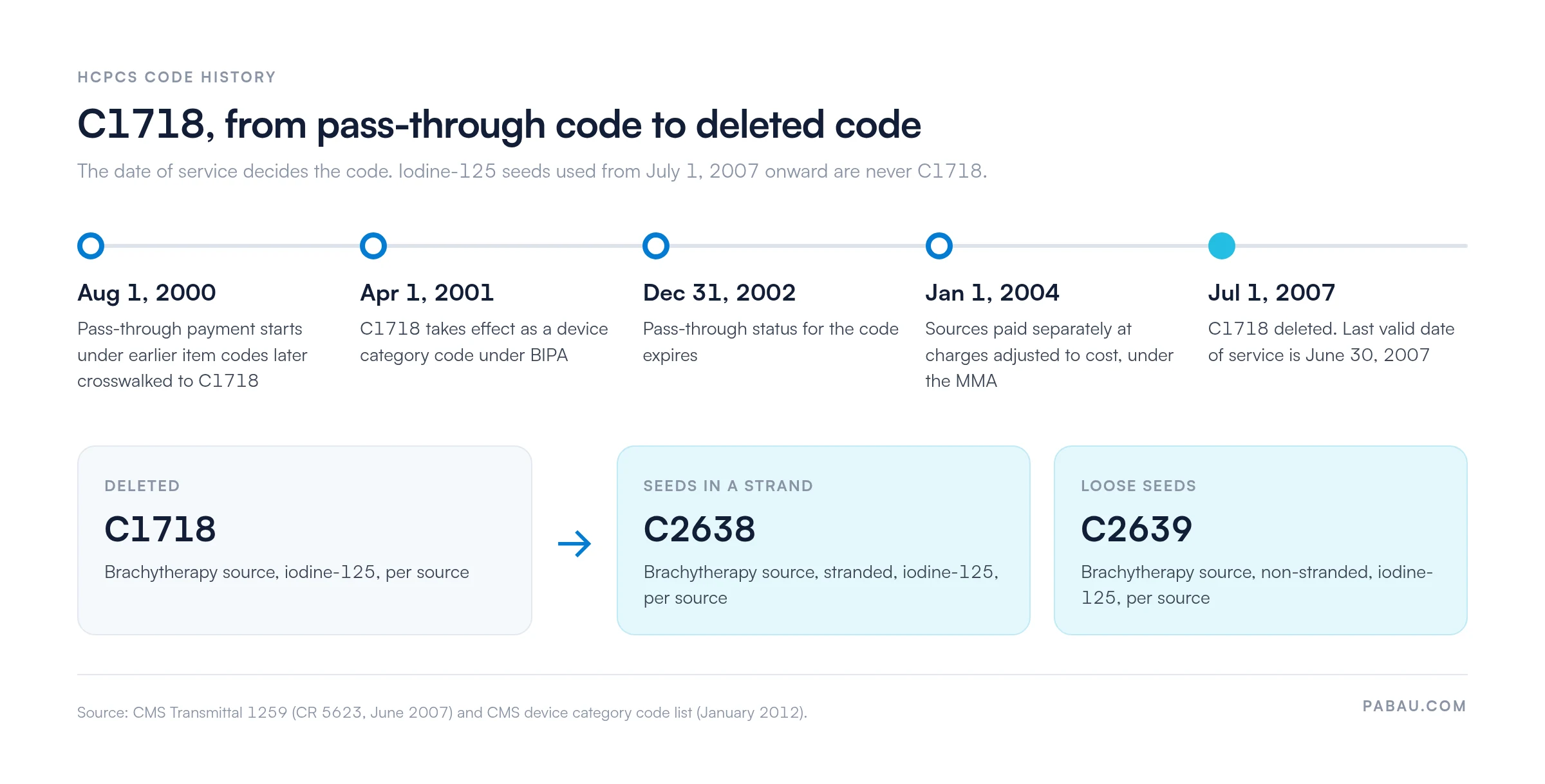
Payment rules changed several times during the code’s life. Pass-through payment for these seeds began on August 1, 2000, under earlier item codes later crosswalked to C1718. C1718 itself was paid as a pass-through device through December 31, 2002. From January 1, 2004, the Medicare Modernization Act required separate payment for brachytherapy sources at hospital charges adjusted to cost.
Two codes took over from C1718 on July 1, 2007, and the source form decides between them. The table also lists the neighboring codes most often confused with it.
Under current OPPS rules, brachytherapy sources carry status indicator U, which means a separate APC payment. They are not packaged into the implant procedure.
Current iodine-125 claims follow the rules CMS set when it retired C1718. They go on the hospital outpatient claim (UB-04 or 837I) alongside the implant procedure.
Getting these details right the first time is the core of a clean claim. Commercial payers set their own rules, so confirm a payer’s policy before you assume it follows Medicare.
Start with the date of service, because it settles almost every C1718 question. A service on or before June 30, 2007 was correctly coded with C1718, while a later one was not.
No C1718-era service can still be billed to Medicare. The last valid date of service was June 30, 2007, and Medicare’s filing limit is one year from the date of service. If a new claim carrying C1718 is rejected, correct the code rather than appeal. The denial codes guide explains how to read the rejection.
Search your chargemaster and saved charge templates for C1718, C1720, and C2633 together. All three were deleted on July 1, 2007, so finding one often means the others are still there too.
Retired codes rarely cause trouble on their own. The damage comes from an old code left in a charge template, copied onto a new claim, and rejected weeks later.
Pabau holds claims for review before they go out. Its claims management software shows the HCPCS code, units, and linked diagnoses on one screen while the claim is still editable. Rejections are tracked by reason code, so a pattern of invalid-code denials shows up quickly.
The procedure note, the invoice, and the claim sit on the same patient record. Billing staff can check the documented seed count against the units billed without switching systems. That supports the wider denial management work every billing team carries.

Pabau holds claims for review, shows codes and units on one screen, and tracks denials by reason code. Your team can fix an outdated code before it costs a payment cycle.

C1718 is a closed chapter in HCPCS, and the right move is to treat it as one. Leave pre-July 2007 claims untouched, recode anything later, and remove the code from any template that still offers it.
The lesson that outlasts this code is that the source form now drives the billing. Stranded or loose, standard or high activity, each choice changes the code and the unit count. Book a demo to see how Pabau helps your billing team catch outdated codes before a claim is submitted.

Want to read the rejection on a claim that used an outdated code? Denial codes in medical billing explains the CARC and RARC codes payers return and what each one asks you to fix.
Working through the other brachytherapy codes deleted in 2007? HCPCS code C1720 covers the palladium-103 source code and the two codes that replaced it.
Keeping historical billing data audit-ready? Medical billing compliance covers the documentation and record-keeping standards auditors expect.
Checking coverage before a procedure is scheduled? Insurance eligibility verification shows how pre-visit checks prevent avoidable denials.
HCPCS code C1718 is a deleted HCPCS Level II code for an iodine-125 brachytherapy source, billed per source. It was valid from April 1, 2001 until CMS deleted it on July 1, 2007.
No. C1718 was deleted effective July 1, 2007, and June 30, 2007 is the last date of service it can be used for. Medicare rejects it on any later claim.
C1718 was replaced by two codes. C2638 covers stranded iodine-125 sources and C2639 covers non-stranded sources, each billed per source. CMS lists C2639 as the related code.
Bill stranded iodine-125 seeds with C2638, reporting one unit for each seed in the strand. CMS instructs hospitals not to bill one unit per strand.
No. C1718 has only ever described an iodine-125 brachytherapy source. Introducer sheaths are reported with other C-codes, such as C1894 and C1766.
The Tax Relief and Health Care Act of 2006 required separate payment groups for stranded and non-stranded sources from July 1, 2007. C1718 did not specify the form, so CMS replaced it.