CPT Code 62284: Injection procedure for myelography
CPT Code 62284: official descriptor and procedure overview The American Medical ...

Last Updated: Oct 19, 2026
E0171 is the HCPCS Level II code for a commode chair with integrated seat lift mechanism, non-electric, any type. It covers a chair whose factory-built lift is spring-assisted or mechanical rather than motorized.
Its neighbor E0170 describes the same chair with an electric seat lift, and billing one for the other is a common denial trigger. To bill E0171, confirm the lift is integrated and non-electric. Then keep a physician order documenting why the patient can't rise from a standard toilet, and submit it to Medicare Part B as DME.
Let Pabau's smart automation suggest the right codes, reduce claim denials, and keep your practice compliant—effortlessly.
Automate repetitive tasks and focus on what matters most—your patients.
Reduce coding errors and ensure compliance with the latest regulations.
Clean claims, fewer denials, and faster reimbursements.
Powerful insights and reporting to help your practice thrive.
HIPAA compliant SOC 2 certified GDPR-compliant Trusted by 4,000+ clinics worldwide

HCPCS code E0171 covers a commode chair with an integrated non-electric seat lift, while E0170 covers the same chair with an electric lift.
Medicare Part B may cover E0171 as DME when medical necessity criteria are documented under CMS Policy Article A52461.
Missing or thin documentation of the patient’s functional limitation is the leading cause of E0171 claim denials.
Pabau’s claims management software helps DME suppliers track documentation requirements and submission status for codes like E0171.
HCPCS code E0171 is the Level II code for a commode chair with an integrated, non-electric seat lift mechanism. It sits in the durable medical equipment (DME) E-series.
The Centers for Medicare and Medicaid Services (CMS) maintains it. Suppliers of durable medical equipment, prosthetics, orthotics and supplies (DMEPOS) use it to bill Medicare, Medicaid and commercial payers.
The code belongs to the E-series group for mobility and bath safety equipment. According to the CMS HCPCS program overview, Level II codes like E0171 are alphanumeric. They cover items and services the five-digit CPT system leaves out, including most DME.
E0171 applies to a commode chair with a non-electric seat lift built into its frame, rather than attached as a separate accessory. The lift helps patients rise from a seated position without upper-body assistance, which addresses a documented functional limitation.
The key qualifier is integration. A seat lift that ships separately and attaches to an existing commode is not E0171. The lift must be a factory-built component of the device delivered to the patient.
E0171 and E0170 are the two most commonly confused commode chair codes. Both describe a commode chair with an integrated seat lift, and the type of lift decides which one applies.
E0170 covers a chair whose lift is electric, while E0171 covers a chair whose lift is non-electric. A supplier who delivers a spring-assisted lift commode and bills E0170 can expect a CO-4 error or a descriptor-mismatch denial.
Check the manufacturer’s product sheet before billing. It should state whether the lift is spring-assisted, mechanical or motor-driven. When in doubt, ask the Pricing, Data Analysis and Coding (PDAC) contractor for a product classification ruling before you submit. The chart below runs the three checks in order.
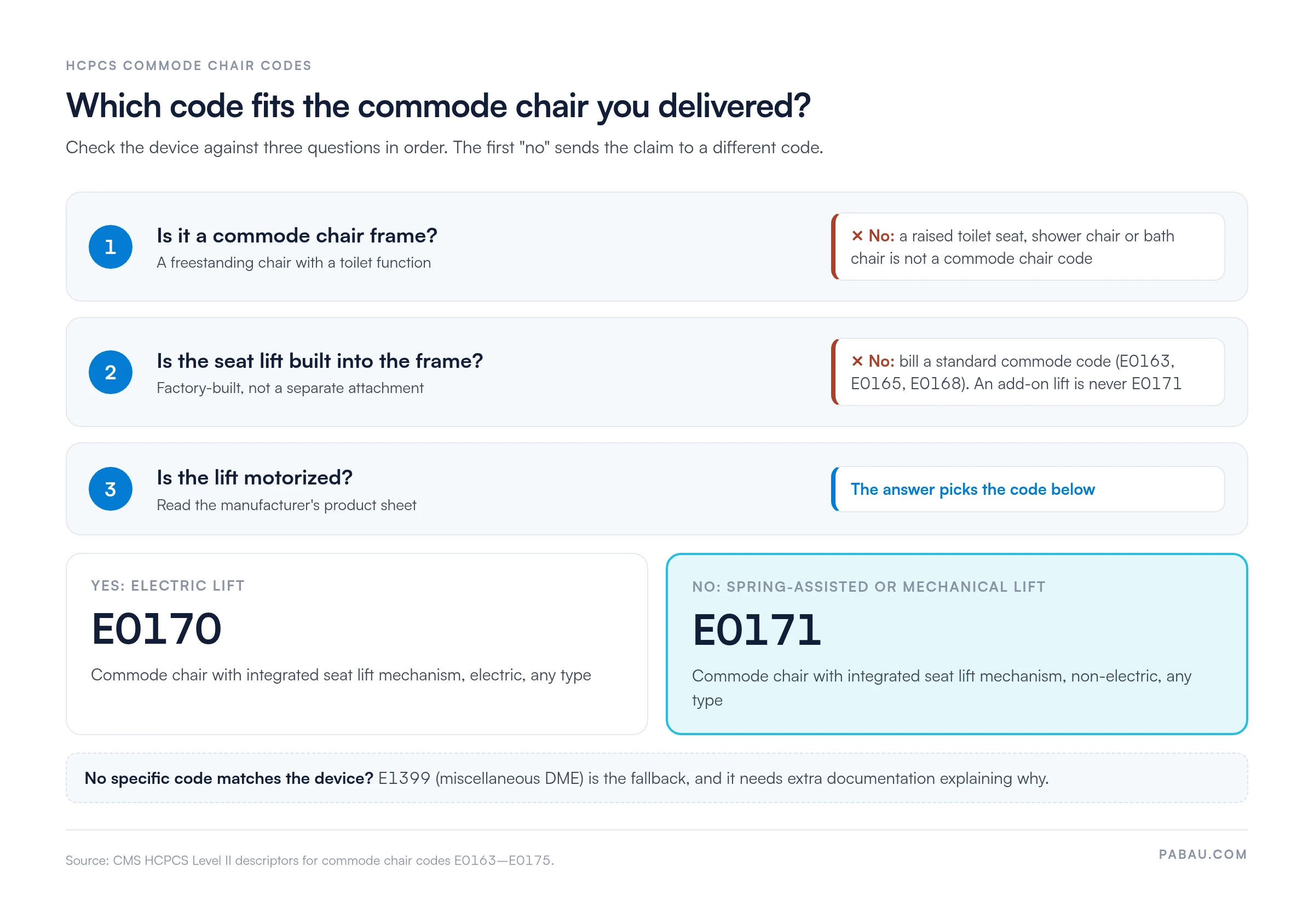
The E0163 through E0175 range covers the commode chair family under HCPCS Level II. Reviewing the adjacent codes confirms whether E0171 is correct or whether a simpler commode code applies.
If an E0171 claim is denied because the product does not match the descriptor, E1399 is the miscellaneous fallback code. It needs extra documentation explaining why no specific code applies, and it may pay a different rate. Search the full AAPC HCPCS code range to verify adjacent codes before defaulting to E1399.
Check the PDAC product classification list before delivering any commode with an integrated lift. A PDAC-verified product code letter is your strongest defense in a post-payment audit. It is far easier to get before delivery than after a denial.
Medicare Part B may cover HCPCS code E0171 as DME when the patient meets the medical necessity criteria in CMS Policy Article A52461 (Commodes). Coverage is not automatic. Each claim needs documentation linking the patient’s diagnosis to a functional limitation that makes the equipment medically necessary.
Diagnoses that commonly support E0171 coverage include:
The diagnosis alone is not enough. The record must connect it to the specific functional limitation the seat lift addresses.
State Medicaid programs and commercial payers often mirror the medical necessity language in A52461, but their policies vary. Verify coverage with the payer before delivery. This matters most for Medicaid beneficiaries, because prior authorization rules and covered item lists differ by state.
Inadequate documentation drives a large share of E0171 denials. A complete package, assembled before delivery, is the most reliable way to protect the claim. Medical billing documentation works differently for DME than for physician billing. The supplier is responsible for the complete package when an audit comes.
Keep every document in the patient’s DME file for at least seven years. Once you track these requirements across many patients, a structured claims workflow keeps each file complete before a payer audit.
Traditional Medicare fee-for-service does not typically require prior authorization for E0171, but the integrated seat lift can draw extra scrutiny. CMS keeps a Required Prior Authorization List for certain DMEPOS items. Check the current list to confirm whether E0171 is on it.
When a payer requires it, follow its prior authorization process before you schedule delivery. Send the physician order, code E0171 with a device description, and the supporting clinical notes. Record the authorization number on the claim.
Billing HCPCS code E0171 follows seven steps, and a skipped step is a common route to denial. The goal at each stage is submitting a clean claim on the first pass. Corrected claims add admin work and delay payment.
Check the current allowable for E0171 on the DMEPOS fee schedule before delivery. Rates vary by state and change every year.
Most E0171 denials are preventable. The denial management process starts with the root cause, before any corrected claim goes out. The table below maps the most frequent denial codes to their cause and fix.
A reference guide to medical billing denial codes help billing staff read remittance advice and prioritize appeals. For E0171, two denials deserve the most attention: the E0170/E0171 code mix-up and the CO-50 medical necessity denial.
Flag any E0171 claim for internal review when the physician order does not explicitly state the patient’s inability to rise from a standard toilet. ‘Mobility limitation’ or ‘balance impairment’ alone may not satisfy the LCD’s functional limitation requirement. The record needs the specific functional deficit tied to this equipment.
Medicare Part B pays for E0171 under the DMEPOS fee schedule, which CMS updates each January. The allowable varies by state, so two suppliers in different states can receive different rates. Check the current figure on the CMS DMEPOS fee schedule rather than relying on last year’s data.
Confirm whether E0171 is paid as a purchase or a rental in your jurisdiction before you bill. In Competitive Bidding Areas that include E0171, only contract suppliers may bill Medicare, and the bid sets the rate.
A superbill for DME claims lists the HCPCS code, modifier, diagnosis code and proof-of-delivery reference. It helps you reconcile what you collected against what the fee schedule allowed.
For programmatic lookups, the NLM HCPCS Level II API is a free, CMS-sourced reference. Use it to build internal coding tools or check descriptors against the official text.
Many DME billing teams track the written order, CMN status and proof of delivery across inboxes, paper files and the billing system. When one document goes missing, the denial arrives weeks after the chair was delivered.
Pabau, the claims management software we build, tracks those documentation requirements against each claim. It flags incomplete records before submission, so your team can chase a missing signature before the payer does.
Once claims go out, Pabau monitors reimbursement against the expected allowable. That makes an underpaid E0171 claim easier to spot and appeal.

Pabau helps healthcare practices track documentation requirements, manage claims submissions, and keep patient records audit-ready. See how it works for your practice.

E0171 claims rarely fail on the code itself. They fail when the physician order doesn’t tie the diagnosis to the patient’s inability to rise from a standard toilet.
So settle two questions before the chair leaves the warehouse. Does the product sheet confirm a non-electric, integrated lift? Does the file hold the order, CMN status, proof of delivery and support for the KX modifier? With both answered, E0171 becomes a routine claim.
Book a demo to see how Pabau keeps each E0171 claim file complete before it reaches the payer.

Delivering a commode without a seat lift? HCPCS code E0163 explains the standard commode chair code with fixed arms.
HCPCS code E0171 is a Level II DME billing code for a commode chair with an integrated non-electric seat lift mechanism. DMEPOS suppliers use it to bill Medicare Part B, Medicaid and commercial payers. The patient needs a documented functional limitation.
E0170 covers a commode chair with an electric integrated seat lift, while E0171 covers one with a non-electric (spring or mechanical) integrated seat lift. Billing the wrong code for the delivered device is a leading cause of CO-4 and descriptor-mismatch denials.
Yes, Medicare Part B may cover HCPCS code E0171 as durable medical equipment. The record must document a functional limitation that prevents use of a standard toilet, and a treating physician’s written order must be on file. The supplier must also be enrolled with Medicare. CMS Policy Article A52461 governs coverage.
You need a signed written order from a physician, NP or PA, plus a Certificate of Medical Necessity if the LCD requires one. Add medical record notes on the functional limitation, signed proof of delivery, and a supplier attestation that the item matches the billed code.
The most common reasons are CO-50 (medical necessity not established), M60 (missing CMN), and CO-4 (wrong modifier or an E0170/E0171 mix-up). CO-97 applies when the seat lift is billed as a separate accessory instead of as part of E0171.
Traditional Medicare fee-for-service does not typically require prior authorization for E0171, but Medicare Advantage plans, commercial payers and state Medicaid programs often do. Verify the prior auth rules with the specific payer before delivering the equipment.
The allowable varies by state, and CMS updates it every January. Under standard Medicare Part B, Medicare pays 80% of the fee schedule allowable and the beneficiary owes 20% co-insurance after the deductible. Check the current rate on the CMS DMEPOS fee schedule.
No. E0171 covers the complete commode chair with integrated seat lift as a single unit. Billing a separate commode code alongside E0171 for the same patient on the same date triggers a CO-97 bundling denial. Accessories such as replacement pails (E0167) may be billed separately on later dates. The lift mechanism must never be unbundled from the chair.