CPT Code 69610: Tympanic membrane patch repair (myringoplasty)
CPT code 69610: official descriptor and procedure overview CPT code 69610 descri...

Last Updated: Oct 19, 2026
Billable Code
77078 is the CPT code for computed tomography, bone mineral density study, 1 or more sites, axial skeleton (eg, hips, pelvis, spine). It reports quantitative CT (QCT) of the hips, pelvis, or spine, the same sites that 77080 covers with DXA.
The modality named in the radiology report decides between the two codes. Medicare covers 77078 under NCD 150.3 once every 23 months, and CMS Article A57132 lists the ICD-10-CM codes that support it. Add modifier TC or 26 when the scan and the interpretation are billed separately.
Let Pabau's smart automation suggest the right codes, reduce claim denials, and keep your practice compliant—effortlessly.
Automate repetitive tasks and focus on what matters most—your patients.
Reduce coding errors and ensure compliance with the latest regulations.
Clean claims, fewer denials, and faster reimbursements.
Powerful insights and reporting to help your practice thrive.
HIPAA compliant SOC 2 certified GDPR-compliant Trusted by 4,000+ clinics worldwide

CPT code 77078 is axial quantitative CT (QCT) of the hips, pelvis, or spine. The same sites scanned by DXA are billed under 77080.
Medicare covers 77078 once every 23 months for qualifying patients under NCD 150.3, and CMS Article A57132 lists the diagnoses that support it.
Add modifier TC or 26 when separate entities perform the scan and the interpretation. Billing globally without doing both is a compliance risk.
Pabau’s claims software runs automated validation checks and real-time eligibility checks through Claim.MD before a 77078 claim is sent.
CPT code 77078 is the American Medical Association’s code for a computed tomography bone mineral density study of the axial skeleton. It covers one or more sites, such as the hips, pelvis, or spine. The study uses quantitative computed tomography (QCT), which measures volumetric bone density from CT images.
CPT 77080 covers the same axial sites with dual-energy X-ray absorptiometry (DXA) instead. The two codes differ by modality, not by body region, so the equipment named in the radiology report decides which one you bill.
The American Medical Association’s CPT code set maintains 77078 within the Radiology section. Because the AMA revises descriptors periodically, always verify the current year’s codebook before submitting a claim.
CPT 77078 and CPT 77080 measure bone mineral density at the same axial sites: The hips, pelvis, and spine. The modality is what separates them. CPT 77078 is billed for quantitative CT, while 77080 is billed for DXA. Coders who choose between them by body region will get it wrong, because the region is identical under both codes.
The deciding factor is the equipment documented in the radiology report. If the report names DXA at the hip, pelvis, or spine, bill 77080. If it names QCT at those axial sites, bill CPT code 77078. Re-submitting with the corrected code after a denial requires a corrected claim, not just a reopening request.
Peripheral studies follow a different path. A DXA study of the wrist or heel is billed under 77081. A hand and wrist film read for skeletal maturity rather than density is a bone age study, billed under CPT 77072.
Peripheral QCT has had no dedicated CPT code since 77079 was deleted on January 1, 2012, so confirm payer guidance before scheduling one. The matrix below maps each modality and site to its code.
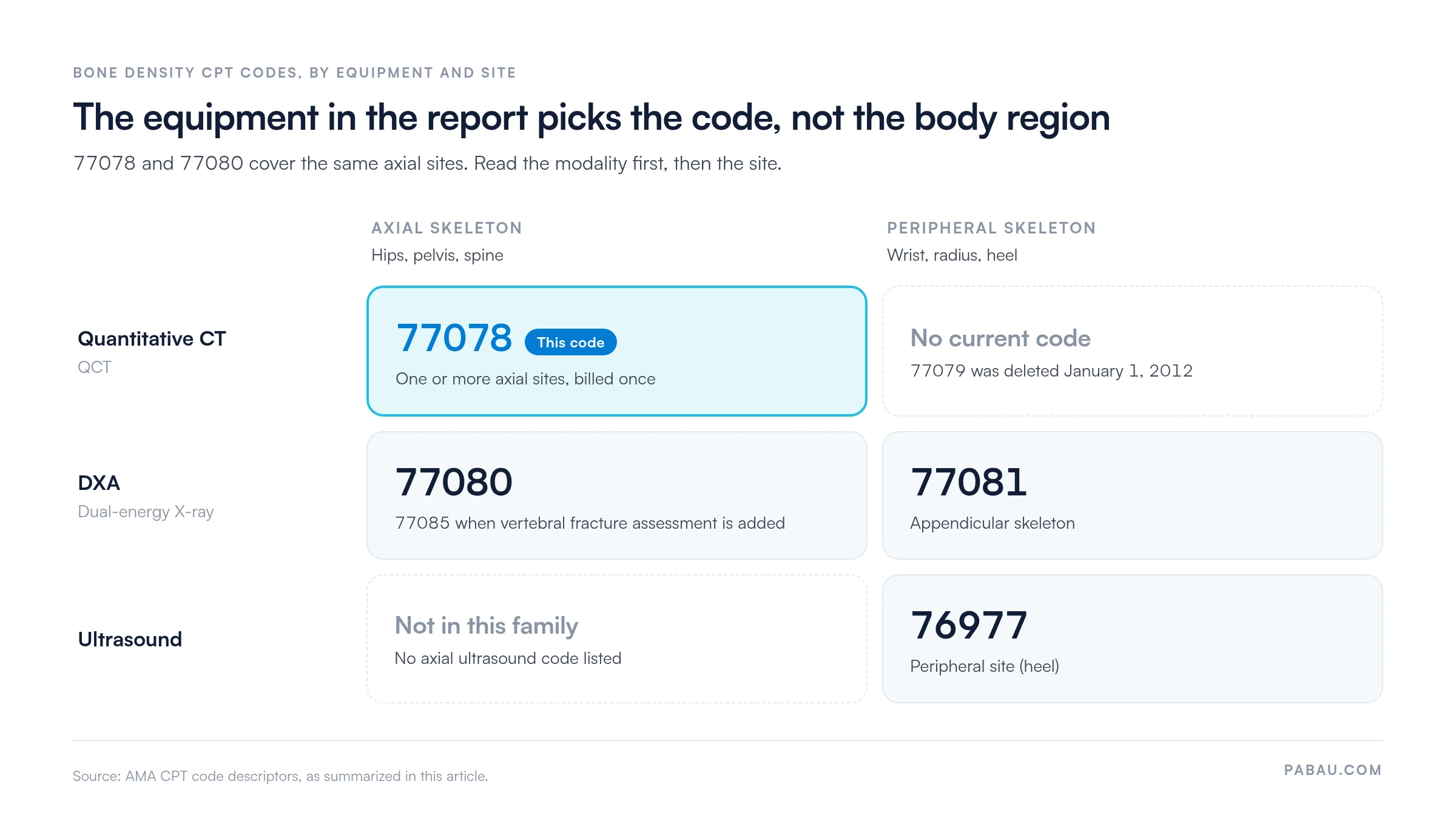
Several CPT codes cover bone density studies. The table below helps coders select the correct code based on equipment and anatomical site.
Medicare covers CPT code 77078 under National Coverage Determination (NCD) 150.3. CMS Billing and Coding Article A57132 sets out the coding rules that go with it. Coverage applies to qualifying patients in specific clinical categories, with a frequency limit of once every 23 months. Billing beyond this frequency without a documented exception generates an automatic denial.
The qualifying patient categories in the Medicare coverage rules are:
The ordering provider must document the qualifying condition in the medical record before the scan date. A physician order without a documented clinical indication does not meet the coverage rules for this code.
Medicare denies CPT code 77078 as not medically necessary when the ICD-10-CM code on the claim is not one that CMS Article A57132 lists. The table below shows the accepted pairings and which codes carry higher denial risk.
Review the CMS ICD-10-CM code files and the current version of CMS Article A57132 to confirm the complete accepted list before submitting. The article is updated periodically, and codes that were acceptable in prior years may have been removed.
Modifier selection on CPT code 77078 depends on which entity owns the scanner and which entity provides the physician interpretation. Billing global (no modifier) when only one component was performed by your organization is a compliance violation.
Before billing CPT code 77078 globally, confirm in writing that your organization owns (or has exclusive use of) the scanner. Then confirm that the interpreting physician is employed by or contracted exclusively with the same billing entity. A misapplied global modifier on a split-component procedure is an overpayment that Medicare will recoup on audit.
Every 77078 claim must be supported by a specific set of clinical documentation. Missing any element is grounds for denial or post-payment audit. Confirm that every item below is present before the claim leaves your system.
In a superbill workflow, the superbill should carry the ICD-10 code, the CPT code, the modifier, and the physician order date. Missing the order date is a frequent audit finding on radiology procedure codes.
Medicare Physician Fee Schedule (MPFS) rates for CPT code 77078 vary by locality, site of service (facility vs. non-facility), and the components billed. The table below shows how the rate is built. Always verify current rates for your MAC jurisdiction and year using the CMS Physician Fee Schedule lookup tool. Rates are updated each January 1.
For precise 2025 and 2026 figures by locality, use the FastRVU RVU lookup tool, which pulls directly from published CMS data. Commercial payer rates are negotiated separately and typically exceed Medicare rates, though they vary significantly by contract and region. Review your electronic remittance advice (ERA) after each claim batch to track the allowed amount each payer pays.
Medicare generally does not require prior authorization for CPT code 77078 when the qualifying criteria under NCD 150.3 are documented. The claim should process on medical necessity alone, supported by the correct ICD-10-CM pairing. Confirm with your MAC (for example, Palmetto GBA for JM jurisdiction) whether any additional payer-specific rules apply in your region.
UnitedHealth, Cigna, Aetna, and many BCBS plans require prior authorization for bone density studies. Requirements vary by plan and year. Before scheduling the procedure, verify the patient’s insurance eligibility and check the specific plan’s prior authorization list. Document the authorization number in the patient chart and on the claim before submission.
CPT code 77078 has a predictable denial profile. The table below maps each denial category to its resolution path, including relevant denial codes in medical billing and correction steps. Reference your remittance advice remark codes (RARC) alongside this table to identify the exact denial category.
Effective denial management on 77078 requires a denial log that tracks CARC and RARC codes per claim. A recurring pattern, such as the same root cause on 10 or more claims in a quarter, signals a workflow issue. It needs a process correction, not just individual appeals.
Each denial in the table above can be caught before the claim is sent. Without a check at that stage, the billing team finds the error weeks later, working back from a remittance code to the radiology report.
Pabau’s pre-submission claims management runs validation checks in the background each time a claim is sent. Those checks confirm that the details insurers need, such as membership numbers and authorization codes, are in place.
In the US, Pabau connects to the Claim.MD clearinghouse, which sends CMS-1500 claims to thousands of US payers. Real-time eligibility checks confirm the patient’s coverage and benefits before the scan is performed.

Once the claim is out, its status updates in the Claims dashboard as the payer processes it. ERA remittances post back against the claims they settle. Denied claims are flagged for rework, so the billing team sees a 77078 denial as soon as the payer returns it.

Pabau runs automated validation checks on every claim and real-time eligibility checks through its Claim.MD integration. Your 77078 claims reach the payer with the details insurers ask for already in place.

Billing CPT code 77078 starts with one check. The radiology report has to name QCT and an axial site, meaning the hip, pelvis, or spine, or the claim belongs under a different code.
Get that right at the point of order, then confirm the diagnosis against CMS Article A57132 and check the 23-month window. Each check takes a minute before submission, while an appeal takes weeks after it.
Pabau’s claim validation and real-time eligibility checks handle the payer-side details, so your coders can focus on modality and diagnosis. Book a demo to see how Pabau keeps bone density claims moving from submission to remittance.

Need a clearinghouse built for US payers? What a medical claims clearinghouse does explains how scrubbing, 835 remittances, and payer routing work before a claim reaches adjudication.
Trying to understand 837 file submissions? 837 electronic claim file guide walks through the HIPAA transaction set used to submit claims electronically to Medicare and commercial payers.
Want more claims paid on the first pass? What is a clean claim in medical billing? covers the fields and checks a claim needs before the payer will accept it.
Seeing the same 77078 denial twice? Denial management in healthcare sets out a process for logging, appealing, and preventing repeat denials.
Adding payers to your bone density billing? Getting credentialed with insurance companies covers the enrollment steps that decide which payers will process your claims.
CPT code 77078 covers a quantitative CT (QCT) bone mineral density study of one or more axial sites, such as the hips, pelvis, or spine. It is used to evaluate bone loss in patients at risk for osteoporosis or fracture. The code does not cover peripheral sites like the wrist or heel. It includes both the scan acquisition and the physician interpretation when billed globally.
CPT 77078 and 77080 cover the same axial sites, the hips, pelvis, and spine, but use different equipment. CPT 77078 is billed for quantitative CT (QCT), and 77080 is billed for dual-energy X-ray absorptiometry (DXA). Let the modality named in the radiology report decide the code. A peripheral DXA study of the wrist or heel is billed under 77081.
Yes, Medicare covers CPT code 77078 under NCD 150.3 for qualifying patients, with coding rules in CMS Article A57132. They include women 65 and older, men 70 and older, and others with documented risk factors for osteoporosis. Coverage is limited to once every 23 months. The qualifying condition must be documented in the chart before the scan date.
Medicare generally does not require prior authorization for CPT 77078 when the NCD 150.3 coverage criteria are met. Many commercial payers, including UnitedHealth, Cigna, Aetna, and BCBS plans, do require prior authorization. Check the specific payer’s requirements before scheduling the procedure, not after.
Medicare reimbursement for CPT code 77078 varies by locality, MAC jurisdiction, and the component billed (global, TC only, or professional component only). Verify current 2026 rates through the CMS Physician Fee Schedule lookup tool using your specific geographic practice cost index. Rates are updated each January 1 with the MPFS final rule.
A 77078 claim is denied when it falls inside the 23-month window or pairs an ICD-10 code that CMS Article A57132 does not list. Other triggers are the wrong modifier, billing global when only one component was performed, and billing 77078 for a DXA study that belongs under 77080. Review the CARC and RARC codes on the remittance advice to identify the specific denial category.