



CCSD code G5100: Bypass of duodenum billing guide
CCSD code G5100 bills a bypass that leaves the duodenum in place CCSD code G5100...

Last Updated: Oct 16, 2026

CPT code 99345 reports a home or residence E/M visit for a new patient presenting with an unstable condition or significant new problem requiring approximately 75 minutes of total time.
The visit must occur in the patient’s private residence (Place of Service 12); assisted living, rest homes, and intermediate care facilities do not qualify.
Documentation must support high medical decision making per the 2023 AMA E/M guidelines; some payers may accept moderate complexity, so always verify with the specific payer.
Pabau’s claims management software helps home visit practices track POS codes, flag documentation gaps, and submit cleaner claims with fewer denials.
CPT code 99345 is the highest-level evaluation and management code for a new patient home or residence visit, reported when the patient has an unstable condition or significant new problem requiring high medical decision making or roughly 75 minutes of total time, billed with Place of Service 12.
Home visit billing is one of the most audit-prone areas in outpatient E/M coding. Selecting the wrong complexity level, listing the wrong Place of Service, or missing a time threshold can trigger a Recovery Audit Contractor review before the claim is even processed.
CPT code 99345 sits at the top of the new patient home visit series. It applies to the most complex encounters: an unstable patient or a significant new problem that demands immediate attention, with total visit time of approximately 75 minutes. This guide covers the official descriptor, documentation requirements, MDM level, place of service rules, Medicare reimbursement rates, the full 99341-99350 code family, the G0318 prolonged services add-on, and the common billing errors that lead to claim denial. The 1500 claim form and its electronic equivalent ask for the same data in a different layout.
The American Medical Association (AMA) maintains the official descriptor for CPT code 99345 as: Home or residence visit for the evaluation and management of a new patient, which requires a medically appropriate history and/or examination and high level of medical decision making.
This places 99345 firmly within the post-2023 E/M framework, where time or medical decision making (MDM) anchors the level selection. A “new patient” is one who has not received any face-to-face professional service from the same physician, or from another physician of the same specialty in the same group practice.
Practices offering house call services, geriatric home care, or concierge primary care rely on this code for their highest-acuity new patient encounters. It also appears in coaching CPT codes discussions and specialty settings where clinicians travel to the patient rather than conducting a standard new patient office visit.
The 99341-99345 series scales by patient complexity and time. 99345 is the ceiling. Use it only when the clinical picture genuinely justifies high MDM or when total time reaches approximately 75 minutes.
Upcoding to 99345 when the encounter qualifies for 99344 is a RAC audit trigger. Documentation must clearly support the selected level.
Under the 2023 AMA E/M revisions, clinicians choose either MDM or total time to determine the visit level. 99345 requires high MDM or approximately 75 minutes of total time on the date of service. Both pathways are valid, but the documentation must support whichever the clinician selects.
High MDM means the encounter involves at least two of the following three elements at the “high” threshold:
Some payers, including certain commercial carriers, describe 99345 using “moderate complexity” language. CMS guidance and the AMA descriptor align on high MDM. Always verify with the specific payer before submitting.
When billing by time, the 75-minute threshold applies to total time on the date of the encounter. This includes face-to-face time with the patient or family, plus time spent on tasks such as reviewing records, ordering tests, documenting notes, and care coordination.
Travel time to and from the patient’s home does not count. Only activities performed on the date of service and directly related to the encounter are included.
Document the start and end times of the encounter and list the specific activities that contributed to total time. A note that simply says ’75 minutes’ without specifying what was done invites denial on audit.
CPT code 99345 must be reported with Place of Service (POS) code 12, which designates the patient’s private residence. According to Noridian Medicare, home visit codes 99341-99350 may only be billed when services are provided in the beneficiary’s private residence. This is one of the most commonly misapplied rules in home visit billing.
The following settings do not qualify as POS 12 for CPT 99345:
These settings have their own dedicated E/M code series. Billing 99345 for a patient in an assisted living facility will result in claim denial and, if repeated, potential recoupment. The CMS Recovery Audit Contractor program has specifically flagged home visit codes billed for hospital inpatients as an approved audit topic. The same logic applies to any non-residential setting.
Practices that use claims management software can configure POS code validation rules to catch mismatches before a claim leaves the system.
Office visits dominate primary care revenue, so primary care software that speeds up visit documentation pays for itself.
Poor documentation is the primary reason auditors downcode or deny 99345 claims on audit. The note must do two things: establish that the patient is genuinely new to the practice, and support the level of MDM (or total time) selected.
Confirm and document that no face-to-face encounter occurred with the billing physician, or any physician of the same specialty in the same group, within the prior three years. A brief statement in the note serves this purpose. Cross-referencing your EHR for prior encounter dates protects against inadvertent misclassification.
If billing by MDM, the note must address all three MDM domains at the appropriate level. Vague language such as “complex patient” or “extensive review performed” does not meet the standard.
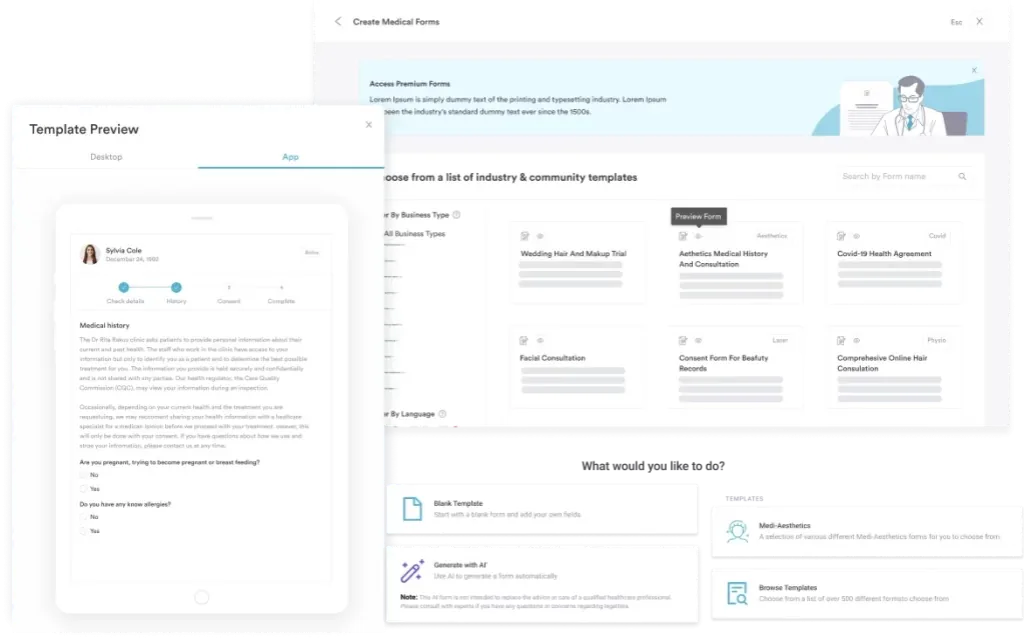
Using digital forms with structured MDM prompts can help clinicians capture each documentation element consistently across every home visit, reducing the risk of missing a required field.
If billing by time, the note must record the total time spent on the encounter date and include a list of the activities that contributed to that time. Examples: reviewing prior records (15 minutes), face-to-face examination and history (35 minutes), ordering labs and documenting the note (25 minutes). The activities must be clinically appropriate and directly related to managing the patient’s condition.
Practices managing high volumes of home visit patients benefit from structured billing workflows that prompt time documentation before a note is closed, preventing the common situation where total time is reconstructed after the fact.

Pabau’s claims management and digital documentation tools help house call practices capture the right POS codes, MDM documentation, and time records before claims go out the door.

Medicare reimbursement for 99345 is set annually through the Medicare Physician Fee Schedule (MPFS). Rates vary by geographic locality and conversion factor updates adjust them each calendar year. Always verify the current-year rate using the CMS Physician Fee Schedule Look-Up Tool or a real-time RVU calculator.
As a general guide, 99345 typically carries work RVU values in the 3.00-3.50 range, reflecting the complexity and time demands of a high-acuity new patient home visit. Use FastRVU’s 2026 RVU lookup to retrieve current work, practice expense, and malpractice RVUs alongside the locality-adjusted payment amount for your specific area.
For practices billing GP clinic services or primary care house calls under Medicare Part B, note that the MPFS also applies distinct facility vs. non-facility rates. For home visits (POS 12, a non-facility setting), the non-facility rate applies and is typically higher than the facility rate, reflecting the overhead of delivering care outside a clinic environment.
| Code | Patient Type | Time (approx.) | MDM Level | RVU Range (Work) |
|---|---|---|---|---|
| 99341 | New | 20 min | Straightforward | 0.70-0.90 |
| 99342 | New | 30 min | Low | 1.20-1.40 |
| 99343 | New | 45 min | Moderate | 1.80-2.20 |
| 99344 | New | 60 min | Moderate | 2.30-2.80 |
| 99345 | New | 75 min | High | 3.00-3.50 |
Note: RVU ranges are approximate. Verify current-year values via CMS MPFS Look-Up Tool. Dollar reimbursement depends on geographic locality and annual conversion factor.
When a home visit genuinely requires more time than the 75-minute base, Medicare provides a prolonged services add-on code. HCPCS code G0318 may be reported alongside 99345 when total time on the date of service reaches 140 minutes or more.
This threshold matters. You cannot add G0318 simply because the encounter ran long. The billing requirements are:
The American Academy of Family Physicians published guidance confirming the 140-minute threshold for G0318 with 99345. Clinicians managing high-complexity homebound patients, such as those with dementia, terminal illness, or multiple chronic conditions in exacerbation, are the most likely users of this add-on code. Use the AAPC Codify reference to confirm current code descriptions and any NCCI edits that may apply.
Practices managing home visit programs for patients with complex behavioral health or ADHD screening needs often encounter prolonged encounters and benefit from systematic time-tracking workflows.
G0318 cannot be billed for the same date as CPT 99417 (the non-Medicare prolonged services add-on). Medicare requires G0318; commercial payers typically use 99417. Check the payer-specific policy before adding a prolonged services code to any 99345 claim.
Home visit billing generates disproportionate claim errors because the encounter setting creates documentation challenges that office-based visits do not. These are the most frequent problems with 99345 claims.
Submitting 99345 with POS 11 (office) or POS 99 (other) instead of POS 12 is the most common mechanical error. It results in immediate denial. The fix is straightforward: confirm POS 12 is mapped to every home visit encounter type in your billing system before submission. Clinicians using a HIPAA compliance checklist for primary care often include POS code verification as a standard step.
CMS has approved this as an active RAC audit topic. If a patient is admitted to a hospital and a home visit code is submitted on the same date, the payer will flag the claim. Cross-referencing the patient’s admission status against the visit date is a mandatory pre-submission check.
Auditors reviewing 99345 claims look for specificity in all three MDM domains. Generic phrases do not pass. The note must name the condition, describe its acuity, list the data reviewed, and explain the reasoning behind treatment decisions. Practices using a structured clinical notes workflow see fewer downcodes on audit because every required field appears as a prompt at the point of documentation.
If a patient saw any physician in the same specialty group within the past three years, they are established, not new, and an equivalent in-office encounter would instead be reported as an established patient office visit rather than a new patient code. Billing 99345 (new patient) when 99350 (established patient, high MDM) applies results in overpayment and potential fraud exposure. The EHR’s encounter history should be checked before the new patient designation is applied.
Every CPT code requires a supporting ICD-10 diagnosis code that establishes medical necessity. For a 99345 claim, the diagnosis must reflect a condition of sufficient acuity to justify a high-MDM home visit. A diagnosis of “routine checkup” (Z00.00) alongside 99345 will not survive audit. Document the specific presenting condition and use the most specific ICD-10 code available.
Practices managing home visit programs for patients with complex needs often run the same clinical workflows used in direct primary care EHR settings, where documentation depth and billing accuracy are tightly linked.
Managing CPT 99345 claims across a home visit practice introduces workflow complexity that office-based billing does not. Clinicians are away from the clinic, often documenting on mobile devices, and the billing team must reconcile POS codes, MDM evidence, and time records across multiple encounter types.
A well-configured practice management software solution handles three areas that directly affect 99345 accuracy:
Pabau’s automated billing workflows and claims management tools are designed to reduce the administrative burden of exactly this type of complex multi-step billing. Built-in compliance prompts and real-time claim validation help home visit practices submit cleaner claims and reduce the time spent on rework.
For practices integrating home visit billing with broader clinical operations, Pabau’s HIPAA-compliant medical office workflows ensure Pabau handles patient data collected during home encounters securely from point of documentation through to billing submission.
CPT code 99345 is the highest-complexity new patient home visit code, but it’s also one of the most frequently miscoded. The combination of strict POS rules, high MDM documentation requirements, and the specific time threshold for G0318 creates multiple audit exposure points for home visit practices.
Pabau’s claims management software helps practices build the verification checkpoints, documentation templates, and pre-submission scrubbing rules that keep 99345 claims compliant from the first encounter note through to final adjudication. To see how Pabau supports home visit billing workflows, book a demo.

Billing a neurostimulator receiver-transmitter? Neurostimulator receiver billing guide covers C1816 and how to avoid confusing the receiver unit with the generator or lead codes.
Billing a rechargeable neurostimulator generator? Rechargeable neurostimulator billing guide covers C1820 and the outpatient and surgical-center settings where the code is billed.
Billing a cardiac contractility modulation device? Cardiac contractility modulation billing guide covers C1824, the CMS-maintained C-code for this implantable cardiac contractility generator.
CPT code 99345 is an evaluation and management code for a home or residence visit with a new patient who has an unstable condition or significant new problem requiring approximately 75 minutes of total time and high medical decision making. It is the highest-level code in the new patient home visit series (99341-99345).
CPT 99345 requires approximately 75 minutes of total time on the date of service, including both face-to-face time with the patient and time spent on related activities such as reviewing records, documenting notes, and care coordination. Travel time does not count.
CPT 99345 must be reported with Place of Service 12, which designates the patient’s private residence. Assisted living facilities, rest homes, intermediate care facilities, and temporary lodging do not qualify and have separate dedicated code series.
Yes. For Medicare patients, HCPCS code G0318 can be added to 99345 when total time on the date of service reaches 140 minutes or more. Commercial payers may use CPT 99417 instead of G0318; always verify payer-specific policy before adding a prolonged services code.
CPT codes 99341-99345 are all new patient home visit codes that increase in time and complexity: 99341 (20 min, straightforward MDM), 99342 (30 min, low MDM), 99343 (45 min, moderate MDM), 99344 (60 min, moderate MDM), and 99345 (75 min, high MDM). Only 99345 applies to unstable patients or those with a significant new problem requiring immediate attention.
Documentation must confirm the patient is new (no face-to-face encounter with the same physician or same-specialty group within 3 years) and must support high MDM across all three domains: problem complexity, data reviewed, and risk of treatment decisions. If billing by time, the note must record total minutes and list specific activities performed on the date of service.



