



HCPCS code E0198: Water pressure pad billing guide
HCPCS code E0198 is a water pad for a standard mattress HCPCS code E0198 is the ...

Last Updated: Oct 13, 2026

CPT Code 99203 is an E/M code for new patient office visits of 30-44 minutes requiring low-complexity medical decision making (MDM) or total time as the billing basis.
Under 2021 AMA guidelines, you choose either MDM complexity or total time to justify the level – detailed history and examination are no longer required components.
Upcoding 99203 to 99204 without documented moderate-complexity MDM is a top OIG audit trigger; every encounter must be coded to what is actually documented.
Pabau’s claims management software flags underdocumented E/M visits before submission, reducing denial rates on 99203 and adjacent new patient codes.
CPT Code 99203 is an evaluation and management (E/M) code for office or other outpatient visits with a new patient. According to the American Medical Association’s CPT code set, 99203 applies when the encounter involves a medically appropriate history and/or examination and either low-complexity medical decision making (MDM) or a total time of 30-44 minutes on the date of the encounter.
The shift matters. Before 2021, billing 99203 required a detailed history, a detailed examination, and low-complexity MDM – three separate documentation elements. Under current AMA guidelines, history and examination are still performed when clinically appropriate, but they no longer drive the code selection.
You choose either MDM or time. Whichever method you apply, you must document the basis for that selection in the encounter note.
The official CPT code 99203 description reads: office or other outpatient visit for the evaluation and management of a new patient, requiring a medically appropriate history and/or examination and low-complexity medical decision making. That definition sets the billing basis, but the table below breaks the descriptor into the elements a coder actually checks before assigning the code.
| Element | CPT 99203 requirement |
|---|---|
| Patient type | New patient (no face-to-face visit with provider or same-group provider in past 3 years) |
| Setting | Office or other outpatient |
| MDM-based billing | Low-complexity medical decision making |
| Time-based billing | 30-44 minutes total time on date of encounter |
| History/exam | Medically appropriate (no longer code-defining) |
| Code family | Office/outpatient new patient (99202-99205) |
Practices that rely on physical therapy EMR documentation for new patient E/M coding frequently use 99203 for initial evaluations where the clinical picture is straightforward but requires genuine professional judgment. The same pattern appears across primary care, chiropractic, behavioral health, and occupational therapy settings.
Explore the full new patient code family via the AAPC Codify CPT lookup to confirm current descriptors and any payer-specific notes for your specialty.
MDM is the method most practices use to justify CPT Code 99203, and low complexity has a specific definition under the 2021 AMA E/M guidelines. Getting it wrong in either direction creates audit risk.
The AMA defines MDM across three components. For low complexity, the encounter must satisfy at least two of the following three elements:
A new patient presenting with mild, well-controlled asthma and requesting a refill of an existing inhaler fits low-complexity MDM. A new patient with the same condition who has had two recent exacerbation-related ER visits does not – that encounter warrants at minimum moderate-complexity MDM, which maps to 99204.
The single most frequent error is listing a problem in the assessment without documenting the clinical reasoning that supports the MDM level. Noting “HTN, stable” tells a payer the problem exists. It does not demonstrate that you evaluated the stability, reviewed relevant data, or made a treatment decision at any particular complexity level.
Effective MDM documentation names the problem, states the basis for complexity assignment, describes what data was reviewed, and specifies the management decision reached. For a 99203 encounter, this does not need to be lengthy – but it must be present and tied to the correct elements. Well-structured digital medical forms that capture these elements at the point of care reduce the documentation burden significantly. First-pass rate measures how often a claim is paid without anyone touching it again. An appeal filed after the timely filing window is denied on timeliness alone, whatever the coding showed.
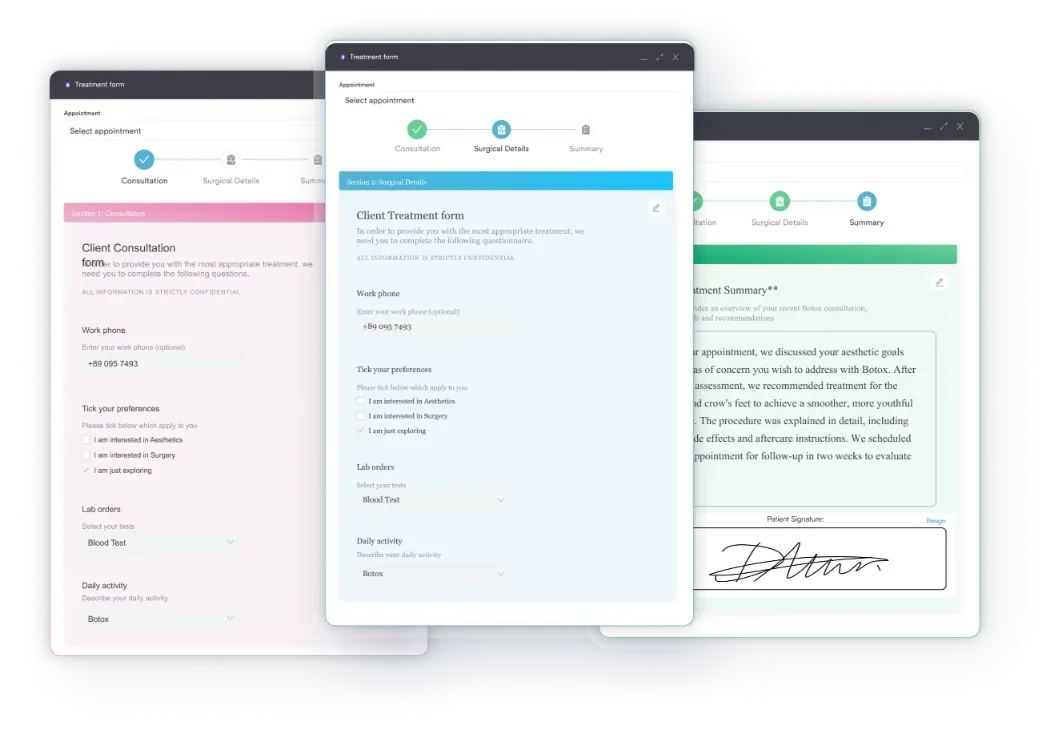
Pabau’s digital intake forms and structured clinical documentation tools capture the problem list, data reviewed, and management plan in a structured format – giving billing teams the fields they need to confirm E/M level before claim submission.
The CPT 99203 time requirement is 30 to 44 minutes of total time on the date of the encounter. Since 2021, “total time” for outpatient E/M includes all time the clinician spends on that date, not just face-to-face time. This is a significant change from pre-2021 rules.
Total time includes:
To bill CPT Code 99203 on a time basis, the total time on that calendar date must fall between 30 and 44 minutes. If total time reaches 45 minutes, the encounter qualifies for 99204 on time alone. If it falls below 30 minutes, 99202 is the appropriate code.
Document total time explicitly: “Total time spent on this encounter today: 32 minutes.” Without a documented time statement, payers treating your claim as MDM-based will apply their own scrutiny to the complexity elements – which you may not have documented to the same standard.
This is where direct primary care EHR workflows make a measurable difference. EHR systems that timestamp documentation activities automatically build the audit trail that time-based billing requires, without adding charting time to an already busy schedule.
Document your total time in the body of every encounter note, not just in a time field that payers may not read. Write the statement explicitly: ‘Total provider time on 06/25/2026: 33 minutes, including chart review, exam, and note completion.’ This makes time-based 99203 billing virtually audit-proof.
Medicare reimbursement for CPT Code 99203 varies by geographic locality, practice setting, and the annual Physician Fee Schedule update. Rates cited here are approximate national averages – always verify current amounts using the CMS Physician Fee Schedule lookup tool for your specific locality.
| Setting | Approximate Medicare rate (national average) | Work RVU |
|---|---|---|
| Non-facility (office) | $115-$140 | 1.42 |
| Facility (hospital outpatient, ASC) | $90-$110 | 1.42 |
The work RVU for 99203 is 1.42 under the Medicare Physician Fee Schedule. Total RVU values (work + practice expense + malpractice) are multiplied by the conversion factor and the geographic practice cost index (GPCI) for your locality to produce the actual payment amount.
Commercial payer rates typically exceed Medicare by 10-40%, but vary significantly by contract. Private pay and cash-pay practices set their own fee schedules independent of the MPFS, though many use a Medicare multiplier as a starting point. For practices using claims management software, payer-specific fee schedules can be loaded directly to flag underpayments at reconciliation.
Selecting the right code from the new patient E/M family requires matching both the MDM level and total time range to the documented encounter. Here is how CPT Code 99203 sits within the full 99202-99205 range.
The CPT code 99203 vs 99204 distinction is the most commonly litigated in OIG audits. The difference is not the number of minutes or the number of problems documented – it is whether the clinical reasoning documented in the note reaches moderate complexity. A new patient with three stable, well-managed chronic conditions does not automatically reach 99204 MDM just because the list is long.
Practices using integrated practice management and EMR systems can configure templates that prompt clinicians to document the specific MDM elements at the right complexity level – reducing both undercoding and upcoding risk across the new patient code family.

Pabau’s claims management tools flag documentation gaps before submission, so your team catches 99203 undercoding and upcoding errors before they become denials or audit triggers.

Two modifiers are used with CPT Code 99203 in specific billing scenarios, and both carry high audit scrutiny.
Modifier 25 is appended to CPT Code 99203 when a separately identifiable E/M service is provided on the same day as a minor procedure (a procedure with a 0-day or 10-day global period). The E/M service must be distinct from the pre-procedure assessment – meaning the clinician addressed a condition or concern beyond what was necessary to perform the procedure.
Example: A new patient presents requesting removal of a skin lesion. During the encounter, the clinician also evaluates and manages a separate complaint of persistent fatigue and orders labs. The E/M service (fatigue evaluation) is distinct from the procedure (lesion removal). Modifier 25 is appropriate.
What is not appropriate: appending Modifier 25 to every new patient E/M simply because a procedure was also performed. If the only clinical activity was evaluation of the lesion itself followed by its removal, only the procedure code bills – the E/M is bundled. This is a leading cause of 99203 claim denials and OIG audit triggers.
Modifier 57 is appended to CPT Code 99203 when the E/M service is the visit at which the decision to perform major surgery (90-day global period) is made. This modifier is far less frequently used with 99203, since a new patient encounter that results in a major surgery decision typically reaches at least moderate-complexity MDM and would more likely support 99204 or 99205.
Teams managing billing for psychiatry EMR software platforms often encounter modifier questions around 99203 when a prescribing visit coincides with a counseling session. The NCCI bundles some of these combinations – always verify the specific procedure pair in the NCCI edits before appending a modifier.
Before appending Modifier 25 to a 99203 claim, ask this: could this E/M visit have happened without the procedure being performed? If yes, and you documented the separate clinical decision making, Modifier 25 is defensible. If the only reason the patient came in was the procedure, it is not.
The Office of Inspector General (OIG) and CMS RAC auditors flag new patient E/M codes as high-risk because they are frequently billed without adequate documentation. CPT Code 99203 has specific failure patterns that practices encounter repeatedly.
Practices that have moved toward simplified practice management workflows report fewer E/M coding errors because documentation prompts are built into the encounter flow rather than handled as a retrospective billing step. When the coder reviews the note, all required elements are already present.
Building compliance reviews into your billing cycle matters here. The claims management software workflow in Pabau flags E/M claims where the documented MDM level does not match the submitted code before they reach the payer, giving your team a chance to correct or add documentation rather than managing a denial or audit retrospectively.
CPT Code 99203 can be billed by any licensed provider authorized to perform E/M services within their scope of practice. This includes physicians (MD, DO), nurse practitioners (NPs), physician assistants (PAs), and other qualified healthcare professionals (QHPs) as defined by CMS and applicable state law.
Scope of practice varies by state and by qualification. An NP billing 99203 must be practicing within their state’s authorized scope and must meet the same MDM or time documentation standard as a physician billing the same code.
Medicare’s “incident-to” billing rules add another layer: incident-to billing requires the supervising physician to be present in the office suite, and the service must be a continuation of the physician’s treatment plan – not a first visit with a new patient. New patient encounters typically cannot be billed incident-to for this reason.
Practices offering services across multiple specialties benefit from features that save practices time by automating the provider credentialing checks that determine which provider is eligible to bill specific codes under each payer contract.
Manual E/M code selection is the root cause of most CPT 99203 billing errors. When coders work from memory or from a static fee schedule rather than from structured documentation, the result is inconsistent coding across providers and encounters.
Modern practice management software closes this gap by embedding documentation structure into the clinical workflow. Rather than asking a provider to complete a note and then asking a coder to interpret it for billing purposes, the system captures MDM elements, time, and provider decisions in structured fields that map directly to E/M level criteria.
Pabau supports compliant E/M documentation workflows through structured clinical records, configurable intake forms, and pre-submission claim review. Practices dealing with high new-patient volumes – common in EHR integration scenarios where patient data arrives from referral networks – benefit from automated checks that confirm new patient status before a claim is submitted.
For practices concerned about the audit exposure of their current 99203 billing patterns, running a coding audit against your existing claims is a practical first step. Looking at 30-90 days of new patient E/M claims, stratified by code level, by provider, and by specialty, reveals whether your code distribution matches the expected clinical mix.
CPT Code 99203 is straightforward when the documentation matches the code – but that match requires active, structured clinical documentation, not retrospective code assignment. The 2021 AMA guideline shift to MDM or total time means every provider billing 99203 needs to choose their method and document accordingly.
Pabau’s claims management software builds those documentation checks into the clinical workflow, so your team catches E/M coding discrepancies before they reach the payer. To see how Pabau handles new patient E/M workflows for your specialty, book a demo.

Billing dialysis supplies instead of visits? Dialysate solution billing guide covers dialysate solution for peritoneal dialysis, billed for bag volumes between 1,000 cc and 1,999 cc.
Need the related dialysate code too? Dialysate solution supply guide is a permanent supply code for dialysate solution, non-dextrose containing, in a 500 ml unit.
CPT Code 99203 is an evaluation and management code for new patient office or outpatient visits that require low-complexity medical decision making (MDM) or a total time of 30-44 minutes on the date of service. It is used across primary care, psychiatry, chiropractic, behavioral health, and other specialties for new patients presenting with stable chronic conditions, prescription management needs, or acute uncomplicated illness.
CPT 99203 requires low-complexity MDM (or 30-44 minutes total time), while CPT 99204 requires moderate-complexity MDM (or 45-59 minutes). The MDM distinction turns on whether the encounter involves a new problem requiring diagnostic workup, multiple chronic conditions, or prescription drug management with risk – all of which reach moderate complexity. A patient with three stable, well-managed conditions does not automatically qualify for 99204 on volume alone.
CPT 99203 is a new patient code, while 99213 is the equivalent level for an established patient (one seen by the practice or a same-specialty provider in the group within the past three years). Both can rest on low-complexity medical decision making, but the time thresholds differ – 20-29 minutes for 99213 versus 30-44 minutes for 99203 – and 99213 reimburses less because a new patient visit involves more work gathering a full history. Confirm patient status before choosing between the two code families.
Medicare pays approximately $115-$140 for CPT 99203 in a non-facility (office) setting at the national average, and approximately $90-$110 in a facility setting. Rates vary by geographic locality and the annual conversion factor update. Use the CMS Physician Fee Schedule lookup tool to find the exact rate for your locality and practice setting.
Yes, but only when a separately identifiable E/M service is performed on the same day as a minor procedure (0-day or 10-day global period). The E/M service must address a problem or concern distinct from what was required to perform the procedure, and the note must document that separate decision making. Modifier 25 cannot simply be appended whenever a procedure and an E/M occur on the same day.
Under 2021 AMA guidelines, 99203 requires either documented low-complexity MDM (covering the number/complexity of problems, data reviewed, and risk of management) or a documented total time of 30-44 minutes on the date of service. A medically appropriate history and examination should also be documented, but they no longer determine the code level. The specific MDM elements or total time statement must appear explicitly in the encounter note.
Any licensed provider authorized to perform E/M services within their scope of practice can bill CPT 99203, including physicians (MD/DO), nurse practitioners, and physician assistants. Scope-of-practice rules vary by state. New patient encounters generally cannot be billed incident-to a supervising physician, so NPs and PAs billing 99203 for new patients typically bill under their own NPI at the applicable Medicare rate (currently 85% of the physician rate for independently billing mid-level providers).



