CPT Code 31653: EBUS With 3+ Mediastinal Stations
CPT code 31653: Official descriptor and clinical scope CPT code 31653 is the pro...

Last Updated: Oct 20, 2026
99153 is the CPT add-on code for each additional 15 minutes of moderate sedation given by the same provider who performs the procedure. An independent trained observer must help monitor the patient's consciousness and physiological status.
It's reported with base code 99151 (under age 5) or 99152 (age 5 and older) and never billed alone. The base code needs at least 10 minutes. Each 99153 unit starts once the next interval passes its midpoint, at 23, 38 and 53 minutes. Different-provider sedation uses the 99155-99157 family instead.
Let Pabau's smart automation suggest the right codes, reduce claim denials, and keep your practice compliant—effortlessly.
Automate repetitive tasks and focus on what matters most—your patients.
Reduce coding errors and ensure compliance with the latest regulations.
Clean claims, fewer denials, and faster reimbursements.
Powerful insights and reporting to help your practice thrive.
HIPAA compliant SOC 2 certified GDPR-compliant Trusted by 4,000+ clinics worldwide

CPT Code 99153 is a same-provider add-on code for each additional 15 minutes of moderate sedation beyond the base code.
The base codes 99151 (under age 5) and 99152 (age 5 and older) need at least 10 minutes of intraservice time.
Each 99153 unit counts once the next interval passes its midpoint, at 23, 38 and 53 minutes.
A qualified independent observer must be documented separately from the performing provider to support any moderate sedation billing.
Practice management software like Pabau submits 99153 claims electronically through its Claim.MD integration and tracks each claim to payment.
The American Medical Association (AMA) defines CPT Code 99153 as moderate sedation given by the same physician or qualified professional who performs the procedure. An independent trained observer must help monitor the patient’s consciousness and physiological status. The code reports each additional 15 minutes of intraservice time, listed on top of the primary service code.
Three details in that descriptor carry most of the billing weight. “Same physician” means the proceduralist and the sedation provider are one person. The “independent trained observer” is required for every unit. And “each additional 15 minutes” makes 99153 a time-based add-on, billed in units on top of 99151 or 99152.
99153 has no minimum age restriction of its own. Age determines which base code you use (99151 vs 99152), not how many add-on units you can bill.
Under AMA CPT guidelines, intraservice time starts when the performing provider administers the sedating agent. It ends when the procedure is complete, the patient is stable for recovery, and the provider ends continuous face-to-face attendance. Pre-sedation assessment and recovery time don’t count.
CPT counts a unit of time once its midpoint is passed, and the thresholds below follow from that rule. The base code needs at least 10 minutes, and each 99153 unit begins at minute 23, 38, 53 and every 15 minutes after that.
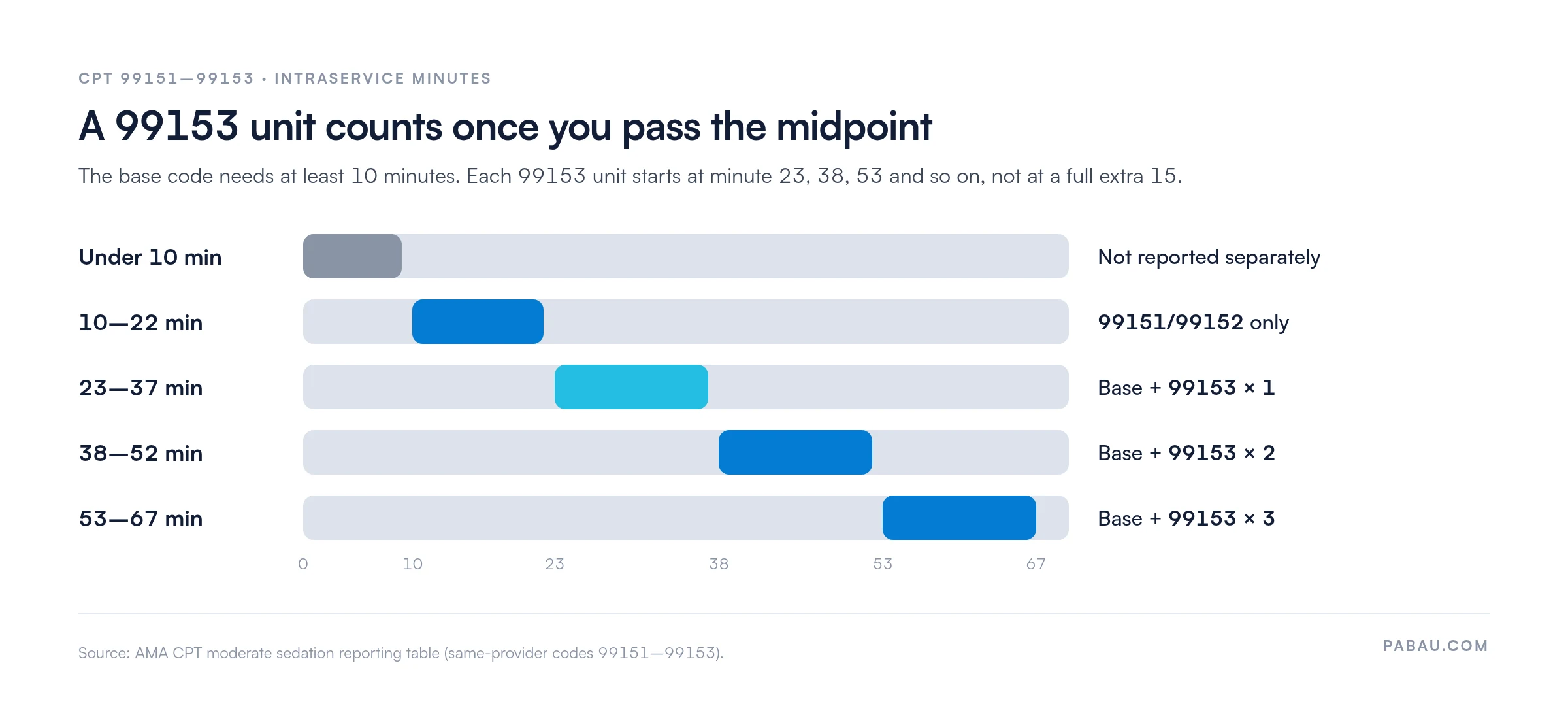
Say a proceduralist sedates a patient age 5 or older for 52 intraservice minutes. That case supports 99152 plus two units of 99153. The table shows where each threshold falls:
The midpoint rule: A 22-minute case gets no 99153 unit, while a 23-minute case gets one. That threshold comes from the CPT time rule, which counts a unit once its midpoint passes. Physical therapy’s 8-minute rule has no bearing on sedation units, so don’t borrow it. Record exact start and stop times, because an auditor will recount the minutes from them.
The same-provider moderate sedation family runs from 99151 to 99153. Selecting the right base code before adding units of CPT Code 99153 is the first place many claims go wrong. The age cutoff is the only variable that distinguishes 99151 from 99152.
All three codes require the independent observer, whatever the procedure length. Even a 25-minute case that supports a single unit of CPT Code 99153 needs the observer named in the record.
Mixing up the two sedation families is a frequent moderate sedation coding error. Sometimes a different qualified provider gives the sedation while the proceduralist performs the procedure. In that case the 99151-99153 family doesn’t apply. The different-provider family (99155, 99156, 99157) is used instead, and the two families can’t be combined for one sedation service.
The CRNA-present nuance: when a CRNA is in the room but the proceduralist still directs and administers the sedation, the 99151-99153 family still applies. The distinction turns on who manages the sedation moment to moment. A CRNA’s presence alone doesn’t decide it. Payer interpretation varies, so check with your MAC and document who gave each dose.
GI endoscopy, cardiology, urology and pain procedures use CPT Code 99153 most, because they often run past 23 minutes of sedation. The longest procedures generate the most units, so gastroenterology and interventional cardiology practices watch these add-on units closely.
The American Society for Gastrointestinal Endoscopy (ASGE) publishes GI-specific coding resources that address how moderate sedation add-on codes interact with colonoscopy and EGD procedure codes. Practices billing these procedures should review ASGE guidance alongside AMA CPT instructions.
Every unit of CPT Code 99153 needs documentation that proves the time billed and confirms the patient was monitored. Missing any element gives a payer a straightforward basis for denial. Capture the following before you submit a claim.
Auditors usually check the start and stop times and the observer documentation first. Take a sedation record with the first drug given at 9:14 AM and the procedure ending at 9:41 AM. That’s 27 intraservice minutes, which passes the 23-minute threshold and supports the base code plus one unit of 99153. Had the procedure ended at 9:36 AM, the 22 minutes would support the base code alone.
Build the independent observer’s name and credentials into your sedation record template as a required field. A structured field can’t be skipped by accident, and auditors find it straight away.
Medicare pays CPT Code 99153 under the Medicare Physician Fee Schedule (MPFS). Since 2017, CMS has paid moderate sedation separately from the procedures it supports. MAC policies on sedation still vary by jurisdiction. If you bill across several MACs, claims software for practices can track each payer’s rules for you.
Medicare doesn’t take 99152 when moderate sedation supports a gastrointestinal endoscopy in a patient age 5 or older. It uses HCPCS code G0500 for the first 15 minutes instead. CPT Code 99153 still reports each additional unit on top of G0500. Check your MAC’s guidance before applying the screening colonoscopy cost-sharing waiver to sedation lines.
Check the patient’s benefits before the procedure too. Some commercial plans still bundle sedation into the primary procedure code, so confirm separate coverage first.
Medicare values 99153 using the Resource-Based Relative Value Scale (RBRVS). The code carries no physician work RVUs, so its payment comes from practice expense and malpractice RVUs. CMS flags its facility value as not payable, so the physician is paid only in a non-facility setting.
Figures come from the CMS CY2026 national RVU file, using the $33.4009 conversion factor for non-qualifying APM participants. Qualifying APM participants use $33.5675, which puts the non-facility rate at about $12.42. Geographic practice cost indices (GPCIs) then adjust the amount for each locality. Check your own rate in the CMS Physician Fee Schedule lookup tool.
The Office of Inspector General (OIG) and Medicare Administrative Contractors (MACs) audit moderate sedation billing. These patterns generate the most denials and recoupment demands. Each one can be caught while the claim is being built.
Review common denial codes to see how payers report each of these reasons on the Explanation of Benefits (EOB) or electronic remittance advice.
Mutual exclusivity rules for CPT Code 99153 are defined primarily through NCCI edits and AMA bundling guidance. Billing any of the following alongside 99153 on the same claim creates a high-risk edit or automatic denial.
Building a clean 99153 claim follows a set sequence. Each step either qualifies or disqualifies units before the claim leaves the practice. An 837P electronic claim sent through a clearinghouse automates many edit checks, but the data must be right before submission.
Many practices still work out sedation units from a paper sedation record, then key them into a separate billing system. Each re-keyed start time is another chance to over-bill or under-bill a unit.
Pabau keeps the appointment, the treatment notes and the invoice in the same patient record. Once your team has confirmed the codes and units, the Claim.MD integration submits the claim electronically. It then tracks the claim’s status through to payment.
The result is less re-keying and one screen showing which 99153 claims are paid, pending or denied. Your billing team spends its time on the denials that need work, not on status calls.

Pabau keeps sedation appointments, notes and invoices in one patient record and submits claims through its Claim.MD integration. You can track every 99153 claim from submission to payment.

Treat 99153 as a timing code first. Count from the first sedating dose, apply the midpoint thresholds, and name the observer. Get those three right and a sedation claim holds up to audit.
The risk sits at the margins. A case that ends at 22 minutes earns no add-on unit, and rounding it up is exactly what auditors look for. Bill what the record proves, and let the next case earn the unit.
Once the units are right, Pabau submits the claim through Claim.MD and tracks it to payment, so your team isn’t chasing status by phone. Book a demo to see how Pabau handles claim submission and tracking for procedure-based practices.

Need to understand how claims move from submission to payment? Revenue cycle management explained walks through the full billing lifecycle for outpatient procedure practices.
Seeing 99153 denials you can’t explain? Healthcare denial management strategies covers how to categorize, appeal, and prevent common claim rejection patterns.
Want to verify eligibility before sedation procedures? Insurance eligibility verification explains how to confirm separate sedation coverage before the appointment.
Filing sedation claims electronically? The 837 file explained breaks down the electronic claim format your clearinghouse sends to payers.
Want every sedation field captured at checkout? How to build a superbill shows what a superbill needs so coders can build the claim without chasing notes.
CPT Code 99153 covers each additional 15 minutes of moderate sedation given by the same provider who performs the primary procedure. It attaches to base code 99151 (under age 5) or 99152 (age 5 and older). An independent trained observer must be present and documented.
No. NCCI bundling edits make CPT Code 99153 and anesthesia codes (00xxx series) mutually exclusive in the same encounter. Moderate sedation and general or monitored anesthesia care are distinct services, and only one can be reported per encounter. Check the current NCCI edit tables before billing, as they update quarterly.
The most common reason is a missing base code, with no 99151 or 99152 on the same claim. Others are documented time that falls short of the units billed and missing observer documentation. Billing 99153 when a different provider gave the sedation also triggers denials, because that case needs the 99155-99157 family.
When a provider other than the proceduralist gives the sedation, the different-provider family applies. That means 99155 or 99156 as the base code and 99157 for each additional 15 minutes. The 99151-99153 family, including CPT Code 99153, is limited to cases where the performing physician gives the sedation.