CPT Code 69610: Tympanic membrane patch repair (myringoplasty)
CPT code 69610: official descriptor and procedure overview CPT code 69610 descri...

Last Updated: Oct 19, 2026
A7560 is the CCSD code for VATS sympathectomy – unilateral, a keyhole operation that interrupts the thoracic sympathetic chain on one side of the chest. It is billed mostly for primary focal hyperhidrosis and is usually paired with ICD-10 code L74.5.
The code covers one side only, so a simultaneous bilateral procedure takes the bilateral CCSD equivalent. UK private insurers require pre-authorization before surgery, and the operative note must state the side, chain levels, and interruption method.
Let Pabau's smart automation suggest the right codes, reduce claim denials, and keep your practice compliant—effortlessly.
Automate repetitive tasks and focus on what matters most—your patients.
Reduce coding errors and ensure compliance with the latest regulations.
Clean claims, fewer denials, and faster reimbursements.
Powerful insights and reporting to help your practice thrive.
HIPAA compliant SOC 2 certified GDPR-compliant Trusted by 4,000+ clinics worldwide

CCSD code A7560 covers a unilateral VATS sympathectomy only, so both sides treated in one sitting need the bilateral code.
Primary focal hyperhidrosis (L74.5) is the ICD-10 diagnosis code most often paired with A7560.
Every major UK private insurer requires pre-authorization for A7560 before surgery, and a missing authorization is the leading denial trigger.
The operative note must state laterality, the sympathetic chain levels treated, and the method of interruption to pass audit.
CCSD code A7560 describes a “VATS sympathectomy – unilateral,” a keyhole thoracoscopic procedure that surgically interrupts the thoracic sympathetic chain on one side.
Most claims pair it with L74.5 for primary focal hyperhidrosis. Every major UK private insurer requires pre-authorization before surgery. The table below summarizes the key coding attributes.
Confirm the current descriptor against the CCSD Technical Guide (October 2025), because descriptors are reviewed every year. A7560 sits in the thoracic surgery section of the schedule, alongside the open sympathectomy codes and the bilateral VATS equivalent. You can compare it with its neighbors in the full list of private practice CCSD codes.
A VATS sympathectomy is a keyhole thoracic operation performed under general anesthesia. The surgeon uses a rigid thoracoscope and one or two additional instrument ports, each roughly 5–10 mm, inserted through the chest wall.
One-lung ventilation, usually through a double-lumen endotracheal tube, deflates the lung on the operated side. That creates the working space the surgeon needs to see the sympathetic chain.
The operative sequence for a unilateral VATS sympathectomy follows these stages:
These steps matter to billing teams because the operative note should map directly onto them. A note that says “sympathectomy performed” without the approach, level, and interruption method won’t survive an insurer audit. Structured operative templates built around these auditable fields keep incomplete records from reaching the billing stage.
Most A7560 claims are submitted for primary focal hyperhidrosis, which is excessive, uncontrollable sweating of the palms, armpits, or face. It must not have responded to conservative treatment such as topical antiperspirants, iontophoresis, or botulinum toxin injections. Insurers typically want evidence of that failed conservative management before they approve the procedure.
Other accepted indications include:
Compensatory sweating on the trunk or thighs after surgery is the complication most often documented in published surgical series. Discuss its likelihood with the patient before the operation, and make sure the consent form reflects that conversation.
Every A7560 claim submitted to a UK private insurer needs a paired ICD-10 diagnosis code. A wrong code, or no code at all, is a fast route to denial. The table below covers the most commonly paired codes and when each one applies.
Check every ICD-10 code against the NHS Classifications Browser before submission. UK private practice uses the ICD-10 5th Edition, which can differ from the ICD-10-CM codes used in the US.
UK insurers accept L74.5 most consistently for hyperhidrosis claims, so use it wherever the clinical notes support primary focal hyperhidrosis. For Bupa claims, the Bupa code search portal shows which diagnosis codes it accepts with a given procedure code.
A7560 covers a unilateral sympathectomy only. Using it when both sides were treated in the same operative session is a coding error, and it typically triggers denial or recoupment on audit. The bilateral equivalent is CCSD code A7561, which covers the sympathetic chain on both sides in one operative session.
Whether a simultaneous bilateral procedure can go in as two A7560 codes on one claim depends on the insurer, so confirm it with each one. The CCSD Technical Guide gives bilateral modifier guidance, but insurers layer their own rules on top of the schedule. Billing two A7560 codes without that approval is a common cause of claim denial.
For staged bilateral cases, request a separate pre-authorization number for each side. Then link each admission to its own authorization on submission. Practice management software like Pabau helps here, because its private practice claims software attaches authorization references at the appointment level.
Several codes in the thoracic surgery section of the CCSD schedule are often confused with A7560 or billed on the same claim. The table below separates them.
A non-surgical route to the thoracic sympathetic chain also sits in the schedule. Chemical interruption with a neurolytic agent, injected under X-ray control, bills as A7620 rather than A7560.
The Pabau guide to Bupa CCSD codes explains how thoracic codes sit in Bupa’s fee schedule and what Bupa expects on submission. Practices that bill several thoracic codes can also build a code-specific audit checklist, so incomplete documentation gets flagged before a claim leaves the practice.
Confirm the bilateral VATS sympathectomy code number on the live CCSD schedule or the Bupa code search portal before each claim cycle. Codes next to A7560 have been revised in past schedule updates. Billing a superseded bilateral code is one of the easiest thoracic denials to avoid.
An A7560 operative note must state the side treated, the VATS approach, the chain levels, and the interruption method. It also needs the four supporting details listed below. It’s the first document an insurer requests when it queries a claim. A7560 draws more audits than routine codes because the procedure is elective and the unilateral/bilateral split is often disputed.
Minimum auditable requirements for a valid A7560 operative note:
Practices that move from free-text dictation to structured digital operative templates send fewer claims to insurers with missing fields. A template built around the eight elements above turns documentation into a checklist rather than a memory exercise.
All major UK private medical insurers require pre-authorization for CCSD code A7560 before surgery takes place. Operating without it is the most common reason a valid claim is denied in full, however well the procedure was documented.
Pre-authorization thresholds change every year. Confirm each insurer’s current requirements against its own policy documents before the patient’s consultation, not when surgery is being scheduled.
Practices that book elective thoracic procedures well ahead should build the pre-authorization step into the first consultation. Left until the week before admission, pre-auth chasing becomes one of the most time-consuming billing tasks a practice has.
A7560 denials cluster around a small number of preventable errors. Most can be recovered on appeal, but an appeal adds weeks or months of delay and more staff time.
Billing teams handling A7560 claims meet a handful of situations the code descriptor doesn’t cover. The four checkpoints below show where each one falls between the first consultation and a clean submission.
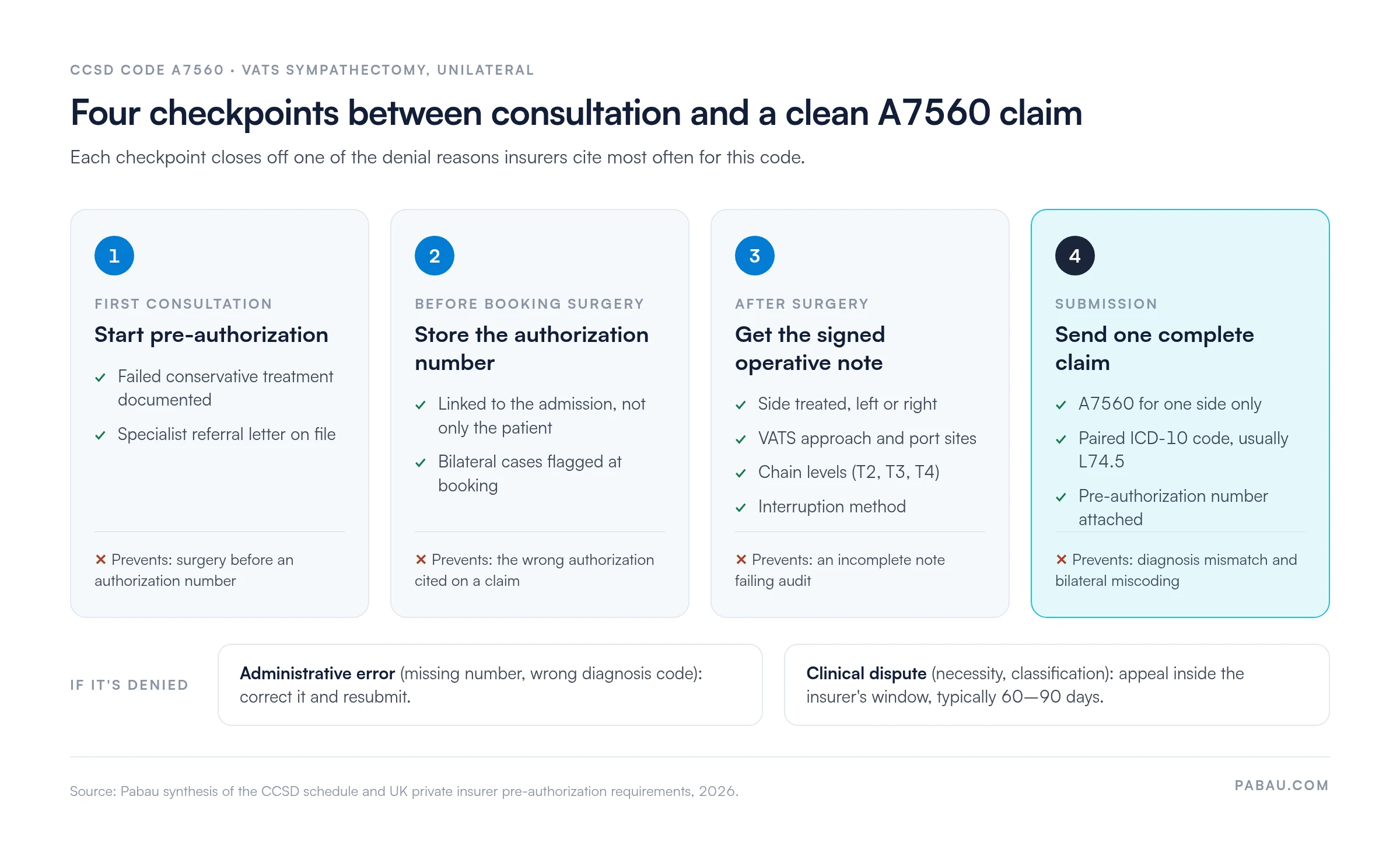
Teams billing across several surgical specialties benefit from a live log of each insurer’s quirks for every CCSD code they bill regularly.
In many practices, the pieces of an A7560 claim live in different places. The pre-auth number sits in an email, the operative note arrives as dictation, and the diagnosis code gets typed in at submission.
Pabau stores the pre-authorization reference against the appointment, so a staged bilateral case keeps a separate number for each side. Digital operative note templates make laterality, chain levels, approach, and interruption method required fields. The claim is then built from the same record the surgeon signed.
Your billing team submits from a complete record instead of chasing the surgeon’s secretary for missing details. Remittances are matched against each appointment, so an unpaid claim surfaces while there’s still time to appeal.

Pabau stores pre-authorization references at the appointment level and captures every auditable field in structured operative templates. Your team submits CCSD claims that are less likely to be denied.

A7560 rewards the practice that does its admin before the patient reaches theater. Raise pre-authorization at the first consultation, and hold the claim until the signed operative note names the side, levels, and interruption method.
The trade-off is a slower submission on every case. That wait costs a few days, while a claim denied in full for a missing authorization can take months to recover. Book a demo to see how Pabau ties pre-authorizations, operative notes, and CCSD claims together for thoracic surgery practices.

Billing an open thoracic sympathectomy instead? CCSD code A7520 covers the documentation and pre-authorization rules for the non-VATS equivalent.
Looking up a neighboring CCSD code? CCSD codes library gathers Pabau’s CCSD procedure code guides in one place.
CCSD code A7560 covers a unilateral video-assisted thoracoscopic surgery (VATS) sympathectomy. One side of the thoracic sympathetic chain is interrupted through keyhole ports under one-lung ventilation. It doesn’t cover bilateral procedures, open sympathectomy, or lumbar sympathectomy.
A7560 covers one side only. When both sides are treated in the same operative session, a separate bilateral CCSD code applies. Billing two A7560 codes for a simultaneous bilateral procedure without explicit insurer approval is a coding error that typically ends in denial or recoupment.
L74.5 (primary focal hyperhidrosis) is the most commonly accepted pairing for hyperhidrosis claims. R61 (generalized hyperhidrosis) and I73.0 (Raynaud’s syndrome) are used for their own indications. Check each insurer’s accepted diagnosis codes against its current policy before submission.
Yes. All major UK private medical insurers, including Bupa, AXA Health, Aviva, Vitality, and WPA, require pre-authorization before a VATS sympathectomy. Submitting without a valid pre-authorization number is the most common reason A7560 claims are denied in full.
Anesthesia codes are billed separately by the anesthetist on their own claim and aren’t bundled into A7560. Assistant surgeon codes may go on the same claim when an assistant was present. Some insurers require prior justification for the assistant, so confirm the policy before adding the code.
The most common triggers are a missing pre-authorization and a bilateral procedure billed as two A7560 codes without approval. Laterality missing from the operative note, an ICD-10 mismatch, and a policy exclusion round out the list.