CPT Code 69610: Tympanic membrane patch repair (myringoplasty)
CPT code 69610: official descriptor and procedure overview CPT code 69610 descri...

Last Updated: Oct 19, 2026
C1230 is the CCSD code for curettage/cryotherapy of lesion of eyelid, a Minor procedure in Chapter 4, Eyebrow and lid. It covers treating an eyelid lesion by scraping it away with a curette or destroying it by freezing.
The method is what the claim turns on. If the surgeon cuts the lesion out, the procedure bills as C1210 instead. A skin graft to the lid is C1420. Insurers compare the note with the code, so a mismatch holds up payment. Below, you'll find what the note needs, how pre-authorization works with each major insurer, and how the claim moves through Healthcode.
Let Pabau's smart automation suggest the right codes, reduce claim denials, and keep your practice compliant—effortlessly.
Automate repetitive tasks and focus on what matters most—your patients.
Reduce coding errors and ensure compliance with the latest regulations.
Clean claims, fewer denials, and faster reimbursements.
Powerful insights and reporting to help your practice thrive.
HIPAA compliant SOC 2 certified GDPR-compliant Trusted by 4,000+ clinics worldwide

CCSD code C1230 covers curettage/cryotherapy of lesion of eyelid, a Minor procedure in chapter 4 of the CCSD schedule.
Its closest neighbors are C1210 for excising an eyelid lesion and C1420 for a skin graft to the eyelid. The note must name the method.
Bupa, AXA Health, VitalityHealth and Aviva each set their own pre-authorization and referral rules, so check the patient’s policy before treatment.
Most rejected C1230 claims trace back to a missing authorization number, a note that describes another method, or a fee above the schedule rate.
CCSD code C1230 bills “Curettage/cryotherapy of lesion of eyelid,” the official descriptor in the CCSD schedule. In plain terms, the surgeon scrapes the lesion away with a curette or destroys it by freezing. The schedule rates it as a Minor procedure.
The code sits in chapter 4, Eye and orbital contents, inside section 4.2 for the eyebrow and lid. You can confirm the entry on the CCSD website or in the CCSD Technical Guide, updated October 2025. If you bill across several specialties, the full list of CCSD codes for specialists is grouped by chapter.
Knowing the descriptor is only half the job. Insurers also read the rest of the schedule entry when they price and query a claim, so it pays to know each part.
C1230 has two close neighbors in section 4.2, C1210 and C1420. Each one describes a different way of treating the eyelid. That means the method written in the note picks the code, not the lesion itself.
Here is how the three compare, and what tends to trip coders up with each one.
The diagram below turns that comparison into one question you can ask of every eyelid note.
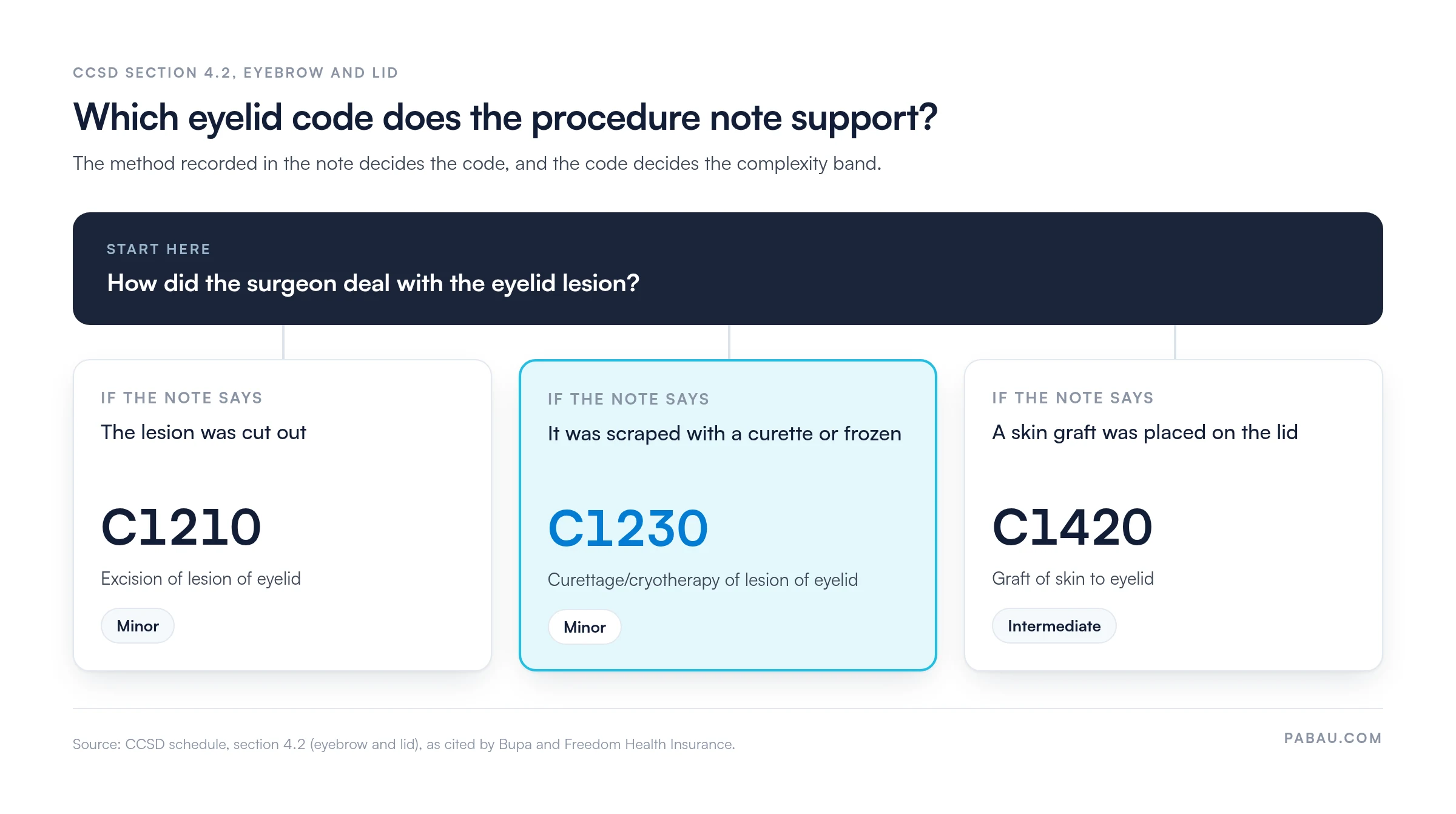
Site matters as much as method. When the lesion sits on the conjunctiva rather than the lid, cautery or cryotherapy bills as C3920, another chapter 4 code. Extent matters too. When excision takes the full thickness of the lid and the surgeon rebuilds both layers, the claim moves to C1700.
Bupa patients add one more check. The insurer’s own code search shows descriptor-level detail for each neighbor, and our guide to Bupa CCSD codes explains how Bupa applies the schedule.
Keep a copy of the CCSD Technical Guide from ccsd.org.uk and refresh it every year. Confirm your procedure note supports “Curettage/cryotherapy of lesion of eyelid” before submitting. A one-minute check is faster than disputing a denial.
The note has to describe curettage or cryotherapy of an eyelid lesion in plain words. Insurers can ask for clinical notes after they pay. A note that doesn’t back the code can lead to clawback.
Take a simple example. A surgeon freezes a small lesion on a patient’s left lower lid during an outpatient visit. A note that supports C1230 would record these points.
Watch the word “removed.” A reviewer can’t tell curettage from excision when the note only says the lesion was removed. That one vague word is often enough to start a query.
A clean note still won’t get paid unless the insurer agreed to the procedure first. That’s where pre-authorization comes in.
Most insurers want a pre-authorization number on the claim before they’ll pay C1230. The rules depend on the insurer and the patient’s policy, so check every time.
Does approval for one patient cover the next? No. Approval is tied to one patient and one policy. A second patient with the same insurer needs their own check.
Can the rules change during the year? Yes. Insurers update policies at renewal and after CCSD schedule updates. A route that worked in January may not work in June.
Where do I check? Each insurer has its own route. The table sums up what each one expects for a procedural code like C1230.
Fees for the same code differ between insurers, and each insurer revises its schedule yearly. So review every insurer’s C1230 rate at the start of the calendar year, before your first claim goes out.
Healthcode is the main electronic clearinghouse for UK private medical billing. Bupa, AXA Health, VitalityHealth and Aviva all prefer electronic claims through it over paper invoices. Here is the walkthrough for a C1230 claim.
Steps two and three are where claims stall most often. One wrong digit in a membership number sends the claim straight back to you.
These checks take about a minute. Each one lines up with a common rejection reason, so a clean pass here saves a resubmission later.
Rejected C1230 claims tend to follow a few repeat patterns. The table pairs each one with its fix.
Picking the wrong level cuts both ways. Billing C1230 when the note supports C1420 leaves money unclaimed. Billing C1230 for an excision invites a query at audit.
Review rejected C1230 claims once a month and group them by reason. Three rejections for the same reason in one month mean a step in your billing process needs fixing. Fix that step first, then correct the claims.
Plenty of practices still track authorization numbers in a spreadsheet and retype patient details into Healthcode. Every retyped field is one more chance for a mismatch.
Practice management software like Pabau keeps the procedure note, consent form and invoice in one patient record. Its claims software for specialists pre-fills the claim from that record.
Before the claim can go, Pabau checks required fields such as membership and authorization numbers. Claims then travel straight to Healthcode, and you can follow their status from the same screen.
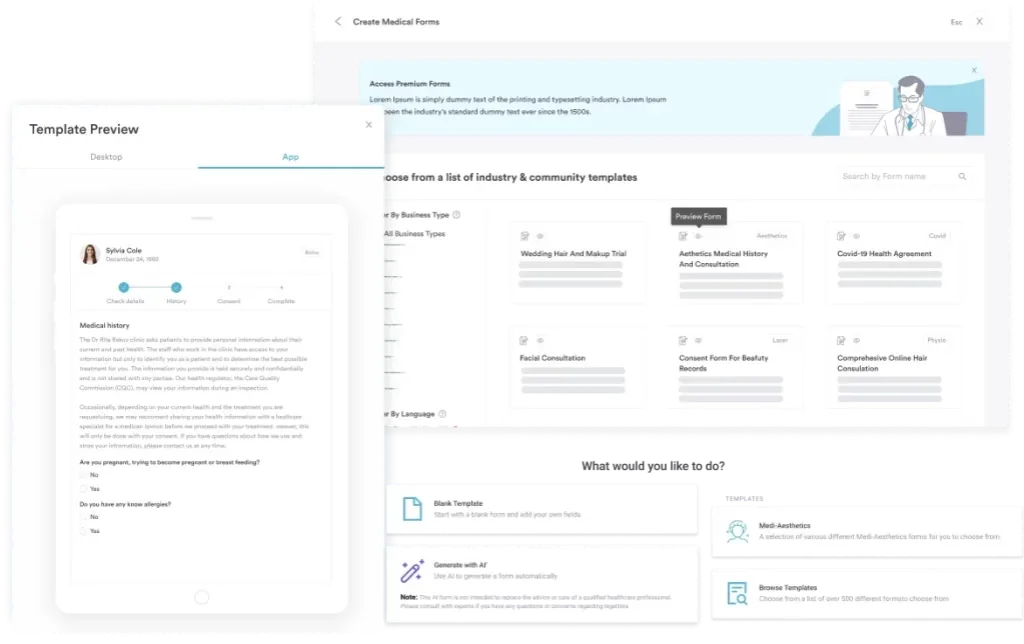
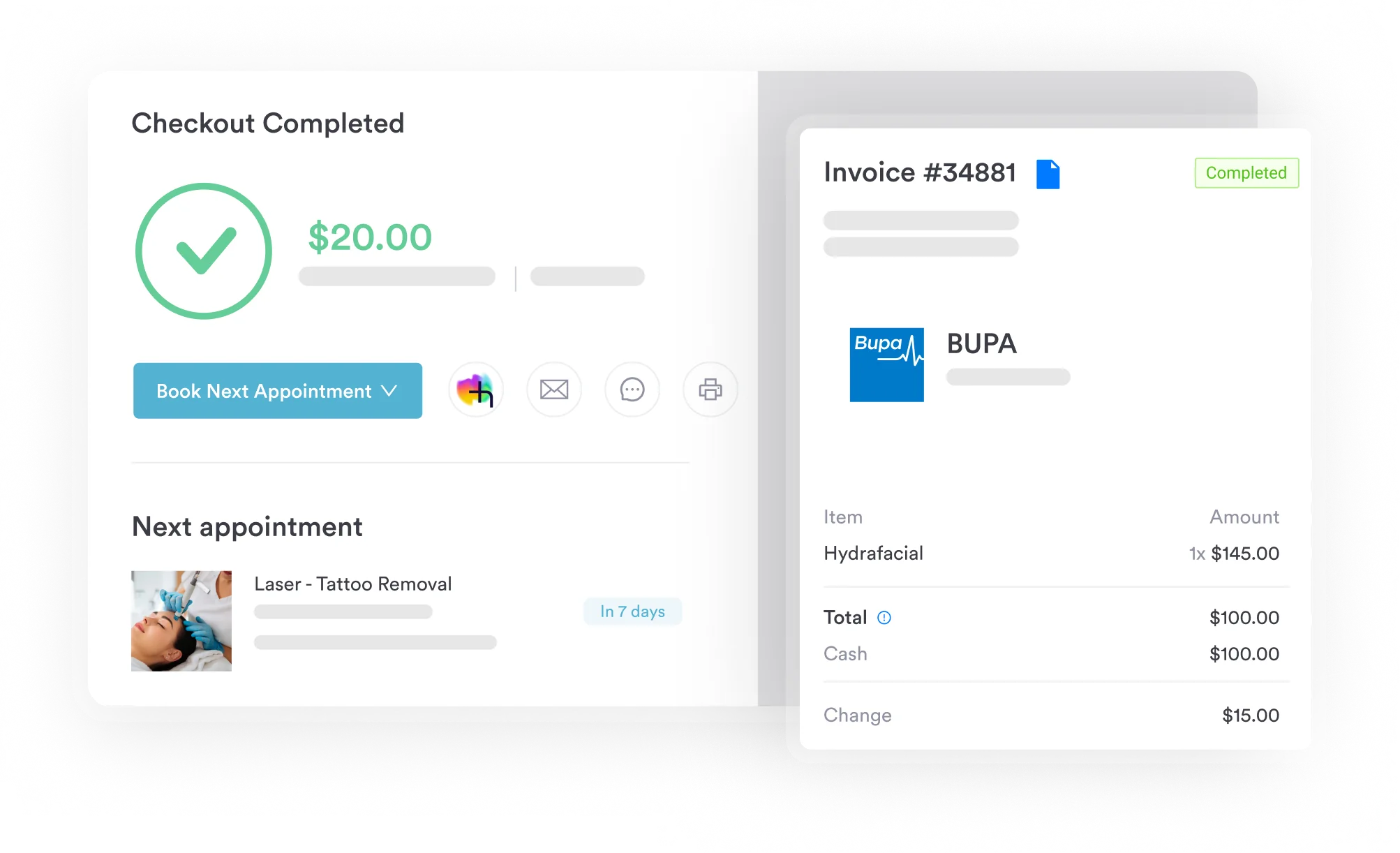
The result is fewer claims bounced for a missing number, and less time on the phone chasing insurers.

Pabau pre-fills insurer claims from the patient record and checks required fields before you submit. Claims go straight to Healthcode, so fewer come back for missing details.

C1230 is one of the easier eyelid codes to get right, as long as the note names the method. Curettage or cryotherapy points to C1230. An excision or a graft points somewhere else.
So make the method a required field in your eyelid procedure note, and get pre-authorization before you book the patient in. Do both, and most C1230 queries never start. The cost is a little more structure at the point of care, and it pays back when the remittance arrives.
Book a demo to see how Pabau helps UK private practices send C1230 claims with the right details the first time.

Treating skin lesions elsewhere on the body? CCSD S1110 covers curettage or cryotherapy of up to three skin lesions, including cauterization.
Treating four or more skin lesions? CCSD S0820 covers curettage and cryotherapy when four or more skin lesions are treated.
Billing an eyelid lesion in the US? CPT 67840 explains the US procedure code for excising an eyelid lesion.
Coding other chapter 4 eye procedures? CCSD C0122 covers eye removal with an orbital implant and the codes around it.
Billing Bupa patients? Bupa CCSD codes guide explains how Bupa applies the schedule to fees and claim submission.
C1230 covers “Curettage/cryotherapy of lesion of eyelid,” a Minor-complexity procedure. The surgeon scrapes the eyelid lesion away with a curette or freezes it. It sits in chapter 4 of the CCSD schedule, under Eyebrow and lid.
Bupa, AXA Health, VitalityHealth and Aviva all bill procedures against the CCSD schedule. Whether a patient is covered for C1230 depends on their own policy, so check before treatment.
Usually, yes. Most insurers want a pre-authorization number on procedural CCSD claims. Contact the insurer before the procedure date and record the reference in the patient file.
The usual causes are a missing pre-authorization number or a note that doesn’t match the descriptor. Unbundled line items, a missing referral and an over-schedule fee follow close behind.
The closest neighbors are C1210, “Excision of lesion of eyelid,” and C1420, “Graft of skin to eyelid.” Choose by the method in the note. Cutting the lesion out is C1210, and a graft is C1420.
Keep a procedure note naming the method and the eyelid treated, the clinical indication, signed consent, the pre-authorization number and any required referral letter. Exact requirements vary by insurer.