



CCSD code G5100: Bypass of duodenum billing guide
CCSD code G5100 bills a bypass that leaves the duodenum in place CCSD code G5100...

Last Updated: Oct 16, 2026

CPT code 95117 covers professional allergen immunotherapy injection services for 2 or more injections in a single visit, not including the allergenic extract itself.
95117 requires a separately identifiable E/M service (with Modifier 25) to bill an office visit on the same day as the injection.
Common denial risk: billing 95117 without pairing it with a supported ICD-10 diagnosis code such as J30.1 (allergic rhinitis due to pollen) or J45.20 (mild intermittent asthma).
Practice management software like Pabau helps allergy practices track CPT 95117 claims, attach modifiers, and reduce denials through automated billing workflows.
Report 95117 as one unit per date of service, no matter how many injections are given — billing multiple units is a common denial trigger.
CPT code 95117 is the code used to bill professional services for allergen immunotherapy injections when two or more injections are given at a single visit, not including the allergenic extract itself.
Per CMS Physician Fee Schedule data, allergen immunotherapy ranks among the most frequently billed outpatient procedures in allergy and otolaryngology practices. A single coding error on these high-volume claims, such as mixing up 95115 and 95117 or missing a modifier, adds up fast across a busy injection schedule.
This guide covers the full billing picture for CPT code 95117: what it includes, how it differs from 95115, which ICD-10 codes pair with it, how Medicare covers it, and what documentation your practice needs to keep claims clean.
CPT code 95117 is defined by the American Medical Association (AMA) as professional services for allergen immunotherapy not including provision of allergenic extracts; 2 or more injections.
In plain clinical terms: the patient arrives at the office, a trained nurse or clinician administers two or more subcutaneous injections of allergen extract at a single visit, and the physician or supervising provider bills for that professional service. The extract itself is billed separately under codes 95144-95149 (single-dose vial/venom preparation) or 95165 (multi-dose vial preparation). Self-pay does not mean uninsured, and many patients recover part of the fee with a superbill. Practices still filing on paper carry this code on the CMS-1500 form, in the service lines.
CPT code 95117 covers the administration component only. The extract is a separate billable item.
It helps to place CPT code 95117 within the wider allergy billing family:
CPT code 95117 covers only the injection administration, when two or more injections are given at the visit.
Many allergy patients receive injections from two or more vials (for example, a tree pollen vial and a grass pollen vial) at the same visit. Each injection is a distinct subcutaneous administration. When the total injection count at a single encounter is 2 or more, use 95117. When only one injection is given, use CPT 95115.
Report 95117 as a single unit per date of service, no matter whether the patient receives two, three, or five injections. Billing multiple units is a frequent denial trigger. Do not report 95117 on the same day as CPT code 95115 (single injection) or the complete-service codes 95120–95134, which already include the allergenic extract.
This code applies to subcutaneous immunotherapy (SCIT). It does not apply to sublingual immunotherapy (SLIT), which is billed under different codes entirely.
In standard allergen immunotherapy practice, injections are patient-specific and follow the ordering physician’s dosage schedule. Once a physician signs off on that schedule, payers should not require a fresh sign-off before each subsequent injection, according to 2024 AAAAI/AAOA/ACAAI guidance reported by Healio.
Allergy practices that use claims management software can configure CPT 95117 as a default billing code for multi-injection encounters, reducing manual selection errors across high-volume injection days.
Per CMS Medicare Coverage Database article A57678, both 95115 and 95117 are payable only in the office setting (Place of Service 11). Neither can be billed in a hospital outpatient or ASC facility under Medicare.
For practices billing other CPT procedure families.
Medicare covers CPT code 95117 under Part B, subject to medical necessity. The beneficiary must have a documented allergic condition that has not responded adequately to standard pharmacotherapy, and the treating physician must have a treatment plan on file.
CMS LCD L37800 establishes that CPT codes 95115 and 95117 are payable only in the office setting (POS 11). Hospital outpatient and ambulatory surgery center billing for these codes is not covered under Medicare.
The cost and reimbursement of CPT code 95117 vary by geographic location and are updated annually. The national non-facility rate for 2026 typically falls in the $11-$15 range per encounter.
Use the FastRVU 2026 RVU lookup tool to find the precise rate for your locality. Commercial payer rates are generally higher, often ranging from $20 to $40 per encounter depending on the insurer and contract terms.
These rates cover the professional service component only. Allergenic extract preparation, billed under 95165 for multi-dose vials or 95144-95149 for single-dose vials, is reimbursed separately and can significantly increase the total per-visit payment.
Allergy and immunology practices billing high volumes of 95117 can use dermatology EMR software or specialty allergy platforms to track reimbursement rates across payers and flag underpayments systematically.
When the practice both prepares the allergenic extract and administers the injections, bill 95165 for multi-dose vial preparation in addition to 95117. CPT code 95144 covers single-dose vial preparation, and per CMS and AAFP billing guidance, it is not billed on the same date of service as 95115 or 95117.
Some commercial payers, including EmblemHealth, reimburse the combined 95165/95117 claim at the 95165 multi-dose vial rate when both codes are submitted together. Verify your payer-specific policy before assuming standard split billing applies.
For Medicare patients, when billing both the extract preparation code (95165) and the administration code (95117), submit both sets of codes on the same claim. The AAFP coding guidance confirms this approach in its practice management resources.
Watch the units on each code. 95117 is reported as one unit per visit, while CPT code 95165 is billed per prepared dose, and most payers cap the number of 95165 units they cover in a year. Check your payer’s maximum units for 95165 before submitting, since exceeding the annual limit is a common source of partial denials.
Run a monthly billing audit comparing 95115 vs 95117 claim volumes. If your ratio of 95117 to 95115 claims drops significantly month-over-month, it may indicate that injection nurses are defaulting to 95115 regardless of injection count. Catching this early prevents months of underbilling on multi-injection visits.
For flat-fee practices, software built for direct primary care tracks these services without generating insurance claims.
CMS Medicare Coverage Database article A57678 specifies the ICD-10-CM diagnosis codes that support medical necessity for CPT 95117. Submitting a claim with an unsupported diagnosis is one of the most common reasons for denial.
These are the primary supported diagnosis groups. For a complete list of qualifying codes, use the AAPC CPT-to-ICD-10 crosswalk to verify all valid pairings for your specific payer.
Use the most specific ICD-10 code available. Unspecified codes such as J30.9 (allergic rhinitis, unspecified) are not on the CMS covered-diagnosis list for CPT 95117 and will fail the highest-specificity requirement payers apply. Coding to the highest level of specificity protects the claim.
Practices standardizing allergy diagnosis documentation across visits can adapt an allergy consultation notes template to keep ICD-10 code capture consistent from the first visit through ongoing immunotherapy.
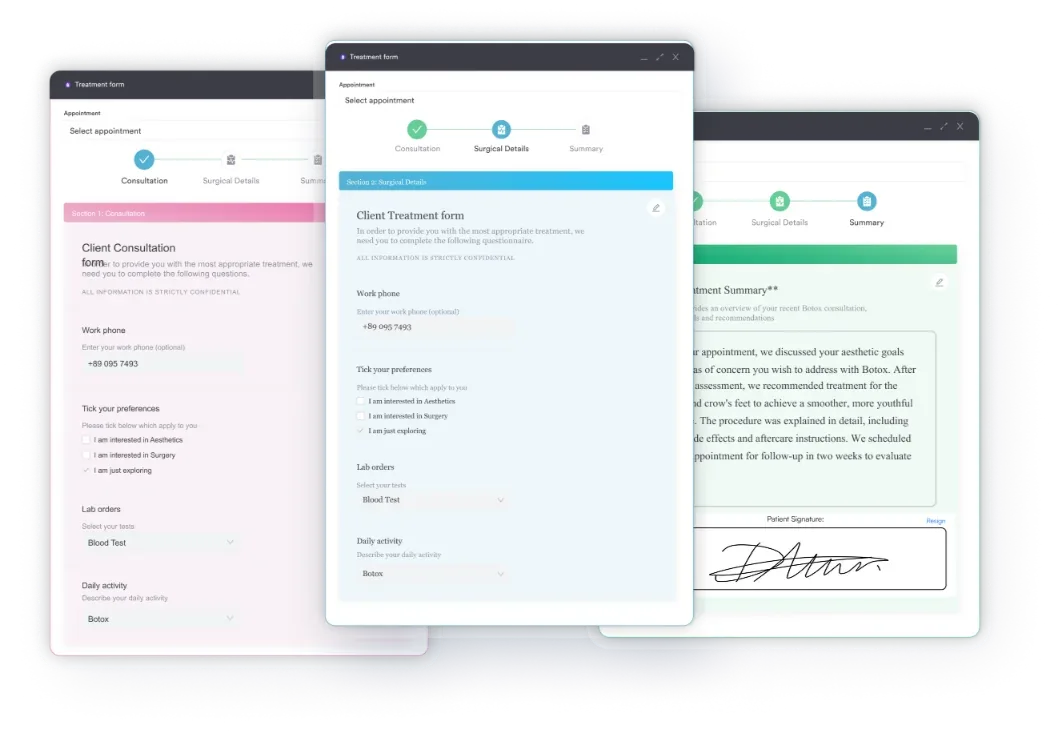
Practices using digital forms can configure intake and pre-injection forms to capture and record the ICD-10 diagnosis code at each visit, reducing missed or inconsistent diagnosis coding before claims submission.

Pabau helps allergy and immunology practices track CPT 95117 claims, attach the right modifiers, and document ICD-10 pairings automatically. See how it works for high-volume injection practices.

Billing teams misapply modifiers on CPT code 95117 more than any other part of the claim. Two modifiers are critical to understand.
Per CMS Medicare Coverage Database article A57678, an evaluation and management (E/M) service may be billed in addition to 95117 only when a separately identifiable service is provided at the same visit. The E/M must be medically necessary, documented in the chart, and distinct from the injection service itself.
In practice: if a patient arrives for their routine allergy shot and nothing else happens, bill 95117 alone. If the physician evaluates a new complaint (nasal polyps, worsening asthma, a reaction concern) and documents a separate problem-focused exam, that E/M can be billed with Modifier 25 appended to the E/M code.
Modifier 25 goes on the E/M code (e.g., 99213-25), not on 95117. Reversing this is a common billing error that triggers claim rejection.
Modifier 59 may be required when CPT 95117 is billed alongside certain other procedure codes to distinguish it as a separate and distinct service. This applies primarily in multi-specialty encounters or when payer edits flag the code combination as potentially bundled. Not all payers require it, so verify your specific payer’s editing rules before applying Modifier 59 routinely.
The same principle of separating distinctly billable services applies in other procedure families.
Clean documentation protects 95117 claims at audit. Private practices and primary care offices running high-volume allergy shot clinics often standardize these fields through GP practice software templates. These are the minimum documentation elements practices should capture at every injection visit.
This level of documentation detail also supports accurate HIPAA compliance for medical offices, which requires that billing records accurately reflect the services rendered.
Configure your injection visit note template to include a mandatory ‘number of injections administered’ field. When this is pre-structured in your EHR or practice management system, coders can select 95115 or 95117 based on that field automatically, rather than relying on manual interpretation of free-text notes.
Understanding why 95117 claims get denied is as important as knowing how to code correctly. Most denials fall into three categories.
The most common denial. The ICD-10 code submitted does not appear on the payer’s covered diagnosis list for 95117. Appeal by submitting documentation showing the patient’s allergic condition, the results of allergy testing, and the treating physician’s immunotherapy plan. Reference CMS article A57678 for covered ICD-10 codes when appealing Medicare denials.
If that allergy testing was intradermal, it was billed under 95024. That code counts one unit per individual test, and the note shows each allergen tested.
Under Medicare LCD L37800, 95117 is only payable in the office setting (POS 11). Claims submitted with POS 22 (hospital outpatient) or other facility settings are automatically denied. Correct the POS and resubmit. For future prevention, verify POS settings in your billing system before claim submission.
When a same-day E/M is billed alongside 95117 without Modifier 25, payers bundle the services and deny the E/M. Append Modifier 25 to the E/M code and ensure the chart contains a separately documented, medically necessary problem-focused encounter. On appeal, include the relevant section of the chart note showing the distinct E/M service.
Practices experiencing high denial volumes benefit from using automated billing workflows that flag missing modifiers and unsupported ICD-10 pairings before claims leave the practice. For comparison.
Billing errors on CPT code 95117 are preventable. The code is straightforward: two or more injections, office setting, no extract included. The complexity comes from modifier management, ICD-10 pairing, and documentation habits that vary by provider and front-desk team.
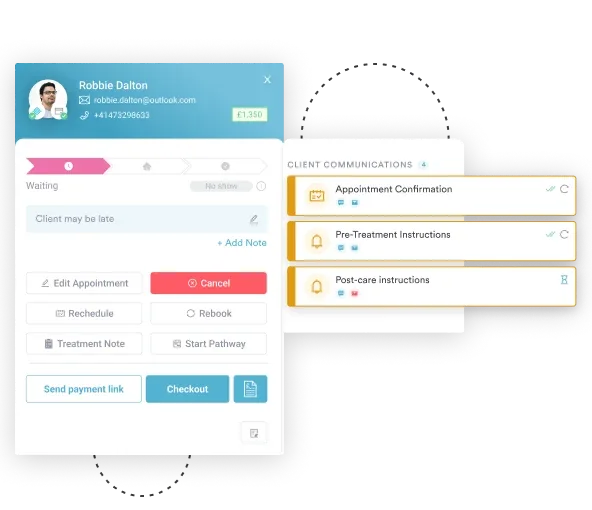
Pabau’s claims management software gives allergy practices structured workflows for CPT 95117 billing: mandatory injection count fields, pre-configured ICD-10 pairings, Modifier 25 alerts for same-day E/M encounters, and denial tracking by code.
For practices running dozens of injection visits per week. Book a demo to see how Pabau handles high-volume allergen immunotherapy billing.

Billing a same-day service alongside a procedure? 99211 covers the lowest-level established patient visit and its own same-day billing rules.
Need a refresher on how ICD-10 specificity plays out in practice? M17.4 shows how laterality affects code selection outside allergy billing.
Billing new patient home visits too? New patient home visit guide covers CPT code 99345, the highest-level new patient home visit code, requiring high medical decision making.
Billing established patient home visits too? Established patient home visit guide covers CPT code 99347 for established patient home visits requiring straightforward decision making or 20 or more minutes.
CPT code 95117 is used to bill professional services for allergen immunotherapy involving 2 or more subcutaneous injections at a single visit, not including the provision of allergenic extracts. It applies to SCIT (subcutaneous immunotherapy) only, in an office setting, and covers the administration component of the injection service.
CPT 95115 covers a single allergen immunotherapy injection at a visit; CPT 95117 covers 2 or more injections at the same visit. Both cover professional administration services only, exclude allergenic extract provision, and are payable only in the office setting (POS 11) under Medicare LCD L37800.
Yes, Medicare Part B covers CPT 95117 in the office setting (POS 11) when medical necessity is documented. Hospital outpatient settings are not covered. The patient must have a documented allergic condition unresponsive to standard pharmacotherapy, and the claim must be paired with a supported ICD-10 diagnosis from CMS article A57678.
Bill both codes on the same claim: 95165 for allergenic extract preparation (single or multi-dose vial) and 95117 for the injection administration service. Some payers, including EmblemHealth, reimburse the combined claim at the 95165 multi-dose vial rate. Verify your payer’s specific bundling policy, as rules vary by insurer.
Yes, but only when a separately identifiable evaluation and management service is provided and documented. Append Modifier 25 to the E/M code (not to 95117) to indicate the separate service. Without Modifier 25, payers will bundle the services and deny the E/M component.
Minimum documentation includes: injection count (to justify 95117 over 95115), specific vials used, dose administered per the ordering physician’s schedule, administering clinician identity, observation period notation, EpiPen availability confirmation, and the ICD-10 diagnosis code supporting medical necessity. Payers may request any or all of these during audit review.
Report one unit of 95117 per date of service in the office setting (POS 11), regardless of how many injections are given. Bill the allergenic extract separately under CPT code 95165, and append Modifier 25 to any separately identifiable E/M service on the same day. Pair the claim with a supported ICD-10 diagnosis so the payer can confirm medical necessity.



