CCSD Code H5230: Haemorrhoid sclerosing injection
CCSD Code H5230: definition and clinical scope CCSD Code H5230 is the Clinical C...

Last Updated: Oct 21, 2026
87186 is the CPT code for susceptibility studies, antimicrobial agent; microdilution or agar dilution (minimum inhibitory concentration [MIC] or breakpoint), each multi-antimicrobial, per plate. It reports MIC testing of a bacterial or yeast isolate, billed as one unit per plate tested.
Labs bill it after a positive culture, usually on the same claim as the culture code. Medicare pays it from the Clinical Laboratory Fee Schedule, at a 2026 national rate of $8.65 per plate.
Let Pabau's smart automation suggest the right codes, reduce claim denials, and keep your practice compliant—effortlessly.
Automate repetitive tasks and focus on what matters most—your patients.
Reduce coding errors and ensure compliance with the latest regulations.
Clean claims, fewer denials, and faster reimbursements.
Powerful insights and reporting to help your practice thrive.
HIPAA compliant SOC 2 certified GDPR-compliant Trusted by 4,000+ clinics worldwide

CPT code 87186 covers MIC-based susceptibility testing by microdilution or agar dilution, billed as one unit per multi-antimicrobial plate.
The method on the lab report decides the code. Disk diffusion is 87184, enzyme detection is 87185, and a single-agent agar dilution or gradient strip is 87181.
For urine isolates, Medicare coverage follows NCD 190.12. Blood, wound and sputum isolates are judged under MAC policy and the reasonable-and-necessary standard.
The 2026 Medicare CLFS national rate for 87186 is $8.65 per plate, with no locality adjustment.
Practice management software like Pabau checks claims for missing details before they go out and submits them through the Claim.MD clearinghouse.
The American Medical Association’s CPT code set gives CPT code 87186 this official descriptor. Susceptibility studies, antimicrobial agent; microdilution or agar dilution (minimum inhibitory concentration [MIC] or breakpoint), each multi-antimicrobial, per plate. The last phrase is the billing rule. Each physical plate tested equals one unit, however many antibiotics sit on it.
The code sits in the CPT microbiology subsection for susceptibility studies (87181-87190). It applies to bacterial isolates when MIC testing is clinically needed. It also covers yeasts and other fungi tested by broth microdilution under CLSI M27, because CPT has no separate antifungal susceptibility code. HIV drug-resistance assays are the exception, with their own codes in the 87900 series.
Both microdilution and agar dilution methods measure how much antibiotic is required to inhibit visible bacterial growth, producing an MIC value. The choice affects lab workflow but not the CPT code. Either technique bills as 87186 when the plate tests multiple antimicrobials.
The lab prepares a series of wells containing progressively diluted antibiotic concentrations in liquid broth. A standardized bacterial inoculum is added to each well. After incubation, the lowest concentration showing no turbidity is the MIC. Commercial panels (such as those from Becton Dickinson or bioMérieux) usually test 12-20 antibiotics on a single 96-well plate. That plate equals one unit of 87186.
Agar dilution embeds antibiotic into solid agar at serial concentrations. The organism is spotted or streaked across plates. The lowest concentration with no visible colony growth is the MIC. This method is more labor-intensive but is the reference standard in CLSI (Clinical and Laboratory Standards Institute) guidelines and is required for certain fastidious organisms.
CLSI’s M07 document sets the procedural standard for both methods. CLSI M100, updated annually, publishes the breakpoint tables that sort isolates into susceptible, intermediate or resistant. Labs performing CPT code 87186 testing should record which CLSI version was in effect on the test date. Breakpoints are revised, and payers may audit results against current guidelines.
All four susceptibility codes describe antimicrobial testing, but each measures something different by a different method. Pick the code from the method written on the lab report.
Common code-selection errors: Labs using an automated panel (VITEK, MicroScan, BD Phoenix) are performing microdilution, so they bill 87186, not 87184. Disk diffusion produces a zone diameter on an agar plate, and that qualitative result maps to 87184. Beta-lactamase strip tests (nitrocefin) are 87185, billed per enzyme. A gradient strip testing one drug is 87181, even though it reports an MIC.
Billing 87184 when the report shows MIC values in mcg/mL underpays each plate by $1.17 at 2026 Medicare rates. It also leaves the claim out of step with the lab record on audit.
CPT code 87186 is reported per plate, never per antibiotic. Two organisms on two panels are two plates. Holding to that rule prevents both underbilling and overbilling, such as 20 units for a single plate that tests 20 drugs.
Susceptibility testing must follow a positive culture. These culture codes are the ones most often billed with CPT code 87186:
Screening cultures are the exception to that pairing. A culture billed as 87081 is screening-only and isolates no organism, so no susceptibility panel can follow it.
Culture and susceptibility are separately reportable when both services are performed and documented, so the culture does not bundle into 87186. Check current National Correct Coding Initiative (NCCI) edits before submitting, since they are updated quarterly.
Submitting 87186 without a payable culture on the same claim is a leading denial trigger, unless a documented order shows the organism was already isolated. A pre-release check that pairs every susceptibility line with its culture line stops these claims before the payer sees them.
Every susceptibility claim needs a diagnosis code that shows why the test was medically necessary. Payers look for an active infection that needs targeted therapy, rather than a screening scenario.
The diagnosis code must match the condition the provider documented when placing the order. Using a screening or prophylaxis diagnosis (Z codes for routine exams, for example) will trigger a medical necessity denial. Local Coverage Determinations (LCDs) from your Medicare Administrative Contractor (MAC) may extend or restrict this list, so check them before submitting.
NCD 190.12, titled “Urine Culture, Bacterial,” is the national coverage policy that applies when the isolate comes from urine. The Centers for Medicare and Medicaid Services (CMS) publishes it. It lists the diagnoses that support a bacterial urine culture. Susceptibility testing on that isolate stands or falls with the covered culture.
Blood, wound, sputum and other specimen types fall outside NCD 190.12. For those, coverage rests on your MAC’s local policy and the reasonable-and-necessary standard, so the chart has to document why the culture was ordered.
Medicare generally covers 87186 when a positive culture was ordered for documented signs or symptoms of infection. The MIC also has to guide antibiotic selection. Coverage fails in three common cases:
A clearinghouse that runs payer edits before the claim reaches the MAC surfaces diagnosis-to-procedure mismatches while they can still be fixed. Commercial payers set their own lab coverage policies, so check each contract when susceptibility volume is high.
Medicaid coverage varies by state. Some state programs mirror NCD 190.12; others require prior authorization for susceptibility panels beyond a defined count. Check the state billing manual before you set a default workflow for outpatient lab orders.
Run insurance eligibility verification before every susceptibility order, not just before the culture. If the payer’s eligibility response flags a plan exclusion for lab testing, catch it upstream. That prevents a susceptibility denial after an already-approved culture claim.
Medicare pays CPT code 87186 from the Clinical Laboratory Fee Schedule (CLFS), not the Physician Fee Schedule. Since 2018, the Protecting Access to Medicare Act (PAMA) has set CLFS rates nationally from the weighted median of private-payer rates that labs report. There is no Geographic Practice Cost Index (GPCI) or locality adjustment, so the rate is the same in every MAC jurisdiction.
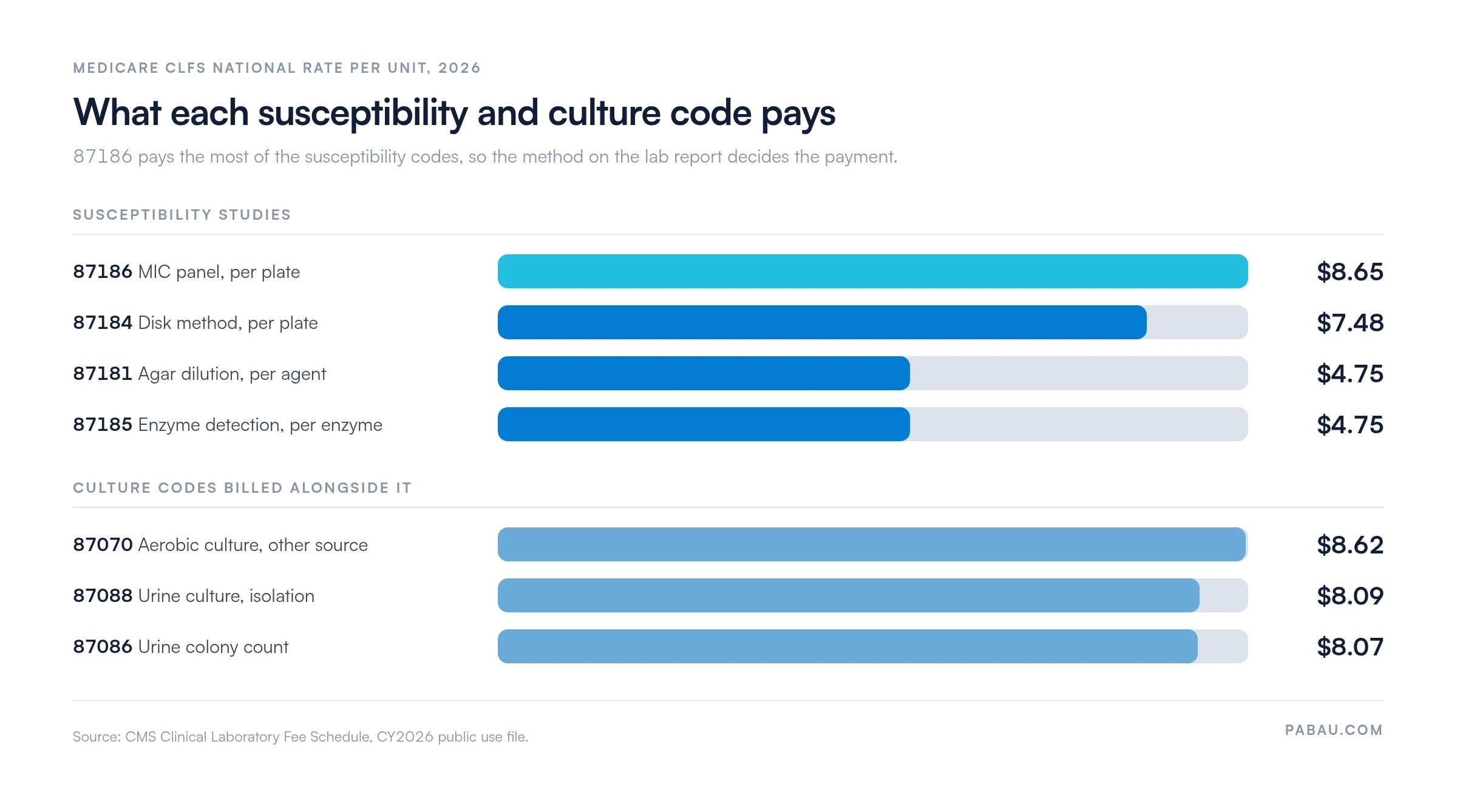
The CY2026 CLFS lists 87186 at $8.65 per plate. Disk diffusion (87184) pays $7.48, while 87181 and 87185 each pay $4.75. The chart below sets 87186 against those codes and the culture codes billed with it.
CMS publishes the CLFS files each January, with quarterly updates for new and revised codes. Commercial payers often pay a percentage of Medicare or use their own schedule. Compare each remittance against the contracted rate to catch underpayments early.
Most CPT code 87186 denials trace back to five root causes, and they show up across lab types and payers.
Sort denials by root cause across all your lab codes, not only 87186, to see patterns a claim-by-claim review hides. Grouping the medical billing denial codes on your remittances by CPT code shows whether a problem is practice-wide or tied to one ordering provider. A practice-wide problem usually sits in the documentation workflow.
A CPT code 87186 claim that holds up needs documentation in two places: the provider’s chart, which shows medical necessity, and the lab report, which shows what was performed. An audit that finds one without the other will recoup the payment.
The lab report must connect back to the physician order and the clinical record. When those three documents align, the claim holds up. Capture the method and plate count when the result is reported, so coders never rebuild them from a partial report.
Audit five random 87186 claims per month: pull the physician order, the lab report, and the remittance. If any of the three is missing or mismatched, fix the step that produced it. That is faster than appealing denials one at a time.
The errors behind most 87186 denials start as data entry. A unit count gets typed from memory, a screening diagnosis slips through, or the susceptibility line goes out without its culture. Catching them by hand means a coder rechecks every lab claim against the report.
Practice management software like Pabau pulls the patient, treatment and insurer details from the patient record into the claim. Its claims management software runs validation checks each time you send, flagging missing details such as membership numbers and authorization codes. US claims go to payers through the Claim.MD clearinghouse, which also runs real-time eligibility checks before the order.
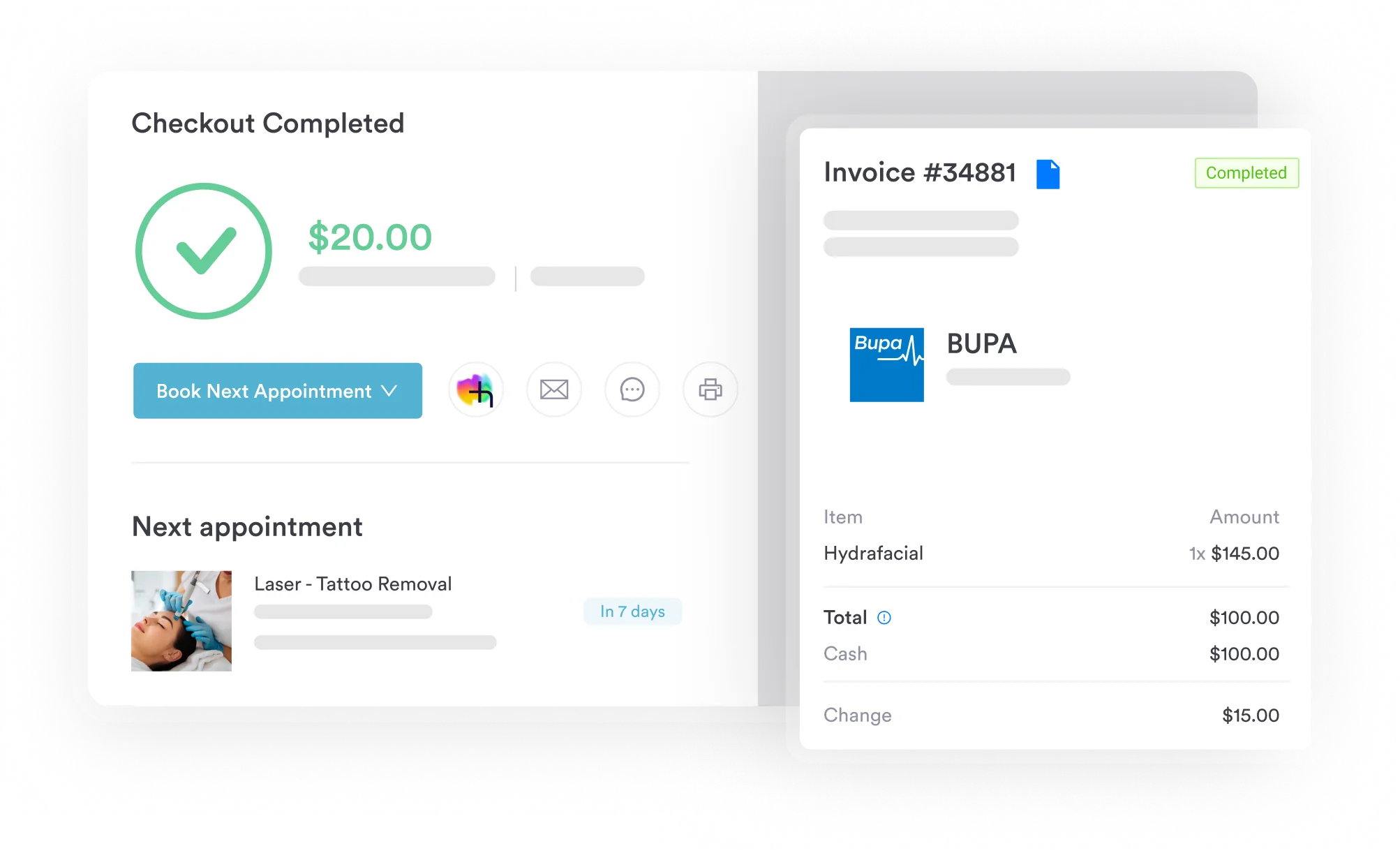
Claim status updates and ERA remittances post back to the same dashboard. When an 87186 line is denied, your team sees the reason code next to the claim. They can fix the plate count or diagnosis without switching systems.

Pabau checks each claim for missing details before it goes out, submits through the Claim.MD clearinghouse and tracks every denial. Your microbiology claims need less manual rework.

A clean 87186 claim depends on three records agreeing: the order, the lab report and the claim. When the report says broth microdilution on three plates, the claim bills three units and the diagnosis matches the specimen.
Recurring denials are usually fixed upstream of billing. Tighten how orders capture the clinical indication and how the lab records plate count, and fewer claims need rework later. Book a demo to see how Pabau’s claim checks and Claim.MD submission keep your lab claims moving.

Need help navigating medical billing from end to end? What is medical billing walks through the full claim lifecycle from patient encounter to payment posting.
Want to reduce claim rejections across all lab codes? Submitting a clean claim covers the pre-submission checklist that prevents the most common microbiology billing errors.
Managing denials across a high-volume lab? Denial management in healthcare explains how to categorize, track, and reverse claim denials by root cause.
Billing the urine culture behind the susceptibility test? CPT code 87088 covers isolation and presumptive identification of urine isolates, with its 2026 fee.
Culturing a wound or sputum specimen? CPT code 87070 explains the aerobic culture code for sources other than urine, blood or stool.
CPT code 87186 covers antimicrobial susceptibility testing by microdilution or agar dilution. It measures the minimum inhibitory concentration (MIC) or breakpoint of each drug against an isolated organism. It is reported per multi-antimicrobial plate and applies to bacterial isolates and to yeasts tested by broth microdilution. Disk diffusion (87184), enzyme detection (87185) and single-agent testing (87181) have their own codes.
Yes, Medicare covers CPT code 87186 when the test is run on an organism from a culture ordered for a medically indicated reason. For urine isolates, the diagnosis must support the culture under NCD 190.12. Blood, wound and sputum isolates fall under MAC policy and the reasonable-and-necessary standard instead. Susceptibility testing for routine surveillance is not covered.
Yes, 87186 and 87086 are separately reportable when both services are performed and documented in the same encounter. The culture code establishes the organism; the susceptibility code covers the follow-on MIC testing. Always verify current NCCI edits before submitting, as bundling rules are updated quarterly and a payer-specific edit could affect this pairing in certain claim contexts.
You need a physician order with a clinical indication and a supporting ICD-10 diagnosis code. The lab report must show the organism identified, the method used, the number of plates and the MIC values or breakpoint interpretations. An audit reviews the provider chart and the lab report together, so the two must agree.