HCPCS Code G0163: Skilled nursing observation and assessment
What is HCPCS Code G0163? HCPCS Code G0163 is a deleted Level II code for skille...

Last Updated: Oct 15, 2026
CPT code 87070 covers aerobic bacterial culture from any specimen source except urine, blood, or stool. Wound swabs, throat cultures, sputum, ear, eye, and cerebrospinal fluid specimens all bill under it.
One fact settles most payment questions about this code. Medicare pays it from the Clinical Laboratory Fee Schedule at a flat national rate of $8.62, not from the Physician Fee Schedule.
Specimen source is what picks the code here, so a swab billed under the wrong number denies on the first pass. The sections below cover the descriptor, the rate, ICD-10 pairings, modifier rules, and the four errors behind most denials.

CPT code 87070 covers aerobic bacterial culture from any source except urine (87086 or 87088), blood (87040), or stool (87045).
Medicare pays 87070 a flat national $8.62 under the Clinical Laboratory Fee Schedule, with no geographic or facility adjustment and no RVUs.
The record must name the specimen source, the clinical indication, the ordering provider, and the collection method and date.
Modifier -QW almost never applies, because 87070 is not on the CMS list of CLIA-waived tests.
Practice management software like Pabau keeps code lookup inside the record, pre-fills the claim from it, and checks required fields before submission.
The official descriptor reads: Culture, bacterial; any other source except urine, blood or stool, aerobic, with isolation and presumptive identification of isolates. Four clauses do the work, and each one narrows the code’s scope.
That fourth clause also separates 87070 from a screening culture. When the lab only screens for a target pathogen and reports it present or absent, 87081 is the code instead.
The American Medical Association’s CPT code set files 87070 in the Pathology and Laboratory section, under Microbiology. That placement matters for one practical reason.
This is a laboratory code rather than a physician service code, so the lab performing the culture bills it, not the clinician who ordered it.
Almost any bacterial culture belongs here, with three exceptions written into the descriptor. Start from the phrase “any other source except urine, blood or stool” and work outward.
Medicare pays $8.62 for CPT 87070 in 2026. That figure sits on the Clinical Laboratory Fee Schedule, which is not where most coders look first. It is a single national amount, unchanged since CMS moved lab pricing to national rates in 2018.
Three questions come up on every fee schedule review, and all three have short answers.
Set against its neighbors, the payment spread is narrow. That changes where the cost of a coding error lands.
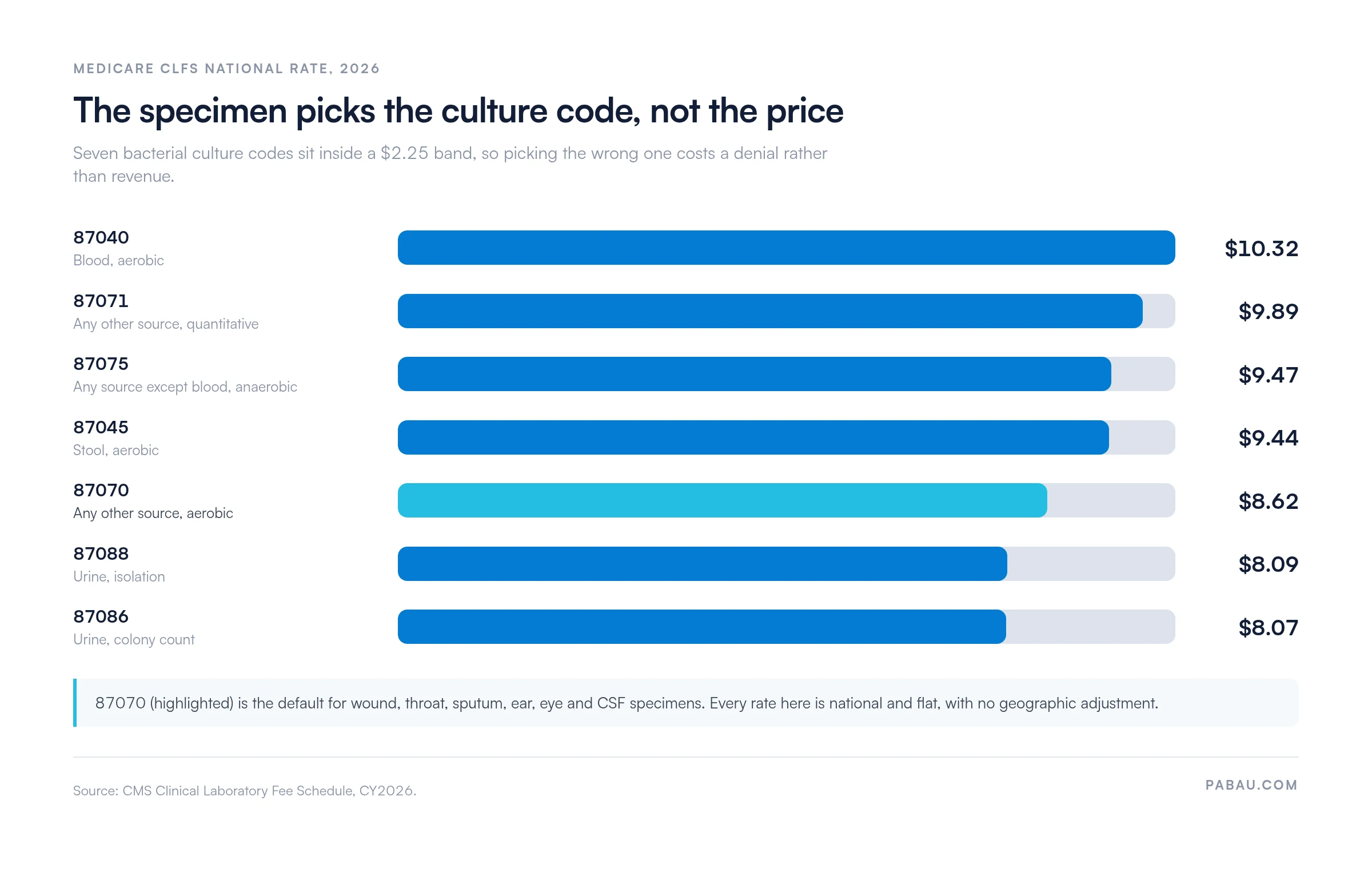
That narrow band is the point. Nobody gains $2 by picking 87070 over 87086, so miscoding buys no revenue. It buys a claim that comes back, gets reworked, and costs far more in staff time than the line was ever worth.
Clinical Laboratory Fee Schedule rates update every January, and CMS posts quarterly corrections on top of that. Pull the current quarter’s CLFS public use file before you set charge master amounts. A Physician Fee Schedule lookup will not return 87070 at all, because the code is not priced there.
Every 87070 claim needs a diagnosis that explains why the culture was ordered. Payers check that the ICD-10 code agrees with the specimen source in the note. A mismatch fails medical necessity review even when both codes are valid on their own.
Here is a pairing that clears without an argument. A patient arrives with a purulent left forearm wound. The provider documents erythema and drainage, then orders an aerobic culture of a left forearm wound swab. The diagnosis coded is L03.114, cellulitis of the left upper limb.
The lab then bills 87070 with L03.114 attached. The diagnosis explains the culture, the specimen is none of the three excluded types, and no part of the claim contradicts another part.
When the indication is less obvious than cellulitis, work back from the ICD-10-CM code set to a diagnosis the record already supports. Adding one after the fact is a familiar audit trigger.
Thin documentation is the most common reason an 87070 claim gets downgraded or denied. Four elements have to be in the record before the claim goes out.
It helps to picture the path the claim takes. The order and diagnosis go into the record, the specimen reaches the lab tagged with its source and collection date, and the result posts back.
The lab drops 87070 onto a charge line with the diagnosis attached, and the 837P file goes out to the clearinghouse. The payer adjudicates it, then returns an electronic remittance advice carrying either a payment or a reason code.
Local Coverage Determinations can add requirements on top of that. Respiratory and CSF specimens are the ones worth checking, since some jurisdictions attach extra expectations to them.
Run that check on every culture line and a clean claim becomes your default rather than your best case.
87070 is a laboratory code, so the modifier list is shorter than it would be for a physician service. These three are the ones that turn up.
Which one gets misused most? -QW, by a wide margin. A site holding only a certificate of waiver cannot perform this culture at all, and appending -QW does not change that. The modifier simply labels a claim that the certificate never covered in the first place.
Several codes sit close enough to 87070 to be picked by mistake. Choosing wrongly by specimen type or by service level drives a large share of microbiology denials.
87086 is the urine code, and swapping the two is the highest-frequency error in outpatient lab billing. The descriptor for 87070 excludes urine outright, and payers run automated edits that read the diagnosis against the specimen type.
Pair 87070 with a urinary tract infection code such as N39.0 and the claim usually denies. The diagnosis says urine while the code says anything but.
Labs that process a wound culture and a urine culture for the same patient on the same date can bill both. Append -59 to one of them, and make sure the documentation names two distinct specimens from two distinct sites.
Check your NCCI edits before billing 87070 alongside susceptibility testing (87186). CMS updates the column one and column two pairs quarterly, so a combination that paid cleanly in Q1 may need documented modifier support by Q3.
Four patterns account for most denials and recoupments on this code. All four are cheapest to fix upstream of the clearinghouse, before a payer ever sees the line.
Billing 87070 for a urine or blood culture is the most common error of the four. Labs processing mixed specimen types in batches sometimes default every line to 87070.
Map each specimen to its own code at the point the batch is built, rather than trusting a scrubber to spot the mismatch later. Scrubbers catch many of these, but not all of them.
A claim with no diagnosis, or one whose diagnosis contradicts the documented source, fails medical necessity review. Every 87070 line needs at least one ICD-10 code explaining why the culture was ordered.
Payers compare the two at adjudication, so a UTI diagnosis sitting next to 87070 reads as a coding error and denies on that basis.
87186 is a natural add-on once a culture grows an organism. It is separately reportable in many situations. The National Correct Coding Initiative decides whether it can go on the same date of service as 87070.
With documentation of a distinct clinical decision, the pair pays. Without it, the second line bundles and disappears. Review the current edits before any standing order is written.
Say a patient has a wound cultured in the morning and sputum cultured that afternoon. Both are 87070, and the second line needs -91 plus a note explaining the separate indication.
Leave the modifier off and the payer treats the two as duplicates, consolidates them, and pays once. The write-off that follows is avoidable and rarely worth appealing at this rate.
Reference sites such as AAPC and FindACode carry accurate descriptors, but they sit outside the record. A coder who leaves the chart to check a descriptor has added a hop to the process. Hops are where transcription errors get in.
Practice management software like Pabau closes that loop by keeping the lookup where the work happens. Pabau’s claims management software carries ICD-10-CM and CPT lookup libraries, so a coder can search 87070 or a cellulitis code without leaving the client file.
The claim form then pre-fills from the record itself. The CPT code already attached to the service lands on the charge line, and the diagnosis slots are seeded from the recorded problem list.
Before the send button unlocks, Pabau checks that the claim’s required fields are complete. It does not choose the code for you, and it does not recommend a modifier. What it does is stop a claim leaving with a missing NPI, a blank authorization field, or an empty diagnosis slot. Those blanks are where lab lines most often fall over.
US claims route through the Claim.MD clearinghouse, which reaches roughly 2,800 payers. Eligibility checks, claim status, and electronic remittance advice all come back into the same system, so posting a paid 87070 line takes no export step.

Pabau’s claims management software puts CPT and ICD-10 lookup inside the client record. It pre-fills the claim form and checks every required field before you submit.

87070 is a small line with an outsized denial rate, and the cause almost always sits upstream of billing. The code gets decided the moment someone writes down what the specimen is.
So the fix belongs to the order, not the scrubber. Put the source and laterality into the order, attach a diagnosis that matches it, and the right code follows on its own. Book a demo to see how Pabau handles code lookup, claim pre-fill, and field validation for lab codes like 87070.

Need to understand how a lab claim reaches the payer? Medical claims clearinghouse guide explains how claims get routed, scrubbed, and adjudicated.
Reading a denial on an 835 file? Electronic remittance advice explained breaks down the reason codes that come back on lab lines.
Building the charge sheet behind the claim? What a superbill is and how to build one shows which fields have to be captured at the point of care.
Working a backlog of denied claims? Denial management in healthcare covers triage, appeal, and the edits worth fixing at the source.
Want the full picture behind lab billing? What is revenue cycle management walks the process from order through to payment posting.
87071 is the quantitative version of the same culture. Both cover any source except urine, blood, or stool, but 87071 reports a colony count and 87070 does not. Medicare pays 87071 $9.89 against 87070’s $8.62.
Yes, when an isolate needs extra methods to identify it definitively. 87070 covers the culture and presumptive identification. 87077 is reported for each isolate that required the additional definitive work, so the bench notes have to show which methods were run.
The specimen collection date, not the date the culture finished growing. Cultures often take two to three days to finalize, so the two dates rarely match. Using the result date can push the claim past a payer’s timely filing window.
Only when you expect Medicare to deny it as not medically necessary. A culture ordered for documented signs of infection normally needs no Advance Beneficiary Notice. Screening cultures on a patient with no symptoms are the case where one protects your ability to bill the patient.
One unit per distinct specimen source. Two swabs taken from the same wound are still one unit. A wound swab and a sputum sample collected the same day are two. The second line needs modifier -91, plus a note on why both were necessary.