

HCPCS code E0198: Water pressure pad billing guide
HCPCS code E0198 is a water pad for a standard mattress HCPCS code E0198 is the ...

Last Updated: Oct 13, 2026
87088 is the CPT code for a bacterial urine culture with isolation and presumptive identification of each isolate. Labs bill it when a urine specimen is cultured and the organisms that grow are isolated and named. The usual reason for the order is a suspected urinary tract infection.
Medicare pays the code under the Clinical Laboratory Fee Schedule at a CY 2026 national rate of $8.09. Coverage turns on documented clinical symptoms under National Coverage Determination 190.12, so routine screening cultures are generally denied. The two codes most often confused with it are 87086 and 87070.
Let Pabau's smart automation suggest the right codes, reduce claim denials, and keep your practice compliant—effortlessly.
Automate repetitive tasks and focus on what matters most—your patients.
Reduce coding errors and ensure compliance with the latest regulations.
Clean claims, fewer denials, and faster reimbursements.
Powerful insights and reporting to help your practice thrive.
HIPAA compliant SOC 2 certified GDPR-compliant Trusted by 4,000+ clinics worldwide

CPT Code 87088 covers isolation and presumptive identification of each isolate from a urine culture, not the quantitative colony count
Medicare pays 87088 under the Clinical Laboratory Fee Schedule at a CY 2026 national rate of $8.09, not under the Physician Fee Schedule
Always pair 87088 with a symptomatic ICD-10 code; routine screening without documented symptoms is not covered
Pabau submits and tracks claims from one dashboard and runs pre-submission validation checks, but coders still assign the CPT and ICD-10 codes
CPT Code 87088 describes “culture, bacterial; with isolation and presumptive identification of each isolate, urine”. The American Medical Association’s CPT code set places it in the Microbiology subsection of Pathology and Laboratory codes. The code pays for the identification work: the lab isolates each organism that grows from the urine specimen and presumptively identifies it.
That isolation step is what separates 87088 from its sibling code 87086. CPT 87086 is the quantitative colony count, which reports how many colony-forming units grew. CPT Code 87088 reports the separate work of isolating and naming each organism, so a full urine culture workup often involves both codes.
Medicare pays CPT Code 87088 under the Clinical Laboratory Fee Schedule (CLFS), not the Physician Fee Schedule. The distinction matters, because the two schedules are built in completely different ways. A CLFS amount comes from reported private payor payment data, so no RVU calculation and no conversion factor sits behind it.
CMS sets each CLFS rate using the weighted median of private payor rates that applicable laboratories report under the Protecting Access to Medicare Act (PAMA). For CY 2026, the CLFS national limitation amount for 87088 is $8.09. Check the current quarterly CLFS file before you rely on any figure, because CMS republishes the schedule every quarter.
The CMS relative value file lists 87088 with 0.00 work, practice expense, and malpractice RVUs. Its status indicator of X means the code is excluded from the Physician Fee Schedule by statute. Any RVU-based rate quoted for this code does not describe how Medicare actually pays it. That holds whether the number comes from a third-party lookup tool or a fee analysis spreadsheet.
Build your lab fee analysis from the CLFS files instead. CMS posts the quarterly and annual files on its CLFS files page, and your Medicare Administrative Contractor publishes the same amounts for your jurisdiction. Many commercial contracts price lab work as a percentage of the CLFS rate. That makes the same file the right starting point for private payer billing.
Medicare governs urine culture coverage under National Coverage Determination 190.12. The code is covered when the ordering clinician documents a clinical indication that justifies the culture. Routine screening without symptoms falls outside coverage.
Confirm the patient’s benefits before the specimen is collected, so any coverage restriction surfaces before the lab does the work.
Private payers largely follow the NCD 190.12 logic but may apply their own prior-authorization rules for repeat cultures. Document the clinical indication clearly in the order, not just in the chart note.
Every claim for CPT Code 87088 must carry at least one ICD-10-CM diagnosis code that establishes medical necessity. The urine culture ICD-10 code you select must match the documented clinical indication. Using an unspecified code when a more specific one is available is one of the most common causes of denial for this test.
A urinalysis (CPT 81001 or 81003) often precedes the culture order. When it shows nitrites or leukocyte esterase, include those findings in the clinical documentation. They strengthen medical necessity and give the ICD-10 code a concrete clinical anchor.
Choosing between CPT Code 87088 and its two closest relatives comes down to what the lab actually did with the specimen. Billing the wrong code, especially reporting 87088 when no isolation or identification was performed, is a common audit trigger. A urine screen that names no isolate and reports only present or absent bills as 87081 instead.
You can bill 87086 and CPT Code 87088 together on the same claim in the right circumstances. That happens when the lab performs the quantitative colony count and then isolates and identifies the organisms that grew. The two codes describe separate steps of the same workup. Confirm your lab’s reporting structure before billing both codes to the same date of service.
Identification under CPT Code 87088 stops at the presumptive level. When additional methods are required to name an aerobic isolate definitively, that step is reported under CPT Code 87077, once per isolate.
Sensitivity and susceptibility testing, when performed, uses a separate code. That is typically 87184 for the disk diffusion method or 87186 for MIC. Both are add-ons to CPT Code 87088, not substitutes.
Strong documentation is the single best defense against denial for CPT Code 87088. Payers audit microbiology codes closely, because culture charges are easy to order without clear clinical justification. Document medical necessity at the point of care, not after the claim is rejected.
Practices using paper requisitions or manual code assignment are most exposed here. A missing or illegible physician signature is enough to trigger a recoupment request during a MAC audit.
Before billing CPT Code 87088, confirm the lab report explicitly states that isolates were identified, not just that the culture was set up. If the report shows only a quantitative colony count, 87086 is the code that describes the work. Billing 87088 without documented isolation and identification is a false claim risk.
Most denials for CPT Code 87088 fall into a short list of repeating patterns. Each one is preventable with a pre-submission checklist, which is where revenue cycle management for lab codes starts.
Each of those failures is created at a specific point in the workflow, and the diagram below shows where.
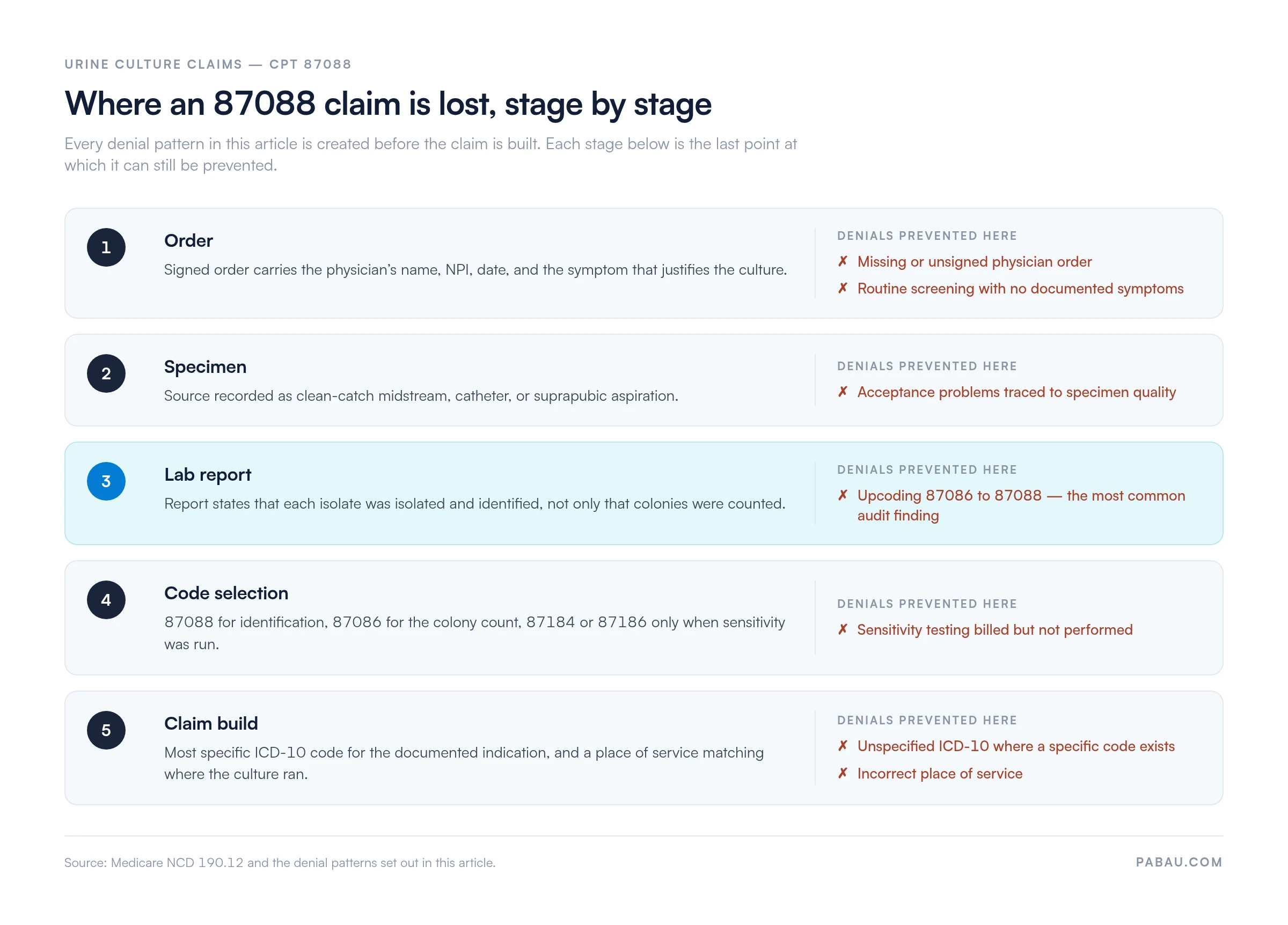
When denials do occur, look up denial codes on the remittance advice before you appeal. They show whether the issue is a coverage determination, a coding error, or a documentation deficiency. Each of those needs a different appeal.
Lab billing usually runs across two disconnected records. A practitioner orders the urine culture and the lab returns a result. A biller then matches that result to a code from memory or from a printed reference sheet. Transcription errors and 87086-versus-87088 mix-ups start there.
Practice management software like Pabau keeps that work in one place, so billers can submit and track claims from a single dashboard. Claim details pre-fill from the invoice already attached to the patient’s record. Pre-submission validation checks then flag the fields payers reject on sight. Your coders and billers still assign the CPT and ICD-10 codes.
For electronic submission, Pabau connects through the Claim.MD clearinghouse, which supports CMS-1500 and 837P claims to thousands of US payers. Eligibility checks before service, ERA remittance posting, and CARC denial tracking feed the same workflow. A denied 87088 claim comes back with enough detail to correct and resubmit.
Tracking denials by CPT code also shows practice managers where the same problem repeats. A provider who keeps ordering cultures on asymptomatic patients shows up in that report before the payer notices.

Pabau pre-fills claims from your invoice data, runs validation checks before submission, and tracks every claim from one dashboard. See where urine culture claims stall in your billing workflow.

Billing CPT Code 87088 correctly comes down to one question. Did the lab isolate and identify the organisms, or did it only count them? Answer that from the lab report rather than from habit, and the most common audit finding for urine cultures disappears.
The rest is documentation the practice already holds. A signed order naming the symptom, a specific ICD-10 code, and a lab report on file will carry an $8.09 claim through almost any review. At that price, reworking a denial costs more than the payment itself.
Pabau runs validation checks before a claim leaves the practice and tracks each submission through the Claim.MD clearinghouse. To see how that fits your lab billing workflow, book a demo with the Pabau team.

Need to understand how clean claims reduce lab denials? Clean claim submission checklist walks through every element required for first-pass acceptance.
Want to see how electronic claims work end to end? Medical billing workflow guide explains the full journey from service to payment.
Looking to reduce your practice’s denial rate? Denial management in healthcare covers structured appeal workflows and root-cause tracking.
Checking a patient’s cover before the specimen goes to the lab? Insurance eligibility verification sets out what to confirm at intake.
CPT Code 87088 is the billing code for a bacterial urine culture with isolation and presumptive identification of each isolate. Labs use it when they culture a urine specimen, isolate the organisms that grow, and identify them. The result confirms a urinary tract infection and guides antibiotic selection. The quantitative colony count is billed separately under CPT 87086.
The most common ICD-10 codes billed with CPT Code 87088 are N39.0 (urinary tract infection, unspecified), N30.00 (acute cystitis without hematuria), and N10 (acute pyelonephritis). R30.0 (dysuria) and O23.40 (UTI in pregnancy) are also frequent pairings. Use the most specific code that matches the documented clinical indication.
No. Medicare National Coverage Determination 190.12 does not cover routine urine cultures ordered without documented symptoms or clinical indication. Coverage requires that the ordering clinician document a symptomatic basis, such as dysuria, frequency, or suspected UTI. Asymptomatic bacteriuria screening in non-pregnant adults is generally not a covered indication.
CPT Code 87088 has no usable RVU value. The CMS relative value file lists it with 0.00 work, practice expense, and malpractice RVUs. Its status indicator of X means the code is excluded from the Physician Fee Schedule by statute. Medicare pays it under the Clinical Laboratory Fee Schedule instead, at a CY 2026 national rate of $8.09. Check the current quarterly CLFS file from CMS rather than an RVU lookup tool.



