

CPT Code 30801: Superficial turbinate ablation billing guide
CPT Code 30801: Official descriptor and procedure overview The American Medical ...

Last Updated: Nov 27, 2026
78707 is the CPT code for kidney imaging morphology with vascular flow and function, as a single study without pharmacological intervention. It covers one renal scan, usually with Tc-99m MAG3 or DTPA, that images perfusion and then tracks uptake and drainage in both kidneys.
A drug challenge, such as an ACE inhibitor or diuretic, moves the study to 78708. A baseline plus a drug-challenge study is 78709, and flow images without function analysis are 78701.
Let Pabau's smart automation suggest the right codes, reduce claim denials, and keep your practice compliant—effortlessly.
Automate repetitive tasks and focus on what matters most—your patients.
Reduce coding errors and ensure compliance with the latest regulations.
Clean claims, fewer denials, and faster reimbursements.
Powerful insights and reporting to help your practice thrive.
HIPAA compliant SOC 2 certified GDPR-compliant Trusted by 4,000+ clinics worldwide

CPT code 78707 is one renal flow and function study with no drug given for it. It covers perfusion images plus time-activity analysis of both kidneys.
A flow study without function analysis is 78701. Give an ACE inhibitor or diuretic during the study and the code becomes 78708.
A baseline study plus a drug-challenge study is 78709, reported once. A planned captopril protocol is never billed as 78707 twice.
Report 78707 once per session, with no LT, RT or 50. The scan covers both kidneys, and Medicare gives it bilateral indicator 0.
Pabau, a practice management platform, sends US claims through Claim.MD and warns staff when a case is missing its prior authorization.
CPT code 78707 is a single nuclear medicine kidney study that images renal blood flow and kidney function without a drug challenge. CMS lists it in its 2026 Physician Fee Schedule relative value files as “K flow/funct image w/o drug.” The full CPT descriptor reads:
Kidney imaging morphology; with vascular flow and function, single study without pharmacological intervention.
The descriptor sets three conditions. Vascular flow and function means perfusion images plus time-activity analysis of uptake and drainage. Single study means one dynamic acquisition. Without pharmacological intervention means no ACE inhibitor or diuretic was given for the study.
Codes 78707, 78708 and 78709 replaced the deleted code 78704. Billed without a modifier, 78707 is a global service covering the technical acquisition and the physician interpretation. Its Medicare global period indicator is XXX, so no global surgery period applies.
A 78707 scan is one dynamic acquisition with no drug challenge. It is often ordered to follow a transplant kidney, to measure split function before a nephrectomy, or to check perfusion after a suspected renal infarction.
Split function and time-activity curves are part of the function component that 78707 already includes. Reporting them does not move the scan to 78708. Only a drug given for the study does that.
The tracer changes the clinical output and the HCPCS supply code, but not the CPT code. A MAG3 study and a DTPA study both bill as 78707 when one study is performed with no drug.
The report must name the agent, the administered activity in millicuries and the route. A common chargemaster error pairs MAG3 with A9512, which is sodium pertechnetate, or DTPA with A9500, which is sestamibi. Neither belongs on a renal flow and function claim.
Medical necessity for 78707 rests on a diagnosis that explains why flow and function were needed. Payers check the linked ICD-10-CM code against their coverage policy, so the order should name the clinical question.
Check the coverage article for your Medicare Administrative Contractor (MAC) before you submit. Contractors word their diagnosis lists differently and revise them, so a pairing that paid last year may now need more documentation.
Before you submit a 78707 claim, check the linked ICD-10 code against your MAC’s coverage article for nuclear medicine renal imaging. Review those articles each quarter, since a diagnosis pairing can drop out of coverage between claims.
The kidney imaging codes split on three questions. Was function analyzed as well as flow? How many studies were acquired? Was a drug given for any of them? Answer each one from the final report, in the order the flow below runs them, before you pick a code.
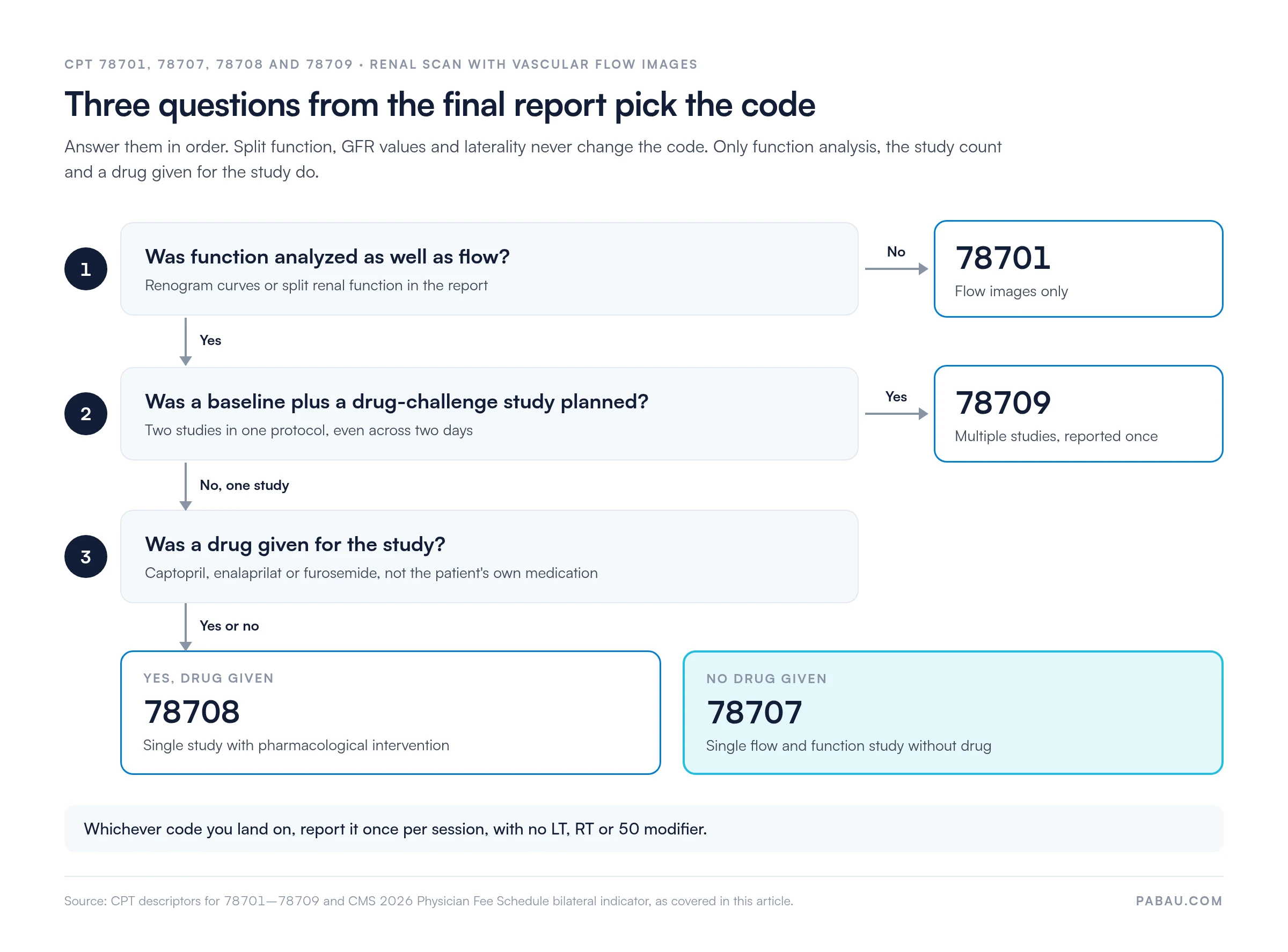
The sister page on CPT code 78708 covers the drug-challenge study in depth, including the diuretic and ACE inhibitor protocols. You can look up CPT codes for the rest of the 78700-78799 genitourinary range in Pabau’s procedural billing reference.
ACE inhibitor (captopril) renography and diuretic renography both put a drug into the study. That drug is the pharmacological intervention named in the 78708 and 78709 descriptors. Neither protocol is billed as 78707, and a planned two-study protocol is never billed as 78707 twice.
Payers watch this pairing closely. Two units of 78707 carry 12.54 total RVUs in 2026, against 9.77 for one unit of 78709. The AAPC Radiology Coding Alert on ACE renal scans warns that 78707 billed twice for a planned protocol can be read as unbundling.
Write the drug challenge into the order. When the order names captopril or furosemide and a possible baseline, coders can see at once whether the session is 78708 or 78709. The report then backs that code with the drug, dose and timing.
Billed without a modifier, 78707 is a global service. When one entity acquires the images and another interprets them, the claim is split with modifiers.
Medicare’s 2026 fee schedule gives 78707 bilateral indicator 0, so the bilateral payment adjustment does not apply. Report one unit per session without LT, RT or 50, unless a payer’s written policy asks for laterality. A patient with a single kidney or a transplant still gets one unit.
Split billing is the more common modifier problem. Apply 26 when the physician only interprets, and TC when the facility owns the equipment and staff. An entity that does both bills the global code with no modifier.
CMS publishes RVUs for 78707 each year in the Medicare Physician Fee Schedule. The 2026 national values below come from the October release of the CMS relative value file. Payment then varies by locality through the Geographic Practice Cost Index (GPCI).
Those payments use the 2026 conversion factor of $33.4009. Qualifying Advanced APM participants are paid at $33.5675, which lifts the global figure to about $210.47. Confirm your locality rate in the CMS Physician Fee Schedule lookup tool before you set fees.
The neighboring codes do not rise in step. In 2026, 78708 carries 5.16 total RVUs, fewer than the 6.27 for 78707, while 78709 carries 9.77. A correctly coded drug study can pay less than 78707, so the choice has to follow the report.
In a physician office, the A9562 or A9539 tracer line is paid on top of the scan. Hospital outpatient payment under OPPS packages diagnostic radiopharmaceuticals into the procedure instead.
Medicare Part B covers 78707 when the record supports medical necessity. Hospital outpatient claims are paid under OPPS, while freestanding imaging centers and physician offices are paid under the Physician Fee Schedule.
Medicare has no national prior authorization requirement for 78707. Many commercial and Medicare Advantage plans do require it, and some route nuclear medicine through a radiology benefit manager. Check each plan before you book the scan.
Request authorization for the protocol you may run. If a plan approved 78707 and the radiologist adds a drug challenge, the code becomes 78708 or 78709, and the approval may need updating. Practices using Pabau’s Claim.MD clearinghouse integration can check eligibility before the scan date.
A clean 78707 claim needs a report that maps to each element of the descriptor: Flow, function, one study and no drug. The report is also the first document an auditor reads.
The function analysis is the element most often left out. A report that shows perfusion images with no curves or split function does not support 78707. Query the interpreting physician before the claim goes out, rather than guessing at a different code.
Structured report templates catch a missing element before the charge is captured. Pair them with a clean claim checklist before submission. The superbill documentation framework shows how to structure the handoff from the report to the claims team.
Most 78707 denials follow a few repeating patterns, and each one shows up in the report before it shows up on a remittance. Good denial management workflows for nuclear medicine check the report before the claim leaves, so fewer cases reach appeal.
Some codes belong on the same claim as 78707, and some replace it.
Renal scan billing trips on three points at once. The code turns on the drug and the study count, the tracer carries its own HCPCS line, and commercial plans set their own authorization rules.
With Pabau, US practices submit claims electronically as CMS-1500/837P files through Claim.MD. Staff check eligibility before the scan date and post ERA remittances back against each claim. Secondary claims go out from the same record.
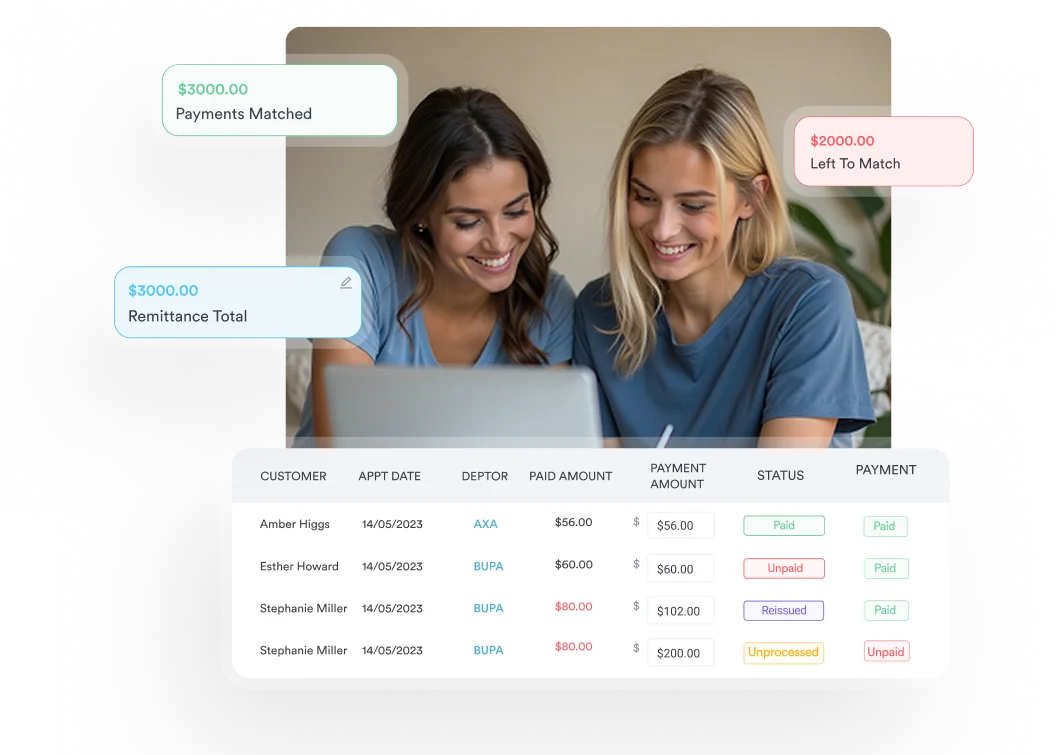
Prior authorizations sit on the patient’s case with their code, dates and sessions, and Pabau warns staff when one is missing. When a 78707 scan grows into a 78709 protocol, staff can see at once which approval is on file. For the wider picture, see how revenue cycle management ties these steps together.

Pabau sends US claims through Claim.MD, checks eligibility before the scan and posts ERA remittances to each claim. Prior authorizations sit on the patient’s case, with a warning when one is missing.

Code 78707 from the final report, not the order. One flow and function study with no drug given is 78707, and a drug given for that study makes it 78708. A baseline plus a drug challenge is 78709, reported once.
Two shortcuts cost practices money on audit. Billing a planned captopril protocol as 78707 twice reads as unbundling. Choosing 78708 because the report shows split function is a coding error, and in 2026 it pays less than 78707 anyway.
Pair the scan with A9562 or A9539 and a diagnosis that explains why it was ordered. Book a demo to see how Pabau sends renal scan claims through Claim.MD and tracks their authorizations.

Need a foundation for your nuclear medicine billing workflow? Claim.MD clearinghouse guide explains how electronic claim submission and ERA processing work for US practices.
Seeing repeated claim rejections across your nuclear medicine codes? Denial codes in medical billing breaks down CARC reason codes and what each denial type requires to resolve.
Building a new nuclear medicine billing protocol? Insurance eligibility verification covers how real-time eligibility checks prevent coverage-based denials before the date of service.
CPT code 78707 is kidney imaging morphology with vascular flow and function, as a single study without pharmacological intervention. It covers one nuclear medicine renal scan that images perfusion and then tracks uptake and drainage. No ACE inhibitor or diuretic is given for the study.
The difference is the drug. CPT 78707 is a single flow and function study with no pharmacological intervention. CPT 78708 is the same single study with a drug given for it, such as captopril, enalaprilat or furosemide. Split function and GFR values belong to both codes and do not decide between them.
CPT 78701 is kidney imaging morphology with vascular flow only. CPT 78707 adds function, meaning time-activity curves that track uptake, transit and drainage, usually with split renal function. A report with perfusion images but no function analysis does not support 78707.
Bill one drug-challenge study as 78708. When a baseline study and a post-captopril study are both performed as a planned protocol, report 78709 once. Do not bill the protocol as 78707 twice, which payers can treat as unbundling.
No. The study images both kidneys in one acquisition and is reported once per session. Medicare’s 2026 fee schedule gives 78707 bilateral indicator 0, so the bilateral payment adjustment does not apply. Use 26 or TC only when the professional and technical components are billed separately.
Tc-99m MAG3 is billed as A9562 and Tc-99m DTPA as A9539, one unit per study dose. The tracer changes the HCPCS supply code but not the CPT code. Hospital outpatient payment packages the tracer into the scan.
In 2026, CPT code 78707 carries 6.27 total RVUs nationally. At the $33.4009 conversion factor, that is about $209.42 for the global service before GPCI adjustment. The professional component pays about $43.42 and the technical component about $166.00.
Medicare has no national prior authorization requirement for CPT code 78707. Many commercial and Medicare Advantage plans do require it. Confirm the requirement for each patient’s plan at eligibility verification, and ask for the full protocol in case a drug study is added.




