CPT code 85651: Erythrocyte sedimentation rate, non-automated
CPT code 85651: Definition, descriptor, and code summary CPT code 85651 is the p...

Last Updated: Nov 24, 2026
78708 is the CPT code for kidney imaging with vascular flow and function, single study, with pharmacological intervention such as an ACE inhibitor or diuretic. It covers one renal scan acquired with the drug challenge, read and reported as one study.
A single study without a drug is CPT 78707. When a baseline scan and a drug-challenge scan are both acquired, the multiple-study code 78709 applies instead.
Let Pabau's smart automation suggest the right codes, reduce claim denials, and keep your practice compliant—effortlessly.
Automate repetitive tasks and focus on what matters most—your patients.
Reduce coding errors and ensure compliance with the latest regulations.
Clean claims, fewer denials, and faster reimbursements.
Powerful insights and reporting to help your practice thrive.
HIPAA compliant SOC 2 certified GDPR-compliant Trusted by 4,000+ clinics worldwide

CPT 78708 reports one kidney flow and function study performed with a drug challenge, such as captopril (an ACE inhibitor) or furosemide (a diuretic).
Use 78707 for a single study without a drug, and 78709 when a baseline study and a drug study are both acquired.
NCCI bundles 78707 into 78708, so the two are never reported together for the same session.
Bill the tracer on its own line: A9562 for Tc-99m MAG3 or A9539 for Tc-99m DTPA, one unit per study dose.
In Pabau, a practice management platform, US claims go through Claim.MD and a missing prior authorization raises a warning on the case.
CPT code 78708 covers one kidney scan with vascular flow and function, performed with a drug challenge such as an ACE inhibitor or a diuretic.
The AAPC Radiology Coding Alert lists it as the single-study code with pharmacological intervention, between 78707 and 78709. Its descriptor reads: Kidney imaging morphology; with vascular flow and function, single study, with pharmacological intervention (eg, angiotensin converting enzyme inhibitor and/or diuretic).
The descriptor turns on two phrases. Single study means one dynamic acquisition, and with pharmacological intervention means the drug was part of that acquisition. A scan with no drug is 78707, and a session that adds a baseline acquisition is 78709.
Billed without a modifier, 78708 is a global service covering both the technical acquisition and the physician interpretation. Its Medicare global period indicator is XXX, so the global surgery concept does not apply.
A 78708 scan is one dynamic acquisition with a drug on board. Two protocols account for most of them: ACE inhibitor renography for suspected renovascular hypertension, and diuretic renography for suspected obstruction.
Many departments run the drug study first and add a baseline scan only if that study is abnormal. If the baseline is never needed, the session stays a single study and 78708 applies. If a baseline acquisition is added the same day, both studies are reported together as 78709.
The tracer changes the clinical output and the HCPCS supply code, but not the CPT code. A MAG3 study and a DTPA study both bill as 78708 when one drug-challenge study is performed.
A common error pairs MAG3 with A9512, which is sodium pertechnetate, or DTPA with A9500, which is sestamibi. Neither belongs on a renal flow and function claim. Check the current-year HCPCS file before loading these codes into a chargemaster.
Medical necessity for 78708 rests on a diagnosis that explains why the drug challenge was needed. The order should name the clinical question, such as suspected renal artery stenosis or suspected obstruction.
Always check supported ICD-10-CM codes against the active Local Coverage Determination (LCD) for your MAC jurisdiction. LCD language changes, and a diagnosis covered under a prior version may now need more documentation or a different code.
The four kidney imaging codes split on two questions. Was flow and function imaged, and how many studies were acquired, with or without a drug? Answer both from the final report before picking a code.
Key decision point: Count the studies first. One study with a drug is 78708, and one study without a drug is 78707. A baseline study plus a drug-challenge study on the same day is 78709, reported once and never as 78707 plus 78708. The decision tree below runs the same three questions in order.
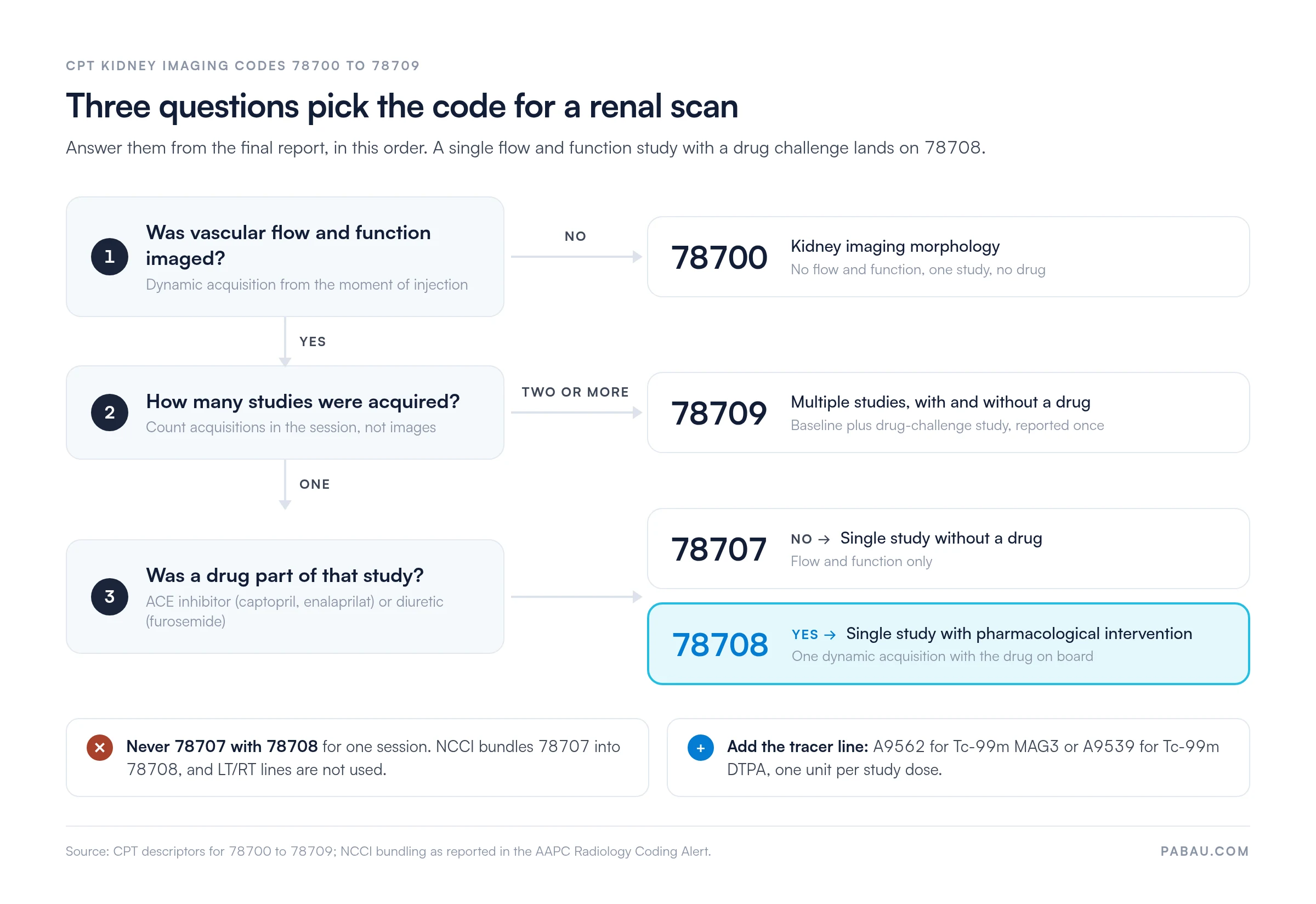
The baseline is sometimes ordered later, after the first study has been read, and acquired on another date. The AAPC alert walks through that case, so confirm the approach with your payer before coding it.
Billed without a modifier, 78708 is a global service. When one entity acquires the images and another interprets them, the claim is split with modifiers.
Some nuclear medicine physicians also have a stake in a freestanding imaging center. Confirm which tax ID and NPI go on the claim before appending 26 or TC. A global 78708 from one entity and a 26 line from another for the same scan will deny as a duplicate.
CMS publishes RVUs for 78708 each year in the Medicare Physician Fee Schedule. The 2026 national values below come from the FastRVU listing for 78708. Payment then varies by locality through the Geographic Practice Cost Index (GPCI).
At the 2026 conversion factor of $33.4009, 5.16 RVUs gives a national global payment of about $172.35 before GPCI adjustment. The professional and technical splits are listed separately, so check the CMS Physician Fee Schedule lookup tool before setting fees.
In a physician office, the A9562 or A9539 tracer line is paid on top of the scan. Hospital outpatient payment packages diagnostic radiopharmaceuticals into the procedure instead.
Medicare Part B covers 78708 when the record supports medical necessity and the claim meets the applicable Local Coverage Determination. Keep the ordering physician’s notes ready for a records request.
Hospital outpatient claims for 78708 are paid under the Hospital Outpatient Prospective Payment System (OPPS). Freestanding imaging centers and physician offices are paid under the Physician Fee Schedule. Sound medical billing compliance means your charge capture records which setting applies.
Medicare has no national prior authorization requirement for 78708, but many commercial plans do. These plans often route nuclear medicine through a radiology benefit manager, so check each plan’s list before scheduling.
A clean 78708 claim needs a report that maps to each element of the descriptor: flow, function, one study and the drug. The report is also the first document an auditor reads.
Building a clean claim submission workflow starts with checking these elements before the charge is captured:
Most 78708 denials follow a few repeating patterns. Denial management workflows that catch them before submission prevent the delays a returned claim causes.
Run a quarterly audit of your 78708 claims. Pull 90 days of denials and group them by reason code. If CARC 197 (authorization absent) or CARC 16 (missing information) leads the list, fix scheduling and report capture rather than reworking claims one by one.
Several codes belong on the same claim as 78708, and two pairings never do.
Renal scan billing trips on three points at once. The code family splits by study count and drug use. Tracer lines carry their own HCPCS codes, and prior authorization rules change from plan to plan.
In Pabau’s claims management software, US practices send CMS-1500/837P claims through Claim.MD. Staff check eligibility before the scan date and post ERA remittances back against each claim. The authorization code, dates and sessions sit on the patient’s case, with a warning when one is missing.
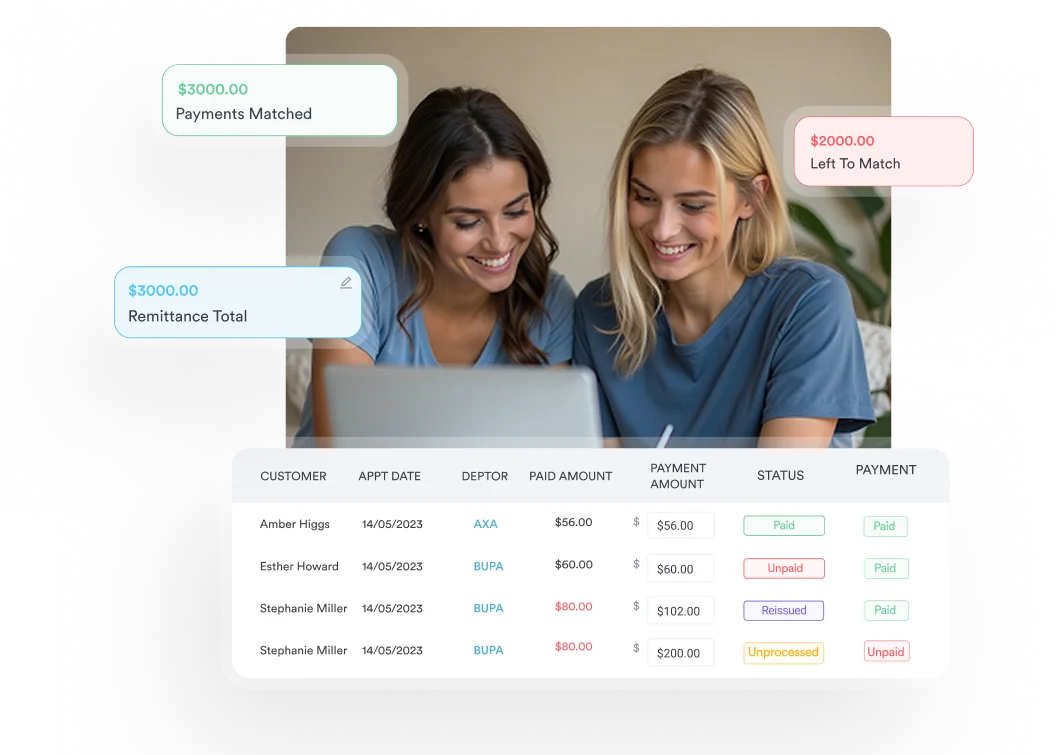
The result is a 78708 scan that is never booked without its authorization, and a short-paid tracer line that stands out when the remittance posts. For the wider picture, see how revenue cycle management ties these steps together.

Pabau sends US claims through Claim.MD and warns when a prior authorization is missing, so renal scan claims go out with the right paperwork.

Code 78708 from the report, not the order. One acquisition with a drug challenge is 78708, and a same-day baseline turns the session into 78709.
Pair the scan with A9562 or A9539 and a diagnosis that explains why the drug was given. Request authorization for the protocol you may run, since a protocol that grows mid-session changes the code. Book a demo to see how Pabau tracks authorizations and claims for nuclear medicine billing.

Need to understand how claims reach payers? Claim.MD clearinghouse guide explains how the Pabau integration routes electronic claims and handles ERA responses.
Seeing recurring denial codes on radiology claims? Denial codes in medical billing breaks down common CARC denial reason codes and the corrective steps for each.
Want to verify eligibility before the scan date? Insurance eligibility verification explains how eligibility checks through Claim.MD catch coverage problems before the scan date.
CPT 78708 covers one kidney imaging study with vascular flow and function, performed with a pharmacological intervention such as an ACE inhibitor or a diuretic. The tracer is billed separately, as A9562 for MAG3 or A9539 for DTPA.
Both are single studies of renal flow and function. 78707 is performed without a drug, while 78708 includes a drug challenge such as captopril or furosemide. NCCI bundles 78707 into 78708, so they are never reported together for one session.
Use 78709 when more than one study is acquired, typically a baseline scan and a drug-challenge scan on the same day. It is reported once and replaces 78708.
Medicare Part B covers CPT 78708 when medical necessity is documented and the claim meets the Local Coverage Determination for your MAC jurisdiction. That LCD defines the covered diagnoses and documentation requirements, so check the active version before submitting.
Modifier 26 reports the physician interpretation alone, and TC reports the technical acquisition alone. Use 59 or XS only for a distinct service that an NCCI edit would otherwise bundle. Do not use LT or RT, because 78708 covers both kidneys.
The most common causes are a wrong study count, a missing drug record, an unsupported or invalid diagnosis code and a missing prior authorization. Wrong tracer codes, such as A9512 or A9500 on a renal scan, cause line-level denials.
No. 78709 already covers a baseline study and a drug-challenge study. When both are performed on the same day, report 78709 alone.