HCPCS Code L0472: Hyperextension TLSO billing guide
HCPCS code L0472: Official descriptor and device definition HCPCS code L0472 des...

Last Updated: Nov 5, 2026
76810 is the CPT add-on code for a complete obstetric ultrasound of each additional fetus after the first trimester. It applies from 14 weeks 0 days, uses a transabdominal approach, and is never billed alone.
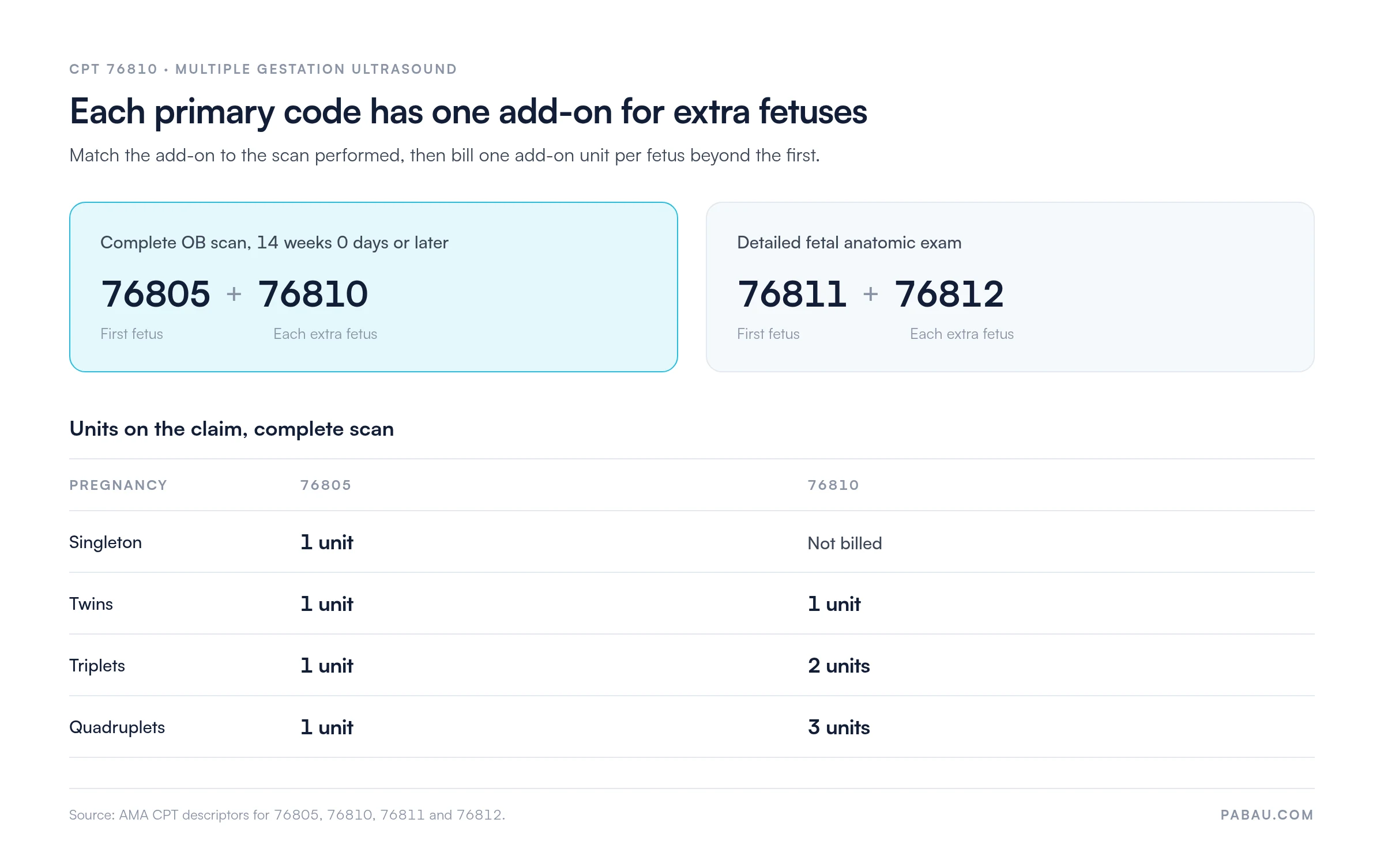
Report 76810 with 76805, which covers the first fetus, and add one unit per extra fetus. Twins take one unit and triplets take two. A detailed anatomic exam uses 76811 with its own add-on, 76812, instead.
Let Pabau's smart automation suggest the right codes, reduce claim denials, and keep your practice compliant—effortlessly.
Automate repetitive tasks and focus on what matters most—your patients.
Reduce coding errors and ensure compliance with the latest regulations.
Clean claims, fewer denials, and faster reimbursements.
Powerful insights and reporting to help your practice thrive.
HIPAA compliant SOC 2 certified GDPR-compliant Trusted by 4,000+ clinics worldwide

CPT Code 76810 is an add-on code for each additional fetus, reported with 76805 for the first fetus and never billed alone.
Bill one unit of 76810 per additional fetus, so twins take 76805 plus one unit and triplets take 76805 plus two units.
A detailed anatomic exam pairs differently, with 76811 for the first fetus and 76812 for each additional fetus.
The ICD-10 code must reflect the fetal count, using the O30 multiple gestation series rather than a singleton code.
Medicare’s 2026 national global rate for 76810 is about $88.51 before GPCI adjustment, at the non-QP conversion factor.
CPT Code 76810 is the add-on code for a complete obstetric ultrasound of each additional fetus in a multiple gestation, performed after the first trimester. Its official descriptor covers a real-time transabdominal ultrasound of the pregnant uterus with image documentation. It includes fetal and maternal evaluation after the first trimester, at 14 weeks 0 days or later, for each additional gestation. The American Medical Association (AMA) CPT Editorial Panel maintains it within the 768xx obstetric ultrasound family.
As an add-on, 76810 is never reported alone. It always appears on the same claim as 76805, the complete OB ultrasound for the single or first gestation after 14 weeks. The phrase “each additional gestation” is the operational signal: one unit of 76810 per additional fetus, not one unit per scan or per visit. Check the pairing on every multiple gestation claim, because a detailed anatomic exam uses a different add-on, 76812.
Payers and the American Institute of Ultrasound in Medicine (AIUM) expect each additional fetus billed under 76810 to have its own complete documentation. Scanning only the primary fetus completely and noting the additional fetus briefly is a common documentation shortfall that supports a denial.
For each fetus billed under 76810, the ultrasound report must document all of the following:
ACOG (American College of Obstetricians and Gynecologists) guidelines note that higher-order multiple gestations carry increased surveillance requirements. Payer LCDs often cite ACOG practice bulletins as the standard of care, so aligning documentation with ACOG-specified parameters strengthens the record against audit.
The 768xx OB ultrasound family is where most coding errors originate. 76810 vs 76811 is the highest-confusion pairing, but mixing up 76815 (limited) and 76816 (follow-up) with 76810 (add-on) causes denials too. The table below maps each code to its clinical scenario.
Critical rule: CPT Code 76810 and 76812 are both add-on codes, and each has one primary code. 76810 pairs with 76805, the complete scan after 14 weeks. 76812 pairs with 76811, the detailed fetal anatomic exam. Reporting 76810 under 76811 is a pairing error that payers deny. Check the AAPC CPT code reference for the current annual descriptor before each coding year.
CPT Code 76810 is billed per additional fetus, not per encounter. One unit covers one additional fetus. The number of units on the claim line must match the number of fetuses beyond the first.
A detailed anatomic exam of twins follows the same unit logic with its own pair. It is reported as 76811 plus one unit of 76812. The diagram below sets the two pairs side by side.
On the CMS-1500 claim form, enter 76810 on its own line with the unit count in Box 24G. Each unit must correspond to a fully documented fetus in the ultrasound report. Payers that apply frequency limitations may cap the total number of complete OB ultrasounds per pregnancy. Confirm the payer’s specific policy before billing multiple units on a single date.
Modifier selection for CPT Code 76810 follows standard diagnostic imaging rules. The choice turns on who owns the equipment and who interprets the scan.
Global OB package note: Antepartum ultrasound is not part of the global obstetric package billed under 59400, 59510, 59610 or 59618. So 76810 is billed separately with 76805, even when the delivering practice performs the scan. A few commercial contracts handle OB imaging differently, so confirm the payer’s policy. CMS updates its NCCI edit tables quarterly, so check them before assuming a code pair is always payable or always bundled.
The ICD-10 code on a 76810 claim must reflect the number of fetuses. Billing 76810 with a singleton pregnancy code (such as Z34.x or O09.x for a single gestation) commonly leads to medical necessity denials. The payer sees no clinical rationale for a multiple gestation add-on when the diagnosis says one fetus.
Select the most specific code available, including trimester (first, second, third) and, where known, chorionicity (monoamniotic, monochorionic, dichorionic). The ICD-10 trimester designator on the O30 code should align with the gestational age documented in the ultrasound report. Mismatches between the trimester in the diagnosis code and the gestational age in the sonography report are a secondary audit risk. For related fertility procedure CPT codes that often precede multiple gestation pregnancies, confirm that the diagnosis code trail is consistent from the originating encounter forward.
Medicare sets reimbursement for CPT Code 76810 each year through the Medicare Physician Fee Schedule (MPFS). It varies by location through Geographic Practice Cost Indices (GPCIs). The figures below are national amounts before GPCI adjustment, so payment in any given locality will differ.
These figures multiply the total RVUs in the 2026 CMS physician fee schedule RVU file by the $33.4009 non-QP conversion factor. Clinicians paid at the QP conversion factor of $33.5675 receive slightly more. CMS updates the rates each January. Verify current payment through the CMS Physician Fee Schedule lookup tool with your Medicare Administrative Contractor (MAC) locality code. Commercial payer rates for CPT Code 76810 vary widely and are typically negotiated as a percentage of Medicare or set by contract.
Before billing CPT Code 76810 to a commercial payer, pull that payer’s coverage policy for obstetric ultrasound. Frequency limits for multiple gestation scans vary. Some plans allow one complete OB ultrasound per trimester, while others follow clinical criteria tied to ACOG guidance. Confirming limits at eligibility verification prevents CO-119 denials after the scan is complete.
Strong documentation is the primary defense against retrospective audit of a 76810 claim. The ultrasound report must stand on its own as evidence of a complete scan of the additional fetus, with each clinical component assessed and recorded.
Required documentation elements for each additional fetus billed under 76810 include:
Payers conducting post-payment audits request the complete signed ultrasound report, not just the billing record. A report that details the primary fetus but only notes “additional fetus also visualized” cannot support a separate 76810 charge. A documented medical billing compliance process keeps the order, the report and the claim tied to the same date of service. Our guide to clean claim submission covers the documentation checklist to run before each claim goes out.
Most denials on CPT Code 76810 claims are preventable. The patterns below are the common ones in OB/GYN billing, along with the standard appeal approach for each.
A pre-submission check can flag 76810 claims that lack 76805 or an O30 ICD-10 code. It catches the two most preventable denial patterns before the claim reaches the payer. Structured denial management workflows that track CARC codes by procedure code help OB/GYN practices fix recurring patterns at charge entry. Our guide to medical billing denial codes explains each CARC in the table and the usual fix.
When a 76810 claim is denied for frequency limit exceeded, check whether the patient’s plan covers additional scans under a separate benefit for high-risk pregnancy. Many commercial plans apply different frequency rules to multiple gestation pregnancies than to singleton pregnancies. Document the multiple gestation diagnosis and file an appeal citing ACOG guidelines on surveillance frequency for twins and higher-order gestations.
Many OB/GYN practices key the 76805 and 76810 lines into a billing system that sits apart from the ultrasound report. With the report and the claim in different places, a missing unit or a singleton diagnosis can reach the payer unnoticed.
Pabau, the practice management platform we build, keeps the signed scan report, the diagnosis and the invoice on one patient record. Its claims management software submits the claim to the clearinghouse through Claim.MD, then tracks its status until payment or denial.
Your coders still choose the codes and the units. The difference is that the record and the claim sit side by side. A denied 76810 line then traces straight back to the report that supports it.

Pabau keeps the ultrasound report, diagnosis and invoice on one patient record, then submits the claim through Claim.MD and tracks it to payment. Your team sees the status of every 76810 claim without switching systems.

CPT Code 76810 rewards a simple habit: count the fetuses in the report before you count the units on the claim. When the report, the O30 code and the 76810 units agree, a payer has little left to question.
The trade-off sits in the detailed scan. A practice that performs anatomic exams on twins switches the whole pair to 76811 and 76812, rather than adding 76810 to a detailed exam.
Book a demo to see how Pabau keeps OB ultrasound reports and claims on one record, so your team can follow each claim to payment.

Need a clearinghouse that handles OB/GYN claims? Pabau’s Claim.MD clearinghouse guide explains how the integration handles 837P electronic submissions and claim status tracking for US practices.
Building a denial prevention workflow? Denial codes in medical billing covers the CARC and RARC codes most commonly returned on OB ultrasound denials, with recommended responses for each.
Want to understand what clean claims look like? Medical billing workflow overview walks through the full claim lifecycle from charge entry to payment posting, including where 76810 errors typically surface.
Billing a detailed anatomic exam instead? CPT code 76811 covers the detailed fetal anatomic exam and its 76812 add-on for each additional fetus.
Coding a repeat scan of a known finding? CPT code 76816 explains the follow-up obstetric ultrasound and what it re-measures.
CPT Code 76810 covers a complete real-time obstetric ultrasound with image documentation for each additional fetus, from 14 weeks 0 days. It is an add-on code, reported alongside 76805 (the primary code for the first fetus) and never billed as a standalone procedure.
Use 76810 for each additional fetus when the primary scan is a complete obstetric ultrasound after 14 weeks (76805). When the primary scan is a detailed fetal anatomic exam (76811), use 76812 as the add-on instead. Pairing 76810 with 76811 is a code mismatch that payers deny.
Yes. Report one unit of CPT 76810 for each fetus beyond the first. Twins take one unit, triplets take two, and quadruplets take three. Enter the unit count in Box 24G on the CMS-1500 form. The ultrasound report must document every required component for each additional fetus.
No. Antepartum ultrasound sits outside the global obstetric package billed under 59400, 59510, 59610 or 59618. Report 76810 separately with 76805 and the right component modifier, whoever performs the scan. A few commercial contracts treat OB imaging differently, so confirm the payer’s policy.
Medicare covers CPT Code 76810 when an O30.x multiple gestation diagnosis code establishes medical necessity. The ultrasound report must also document every required clinical component. Medicare Advantage plans may apply additional coverage criteria. Verify current coverage through your MAC’s LCD and the CMS Physician Fee Schedule lookup tool, as coverage policies and reimbursement rates are updated annually.
The top denial reason is billing 76810 without 76805 on the same claim (CO-107). Next is a singleton ICD-10 code where an O30 multiple gestation code belongs (CO-11). Exceeding the payer’s frequency limit without documented clinical necessity returns CO-119. Incomplete documentation for an additional fetus also triggers post-payment audit recoupment.