CCSD Code F3400: Tonsillectomy guide for ENT practices
What is CCSD Code F3400? CCSD Code F3400 is the Clinical Coding and Schedule Dat...

Last Updated: Oct 22, 2026

CPT code 76811 is the detailed fetal anatomic ultrasound, and its AMA descriptor names no trimester and no gestational sac count.
Only a maternal-fetal medicine specialist, or an equivalently credentialed provider, may bill 76811, however thorough the scan was.
The report has to document every required anatomic structure individually, and explain any structure that could not be seen.
The ICD-10-CM code carries the medical necessity, so a routine obstetric supervision code will not support 76811.
Work RVUs for 76811 sit at 1.85, and billing it in place of 76805 without credentials is an active OIG audit target.
CPT code 76811 is the detailed fetal anatomic ultrasound, the high-risk scan that goes well past a routine anatomy survey. Maternal-fetal medicine specialists perform it, and payers price it above the standard scan, CPT 76805.
The rendering provider’s credential, not the depth of the scan, controls whether the code applies. A general OB/GYN who documents every structure still cannot bill it, and payers recoup the difference years later.
Let’s start with the descriptor itself, because it is narrower than many coding summaries suggest.
76811 covers a fetal and maternal evaluation plus a detailed anatomic examination, performed transabdominally on the single or first gestation.
The American Medical Association maintains the CPT code set and publishes the descriptor as follows:
Ultrasound, pregnant uterus, real time with image documentation, fetal and maternal evaluation plus detailed fetal anatomic examination, transabdominal approach; single or first gestation.
The descriptor names no trimester, and it sets no count tied to gestational sacs. Practices still schedule the exam in the second and third trimesters, once fetal anatomy is developed enough to assess. For twins and higher-order pregnancies, 76812 covers each additional gestation.
Scope is the other half of the definition. A 76811 report reaches every fetal organ system, the placenta, the amniotic fluid, and the maternal adnexa. A careful 76805 report that stops short of that list is still a 76805 report.
Scope and signature are what separate the two codes.
Provider credential and documentation depth separate the two codes, not how carefully the sonographer worked. Billing 76811 where 76805 fits is one of the most flagged patterns in obstetric ultrasound billing.
The table below sets the distinctions side by side.
Payers measure the documentation against the SMFM, AIUM and ACOG consensus report on the detailed fetal anatomic examination. A report that falls short of that standard supports a downcode to 76805, or a flat denial.
In practice, the call runs as three gates checked in order.
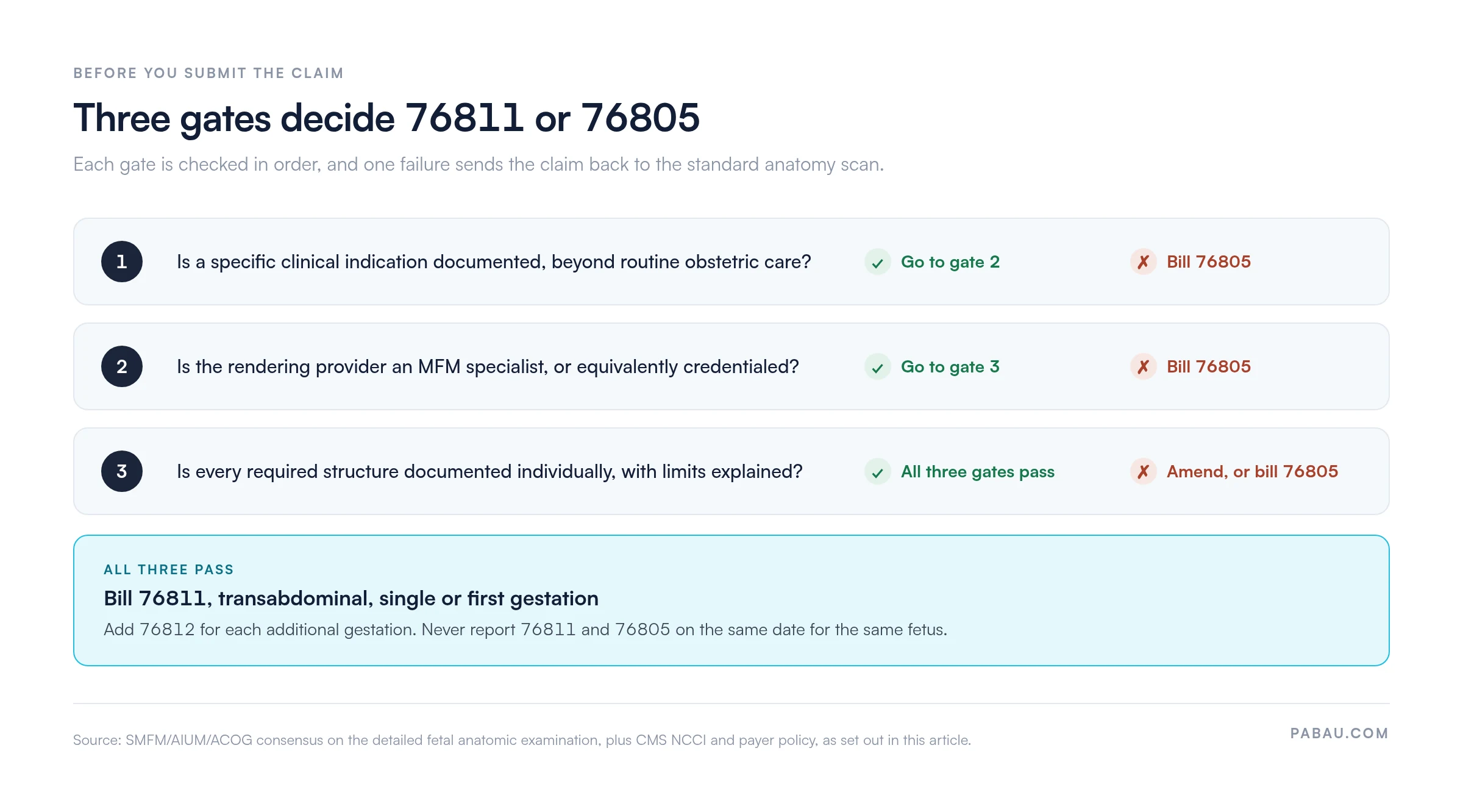
Payers cover 76811 only when a specific indication justifies the detailed exam. Ordering it for every obstetric patient reads as a billing pattern rather than a clinical one.
The Society for Maternal-Fetal Medicine (SMFM) sorts accepted indications into four practical groups:
Aetna’s Clinical Policy Bulletin 0199 asks for that specific indication in the documentation behind the claim. A note reading “high-risk pregnancy”, with no underlying factor named, fails the test at most payers.
Code the underlying condition, and put the same reason in the scan report.
That same requirement follows the patient into serial fetal surveillance. A biophysical profile billed under CPT code 76819 also needs a specific ICD-10-CM diagnosis, such as growth restriction or preeclampsia, on the claim.
When a non-stress test is performed in the same encounter, the biophysical profile is billed as 76818 and the test is not reported separately.
A cardiac risk factor, or an abnormal four-chamber view on the anatomy scan, calls for a separate fetal heart study billed under 76825.
Only a maternal-fetal medicine specialist, or a provider who meets equivalent credentialing standards, may bill 76811. This is not a soft guideline, and payers now write the thresholds into their coverage policies.
The consensus report recognizes three routes:
Scan quality cannot stand in for the credential. A general OB/GYN who performs a detailed anatomy scan still bills 76805, because the credential has to exist before the exam does.
Where a provider’s status is unclear, confirm it with the payer before the claim goes out.
The detailed anatomy scan carries a defined checklist, and each structure needs its own written finding. Structures the sonographer viewed but never wrote up will not support the claim in an audit.
AIUM practice guidelines also ask you to retain an image for each documented structure. Where fetal position or maternal habitus blocks a view, say so in the report.
An explained omission survives review, while a silent one looks like an incomplete exam.
A 76811 report needs seven elements before it will hold up under review. Documentation failures, not coding errors, drive most denials and post-payment recoupment on this code.
Build the template once and the report writes itself into the right shape. Getting these seven right is most of what clean claim submission means for a code at this value.
Build a structured 76811 report template that prompts for every required field before sign-off. By the time a coder opens the finished report, the credential, the indication, and each anatomic finding should already be there. Templates cut audit risk, and they cut the hours your team spends answering addenda requests.
How you bill 76811 matters as much as whether you may. Modifier choice, place of service, and the NCCI edits all move the payment, and they work differently here than across the wider obstetric ultrasound family.
Most clearinghouses run a scrubbing step before the payer ever sees the claim, which catches modifier conflicts and NCCI pairs early.
That check sits with the clearinghouse, not with the record system where the report was written. So treat code and modifier selection as a decision your team owns.
Run a short check before each 76811 claim leaves the practice:
Medicare pays 76811 from the Physician Fee Schedule, adjusted by geographic locality, and refreshes the rates every January 1. Pull the current figure from the CMS Physician Fee Schedule lookup tool rather than a static table.
The 2025 national averages below are for orientation only.
Commercial payers usually pay a multiple of the Medicare rate, so the work RVU matters most when you negotiate a contract.
After adjudication, the 835 electronic remittance advice tells you whether the payer accepted, adjusted, or denied the line, and it carries the reason code.
The diagnosis code on the claim is what establishes medical necessity for 76811. A routine obstetric supervision code from the Z34 range will not support it. Automated payer rules reject that pairing before a person ever reads the claim.
Diagnosis codes change every October 1, so check each pairing against the current ICD-10-CM codes before you submit.
The table below covers the pairings that come up most often with a detailed fetal anatomy scan.
Code to the highest level of specificity the record supports. Watch the trailing digits in particular, because they carry the trimester or the fetus identifier. A truncated code is not billable, and payers reject it on the first pass.
Regulators watch this exact substitution. The Health Plan of San Joaquin published a fraud, waste, and abuse bulletin on billing 76811 in place of 76805. The OIG keeps improper obstetric ultrasound coding in its annual Work Plan.
Five errors draw most of the scrutiny:
Denial reason codes tell you which of the five you hit. Sorting denied 76811 claims by reason code turns a vague problem into a named one. That might be a credential mismatch, an NCCI conflict, or a missing indication.
Fix the pattern once and the same denial stops recurring.
Run a quarterly audit of your 76811 claims. Pull the rendering provider NPI on each one, and confirm it matches a credentialed MFM specialist in your own records. Credential mismatches are the most common reason payers flag these claims for recoupment. They are also the easiest error to catch before the payer does.
Coverage criteria for 76811 vary by payer, so check the applicable policy before the patient is scanned. Practices billing across several plans cannot assume one rule set covers them all.
Where prior authorization applies, secure it before the scan. Payers rarely grant retro-authorization for diagnostic ultrasound. Confirm the requirement at scheduling, not at billing.
76811 is one of seven obstetric ultrasound codes practices reach for regularly, and each has its own scope and provider requirement. The AAPC CPT code lookup carries the full range with descriptors.
Picking the right code from that list is the easy part. Keeping the credential, the indication, and the anatomic findings attached to the claim is where most MFM practices lose time.
Most MFM billing teams work across two systems. The scan report lives in the clinical record, and the claim goes out from somewhere else. A missing credential attestation only surfaces once the payer rejects the line, weeks after the patient went home.
Practice management software like Pabau holds both in one place. Pabau pre-fills the CMS-1500 from the client record, so the CPT code attached to the service lands on the charge line.
ICD-10 slots draw from the recorded problem list. CPT and ICD-10-CM lookup libraries sit behind search icons in the claim form, and required-field checks keep the claim locked until it is complete.
For US practices, Pabau sends 837P claims to Claim.MD and posts the 835 remittances back against the client record. Eligibility checks and claim-status tracking run on the same connection.
Modifier selection and NCCI edit checking stay with the clearinghouse and the payer, so plan for those as a separate step.
Running the note and the claim through one claims management workflow puts the denial reason next to the documentation that caused it. Root-cause analysis then takes minutes instead of a records request.
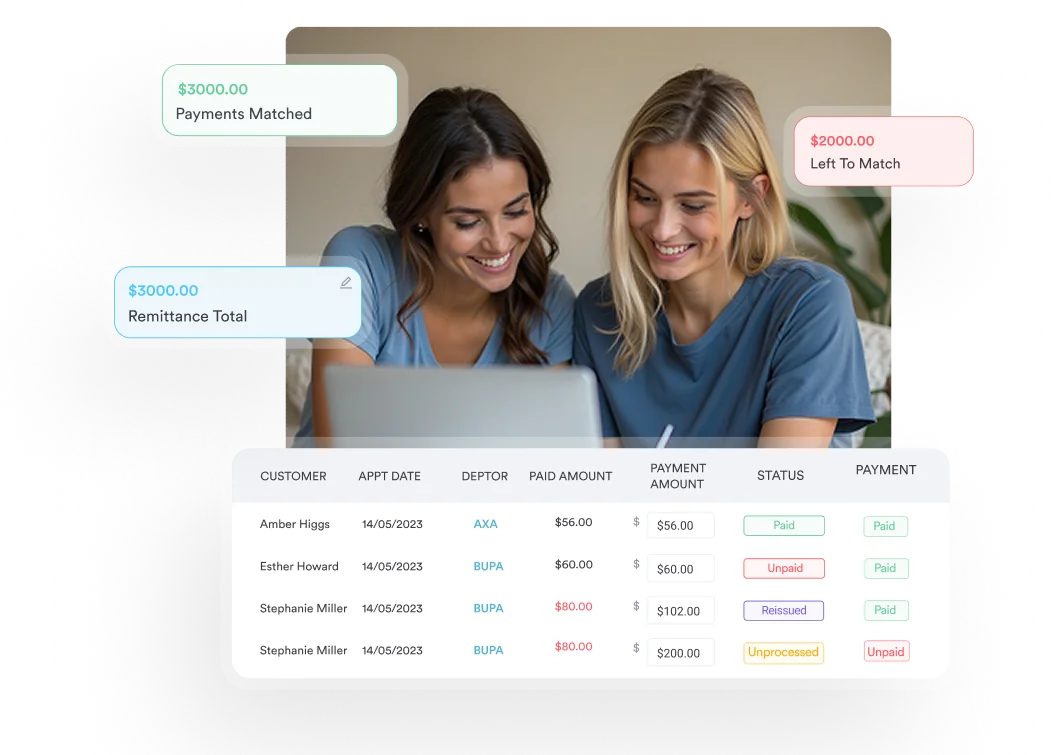

Pabau pre-fills the CMS-1500 from the client record, holds the claim until required fields are complete, and posts 835 remittances back against the same chart. Denials land next to the documentation behind them.

76811 pays more than 76805 because it asks for more. A credentialed provider, a documented reason, and a report covering every required structure are the price of the higher rate. Treat those three as gates before the scan, not as a defense after the audit letter arrives.
The practices that stay clear of recoupment are rarely the ones with the sharpest coders. They are the ones whose scan template will not close until the credential, the indication, and the anatomic findings are all in it.
Book a demo to see how Pabau links the 76811 scan report to the claim and the remittance. Every denial then traces back to the documentation behind it.

Need to verify credentials before billing? Credentialing with insurance companies walks through the payer enrollment steps MFM practices need before submitting high-value codes like 76811.
Seeing unexplained 76811 denials? Claim.MD vs Office Ally clearinghouse comparison covers which clearinghouse tools catch NCCI edit conflicts and credential mismatches at the scrubbing stage.
Managing billing across a multi-provider MFM practice? Best medical billing software for US practices compares platforms that handle 837P submission, ERA reconciliation, and denial tracking in one place.
Once per pregnancy, per practice, is the normal expectation. A second detailed exam is supported only when a new indication appears, such as an anomaly found on the first scan. Report other follow-up imaging with 76816 instead.
Yes, when the heart study carries its own indication. Fetal echocardiography codes 76825 and 76827 describe a separate service, not part of the anatomic survey. Document why each exam was needed, because payers do ask.
76813 covers the first-trimester nuchal translucency measurement, which is one targeted measurement. 76811 is the detailed anatomic examination, usually performed in the second trimester. Different timing, different scope, and no overlap in what each report documents.
No. Umbilical artery Doppler velocimetry is 76820, and middle cerebral artery Doppler is 76821. Report either one separately when the clinical indication calls for it, with its own finding in the report.
76811 carries 1.85 work RVUs under the Medicare Physician Fee Schedule. Total RVUs also include practice expense and malpractice components, and those shift with place of service. Pull the current, locality-adjusted figure from the CMS lookup tool.