

HCPCS code E0198: Water pressure pad billing guide
HCPCS code E0198 is a water pad for a standard mattress HCPCS code E0198 is the ...

Last Updated: Oct 13, 2026
76816 is the CPT code for a follow-up obstetric ultrasound of the pregnant uterus, performed transabdominally in real time with image documentation. It re-measures fetal growth parameters and amniotic fluid volume, or re-evaluates an organ system flagged as abnormal on a previous scan.
The code is reported per fetus, so a twin scan carries two units. What separates it from 76815 and 76805 is the comparison. The report has to name the prior study and measure this scan against it.
Let Pabau's smart automation suggest the right codes, reduce claim denials, and keep your practice compliant—effortlessly.
Automate repetitive tasks and focus on what matters most—your patients.
Reduce coding errors and ensure compliance with the latest regulations.
Clean claims, fewer denials, and faster reimbursements.
Powerful insights and reporting to help your practice thrive.
HIPAA compliant SOC 2 certified GDPR-compliant Trusted by 4,000+ clinics worldwide

CPT 76816 is the follow-up or repeat OB ultrasound code, distinct from 76815 (limited) and 76805 (initial complete survey).
Documentation must state the clinical reason for follow-up, fetal measurements compared to a prior scan, and real-time imaging confirmation per AIUM standards.
Modifier -59 is required when 76816 and 76817 are billed on the same date of service. Per-fetus billing applies in multiple gestations.
Pabau’s claims management software tracks OB/GYN billing workflows, flags missing modifiers, and submits claims via Claim.MD to thousands of US payers.
CPT code 76816 describes an ultrasound of the pregnant uterus performed as a follow-up or repeat examination, real time with image documentation.
The American Medical Association (AMA) maintains the CPT code set. Its descriptor separates 76816 from the other obstetric ultrasound codes. The exam has to follow a prior study rather than open one.
The code sits in the 768xx obstetric ultrasound family alongside 76801 (first trimester), 76805 (second or third trimester complete), 76815 (limited), and 76817 (transvaginal). What defines it is the follow-up intent. The scan has to be clinically indicated as monitoring a previously identified finding or risk factor.
CPT 76816 covers re-evaluation of fetal size using the standard growth parameters — biparietal diameter, head circumference, abdominal circumference and femur length. It also covers amniotic fluid volume, placental location, and any organ system flagged on a prior scan. The word that decides the code is “re-evaluation”. A documented prior study has to exist for this scan to reference.
Included: fetal biometry measurements, amniotic fluid index (AFI) or maximum vertical pocket (MVP), and placental position. The code also covers evaluation of a previously identified anomaly, plus real-time imaging with saved image documentation.
Not included / separately billable:
Which biophysical profile code applies depends on whether a non-stress test ran in the same encounter. 76819 covers the biophysical profile without that test, and 76818 covers the version that includes it. Only one of the two is billed per encounter, so the scan note has to record whether a non-stress test was performed.
Payers routinely deny 76816 when the note reads like a routine first-trimester screening rather than a follow-up. The diagnosis code on the claim has to support a clinical reason for repeat imaging, which the ICD-10 section below works through.
Each of these three codes has a distinct clinical trigger. Picking the wrong one usually ends in a denial or a payer audit flag, and the three sit close enough together that it happens often.
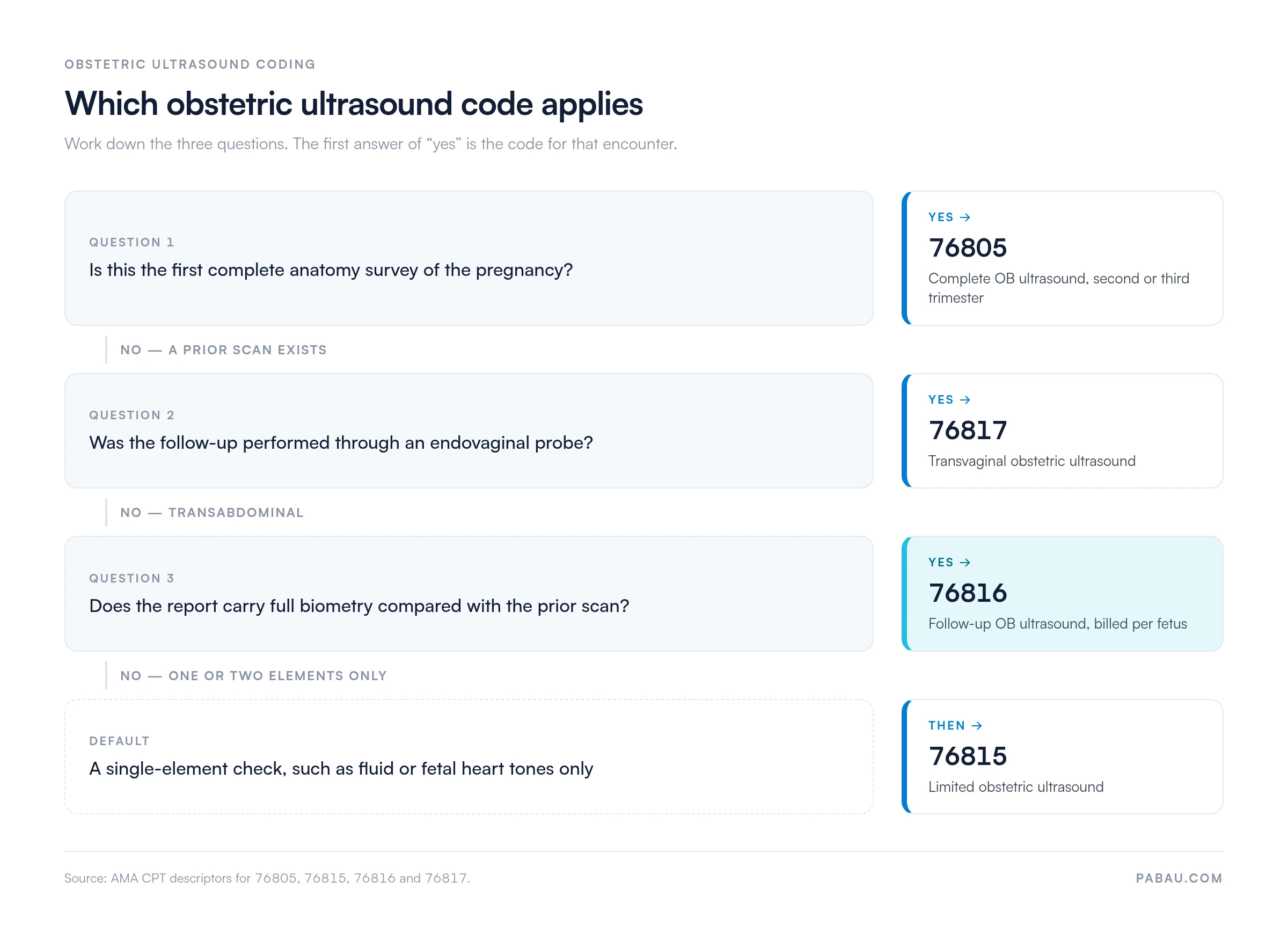
The practical rule runs in three steps. If the scan evaluates multiple growth parameters against a prior measurement, use 76816. If it checks one quick element, such as a fetal heart rate at a routine visit, use 76815. If it is the first complete anatomy survey of the pregnancy, use 76805. Defaulting to 76816 for every repeat ultrasound, quick fluid checks included, builds up denials for missing the 76815 criteria.
CPT 76817 is the transvaginal obstetric ultrasound. It carries the same follow-up intent as 76816, but the scan runs through an endovaginal probe instead of the abdomen. The two codes are not interchangeable, because the approach decides which one applies.
Both can be billed on the same date of service when the clinical picture justifies both approaches. A transabdominal follow-up may also need a transvaginal scan to measure cervical length in a patient at risk of preterm labor. The National Correct Coding Initiative (NCCI) places these codes in an edit pair. Modifier -59 therefore goes on the second code, to signal a distinct procedural service. Verify the current NCCI column assignments before billing, since edit relationships are updated quarterly.
Four codes cover the same anatomy, so the choice comes down to three questions about the encounter.
Modifier selection is one of the most common sources of billing error on this code. Three modifiers come up repeatedly — -59, -26 and -TC — alongside the per-fetus unit count in multiple gestations.
Missing or incomplete documentation is the top reason CPT code 76816 claims are denied on post-payment audit. The American Institute of Ultrasound in Medicine (AIUM) publishes practice parameters for obstetric ultrasound that most payers use as their documentation benchmark. A report that satisfies AIUM standards is also a report that survives a retrospective payer review.
A complete 76816 report must include all of the following, per AIUM guidance:
One documentation failure surfaces more often than the rest. The note records the measurements but never compares them with the prior scan. Without that comparison the exam reads as a routine scan, and payers reclassify it to 76815 on review. A structured report template with a mandatory “compared to prior exam dated ___” field stops the pattern.
Attaching a 76816 documentation checklist to the order helps the sonographer capture every required element before the report is finalized.
Build a 76816-specific ultrasound report template with a mandatory ‘Reason for follow-up’ field and a ‘Compared to scan dated [date]: [findings]’ field. Sonographers who complete both fields satisfy the two documentation elements behind most denials. Those two are the missing clinical indication and the missing prior-scan comparison.
Medicare reimbursement for CPT code 76816 is set annually by the CMS Physician Fee Schedule (MPFS). Rates vary by geographic locality, and by whether the claim is submitted in a facility or a non-facility setting. Verify the current-year rate with the CMS MPFS lookup tool, since the figures change each January 1. The FastRVU 2026 lookup tool shows work, practice expense and malpractice RVU values with geographic adjustment.
As a rough benchmark, recent national average Medicare non-facility rates for 76816 have sat around $90 to $120 per fetus under global billing. Commercial payers typically reimburse a percentage of the Medicare allowable, commonly 110% to 150% for in-network OB/GYN providers. Contracts vary by plan and geography, so confirm your own rates before you rely on a figure.
Practice management software like Pabau integrates with the Claim.MD clearinghouse, which reaches thousands of US payers. Billing staff can verify patient benefits before the appointment, then submit the 76816 claim with the right modifier stacking from the same workflow.
Reading the electronic remittance advice (ERA) closely lets OB billing teams act on underpaid 76816 claims before they age. The Claim Adjustment Reason Code on the ERA states why the claim was reduced or denied, and that drives the appeal.
Medicare does not require prior authorization for CPT 76816. Medicaid requirements vary by state. Many state programs cover a medically necessary follow-up OB ultrasound without prior auth, provided the diagnosis code establishes the clinical indication. O36.xx for fetal growth restriction and O09.xx for high-risk pregnancy supervision both do that.
Commercial payer requirements differ. Aetna, for example, publishes its obstetric ultrasound medical necessity criteria in Clinical Policy Bulletin 0199. Most Aetna plans cover 76816 without prior auth when the indication is documented, though they audit for medical necessity after payment. Plans that do require prior auth usually trigger it past a threshold number of ultrasounds in the pregnancy, often three or more. Confirm the requirement in each payer’s provider portal before the encounter, and check eligibility at scheduling so any auth requirement surfaces early.
Denial patterns on CPT code 76816 are predictable, and the same four or five root causes account for most of them. Prevention starts with training front-of-house and clinical staff on what the note must contain before the claim goes out. Learning to read the denial codes that come back on an ERA helps staff route each appeal correctly.
An appeal on a denied 76816 claim should carry three documents. Send the complete ultrasound report, the referring provider’s order stating the clinical indication, and the prior scan being referenced. A clean claim with the correct ICD-10 code, the right modifier stacking and a compliant report heads off most of these scenarios. Build that checklist into the point of billing rather than the point of appeal.
CPT 76816 is reported per fetus, and the official descriptor closes on exactly that phrase. The rule is simple to state and harder to bill, because payers handle multiple units in different ways.
For a twin pregnancy, bill two units of 76816 when both fetuses are examined and documented. The report has to carry biometry and findings for each fetus separately. Distinct measurements and comparisons for Fetus A and Fetus B satisfy that. A single combined measurement set does not support two units.
Billing rules set up for multiple-gestation encounters can prompt the correct unit count and diagnosis pairing at charge entry. That catches per-fetus errors before the claim submits.
CMS sets no universal per-pregnancy frequency limit for CPT code 76816. Payers apply their own medical necessity thresholds, and a claim that exceeds the expected utilization pattern attracts review. Knowing where those thresholds sit keeps the practice out of avoidable audits.
Medicare publishes no blanket frequency cap for 76816. Medicare Administrative Contractors (MACs) instead review claims against local coverage determination criteria for ultrasound utilization. Medicaid plans vary widely by state. California’s Medi-Cal, for example, defines covered indications for follow-up ultrasounds rather than imposing a fixed count.
Commercial payers most often accept three to five follow-up ultrasounds per singleton pregnancy without extra documentation. Beyond that, many plans trigger a post-payment review or require prior authorization. High-utilization patients — fetal growth restriction, preeclampsia risk, multiple anomalies — need each visit’s own indication stated in the note. Restating the original diagnosis is not enough. Every 76816 claim for that patient should cite the finding or measurement that justifies repeat imaging at that encounter.
A billing platform that keeps encounter history makes per-patient ultrasound frequency easy to track across a pregnancy. Staff can then see a fourth or fifth scan coming and raise the documentation before the claim goes out.
The ICD-10-CM diagnosis code paired with CPT 76816 must support the clinical indication for a follow-up ultrasound. A routine supervision code (Z34.xx) is the wrong choice when a specific fetal or maternal finding prompted the scan. That mismatch is a leading cause of medical necessity denials. Code the condition that required the repeat imaging.
Cross-reference each pairing in the AAPC Codify CPT lookup and confirm that no Correct Coding Initiative edit applies to the combination. Always pick the most specific ICD-10-CM code the documentation supports. An unspecified-trimester code is defensible only when the trimester cannot be determined from the note.
Most OB/GYN practices run the 76816 workflow across three systems. The sonographer writes the report in the imaging software. A coder picks the units and modifiers in a separate billing tool. Someone else checks eligibility in a payer portal. Each handoff is a chance for the prior-scan comparison or the second unit to go missing.
Pabau is an all-in-one practice management system, and its claims management software holds those steps in one patient record. Charge entry reads the encounter, so a twin scan prompts two units and the matching O30.0xx diagnosis. Eligibility runs through the Claim.MD connection ahead of the appointment, and the claim submits from the same screen.
For an OB practice, that means fewer 76816 claims reaching the payer with a missing modifier or an unsupported unit count. When an ERA comes back short, the report, the order and the prior scan are already filed against the patient. The appeal can go out the same week.

Pabau’s claims management tools help OB/GYN practices submit accurate CPT 76816 claims, track modifier usage, and connect to thousands of US payers through Claim.MD. Book a demo to see how it works.

CPT code 76816 pays reliably when the report does one thing the other OB ultrasound codes never ask for. It names the finding being followed, then measures this scan against the prior one. The units, the modifiers and the diagnosis pairing all fall out of that comparison.
Build the comparison into the report template rather than into the appeal workflow. The trade-off is two extra fields for the sonographer, and the return is a denial queue that stops filling up with the same three reasons.
Book a demo to see how Pabau handles OB ultrasound coding, modifier checks and claim submission in one workflow.

Working a queue of denied OB claims? Denial management in healthcare sets out how to triage, appeal and prevent denials across a practice.
Want to understand your ERA denial codes? Electronic remittance advice explains how to read ERA files and act on CARC codes from payers.
Looking to reduce claim denials across all CPT codes? Revenue cycle management walks through the end-to-end billing workflow for healthcare practices.
Building the charge sheet behind the claim? Superbill covers what the document has to carry before a coder can work from it.
Catching auth requirements before the scan? Insurance eligibility verification shows how to check benefits and prior-auth rules at scheduling.
CPT code 76816 is the follow-up or repeat obstetric ultrasound of the pregnant uterus, performed transabdominally in real time with image documentation. It is billed per fetus. The code re-evaluates fetal growth parameters, amniotic fluid volume, or a previously identified finding, which separates it from 76815 (limited) and 76805 (initial complete survey).
CPT 76816 is a follow-up exam that includes full fetal biometry with comparison to a prior scan. CPT 76815 is a limited exam covering only one or two elements, such as fetal heart tones or fluid. Use 76815 for quick single-element checks, and 76816 only when full growth parameters are measured and compared to a previous study.
The most common modifiers are -59, -26 and -TC. Use -59 when 76816 and 76817 are billed on the same date. Use -26 for the professional component when the physician does not own the equipment, and -TC for the technical component in facility billing. In multiple gestations, 76816 is reported per fetus with the appropriate unit count rather than a modifier.
Yes, when both approaches are clinically indicated on the same date. A transabdominal follow-up plus a transvaginal cervical length assessment is the usual example. Modifier -59 must be appended to 76817 to satisfy NCCI edit requirements, and the report must document the distinct clinical reason for each approach. Verify current NCCI edits before billing, as edit relationships update quarterly.
CPT 76817 is the transvaginal obstetric ultrasound, the follow-up exam performed through an endovaginal probe. Use 76817 when the transvaginal approach is clinically indicated, such as cervical length measurement, early gestation, or technically limited transabdominal views. It pairs with 76816 when both approaches are used on the same date, with modifier -59.
There is no universal CMS frequency limit. Most commercial payers accept three to five follow-up ultrasounds per singleton pregnancy before triggering a review or a prior authorization requirement. High-utilization patients include those with fetal growth restriction, placenta previa or multiple gestations. Each claim for them should cite the specific clinical finding that justifies that encounter, not just the original diagnosis.
Per AIUM standards, the report must include the clinical indication for follow-up and a reference to the prior scan being re-evaluated. It also needs full fetal biometry (BPD, HC, AC, FL), amniotic fluid assessment and placental location. Fetal cardiac activity and position, a comparison against the prior scan, real-time imaging confirmation and the ordering provider’s name complete it. Missing the prior-scan comparison is the most common deficiency that triggers denial.



