CPT Code 98981: RTM Treatment Management Billing Guide
CPT code 98981: Definition and official descriptor CPT code 98981 is an add-on c...

Last Updated: Nov 9, 2026
66983 is the CPT code for intracapsular cataract extraction with insertion of an intraocular lens prosthesis in one stage. The surgeon removes the whole lens, capsule included, and implants an IOL in the same session.
It is rarely billed, because extracapsular surgery coded 66982 or 66984 has replaced it for most cataracts. Medicare lists 66983 as contractor-priced, with a 90-day global period.
Let Pabau's smart automation suggest the right codes, reduce claim denials, and keep your practice compliant—effortlessly.
Automate repetitive tasks and focus on what matters most—your patients.
Reduce coding errors and ensure compliance with the latest regulations.
Clean claims, fewer denials, and faster reimbursements.
Powerful insights and reporting to help your practice thrive.
HIPAA compliant SOC 2 certified GDPR-compliant Trusted by 4,000+ clinics worldwide

CPT code 66983 reports intracapsular cataract extraction with insertion of an intraocular lens in one stage, with the lens capsule removed.
A difficult case does not turn into 66983. Complex extracapsular surgery without ECP is 66982, and routine extracapsular surgery is 66984.
Medicare lists 66983 as contractor-priced, so there are no national RVUs and each MAC sets the payment.
The code carries a 90-day global period and a bilateral indicator of 1, so modifier 50 applies when both eyes are done the same day.
The MAC prices the claim from the operative report. Document why the capsule could not be kept, plus the IOL type and its fixation.
CPT code 66983 is the American Medical Association (AMA) code for “Intracapsular cataract extraction with insertion of intraocular lens prosthesis (1 stage procedure).” The surgeon removes the whole lens, capsule included, and implants an intraocular lens (IOL) in the same session.
That one detail separates 66983 from the cataract codes billed every day. Extracapsular surgery leaves the posterior capsule in place to hold the IOL. Intracapsular surgery takes the capsule out, so the new lens has to sit in the anterior chamber or be fixated to the iris or sclera.
Surgeons now choose intracapsular extraction only when the capsule cannot be saved, so 66983 is rarely billed. Most of its claims come from subluxated or dislocated lenses, often after trauma or in a connective tissue disorder.
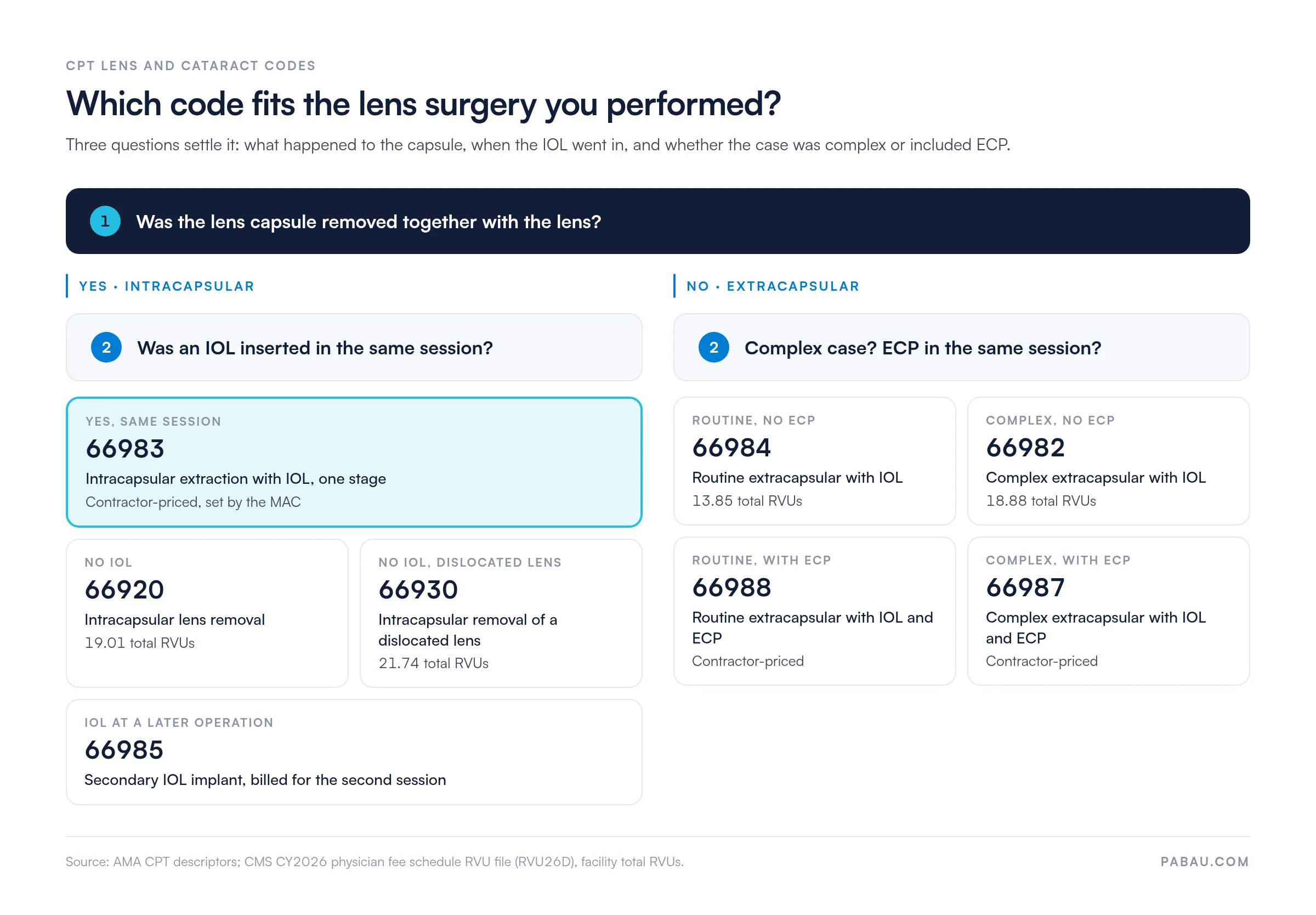
The capsule decides the first branch. If the capsule was removed with the lens, the code is 66983. If the capsule stayed, the case is extracapsular and moves to 66982, 66984, 66987 or 66988.
Among the extracapsular codes, two questions settle the choice. Was the case complex under the CPT definition, and was endoscopic cyclophotocoagulation (ECP) performed in the same session? ECP is never an add-on to 66982 or 66984, because it has its own combined codes.
CPT defines a complex case as one needing devices or techniques not generally used in routine cataract surgery. Examples are an iris expansion device, suture support for the IOL, or primary posterior capsulorrhexis. Surgery in the amblyogenic developmental stage also counts. That definition belongs to CPT 66982 and 66987, not to 66983.
Routine extracapsular surgery is CPT 66984, and its ECP counterpart is 66988. Both include IOL insertion. Two more codes, 66989 and 66991, pair complex or routine extracapsular surgery with an intraocular aqueous drainage device.
Four neighboring codes cover intracapsular work or a lens implant on its own. Check them before you settle on 66983, because the IOL timing changes the code.
If the surgeon removes the lens intracapsularly and leaves the eye aphakic, bill 66920 or 66930. A lens implanted at a second operation is 66985. Billing 66983 for that staged sequence overstates what happened in the first session. The decision path below puts both code families side by side, from the capsule question to the final code.
Modern surgeons keep the capsule whenever they can. Intracapsular extraction becomes the plan when the zonules or capsule can no longer support a lens. Typical scenarios include the following.
Because the capsule is gone, the IOL choice matters for coding and for the record. The note should name the lens type and how it was fixated, such as an anterior chamber IOL or a scleral-fixated posterior chamber lens.
The diagnosis should explain why the capsule could not be preserved, as well as the cataract itself. Pair the codes by laterality, because the ICD-10 code has to name the same eye as the RT or LT modifier.
These are illustrative pairings, not a coverage list. Confirm each code in the current ICD-10-CM tabular list and check your MAC’s cataract billing article for any covered-diagnosis requirements.
Medicare has no national payment amount for CPT 66983. The CY2026 CMS physician fee schedule relative value file gives it status C, contractor-priced, with every RVU column at 0.00. Your Medicare Administrative Contractor (MAC) prices each claim individually.
MACs usually price a contractor-priced code by comparing it with similar paid codes and reviewing the operative report. Expect a documentation request, and some MACs want the report with the claim.
CY2026 also has two conversion factors. Qualifying alternative payment model participants (QPs) are paid at $33.5675 per RVU, and other clinicians at $33.4009. The comparison codes below show what national rates look like before geographic adjustment.
Figures come from the October 2026 RVU file (RVU26D), multiplied by each conversion factor. Your locality’s geographic practice cost index (GPCI) moves the final amount up or down.
All of these codes are flagged NA for a non-facility setting, so CMS does not price them for an office. The surgeon is paid the facility rate. The hospital outpatient department or ambulatory surgical center (ASC) bills its own facility claim under the outpatient or ASC payment system.
Laterality goes on every 66983 claim. The payment indicators in the RVU file decide how the other modifiers behave.
Same-day bilateral intracapsular surgery is unusual, so most 66983 claims carry RT or LT alone. If a commercial payer wants two lines with RT and LT for a bilateral case, follow that payer’s published rule.
CPT 66983 carries a 90-day global surgical period under Medicare. The package starts the day before surgery and runs 90 days after it.
A contractor-priced code is paid from the record, so the operative report carries more weight than usual. A complete note also supports a clean claim on the first pass.
Check the National Correct Coding Initiative (NCCI) edits before you report an anterior vitrectomy or another eye procedure on the same claim. NCCI bundles many of them into the cataract code.
Traditional Medicare generally does not require prior authorization for cataract surgery. Coverage of the implanted lens follows NCD 80.12, Intraocular Lenses, and MACs publish their own cataract LCDs and billing articles.
Medicare Advantage and commercial plans set their own rules, and many require authorization for cataract surgery. Build the check into your medical billing compliance routine before the case is scheduled.
Most 66983 denials come from picking the code for the wrong technique or from a thin record. Use the denial codes in medical billing guide to read the CARC and RARC codes on the remittance.
Keep a short pricing packet ready for every 66983 claim. Include the operative report, the IOL log and a note naming a comparable priced code, such as 66920 plus the lens work. A MAC that can price the claim from one packet pays it faster.
A code billed a few times a year is easy to get wrong, because nobody on the team remembers the last one. The operative note, the IOL details and the claim end up in different places.
Pabau, the practice management and billing platform we build, keeps the clinical record and the invoice on one patient file. Its claims management software turns that invoice into a claim carrying the code, modifiers and diagnosis your team has entered.
Pabau submits the claim electronically through the Claim.MD clearinghouse and tracks its status. Electronic remittance advice comes back into the billing workflow, so your team sees each payment or denial against the right case.

Pabau builds claims from your invoices, submits them through Claim.MD, and tracks each one until the remittance comes back. Your 66983 claim stays linked to the operative note behind it.

CPT 66983 belongs to one narrow situation: the lens and its capsule come out together and an IOL goes in during the same operation. A difficult extracapsular case belongs under 66982 or 66987, so billing 66983 for it sends the claim down the wrong pricing path.
Because Medicare prices it claim by claim, the operative report decides the payment. Name the reason the capsule could not be kept, record the lens and its fixation, and check the bilateral and global rules before you submit.
Book a demo to see how Pabau keeps rare surgical codes tied to the records that support them.

Was the case complex, with the capsule preserved? CPT 66982 covers complex extracapsular cataract surgery with an IOL and no ECP.
Billing a routine cataract case? CPT 66984 explains the standard extracapsular code and its documentation.
Setting up electronic claims in the US? Claim.MD clearinghouse guide walks through how claims and remittances move between practice and payer.
Working a denial on a surgical claim? Denial codes in medical billing maps common CARC and RARC codes to the right correction.
CPT code 66983 reports intracapsular cataract extraction with insertion of an intraocular lens prosthesis in one stage. The surgeon removes the lens and its capsule together, then implants an IOL in the same session. It is rarely billed, because extracapsular surgery is now standard.
No. Complex extracapsular cataract surgery with an IOL and no ECP is CPT 66982. Routine extracapsular surgery is 66984. CPT 66983 is defined by the intracapsular technique, not by complexity.
Medicare has no national rate for CPT 66983. The CY2026 RVU file lists it as contractor-priced, so each MAC sets the payment, usually after reviewing the operative report. The surgeon is paid at the facility rate.
Yes, when both eyes are operated in the same session. The bilateral indicator is 1, so Medicare pays 150% and expects one line with modifier 50. Confirm your MAC’s format, and use RT or LT for single-eye surgery.
CPT 66983 has a 90-day global period. Routine postoperative visits are included. Unrelated visits take modifier 24, related returns to the operating room take 78, and unrelated procedures take 79.
Not for a lens placed in the same session, because 66983 already includes IOL insertion. CPT 66985 is a secondary implant not associated with concurrent cataract removal. If the IOL went in later, bill 66920 or 66930 first, then 66985.
Traditional Medicare generally does not require prior authorization for cataract surgery. Medicare Advantage and commercial plans often do. Authorize 66983 specifically, because approval for 66982 or 66984 does not carry over.