HCPCS Code J7637: Dexamethasone inhalation solution
HCPCS Code J7637: official descriptor and drug overview HCPCS Code J7637 is the ...

Last Updated: Nov 24, 2026
65920 is the CPT code for removal of implanted material, anterior segment of eye. It covers taking out a synthetic implant placed in an earlier surgery, such as an anterior chamber IOL or a phakic IOL.
Confusion with CPT 66920 (intracapsular lens extraction) is a common source of claim errors. An IOL removed and replaced in the same session is reported as an exchange, CPT 66986, instead.
Let Pabau's smart automation suggest the right codes, reduce claim denials, and keep your practice compliant—effortlessly.
Automate repetitive tasks and focus on what matters most—your patients.
Reduce coding errors and ensure compliance with the latest regulations.
Clean claims, fewer denials, and faster reimbursements.
Powerful insights and reporting to help your practice thrive.
HIPAA compliant SOC 2 certified GDPR-compliant Trusted by 4,000+ clinics worldwide

CPT Code 65920 covers removal of a synthetic implant from the anterior segment of the eye, such as an anterior chamber or phakic IOL.
In contrast, crystalline lens removal is coded 66920 or 66930, and an IOL removed and replaced in the same session is coded 66986.
Report RT or LT on every claim, because a missing laterality modifier is a common denial trigger.
Pair the claim with a diagnosis that shows why the implant came out, such as T85.22XA for a displaced IOL or T85.848A for implant pain.
Medicare assigns 65920 a 90-day global period, so it counts as major surgery under the fee schedule.
CPT Code 65920 is the surgical code for removing previously implanted material from the anterior segment of the eye. It is an active, separately payable code with a 90-day global period in CMS’s October 2026 RVU file. In addition, the AMA’s official descriptor reads “Removal of implanted material, anterior segment of eye.” Overall, the code sits in the Eye and Ocular Adnexa subsection (65091-68899), inside the anterior segment range (65400-66999).
In fact, the AMA maintains the CPT code set and updates it every year. Therefore, report 65920 when the operative report documents removal of a previously implanted device from the anterior segment, naming the implant type and its location.
CPT Code 65920 applies to a specific category of anterior segment implants. Therefore, knowing what falls inside and outside the code’s scope prevents unbundling errors and wrong substitution with nearby codes.
Knowing the operative sequence lets a coder confirm that the report supports CPT Code 65920 and not an adjacent procedure. Overall, the steps below describe a typical anterior segment implant removal. However, technique varies by surgeon and implant type.
Payers audit operative reports for specific elements before approving CPT Code 65920. A vague or incomplete note is a common reason for clean claim failures on this procedure. Therefore, the operative report should contain each of the following.
Consistent medical billing compliance starts with a documentation checklist built into the operative note template. The surgeon then completes it during the case instead of reconstructing it from memory afterward.
Every CPT Code 65920 claim needs a diagnosis code that establishes medical necessity for the removal. Payers, Medicare in particular, check the ICD-10 pairing to confirm the removal was clinically indicated rather than elective. In short, the table below lists common pairings.
T85 codes need the right 7th character. Use “A” for the initial removal encounter, “D” for routine follow-up, and “S” for sequela. Otherwise, a wrong 7th character can trigger a denial even when the code family is right.
When corneal decompensation drives the removal and the report names the eye, a laterality-specific bullous keratopathy code is therefore more precise than H18.10.
CPT 66920 describes intracapsular removal of lens material, meaning the patient’s own crystalline lens. In contrast, CPT Code 65920 covers removal of a synthetic device implanted in an earlier surgery. As a result, reporting one where the other is correct leads to a denial or an audit flag for upcoding.
However, a third code enters when the surgeon removes an IOL and places a new one in the same session. That exchange is therefore reported as 66986, not as 65920.
Finally, the decision chart below maps each operative finding to its code.
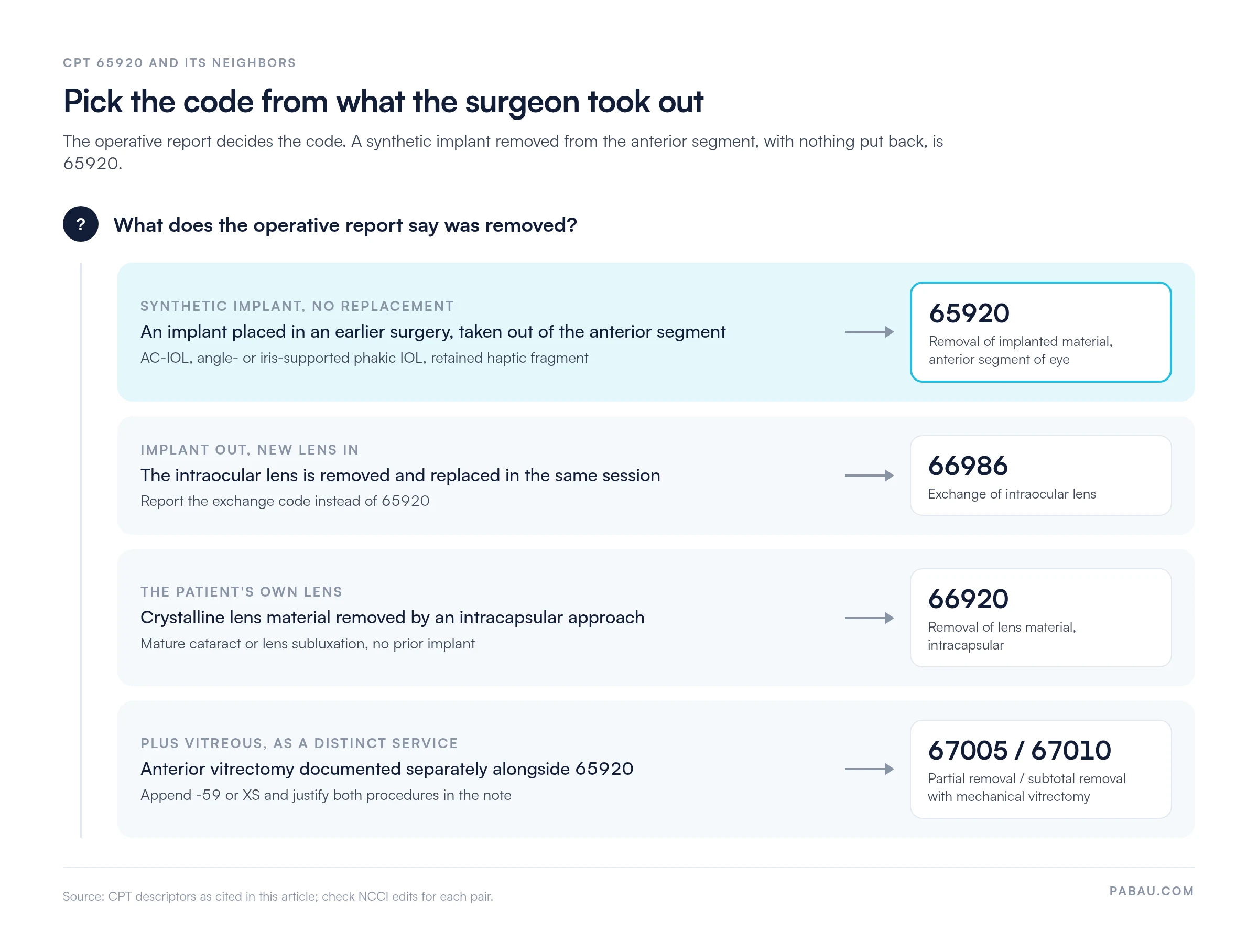
If the item removed was placed in an earlier operative session, reach for CPT 65920. If the surgeon is removing the patient’s own crystalline lens, use a 66xxx code. When unsure, check the diagnosis. For example, a T85 complication code points to 65920, and a cataract code such as H26 points to 66xxx.
Several adjacent codes appear in the same operative notes as CPT Code 65920. Therefore, knowing each one prevents both undercoding and incorrect bundling.
In addition, check the National Correct Coding Initiative (NCCI) edits before billing 65920 alongside any of these codes. CMS updates the edits every quarter, so a pair that was separately billable before may be bundled now.
CPT Code 65920 is payable under the Medicare Physician Fee Schedule (MPFS) when removing the anterior segment implant is medically necessary. Rates change every year through the MPFS final rule. So, check the current-year rate in the CMS Physician Fee Schedule lookup tool before quoting a payment amount. The same tool shows the work, practice expense, and malpractice RVUs for 65920.
In short, Medicare and most commercial payers expect these modifiers on eye surgery claims.
Denials on CPT Code 65920 cluster around a small set of avoidable errors. So, build a pre-submission check for each trigger below into your denial management process.
Reading medical billing denial codes against your ERA remittances shows patterns before they build into accounts-receivable backlogs. For example, a superbill for eye procedures that pre-fills laterality and common diagnosis pairings prevents many of these errors.
Traditional Medicare (Parts A and B) usually does not require prior authorization for CPT Code 65920 when medical necessity is documented. However, Medicare Advantage plans may require it for non-urgent anterior segment surgery, and Medicaid managed care rules vary by state. So, before scheduling an elective phakic IOL removal, check the patient’s plan policy.
A PA request should carry the clinical rationale, the operative plan, and the surgeon’s credentials. For example, the rationale covers the ICD-10 complication code, endothelial cell counts, and photos of corneal decompensation where relevant. Many plans also ask for proof that conservative management was tried first.
Before billing CPT Code 65920 with any same-session ophthalmic procedure, run the pair through the current quarter’s NCCI edit table. For example, some pairs carry a modifier indicator of 0, which means no modifier overrides the edit. Billing both codes on one claim then produces a denial.
The denials above start on the claim line. A missing RT or LT, a diagnosis that does not explain the removal, or 66920 in its place each sends the claim back. In fact, each one is cheaper to catch before submission than to rework after a denial.
Pabau, a practice management platform with built-in claims management software, submits US claims online through its clearinghouse partner, Claim.MD. As a result, your billing team builds the CMS-1500 claim from the visit, with the CPT code, modifiers, and diagnosis in one view.
Eligibility checks confirm the patient’s coverage before the surgery date. ERA remittances post back against the claim, so a denial arrives with its reason code attached. So your team can correct it and resubmit without chasing paperwork.

Pabau connects claim submission, modifier entry, ERA posting, and denial tracking in one platform. See how ophthalmic practices use it to catch CPT 65920 claim errors before submission.

Code 65920 from the operative report, never from habit. A synthetic implant taken out of the anterior segment with nothing put back is 65920. In contrast, a replacement lens points to 66986, and the patient’s own lens points to 66920.
Before the claim goes out, confirm RT or LT and a complication diagnosis that explains the removal. Then check whether the case falls inside another procedure’s global period. That check takes a minute, while a denial means rework and a resubmission.
Book a demo to see how Pabau helps your team submit and track ophthalmic surgery claims in one place.

Removing an IOL and placing a new one in the same session? CPT code 66986 covers how to bill an intraocular lens exchange.
Want to understand how claim denials are classified and appealed? Denial codes in medical billing explains CARC codes, the appeals process, and how to track denial patterns by procedure.
Looking for a primer on the full billing cycle behind surgical procedures? Revenue cycle management explained covers each stage from eligibility check through ERA posting.
CPT Code 65920 is the surgical code for removing implanted material from the anterior segment of the eye. It covers synthetic devices such as anterior chamber IOLs, angle-supported phakic IOLs, and retained haptic fragments. Removal of the natural crystalline lens is coded 66920 or 66930 instead.
CPT 65920 applies when a synthetic device implanted in an earlier surgery is removed from the anterior segment. CPT 66920 applies when the patient’s own crystalline lens is removed by an intracapsular approach. The deciding question is whether the item removed was an implant or the natural lens.
Common pairings are T85.22XA (displacement of intraocular lens, initial encounter) for a dislocated implant and T85.848A for pain due to an internal prosthetic device. H18.10 (bullous keratopathy) fits when corneal decompensation drives the removal. Z96.1 (presence of intraocular lens) works as a secondary code that confirms the implant.
Yes, when the E/M is a separately identifiable service beyond the decision to operate. Append modifier -25 to the E/M code. The documentation must keep the E/M decision-making separate from the surgical decision for 65920.