CCSD code H0410: Panproctocolectomy and ileostomy
CCSD code H0410: What it covers and when to use it CCSD code H0410 sits within t...

Last Updated: Nov 23, 2026
66825 is the CPT code for repositioning of intraocular lens prosthesis, requiring incision (separate procedure).
It covers the surgical work of returning a dislocated or subluxated lens implant to its correct position through an incision. That separates it from YAG laser capsulotomy (CPT 66821) and from IOL exchange (CPT 66986). The code carries a 90-day global period, and modifier 78 is required when it falls inside the global period of an earlier cataract surgery.
Let Pabau's smart automation suggest the right codes, reduce claim denials, and keep your practice compliant—effortlessly.
Automate repetitive tasks and focus on what matters most—your patients.
Reduce coding errors and ensure compliance with the latest regulations.
Clean claims, fewer denials, and faster reimbursements.
Powerful insights and reporting to help your practice thrive.
HIPAA compliant SOC 2 certified GDPR-compliant Trusted by 4,000+ clinics worldwide

CPT code 66825 covers surgical repositioning of a displaced intraocular lens through an incision. It is neither a laser procedure nor a lens removal.
Every 66825 claim needs an RT or LT modifier, and modifier 78 is required when the repositioning falls inside a cataract surgery global period.
With modifier 78, Medicare pays only the intraoperative share of the fee, which CMS sets at 70% for 66825 in 2026.
A displaced lens implant is coded T85.22xA or T85.22xD, because the H27.1 lens dislocation codes exclude pseudophakia.
Pabau’s claims management software sends 66825 claims through Claim.MD and posts the remittance back against the visit.
CPT code 66825 is the CPT code for surgically repositioning a displaced intraocular lens (IOL) through an incision. Medicare pays it as a major surgical procedure with a 90-day global period in CMS’s 2026 relative value file.
The official descriptor, maintained by the American Medical Association (AMA), is Repositioning of intraocular lens prosthesis, requiring incision (separate procedure).
The “separate procedure” designation means 66825 is usually not reported alongside another ocular procedure performed through the same incision at the same session. The code applies to anterior chamber and posterior chamber IOLs alike. Suturing the haptics, repositioning the optic, and reforming the anterior chamber to stabilize the lens all fall within its work.
IOL dislocation or subluxation occurs when the lens implant shifts out of its intended position in the capsular bag or sulcus. The rate of late in-the-bag IOL dislocation rises with time after cataract surgery, and pseudoexfoliation syndrome is the most significant risk factor.
To reposition the lens, the surgeon enters the anterior segment through an incision and moves the lens back into place. The haptics may then be sutured or refixated to hold it.
66825 requires an incision, which separates it from non-incisional procedures. If a minor displacement can be corrected without an incision, 66825 is not supported. The operative note must document the approach, the degree of displacement, and the technique used to reposition and secure the lens.
CPT 66821 describes YAG laser posterior capsulotomy, a laser procedure that treats opacification of the posterior capsule after cataract surgery. CPT 66825 describes surgical repositioning of a physically displaced IOL through an incision. The two differ in indication, setting and payment, yet they are often confused in post-cataract billing.
Several codes in the lens family describe procedures that can be confused with IOL repositioning or performed alongside it. When the implant is removed and replaced rather than moved, the correct code is 66986, not 66825. The table sets out how each neighbor differs.
T85.22xA (displacement of intraocular lens, initial encounter) is the primary ICD-10-CM pairing for CPT code 66825, and T85.22xD covers subsequent encounters. The H27.1 codes do not fit an IOL case. ICD-10-CM gives category H27 an Excludes1 note for pseudophakia (Z96.1), so H27.1 codes apply only to a dislocated natural lens.
Within H27.1, the fifth character records the type of dislocation, not the eye. H27.10 is unspecified, H27.11 is subluxation, H27.12 is anterior dislocation, and H27.13 is posterior dislocation. Laterality sits at the sixth character, as in H27.111, H27.121 and H27.131 for the right eye.
T85.22x carries no laterality of its own, so the RT or LT modifier on the claim is what records the eye. Coders should verify sequencing rules against the CMS ICD-10-CM Official Guidelines for the applicable fiscal year.
On a 66825 claim, the modifiers record two facts the code cannot. One is the eye treated, and the other is whether an earlier surgery’s global period applies. A missing RT or LT modifier is a common reason an ophthalmic surgical claim comes back. The table lists the modifiers that apply to 66825 and the mistake most often made with each.
CPT code 66825 carries a 90-day global surgical period. That creates two global periods for billers to track. One is the global period of 66825 itself, and the other is the global period of the cataract surgery that 66825 may fall inside. The chart below maps the cataract surgery date to the modifiers it requires.
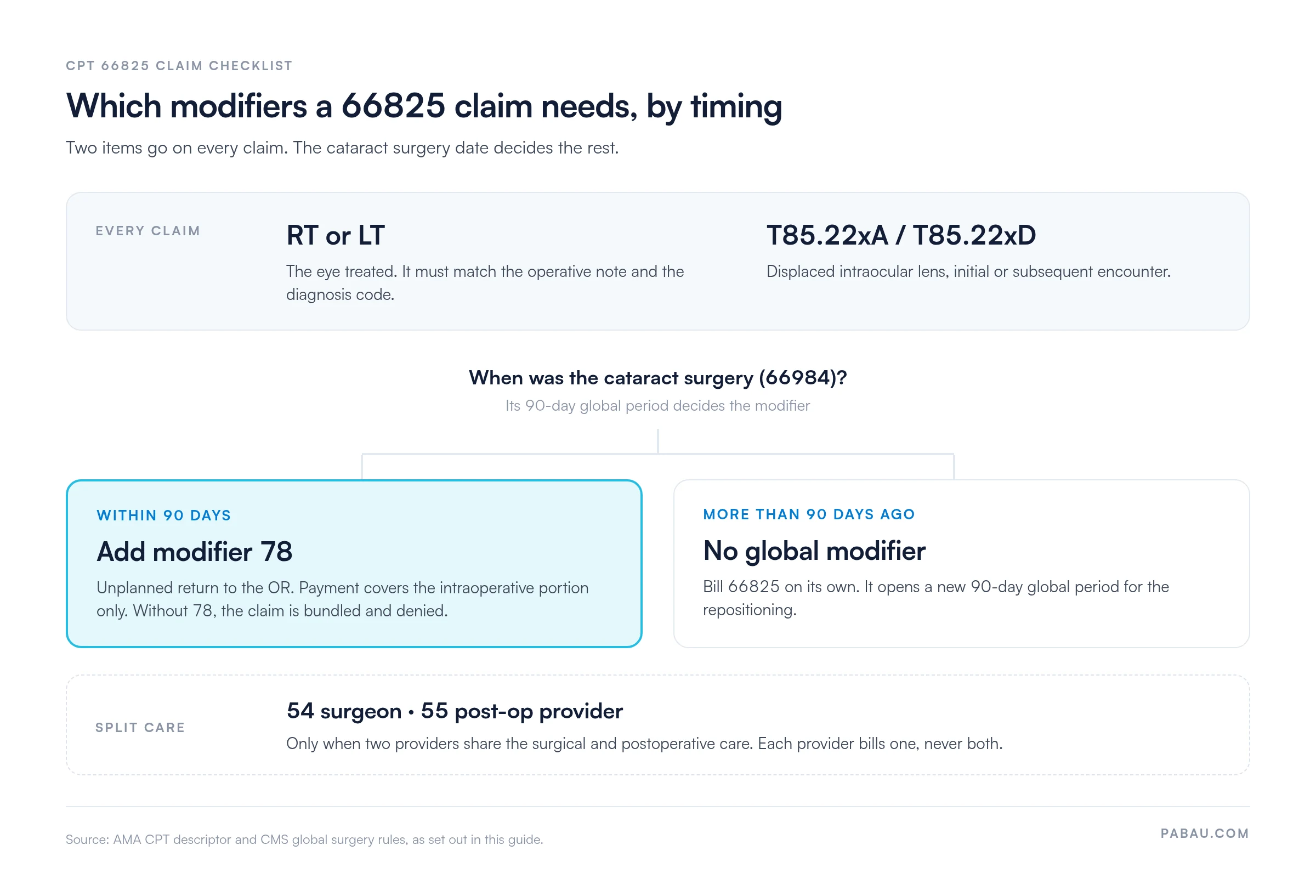
Routine cataract surgery, billed with CPT 66984, carries a 90-day global period. If the IOL displaces and needs repositioning within that window, the repositioning counts as a related return to the operating room.
Modifier 78 is required to override the global bundling and allow separate payment. Without it, the payer bundles 66825 into the cataract surgery package and denies it.
With modifier 78, Medicare and most commercial payers pay only the intraoperative share of the RVUs. For 66825, CMS sets that share at 70% in 2026, because the original cataract package already covers postoperative care. Practices using a structured revenue cycle can flag these global period overlaps before claims are submitted.
Once 66825 is billed, its own 90-day global period begins. Routine post-op visits for the repositioning, suture removal, and E&M visits for normal recovery are all bundled into it. A service outside normal recovery, or one for a separate diagnosis, may be reported with the right modifier.
Track the original cataract surgery date for every IOL repositioning case before submitting a 66825 claim. If the cataract surgery date falls within 90 days of the repositioning, Modifier 78 is required. Build a date-check step into your pre-submission workflow to catch this before the payer does.
Medicare pays CPT code 66825 under the Medicare Physician Fee Schedule (MPFS), which CMS updates every year. For 2026, CMS assigns 66825 a total of 21.86 facility RVUs. At the $33.4009 conversion factor, that is about $730 nationally before geographic adjustment.
CMS lists no non-facility practice expense for 66825, so Medicare sets no office rate for it. The procedure is billed from a hospital outpatient department or ASC. A claim with POS 11 (office) is a place-of-service error that invites an audit. Use the CMS Physician Fee Schedule search tool to look up current rates by locality and place of service.
For 2026 dollar amounts in your locality, use the FastRVU lookup tool or the CMS MPFS search. Both apply the geographic practice cost index (GPCI) for your area. Check the figures again when CMS publishes the next annual update.
The operative report is the most scrutinized document in a 66825 audit. Payers, including Medicare Administrative Contractors (MACs) with ophthalmology Local Coverage Determinations, look for specific elements before they pay. A note that leaves out any of the following commonly triggers a denial or a post-payment audit.
Traditional Medicare does not typically require prior authorization for CPT code 66825. Medicare Advantage plans and commercial payers often have their own PA rules, so verify with each payer before scheduling.
Keep the authorization number and reference it on the claim form. A missing number can trigger a denial even when the procedure itself was authorized.
CPT code 66825 claims fail for a predictable set of reasons, and most of them can be caught before submission. The table maps each denial to its root cause and the fix. Tracking them through a denial management workflow shortens the correction cycle from weeks to days.
Each denial arrives with a claim adjustment reason code, and our guide to denial codes explains what each one asks for. When an appeal is needed, include the operative report, the authorization number if there is one, and a letter of medical necessity. Reference the applicable MAC Local Coverage Determination in that letter.
A clean claim workflow that checks modifiers, diagnosis codes and place-of-service codes before transmission catches most of these errors. Use the AAPC Codify CPT lookup or the PGM Billing CPT lookup to verify descriptors and check for active NCCI bundling edits.
Most 66825 denials start before the claim is built. The billing team rekeys the eye, the diagnosis and the cataract surgery date from the operative note, and one of them comes across wrong.
Pabau, a practice management platform with built-in insurance billing, keeps the operative note and the claim in the same patient record. Eye practices use Pabau’s insurance claims tools to send CMS-1500 and 837P claims through the Claim.MD clearinghouse. The same tools run eligibility checks and post ERA remittances back against the visit.
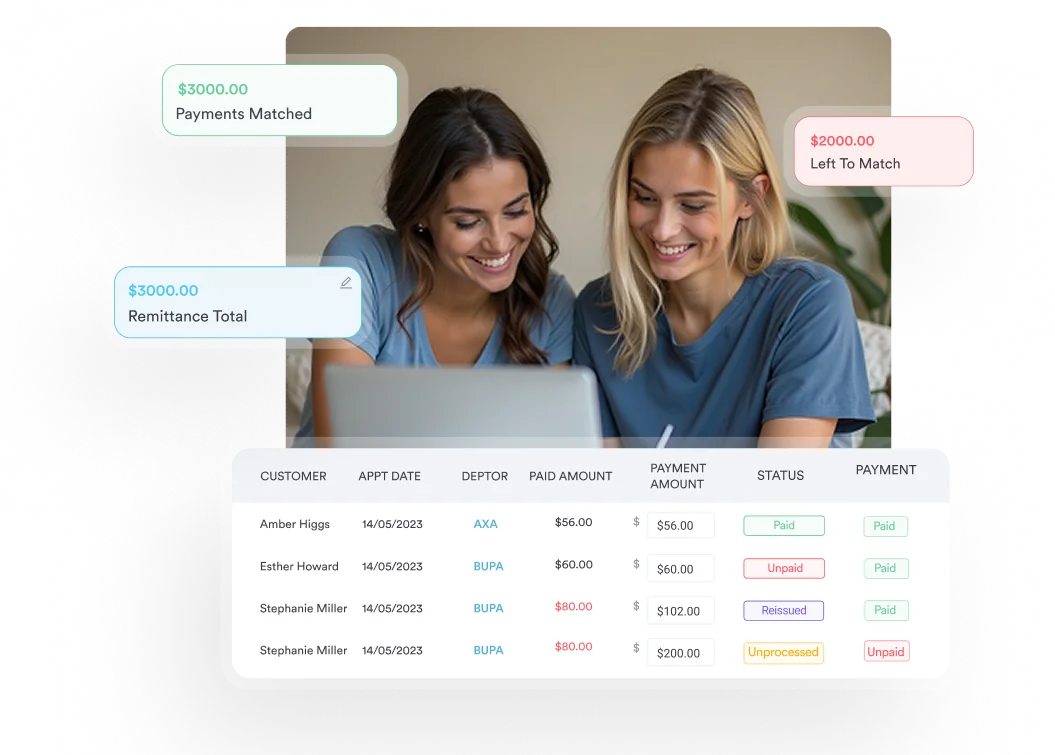
Prior authorization codes, dates and sessions sit on the patient’s case, and Pabau warns when one is missing. When the remittance posts, a 66825 claim paid at the modifier 78 rate is visible without opening a payer portal.

Pabau sends CPT 66825 claims through the Claim.MD clearinghouse, checks eligibility, and posts remittances back against the visit. See how it fits an ophthalmology billing workflow.

A 66825 claim turns on three facts the coder cannot infer: the eye, the lens that moved, and the date of the cataract surgery. Put the eye on the RT or LT modifier and code the implant with T85.22xA. Then check the surgery date against the 90-day window before the claim leaves.
Inside that window, modifier 78 trades full payment for the 70% intraoperative share, and that is still far better than a bundling denial. Book a demo to see how Pabau keeps the operative note, the claim and the remittance for each IOL repositioning in one record.

Submitting claims electronically for the first time? Claim.MD clearinghouse guide explains how the clearinghouse integration routes claims to 4,000+ US payers with real-time eligibility and ERA processing.
Want to understand the 837P claim format? 837 file overview breaks down the electronic claim format used for CPT-coded surgical procedures submitted to Medicare and commercial payers.
CPT code 66825 describes surgical repositioning of an intraocular lens (IOL) that has become displaced, through an incision that returns it to its correct position. It applies to both anterior and posterior chamber IOLs. It does not cover non-incisional techniques or laser procedures.
CPT 66821 is a YAG laser posterior capsulotomy for posterior capsule opacification, with no incision, and it is usually performed in an office. CPT 66825 is surgical repositioning of a displaced IOL through an incision, performed in a hospital outpatient department or ASC. The two codes treat different problems and are never interchangeable.
RT (right eye) or LT (left eye) is required on every CPT 66825 claim, and leaving it off is a common denial trigger. When the procedure falls within the 90-day global period of a prior cataract surgery, modifier 78 is also required. Modifiers 54 and 55 apply when two providers split the surgical and postoperative care.
Yes, but modifier 78 must be appended. Without it, the claim is denied as bundled into the cataract surgery global package. With modifier 78, payment covers the intraoperative share only, which CMS sets at 70% for 66825, because postoperative care stays bundled in the cataract package.
The primary pairing is T85.22xA, displacement of intraocular lens, initial encounter, with T85.22xD for subsequent encounters. The H27.1 lens dislocation codes do not apply to an IOL, because category H27 excludes pseudophakia. Record the eye with the RT or LT modifier, since T85.22x carries no laterality.
Traditional Medicare generally does not require prior authorization for CPT 66825, but Medicare Advantage plans and commercial payers often do. Requirements vary by plan year and carrier. Verify PA with each payer before scheduling, and keep the authorization number for the claim form.