CPT Code 31653: EBUS With 3+ Mediastinal Stations
CPT code 31653: Official descriptor and clinical scope CPT code 31653 is the pro...

Last Updated: Oct 20, 2026
Billable Code Specific Code
65426 is the CPT code for excision or transposition of pterygium, with graft. It covers removing the pterygium and covering the bare sclera with a conjunctival autograft or amniotic membrane in the same session.
It sits in the Eye and Ocular Adnexa range of the CPT Surgery section, next to 65420, the same excision without a graft. The operative note decides between the two, so it needs to record the graft type, harvest site and fixation method.
Let Pabau's smart automation suggest the right codes, reduce claim denials, and keep your practice compliant—effortlessly.
Automate repetitive tasks and focus on what matters most—your patients.
Reduce coding errors and ensure compliance with the latest regulations.
Clean claims, fewer denials, and faster reimbursements.
Powerful insights and reporting to help your practice thrive.
HIPAA compliant SOC 2 certified GDPR-compliant Trusted by 4,000+ clinics worldwide

CPT code 65426 covers pterygium excision with a graft, while 65420 covers the same excision without one and pays less.
Every 65426 claim needs an RT or LT modifier, and same-session bilateral surgery depends on the MPFS bilateral surgery indicator.
Payers typically deny V2790 when it’s billed with 65426 and 65780 on the same claim, so check the MAC’s LCD first.
Pair the claim with a laterality-specific diagnosis such as H11.001 or H11.002, not the unspecified-eye code H11.009.
Pabau’s claims management software sends 65426 claims to Claim.MD and tracks their status, so denials surface on the same dashboard.
CPT code 65426 describes “Excision or transposition of pterygium; with graft.” The American Medical Association (AMA) maintains this code within the Surgery/Eye and Ocular Adnexa section of the CPT code set. It is a five-digit numeric code with a 90-day global surgery period assigned under the Medicare Physician Fee Schedule (MPFS). The table below covers the key reference data for claim entry.
CPT code 65426 covers the surgical excision or transposition of a pterygium combined with the placement of a conjunctival graft to resurface the exposed sclera. The graft step is what separates this code from 65420 and is the single most important element to document in the operative note.
The procedure, as described in clinical guidance from the AMA coding resources, encompasses three operative stages performed in one surgical session:
What is not included: CPT code 65426 does not bundle the supply of an amniotic membrane product (V2790). Separate billing of V2790 is payer-dependent and frequently denied when 65780 appears on the same claim. Anesthesia is billed separately by the anesthesiologist.
CPT code 65426 reimburses at a higher rate than 65420 because the graft step adds operative complexity and time. Reporting 65420 after a graft was placed undercodes the claim. Reporting 65426 when no graft was used overcodes it. A note showing epithelial removal across the cornea without pterygium excision belongs on CPT code 65435 instead.
The graft is only the first call on the claim. Three more decisions follow it, and the flow below puts all four in the order a coder meets them.
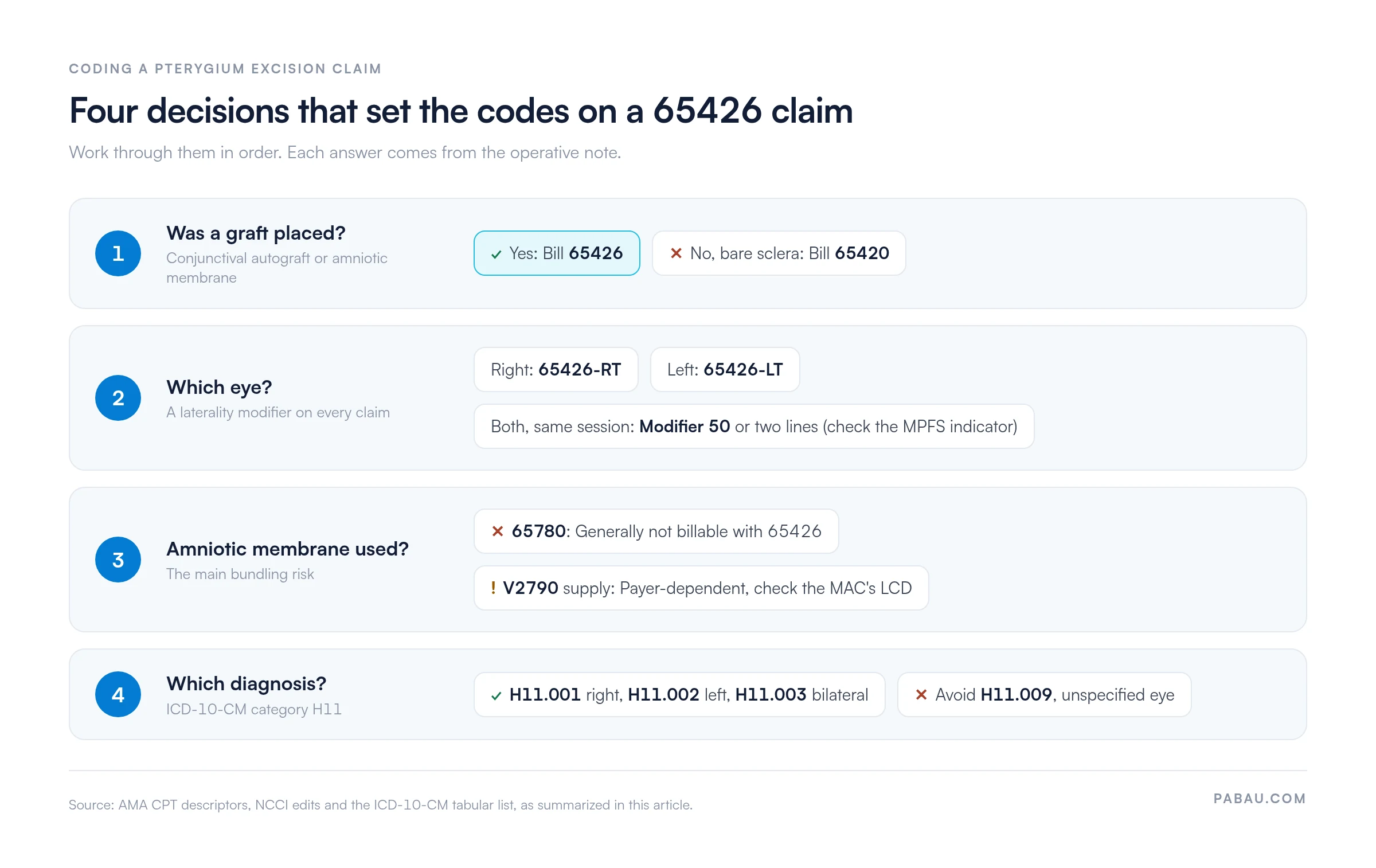
Three codes regularly appear alongside CPT code 65426 on claims, and each carries its own bundling risk. Understanding when they can and cannot be billed together prevents the most common denial patterns in pterygium surgery billing. The NCCI Policy Manual sets the bundling logic behind each one.
The V2790 problem: Coders on the AAPC (American Academy of Professional Coders) forums report the same pattern. Payers routinely deny V2790 when it appears on the same claim as 65426 and 65780. The payer logic is that the amniotic membrane supply is bundled into the procedure. Some Medicare Administrative Contractors (MACs) allow separate billing of V2790 under specific circumstances. Verify against the applicable Local Coverage Determination (LCD) before submitting.
Every CPT code 65426 claim requires an ICD-10-CM diagnosis code that establishes medical necessity. The primary pterygium codes fall within category H11, which is titled “Other disorders of conjunctiva.” Reporting the unspecified-eye code, or the wrong eye, after surgery on a known eye is a common oversight. It can trigger a medical necessity denial.
Confirm all H11 codes against the current CMS ICD-10-CM tabular list before use. The eye on the diagnosis code should always match the RT or LT modifier on the claim line.
CPT code 65426 is a lateralized procedure, meaning a modifier identifying which eye was operated on is required on every claim. Submitting without a laterality modifier is one of the most common technical denials in ophthalmology billing.
Yes, CPT 65426 can be reported for each eye. How you report a same-session bilateral case depends on the Medicare bilateral surgery indicator for 65426 in the current MPFS. Verify it before submitting. Surgeries on separate dates go on two claims, with RT on one and LT on the other.
Same-session bilateral claims may use modifier 50 or two line items with LT/RT, depending on payer preference. Check your MAC’s billing guidelines before submitting a bilateral claim for this procedure.
Flag any bilateral pterygium surgery for manual review before claim submission. Some payers require two separate line items (65426-RT and 65426-LT) rather than one line with modifier 50. Call the payer’s provider line to confirm their preference and document the call in the patient account.
Medicare reimbursement for CPT code 65426 is calculated using the relative value units (RVUs) published in the annual CMS Medicare Physician Fee Schedule. The national unadjusted rate multiplies the work, practice expense and malpractice RVUs by the annual conversion factor. A Geographic Practice Cost Index (GPCI) then adjusts it for the practice location.
Always verify current rates directly on the CMS MPFS lookup tool, as rates change with each annual rulemaking cycle. The non-facility rate (office or ASC) generally exceeds the facility rate (hospital outpatient department).
Commercial payer rates for CPT code 65426, including United Healthcare (UHC), are contractual and geography-dependent. No single authoritative rate applies across all contracts. Use your executed fee schedule or call the payer’s provider relations line for the applicable contracted amount. Also use the electronic remittance advice (ERA/835) from prior claims to benchmark expected reimbursement for your practice location.
The global period for CPT code 65426 is 90 days under the Medicare Physician Fee Schedule, beginning the day after the surgery date. During this period, routine post-operative services are bundled into the surgical payment and cannot be billed separately. The list below splits what the global package covers from what you can still bill.
Verify the current global days indicator against the MPFS file published by CMS each year. Some procedure codes have been reassigned from 90-day to 10-day global periods under CMS reform efforts, and relying on an outdated value risks incorrect billing.
The operative note for CPT code 65426 must document the graft explicitly. Payers reviewing a claim for this procedure look for evidence that the graft technique was performed. A complete operative record protects the claim in an audit and stops an automatic downcode to 65420.
The operative note should include all of the following to withstand payer audit, per guidance from the American Academy of Ophthalmology (AAO):
Audit a sample of recent operative notes against this list before the next claims batch goes out. The graft type and harvest site are the elements most often left out. Either omission can trigger a medical records request and a reduced payment.
CPT code 65426 has a predictable denial profile. Most rejections fall into five categories, and each has its own appeal route. The claim adjustment reason code (CARC) on the remittance tells you which one you’re facing. Our list of medical billing denial codes explains each CARC.
The V2790 denial pattern is the most complex on this code. V2790 is an HCPCS supply code for the amniotic membrane itself, not the surgical placement procedure. A surgeon who places an amniotic membrane graft during pterygium excision may bill 65426 plus 65780, the surgical placement code. Payers then view V2790 as bundled into the procedural payment.
Some MACs do allow V2790 as a separately billable supply in a specific clinical context. That exception applies only when 65780 is not on the same claim. The operative note must document the product name, lot number, and clinical justification. Check the applicable MAC’s LCD for pterygium or ocular surface reconstruction before billing V2790 on any claim that also includes 65426.
An NCCI edit check before submission catches these bundling conflicts while the claim is still inside the practice. Make that check a standard step in your clean claim submission routine for every pterygium claim.
Run an NCCI edit check on every 65426 claim that also includes 65780 or V2790 before submission. Most clearinghouses surface these bundling conflicts automatically. If your billing software does not flag NCCI edits, add a manual review step to the claim scrubbing workflow for all ophthalmology pterygium claims.
In many ophthalmology practices, the operative note lives in one system and the claim gets keyed into another. That handoff is where a missing RT modifier or an unrecorded graft type slips through.
Pabau, the practice management platform we build, raises the claim from the patient record itself through its built-in claims management. When the invoice is ready, one click sends it to Claim.MD with the patient and treatment details already attached. You can run an eligibility check before surgery day and track each claim’s status after it goes out.
ERA remittances post back to the same dashboard, so a 65426 denial shows up next to the claim it belongs to. Your billing team sees the reason, corrects the modifier or attaches the operative report, and works the appeal from one record.

Pabau sends claims to Claim.MD from the patient record and posts ERA remittances back, so your team tracks each pterygium claim in one place.

The graft decides the code, and the operative note has to prove it. When the note names the graft type, harvest site and fixation method, 65426 holds up. When it doesn’t, expect a downcode to 65420 or a records request.
Settle the V2790 question before surgery, not after the denial. Check your MAC’s LCD once, write the answer into your billing rules, and apply it to every amniotic membrane case.
Book a demo to see how Pabau keeps pterygium claims, eligibility checks and remittances on the same patient record.

Need guidance on clearinghouse claim submission? How Claim.MD clearinghouse works explains the electronic claims pathway from practice to payer.
Want to understand denial appeal workflows? Denial codes in medical billing covers CARC denial reason codes and appeal strategies across surgical claims.
Building a clean claim checklist? Medical billing compliance outlines the documentation and coding standards that prevent pre-submission errors.
Reconciling payments after the claim? What is electronic remittance advice (ERA)? explains how to read the 835 file and match it to what you billed.
Capturing codes at checkout? What is a superbill? walks through the fields a superbill needs before a claim goes out.
CPT code 65426 describes excision or transposition of a pterygium with a graft to cover the exposed sclera. The graft separates it from 65420, which covers excision without a graft and leaves bare sclera.
Modifier RT (right eye) or LT (left eye) is required on every claim. Modifier 50 may apply for bilateral same-session procedures, but verify the MPFS bilateral surgery indicator first. During the 90-day global period, modifier 78 covers an unplanned return to the OR and 79 covers an unrelated procedure.
V2790 is typically denied when billed with 65426 and 65780 on the same claim. Some MACs allow separate billing of V2790 under specific LCD conditions. Check the applicable MAC’s Local Coverage Determination before submitting V2790 with any pterygium surgery code.
The global period for CPT 65426 is 90 days under the Medicare Physician Fee Schedule. Routine post-operative visits during this window are bundled into the surgical payment. Use modifier 24, 78, or 79 to bill separately for unrelated or complication-related services.
CPT 65420 covers pterygium excision without a graft, leaving bare sclera. CPT 65426 covers the same excision but adds a conjunctival or amniotic membrane graft to resurface the sclera, reducing recurrence risk. The graft step produces a higher RVU value and requires additional operative note documentation.
Yes, bilateral pterygium excision with graft can be billed when both eyes are operated on. The billing method depends on the current MPFS bilateral surgery indicator. Same-session procedures may use modifier 50 or two line items with LT and RT, so confirm with the payer before submitting.