

CPT Code 30801: Superficial turbinate ablation billing guide
CPT Code 30801: Official descriptor and procedure overview The American Medical ...

Last Updated: Nov 27, 2026
65091 is the CPT code for evisceration of ocular contents without implant. The surgeon removes the eye's internal contents, leaves the scleral shell in place, and inserts no orbital implant.
Coders frequently confuse it with 65093 (evisceration with implant, same anatomy plus an implant) and 65101 (enucleation without implant, entire globe removed). The wrong code selection is a common cause of claim denials, and a missing laterality modifier compounds the error.
Let Pabau's smart automation suggest the right codes, reduce claim denials, and keep your practice compliant—effortlessly.
Automate repetitive tasks and focus on what matters most—your patients.
Reduce coding errors and ensure compliance with the latest regulations.
Clean claims, fewer denials, and faster reimbursements.
Powerful insights and reporting to help your practice thrive.
HIPAA compliant SOC 2 certified GDPR-compliant Trusted by 4,000+ clinics worldwide

CPT Code 65091 covers evisceration of ocular contents without implant. The sclera stays intact, which separates it from 65093 (with implant) and from the enucleation codes.
Most payers require a laterality modifier, RT or LT, on a 65091 claim, and a missing one is a common denial trigger.
Medical necessity documentation must explicitly state that no implant was placed and that the sclera was preserved, or payers will recode or deny the claim.
Pabau, a practice management platform, supports insurance billing, with US claims sent through Claim.MD and prior authorizations tracked on the patient’s case.
CPT Code 65091 describes evisceration of ocular contents without implant. The surgeon removes the contents of the eye, leaves the sclera in place, and inserts no implant. The AAPC’s procedure summary for 65091 describes the same work, with the sclera and its attached muscles left behind and no implant inserted. The American Medical Association maintains the official descriptor, Evisceration of ocular contents; without implant. The code sits in the eye and ocular adnexa subsection (65091-68899), under removal of eye (65091-65114).
The defining anatomical feature is scleral preservation. The surgeon enters through the limbal region, removes the cornea, and evacuates all intraocular contents, but the scleral coat, conjunctiva, and extraocular muscle insertions remain. No orbital implant is placed into the scleral shell at the time of surgery.
Surgeons choose evisceration over enucleation when the sclera is structurally sound. The clinical goal is pain relief or infection control rather than cosmetic rehabilitation with an implant. Common indications include:
Evisceration is generally contraindicated when intraocular malignancy is suspected, because the sclera must be examined histologically. In those cases, enucleation (65101-65105) is the appropriate code family.
The only surgical difference between CPT 65091 and CPT 65093 is whether an orbital implant goes into the scleral shell during evisceration. The wrong selection here produces a straightforward coding error with predictable denial consequences.
Read the operative report before selecting between these two. The surgeon’s explicit statement about implant placement (or absence of it) is the deciding factor, not the clinical indication or the diagnosis code.
Evisceration and enucleation are frequently confused because both result in a non-sighted eye socket. The anatomical distinction determines the code family, and getting it wrong triggers a code-mismatch denial.
One question separates evisceration from enucleation. Is the sclera still present? An operative note that describes severing the optic nerve and removing the entire globe documents enucleation, whatever the team calls it verbally. If the scleral coat remains in the orbit, it is evisceration. A second question about the implant then picks the code within each family, as the decision path below shows.
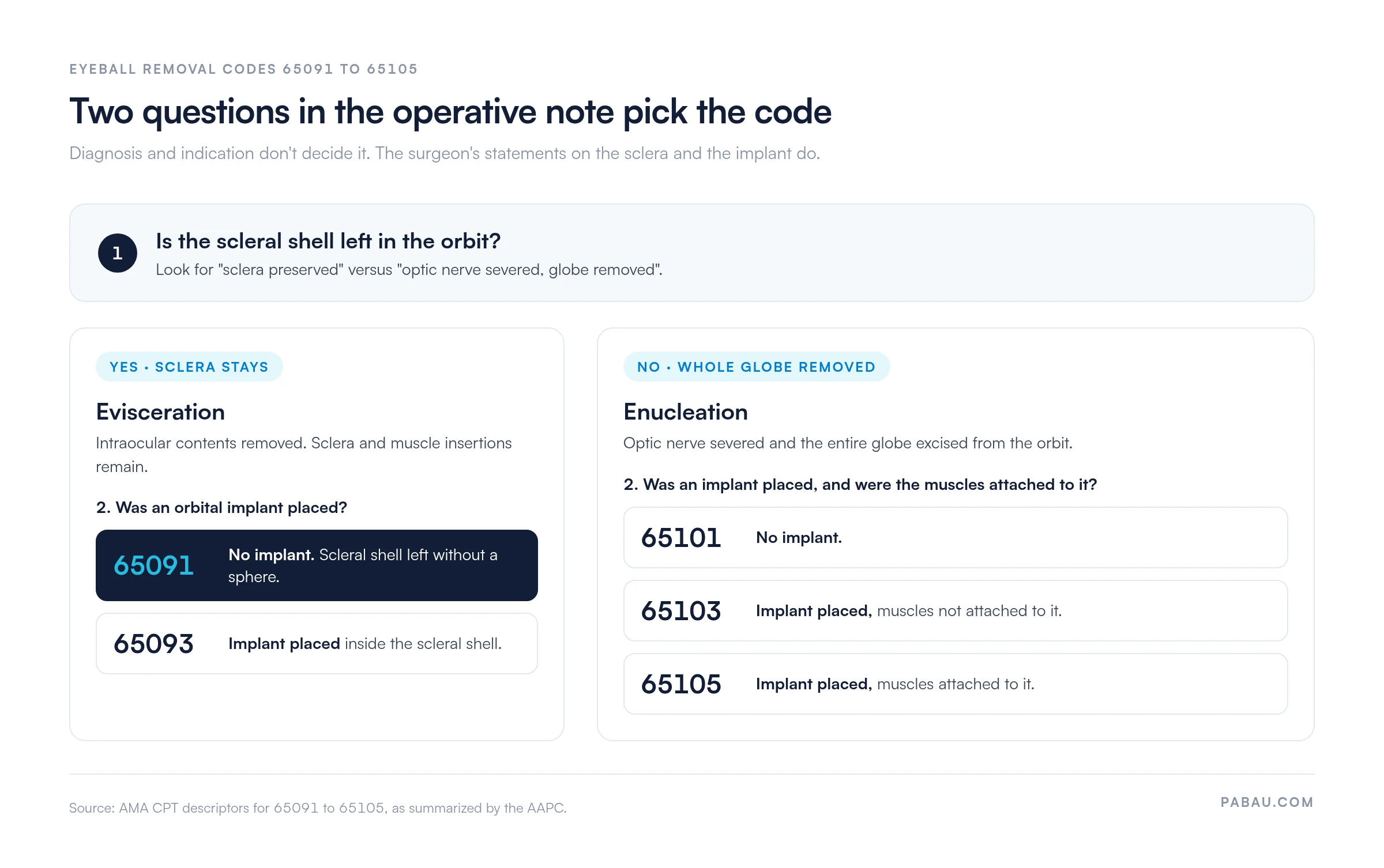
See the AAPC CPT code lookup for reference details on the full 65091-65114 code family and neighboring codes within the ophthalmology surgery subsection.
Every CPT 65091 claim needs at least one supporting ICD-10-CM diagnosis code that establishes medical necessity. The codes below are commonly paired with it, based on the clinical indications that drive evisceration without implant. Verify currency against the active ICD-10-CM fiscal year release before submitting claims.
Laterality in the ICD-10 code must match the laterality modifier on the CPT claim. A claim with modifier RT and an ICD-10 code ending in “2” (left eye) will trigger a laterality mismatch denial.
The operative report is the primary documentation vehicle for CPT 65091. Payers, including Medicare, audit this record when they process or review claims. Missing specific language is a common trigger for medical billing compliance issues and claim delays.
The operative note must explicitly address each of the following to support clean claim submission:
A vague operative note that simply records “evisceration performed” without addressing implant placement or scleral status will not hold up under payer review or audit.
Medicare pays for CPT Code 65091 under the Medicare Physician Fee Schedule (MPFS). Reimbursement is the code’s Relative Value Units (RVUs) multiplied by the annual conversion factor. The geographic practice cost index (GPCI) then adjusts it for the practice location.
RVU data changes annually with each CMS update. Because specific dollar reimbursement figures are updated every January and vary by locality, do not rely on figures embedded in published articles. Use the CMS Physician Fee Schedule lookup tool for the current calendar year’s payment rates. The FastRVU lookup gives a quick RVU reference with locality adjustments.
Key payment concepts for 65091 claims:
Prior authorization requirements for CPT 65091 vary by payer and plan year. Medicare does not currently require prior authorization for this code under standard surgical guidelines, but commercial payers and Medicare Advantage plans frequently do.
When submitting a prior authorization request for evisceration without implant, most payers require:
Confirm prior authorization requirements directly with each payer before scheduling. Insurance eligibility verification at the time of scheduling is the simplest way to surface prior auth obligations before the procedure date.
Modifier selection for CPT 65091 turns on which eye was operated on, how many surgeons took part, and whether the procedure was reduced in scope.
Laterality: Use RT or LT on CPT 65091, which Medicare and most commercial payers require. E1-E4 are eyelid modifiers, so they do not apply to a globe procedure such as evisceration.
Before you submit 65091, check that the RT or LT modifier matches both the operative eye and the ICD-10 code. A missing or mismatched modifier is a common denial trigger and can delay payment while you rework the claim.
CPT 65091 claims are denied for predictable, preventable reasons, so knowing the patterns in advance keeps rework down. Building denial management workflows around these triggers helps. Keep a denial code lookup open as well, so each CARC on the remittance maps straight to its fix.
Billing CPT 65091 cleanly depends on the right code family, the correct laterality modifier, and an operative note that supports both. Those decisions stay with your surgeons and coders. Pabau’s claims management then keeps the submission, the payer’s response and the authorization on one patient record.

For a US ophthalmology practice, that support covers five steps:
Code selection still rests with your team and the operative note. Pabau handles the parts of the medical billing workflow that follow once the code is chosen.

Pabau supports insurance billing, with US claims sent through Claim.MD (837P), eligibility checks and ERA remittances. The authorization code, dates and sessions are tracked on the case, with a warning when one is missing.

The operative note decides whether a CPT 65091 claim holds up. When it states that the sclera was preserved and that no implant was placed, the code choice defends itself.
Build both statements into every evisceration template, and match the RT or LT modifier to the ICD-10 laterality before the claim leaves. The cost is a few extra lines of dictation. The alternative is a recoded or denied claim and weeks of rework.
Book a demo to see how Pabau sends your ophthalmology claims through Claim.MD and tracks each authorization on the patient’s case.

Need a broader overview of ophthalmology claims submission? Claim.MD clearinghouse guide explains how electronic claim submission works across US payers, including real-time eligibility and ERA processing.
Seeing a pattern of denied claims across your practice? Denial codes in medical billing breaks down the most common CARC codes and what each one requires for a successful appeal.
Want to understand how the revenue cycle connects to surgical billing? Revenue cycle management explained covers the end-to-end process from eligibility verification through payment posting.
CPT code 65091 covers evisceration of ocular contents without implant placement. The surgeon removes the uvea, lens, vitreous and retina, leaves the scleral shell intact, and inserts no orbital implant. It is used for painful blind eyes, phthisis bulbi, purulent endophthalmitis, and end-stage glaucoma when no implant is placed at the same session.
CPT 65091 is evisceration without implant; CPT 65093 is evisceration with an orbital implant placed into the scleral shell at the time of surgery. Both codes preserve the sclera, so the only difference is implant placement. The operative note must explicitly state whether an implant was or was not placed to support the correct code selection.
Evisceration (65091 or 65093) removes the intraocular contents while preserving the scleral shell. Enucleation (65101, 65103 or 65105) removes the entire globe from the orbit, severing the optic nerve and extraocular muscles. If the operative report confirms the sclera is still present, bill from the evisceration family. If the entire globe was excised, bill from the enucleation family.
Most payers require a laterality modifier on CPT 65091, either RT for the right eye or LT for the left eye. E1-E4 are eyelid modifiers and do not apply to evisceration. Other modifiers include -62 (co-surgeons), -80 (assistant surgeon), and -52 (reduced services) where they apply. A missing laterality modifier is a common denial trigger.




