CPT Code 28005: Incision of bone cortex, foot
CPT Code 28005: Definition and clinical scope CPT Code 28005 is the Current Proc...

Last Updated: Oct 22, 2026
49450 is the CPT code for replacement of a gastrostomy or cecostomy (or other colonic) tube, percutaneous, under fluoroscopic guidance. The code includes the contrast injection, image documentation and report, so fluoroscopy (77002) is not billed separately.
Assignment turns on two facts in the note. The tube went through an established tract, and fluoroscopy guided the exchange. A first-time placement is 49440, and a tube replaced without imaging or endoscopic guidance is 43762 or 43763.
Let Pabau's smart automation suggest the right codes, reduce claim denials, and keep your practice compliant—effortlessly.
Automate repetitive tasks and focus on what matters most—your patients.
Reduce coding errors and ensure compliance with the latest regulations.
Clean claims, fewer denials, and faster reimbursements.
Powerful insights and reporting to help your practice thrive.
HIPAA compliant SOC 2 certified GDPR-compliant Trusted by 4,000+ clinics worldwide

CPT Code 49450 covers percutaneous replacement of a gastrostomy or cecostomy tube under fluoroscopic guidance, not initial insertion.
49450 includes fluoroscopic guidance, contrast injection and the imaging report, so you do not bill 77002 separately.
Report a tube replaced without imaging or endoscopic guidance with 43762 or 43763, not 49450.
Common denial triggers include wrong code selection (49440 vs 49450) and missing medical necessity documentation.
Pabau’s claims management generates the claim from the invoice, then tracks it through Claim.MD.
CPT Code 49450 covers “Replacement of gastrostomy or cecostomy (or other colonic) tube, percutaneous, under fluoroscopic guidance including contrast injection(s), image documentation and report.” The American Medical Association maintains this code within the digestive system surgery section (codes 40490-49999). Key elements in the descriptor:
First, the operator removes the dislodged or worn tube from the existing stoma tract. Then the operator advances a replacement tube of the same or a different French size, confirms its intraluminal position, and secures it. The procedure note must capture the entire event, including the fluoroscopic imaging and its interpretation.
Knowing what 49450 bundles in prevents unbundling errors and unnecessary modifier use. The table below outlines included versus excluded services.
The 49440-49465 code family covers a range of enteral access procedures. Within it, the code turns on whether the tract is new, which tube is in place, and how the exchange was guided. Verify the AAPC code descriptor for each when in doubt.
Read in order, the three questions behind that table settle the code for any tube exchange in this family.
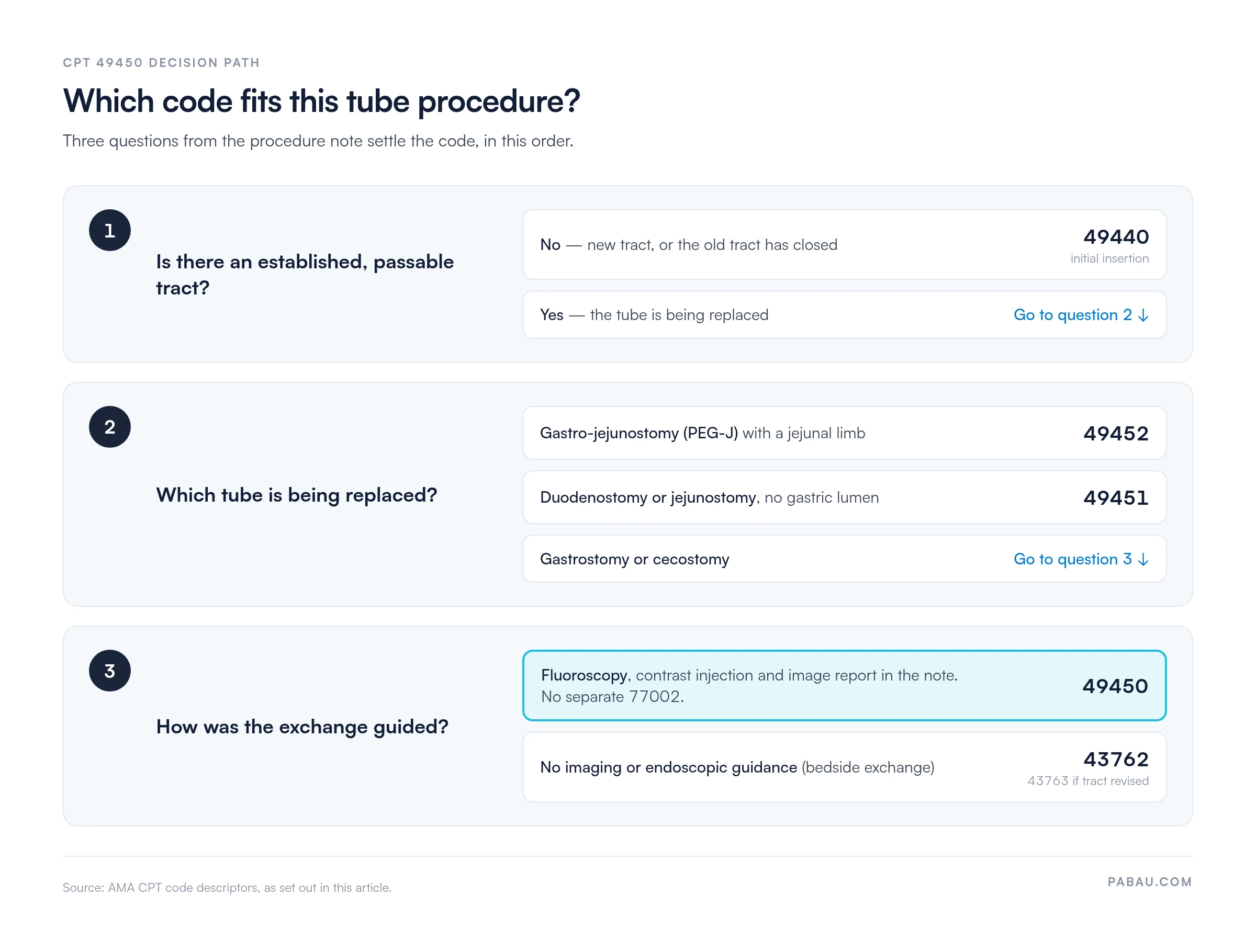
When a patient presents with a dislodged tube and the stoma tract has closed, the procedure becomes an initial insertion, not a replacement. Bill 49440 in that scenario, not 49450. The distinction hinges on whether the tract was passable at the time of the procedure.
Payers audit the procedure note for specific elements before paying CPT Code 49450. For example, a note that simply states “G-tube replaced without difficulty” will not survive a post-payment audit. So every element below should appear in the note, grounded in sound medical billing compliance practice:
Also, the imaging notation supports 49450 itself. The code includes fluoroscopic guidance, contrast injection, image documentation and a report, so the note must record each of them. A note with no imaging record describes a 43762 or 43763 service, and a payer reviewing it can down-code or deny the 49450 claim.
Fluoroscopic guidance is part of CPT Code 49450, so you do not report fluoroscopy (CPT 77002) alongside it. The descriptor reads “under fluoroscopic guidance including contrast injection(s), image documentation and report”, which means the code already prices in the imaging.
The National Correct Coding Initiative (NCCI) applies the same rule across radiology. When a procedure’s descriptor includes imaging guidance, the guidance code is not separately reportable. The Centers for Medicare and Medicaid Services (CMS) publishes the edits and the policy manual on its NCCI edits page.
Likewise, the same rule holds when a radiologist and a proceduralist share the case. A separate 77002 claim for the same tube exchange will deny as included in 49450, whichever group submits it.
Applying the correct modifier prevents automatic denial and tells the payer exactly what clinical circumstance changed the standard service. The table below covers the modifiers most relevant to CPT Code 49450 billing.
Also, CPT 49450 carries a 000 (zero-day) global period on the Medicare Physician Fee Schedule, so the replacement has no postoperative days of its own. Modifiers 78 and 79 apply when the replacement falls inside the global period of another procedure. Verify current global period assignment with the CMS Physician Fee Schedule lookup tool for the current year.
A linked diagnosis code must support medical necessity for CPT Code 49450 and explain why the replacement was clinically required. For a planned exchange with no complication, Z43.1 is the encounter code. The K94.2- codes cover a tube replaced because of a complication.
Indeed, specificity matters. A claim that pairs K94.20 (unspecified complication) with a note documenting a ruptured balloon is more likely to face scrutiny than one using K94.23 (malfunction). So code to the highest level of specificity the documentation supports. Z93.1 only records that the patient has a gastrostomy, so it never sits on a 49450 claim beside Z43.1 or a K94.- code.
CMS sets Medicare reimbursement for CPT Code 49450 each year through the Medicare Physician Fee Schedule (MPFS). Rates differ by place of service, geographic region, and whether the procedure is billed in a facility or non-facility setting. Always retrieve current-year rates directly from the CMS Physician Fee Schedule lookup. Do not rely on prior-year figures, as conversion factor adjustments affect payment each January.
Prior authorization requirements for CPT Code 49450 vary by payer, plan type, and clinical urgency. In fact, no universal rule applies across all insurers. General patterns from the major payer categories:
Track authorization status in the patient record before scheduling any elective tube exchange. Otherwise, you can recover a claim denied for missing auth only through a formal appeal with documentation of medical necessity, which slows payment a lot. Maintaining a clean superbill for G-tube claims that captures auth numbers alongside procedure codes reduces manual follow-up at billing time.
CPT Code 49450 denials cluster around a handful of root causes. Addressing each one at the documentation and pre-billing stage is more efficient than building appeals after the fact. Denial management workflow tracking across G-tube claims reveals which of these patterns is most frequent for a given payer.
For a denied claim, start with the denial codes on the remittance advice. Next, cross-reference the Claim Adjustment Reason Code (CARC) against the root causes above to confirm the denial category before you draft the appeal. Finally, to cut repeat denials, check each G-tube claim against clean claim submission rules before it goes out.
When appealing a lack-of-medical-necessity denial for 49450, attach the nursing or physician note on the tube’s state at presentation (dislodged, deflated balloon, clogged). The procedure note alone is not enough. Payers want to see the clinical event that made replacement necessary, not just what was done.
Tube replacements are often urgent, so teams write the procedure note and the claim quickly, often as different people. That is how a 49440 ends up on a replacement claim, or a 77002 line gets added for imaging the code already pays for.
Pabau, the practice management and billing platform we make, builds the online claim from the invoice you already raise. You can check coverage from the patient record before treatment, so a coverage problem shows up before the tube is exchanged. Each CPT Code 49450 claim then goes out through Claim.MD, which tracks its status through payment or denial. For a broader look at how claims flow from encounter to payment, see Pabau’s claims management software overview.
As a result, your billing team stops retyping invoice details into a separate claim form. When a payer pushes back on a G-tube claim, the status trail shows where it stalled.
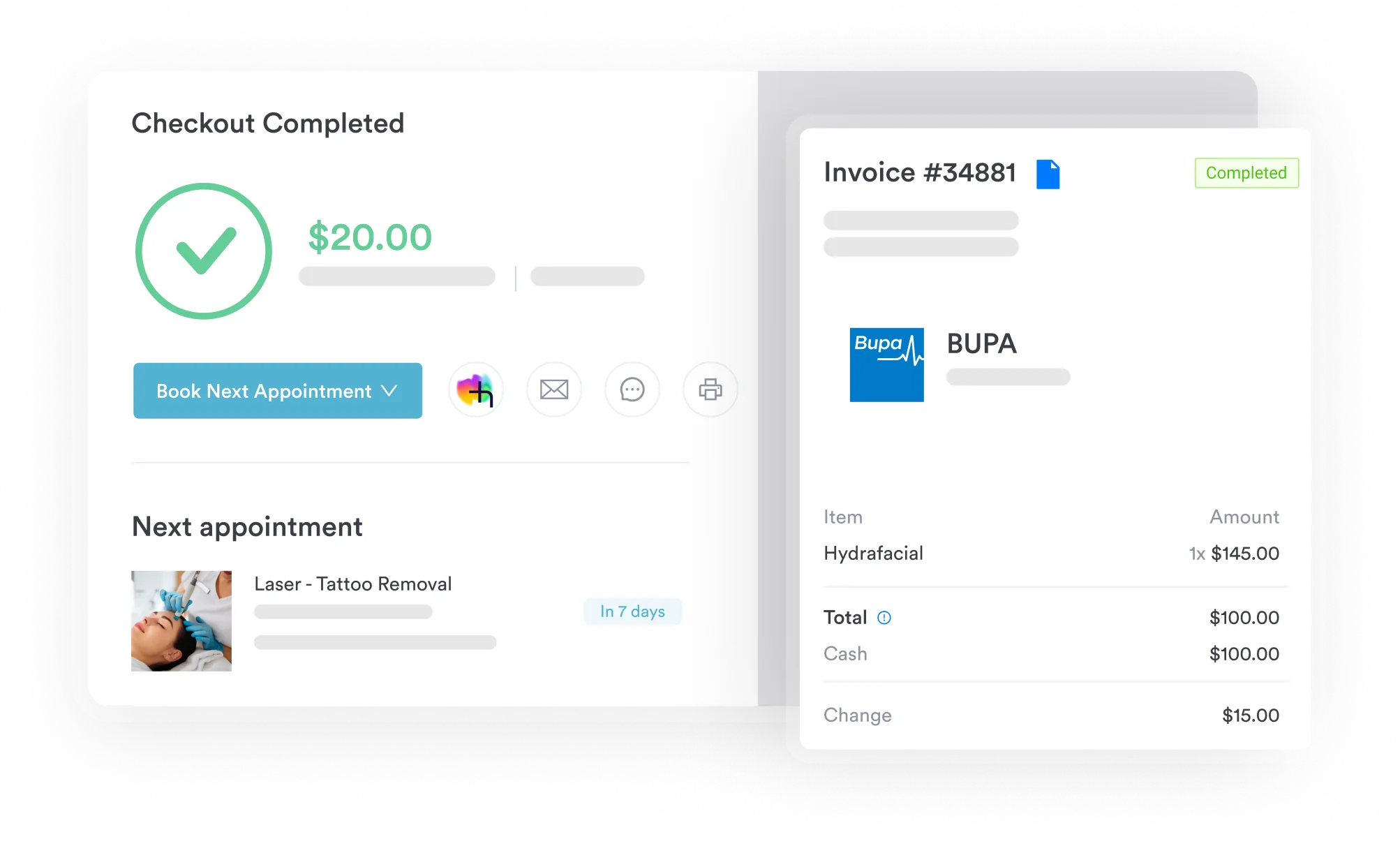

Pabau builds CPT 49450 claims from your invoices and tracks them through Claim.MD, so tube replacement claims aren’t retyped by hand.

CPT Code 49450 is straightforward in principle, but its claims fail when the note and the claim drift apart. So use it only when the tube went through an established tract under fluoroscopy, record that imaging in the note, and leave 77002 off the claim.
If no imaging was used, 43762 or 43763 is the right code. A note that says so holds up better than a 49450 the documentation can’t support. Book a demo to see how Pabau keeps G-tube procedure notes and claims in step across your medical billing workflow.

Need a clearinghouse that handles real-time eligibility for procedure codes? Medical claims clearinghouse guide explains how electronic clearinghouses route and validate claims before payer submission.
Want to understand remittance advice and denial codes in depth? Electronic remittance advice covers 835 transaction sets, CARC codes, and how to read an ERA to action denials faster.
Looking for guidance on revenue cycle fundamentals? Revenue cycle management overview walks through the end-to-end billing cycle from eligibility check to payment posting.
Coding the first tube placement endoscopically? CPT code 43246: PEG tube placement covers the EGD-guided insertion that comes before any replacement.
Pairing a routine exchange with its diagnosis? ICD-10 code Z43.1 explains the encounter code for attention to a gastrostomy.
CPT Code 49450 covers the percutaneous replacement of a gastrostomy or cecostomy tube through an existing stoma tract, under fluoroscopic guidance. The code includes the fluoroscopy, contrast injection and imaging report. It does not cover initial insertion (CPT 49440), gastro-jejunostomy tube replacement (CPT 49452), or open surgical tube exchange.
CPT 49440 is used for the initial insertion of a gastrostomy tube through a newly created tract. CPT 49450 applies when a tube was already in place and is being replaced through an established stoma tract. Billing 49440 for a replacement procedure, or vice versa, is a frequent coding error in this family and leads to denial.
The modifiers most often applied with CPT 49450 are 52 (reduced service), 53 (discontinued procedure) and 76 (repeat procedure by the same provider). Modifiers 78 and 79 apply when the replacement falls inside another procedure’s global period. Do not use modifier 59 or XU to bill 77002 with 49450, because the code includes imaging guidance.
Frequent denial reasons for CPT Code 49450 include wrong code selection (49440 instead of 49450) and vague medical necessity documentation. Missing prior authorization for elective replacements and global period conflicts follow. A 77002 line billed with 49450 also denies, because the code includes imaging guidance. The CARC code on the remittance advice points to the right appeal path.