ICD-10 code S52.311P: Right radius shaft greenstick malunion
ICD-10 code S52.311P covers a right radius that healed out of line ICD-10 code S...

Last Updated: Oct 16, 2026
Billable Code Specific Code
Z43.1 is the billable ICD-10-CM code for encounter for attention to gastrostomy.
The hard part is the line between active care and passive status. Z43.1 belongs on the claim when care is rendered. Z93.1 covers a gastrostomy that is simply present, and payers treat that line as the difference between a paid claim and a denied one. According to the Centers for Medicare and Medicaid Services (CMS), accurate ICD-10-CM coding is a prerequisite for clean claim submission across all payer types.
Let Pabau's smart automation suggest the right codes, reduce claim denials, and keep your practice compliant—effortlessly.
Automate repetitive tasks and focus on what matters most—your patients.
Reduce coding errors and ensure compliance with the latest regulations.
Clean claims, fewer denials, and faster reimbursements.
Powerful insights and reporting to help your practice thrive.
HIPAA compliant SOC 2 certified GDPR-compliant Trusted by 4,000+ clinics worldwide

ICD-10 Code Z43.1 is a billable ICD-10-CM code for an encounter where a patient receives active attention to an existing gastrostomy.
Z43.1 covers tube flushing, replacement, stoma wound care, and enteral feeding management performed during the visit.
The Z43.1 decision table below separates Z43.1 from Z93.1, K94.22, and K94.23 in a single glance.
PEG tubes, button gastrostomies, and surgically placed tubes all code to Z43.1, because the code ignores placement method.
Practice management software like Pabau puts ICD-10 code search and structured documentation inside the encounter note itself.
ICD-10 Code Z43.1 is a billable ICD-10-CM code covering any encounter for attention to an existing gastrostomy, effective October 1, 2025.
The official descriptor is “Encounter for attention to gastrostomy.” The CDC/NCHS ICD-10-CM web tool confirms Z43.1 took effect on October 1, 2025, in the FY2026 edition. The code carried forward from FY2025 without modification.
Z43.1 applies any time a patient presents specifically for care or maintenance of an existing gastrostomy. That covers routine tube care, flushing, tube replacement, stoma site wound management, and enteral feeding management. Z43.1 does not cover the original surgical creation of the gastrostomy, which is reported with a procedure code instead.
When a coder looks up a gastrostomy tube ICD-10 assignment, two codes compete for the claim. Z43.1 records a care encounter. Z93.1 records status alone.
Use Z43.1 for active gastrostomy care, Z93.1 when the tube is only present, K94.22 for a stoma infection, and K94.23 for a malfunction.
Two further complication codes sit alongside those four. K94.21 covers gastrostomy hemorrhage, and K94.29 covers other complications of gastrostomy. The G-tube status ICD-10 code, Z93.1, draws the most mistakes of the group. A note can describe a tube in detail without describing any care given to it.
The complication codes are additional diagnoses, not replacements. When a clinician treats an infected stoma, the claim carries Z43.1 for the care and K94.22 for the infection. Sequence the two by the reason the patient presented.
Understanding the Z43 block helps coders choose the right sibling code when a patient has multiple artificial openings. It also matters when the gastrostomy is not the focus of the encounter. Within Chapter 21, the Z43 category covers every attention-to-artificial-opening scenario.
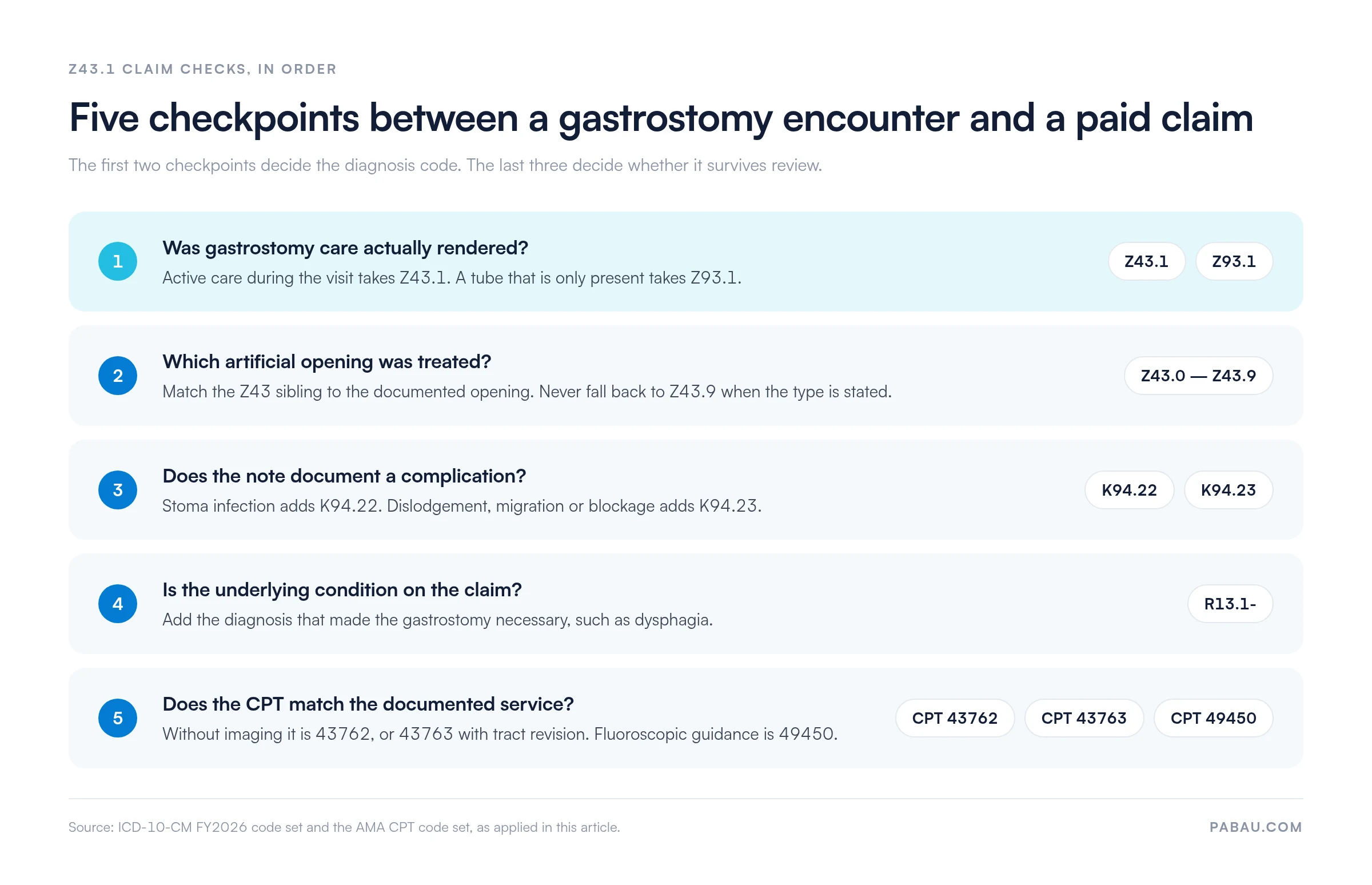
The full hierarchy path for ICD-10 Code Z43.1 runs from Chapter 21 (Z00-Z99) to block Z40-Z53, then category Z43, then Z43.1. When a patient has both a gastrostomy and a colostomy and the encounter covers both, code each separately as Z43.1 and Z43.3. Never use Z43.9 when the specific opening type is documented. Z43.9 is a fallback only when the opening type is genuinely unknown.
ICD-10 Code Z43.1 is justified when the encounter’s purpose is active work on the tube or stoma, not a passing mention in the patient history.
Misapplication here is the root of most Z43.1 denials, so the two lists below are worth reading against your own encounter templates.
Covered encounter types:
What does not qualify:
The ICD-10-CM Official Guidelines distinguish clearly between status codes (Z93.x) and attention-to codes (Z43.x). Z93.1 tells the payer the patient has a gastrostomy. ICD-10 Code Z43.1 tells the payer the patient came in to receive care for it. Both can appear on the same claim when the encounter also addresses the underlying condition, but Z43.1 stays primary when tube maintenance is the purpose.
PEG tube ICD-10 coding uses Z43.1, because a PEG is a gastrostomy and the code does not differentiate by placement method.
A common question in coder forums is whether Z43.1 covers percutaneous endoscopic gastrostomy tubes as well as surgically placed ones. A G-tube ICD-10 lookup returns the same answer as a PEG lookup. Any encounter for attention to an existing gastrostomy maps to Z43.1, regardless of how the tube got there.
Codes in the Z93 category record status rather than care. Z93.1 and Z43.1 are not interchangeable. Using Z43.1 when only Z93.1 applies can produce a denial. The payer’s reason is that the billed service does not match the documented purpose of the encounter.
CMS and the AAPC ICD-10-CM code lookup recognize several approximate synonyms and lay terms that map to Z43.1. These appear in the ICD-10-CM alphabetic index. They also turn up constantly in nursing documentation, referral notes, and patient records.
All of these terms map to Z43.1 when the clinical context is an existing gastrostomy with active care during the encounter. Documentation using any of them should be coded to Z43.1, provided the record also specifies the care rendered.
ICD-9-CM code V55.1 (Attention to gastrostomy) maps one-to-one to ICD-10-CM Z43.1, with no alternate target in the CMS General Equivalence Mappings.
The mapping loses no clinical specificity in either direction. For legacy claims and retroactive audits, V55.1 was correct for dates of service before October 1, 2015. Z43.1 applies for every encounter from that date forward.
GEM files are directional guidance, not a guarantee of payer acceptance. Some commercial payers with legacy systems may ask for additional crosswalk verification. Building Z43.1 into your encounter templates now removes the manual lookup from every visit. See the ResDAC guidance on ICD codes in Medicare files for research and retroactive audit contexts.
Z43.1 is the diagnosis code, and the procedure is reported separately with the appropriate CPT code. The pairing has to be logically consistent. The CPT code must describe a service that would reasonably occur during an encounter for gastrostomy attention. Mismatched CPT-to-ICD pairings are a common trigger for medical necessity denials, so check each pairing against the current CPT code reference before submission.
Two retired pairings still circulate in encounter templates and superbills. CPT 43760 was deleted effective January 1, 2019, and 43762 and 43763 replaced it. CPT 43761 covers repositioning a naso- or oro-gastric feeding tube through the duodenum, so it never applied to gastrostomy tubes at all. A claim carrying either code today is denied.
CPT code descriptors change annually, so verify each code against the current AMA CPT codebook before billing. The pairings above reflect commonly documented clinical scenarios, and individual payer coverage policies may still differ. A superbill for a gastrostomy encounter should carry the CPT, ICD-10 Code Z43.1, and the underlying condition code as an additional diagnosis.
A Z43.1 claim needs the encounter reason, the gastrostomy type, the care rendered, the stoma condition, the underlying condition, and the follow-up plan.
An incomplete record is the most common reason a Z43.1 claim fails audit. CMS and commercial payers require the clinical record to support both the diagnosis code and the procedure billed. Documentation requirements follow the same logic across every ICD-10 encounter type. The record must independently justify every code on the claim, and that is what billing compliance comes down to in practice.
Missing the underlying condition code is the single most common omission. Payers read its absence as an incomplete record, even when the gastrostomy is the sole focus of the visit. Submitting a clean claim means the record above is finished before the claim leaves the practice.
Requirements lists are easier to apply against a note. Here is a short mock encounter note, written the way a home health visit is usually charted.
Sample encounter note
Home health visit, established patient. Gastrostomy tube placed 14 months ago for dysphagia after a stroke. Tube found dislodged this morning. Stoma site clean and intact, with no erythema or drainage. Replacement tube inserted at bedside without imaging guidance. Balloon inflated with sterile water and placement confirmed by aspirate. Patient tolerated a water flush. Feeding regimen unchanged. Review in four weeks.
Four codes come out of that note, and each one traces to a specific line in it.
Z93.1 appears nowhere on that claim. The tube was actively replaced, so a status code would contradict the service billed. The note earns Z43.1 because it names the failure, the action taken, and how placement was confirmed.
Audit your last 10 Z43.1 claims for the underlying condition diagnosis. If more than three are missing it, add a required field for that condition to your encounter template. The next audit tells you whether the change held.
Most Z43.1 denials come from six errors: wrong status code, wrong opening type, missing underlying condition, duplicate coding, thin procedure detail, and uncoded complications.
In practices we onboard, the Z43.1 denials we see almost always trace back to a note that never says what was done to the tube. The errors below come from that same pattern, and each one is a preventable denial. Denial reviews for artificial-opening codes nearly always land on one of these six.
Four of the six errors above are settled by the Z43.1 decision table near the top of this page. The other two are documentation problems, fixed in the note rather than in the claim scrubber. The checkpoints below run the same logic in the order a claim actually moves.
Gastrostomy encounter notes need consistent structure to pass audit, and most teams get that structure from memory and a paper crib sheet. Practice management software like Pabau moves it into the note. Pabau’s claims software for coders includes built-in ICD-10 code search, so a provider can find Z43.1 and its Z93.1 counterpart without leaving the encounter.
Pabau’s digital intake forms can be configured to prompt for gastrostomy type, stoma condition, and care rendered. The prompts mean the record is complete before the claim is built. No one chases the clinician for a missing line a week later.
For practices submitting through the Claim.MD clearinghouse integration, a Z43.1 encounter follows the same 837P electronic claim pathway as any other diagnosis. Eligibility verification runs in real time, and remittance advice (ERA/835) returns automatically. Teams handling enteral nutrition patients can confirm coverage before the visit and reconcile payment without calling the payer.

Pabau’s built-in ICD-10 code search and configurable encounter templates help practices document gastrostomy care in full. Your team pairs the right CPT code and submits clean claims through Claim.MD. See how the workflow fits your team.

Gastrostomy encounter coding comes down to one distinction: active attention versus passive status. ICD-10 Code Z43.1 belongs on every claim where a clinician actively manages a gastrostomy tube, stoma site, or enteral feeding regimen. Z93.1 covers the rest, and K94.22 or K94.23 joins Z43.1 when the note documents a complication.
Get that line right, document the underlying condition, and pair the correct CPT code. Those three levers decide whether a Z43.1 claim pays on first submission. The trade-off worth remembering is that none of them can be fixed at the scrubber. Each one depends on what the clinician wrote in the room.
Pabau’s configurable encounter templates and integrated ICD-10 search remove the manual steps that leave a note incomplete. Book a demo to see how a gastrostomy encounter runs from note to paid claim in one system.

Need to understand how claims flow from ICD-10 to payer? How a medical claims clearinghouse works explains the 837P pathway and how remittance advice closes the payment loop.
Concerned about denial patterns on gastrostomy claims? Denial codes in medical billing covers the most common CARC reason codes and how to respond to each one.
Want to verify eligibility before the encounter? Insurance eligibility verification outlines the steps to confirm coverage before a gastrostomy care visit is rendered.
ICD-10 Code Z43.1 is the billable ICD-10-CM code for any encounter where a patient receives active attention to an existing gastrostomy. This includes routine tube care, tube replacement, stoma wound management, and enteral feeding management. Z43.1 does not apply to visits where the gastrostomy is only noted in the history without active care being rendered.
Yes. Z43.1 is a specific, directly billable ICD-10-CM code, valid for submission for fiscal year 2026 (effective October 1, 2025). Z43.1 is not a non-billable parent category code. Z43.1 can be used as the primary diagnosis on a claim without requiring a more specific child code.
Z43.1 (Encounter for attention to gastrostomy) is used when the patient receives active care for their gastrostomy during the visit. Z93.1 (Gastrostomy status) is a status code used when the patient has a gastrostomy but no gastrostomy-related care occurs. Using Z43.1 on a visit where only status is documented is a common audit trigger.
Yes. A PEG tube is a type of gastrostomy, so Z43.1 covers PEG tube care exactly as it covers a surgically placed gastrostomy. The code also applies to button gastrostomies. Placement method never changes the code, so any active encounter for attention to an existing gastrostomy maps to Z43.1.
The ICD-9-CM equivalent is V55.1 (Attention to gastrostomy). The crosswalk is one-to-one with no alternate mappings per the CMS General Equivalence Mapping (GEM) files. V55.1 was valid for encounters through September 30, 2015. Z43.1 applies to all encounters from October 1, 2015 onward.
The most commonly paired CPT codes are 43762 for G-tube replacement without imaging and 49450 for replacement under fluoroscopic guidance. Use 43763 when the replacement requires revision of the gastrostomy tract. Wound care at the stoma site uses 97597 or 97602, and outpatient management visits use E/M codes 99213 and 99214. CPT 43760 was deleted in 2019, so check every descriptor against the current AMA codebook before billing.
The record must document the reason for the encounter, the gastrostomy type (G-tube, PEG, button), the care provided, and the stoma site condition. The note must also carry nutritional status where relevant, the underlying condition as an additional diagnosis, and the follow-up plan. The underlying condition is the element most often missing on Z43.1 claims.
The Z43 category covers attention to tracheostomy (Z43.0), ileostomy (Z43.2), colostomy (Z43.3), and other digestive tract openings (Z43.4). The category also covers cystostomy (Z43.5), other urinary tract openings (Z43.6), other artificial openings (Z43.8), and unspecified artificial opening (Z43.9). All are specific billable codes. Use the sibling code that matches the documented artificial opening type.
No. ICD-10-CM has no dedicated GJ tube ICD-10 code, and no official guidance distinguishes the gastric limb of a GJ tube from the jejunal limb. A gastrojejunostomy tube enters through a gastric stoma but delivers feed into the jejunum. Code the gastrostomy opening to Z43.1, then document which port was serviced. Verify the assignment against your payer’s own policy before you submit, rather than treating a Z43.4 split as settled. A jejunostomy tube is a different case, because its opening enters the jejunum rather than the stomach.
There is no PEG tube placement ICD-10 diagnosis code. ICD-10-CM describes conditions, so a placement encounter carries the condition that made the tube necessary, such as dysphagia or a neurological disorder. The placement itself is reported with a procedure code. In the outpatient setting that is usually CPT 43246, an upper endoscopy with directed placement of a percutaneous gastrostomy tube. Z43.1 does not apply to a placement visit, because the code covers attention to a gastrostomy that already exists.
The dislodged PEG tube ICD-10 code is K94.23, gastrostomy malfunction, which covers dislodgement, migration, blockage, and breakage. Add Z43.1 when the same visit includes replacing or repositioning the tube, and sequence the two by the reason the patient presented. If the stoma is also infected, code K94.22 (gastrostomy infection) as well. Document what failed, what was done about it, and how placement was confirmed.
The presence of G-tube ICD-10 code is Z93.1, gastrostomy status. Use Z93.1 when the patient has a feeding tube in place and no gastrostomy care happens during the encounter. Z93.1 tells the payer the tube exists, which matters for risk adjustment and for the medical necessity of related services. Z93.1 records no service, so it cannot support a tube-care procedure code on its own.