

HCPCS code E0198: Water pressure pad billing guide
HCPCS code E0198 is a water pad for a standard mattress HCPCS code E0198 is the ...

Last Updated: Oct 13, 2026
43246 is the CPT code for upper gastrointestinal endoscopy with directed placement of a percutaneous gastrostomy tube. The official descriptor covers the esophagus, stomach, and either the duodenum or jejunum as appropriate.
The code covers first-time placement through an endoscopic approach only. It bundles the base EGD service (43235) and any fluoroscopic guidance used during the session. Laparoscopic and open placements belong to separate code families, which is where most 43246 denials start.
Let Pabau's smart automation suggest the right codes, reduce claim denials, and keep your practice compliant—effortlessly.
Automate repetitive tasks and focus on what matters most—your patients.
Reduce coding errors and ensure compliance with the latest regulations.
Clean claims, fewer denials, and faster reimbursements.
Powerful insights and reporting to help your practice thrive.
HIPAA compliant SOC 2 certified GDPR-compliant Trusted by 4,000+ clinics worldwide

CPT 43246 covers endoscopic PEG tube placement only. Laparoscopic placement is coded 43653, and open surgical placement is coded 43830 or 43832.
The base EGD service (43235) is bundled into 43246 and must not be billed separately on the same date.
Medical necessity documentation must name a qualifying diagnosis, such as dysphagia or neurological impairment, and confirm the endoscopic approach.
Medicare MPFS rates differ between facility and non-facility settings, so check the current-year CMS fee schedule before submitting.
Pabau’s claims management software flags NCCI bundling conflicts and approach-code mismatches before claims reach the clearinghouse.
The American Medical Association defines CPT code 43246 with a single descriptor. It reads: Upper gastrointestinal endoscopy including esophagus, stomach, and either the duodenum and/or jejunum as appropriate; with directed placement of percutaneous gastrostomy tube. Each component of that descriptor carries a billing implication.
Fluoroscopic guidance, when performed during the procedure, is included in 43246 and cannot be billed separately. Practices that also bill 76000 or 74300 for the same session are unbundling a service the AMA descriptor already covers. That is a frequent audit trigger.
Understanding the clinical steps helps coders verify that what the operative note describes actually matches what CPT code 43246 covers. The sequence below reflects standard endoscopic technique.
Every one of those steps should be identifiable in the procedure note. A note that says only “PEG placed without complication” will not survive a payer audit.
NCCI edits bundle several services into 43246. Billing them separately without a valid modifier is the most common route to a denial or recoupment demand.
Practice management software like Pabau runs the same check before submission. Its denial-preventing claims software cross-checks code pairs against the current NCCI edits, so conflicts surface in review rather than as clearinghouse rejections.
The 43200-series contains several codes that are routinely confused with CPT code 43246. The table below maps each adjacent code to its correct use case.
A note that also describes endoscopic ultrasound with fine needle aspiration points to 43242, a separate code that already covers the ultrasound examination. Check that pair against the current NCCI edits before reporting both.
CPT code 43239 (EGD with biopsy) and CPT code 43246 sit in an NCCI Column I/II edit relationship. Billing both on the same date without an override modifier generates an automatic denial. Modifier 59 applies only when three conditions hold.
Biopsies taken incidentally during PEG placement do not meet that standard. A polyp removed by snare at a distinct site is a separate therapeutic service, coded 43251. Whether it is separately payable alongside 43246 depends on the current NCCI edits.
CPT code 43246 applies to initial placement only. Once a PEG tube is in place, later exchanges and replacements map to a different code family. Using 43246 for a replacement is a miscoding error that surfaces in payer audits.
Approach is the single most consequential variable in gastrostomy tube coding. CPT code 43246 is endoscopic only. The endoscope guides tube placement through the intact abdominal wall. When a surgeon reaches the abdomen laparoscopically or through an open incision, a different code applies and 43246 must not be used.
A practice that codes every gastrostomy to 43246, whatever the operative note says, is upcoding the laparoscopic cases. 43653 carries a different RVU value. The open cases are simply miscoded, and both errors carry audit exposure.
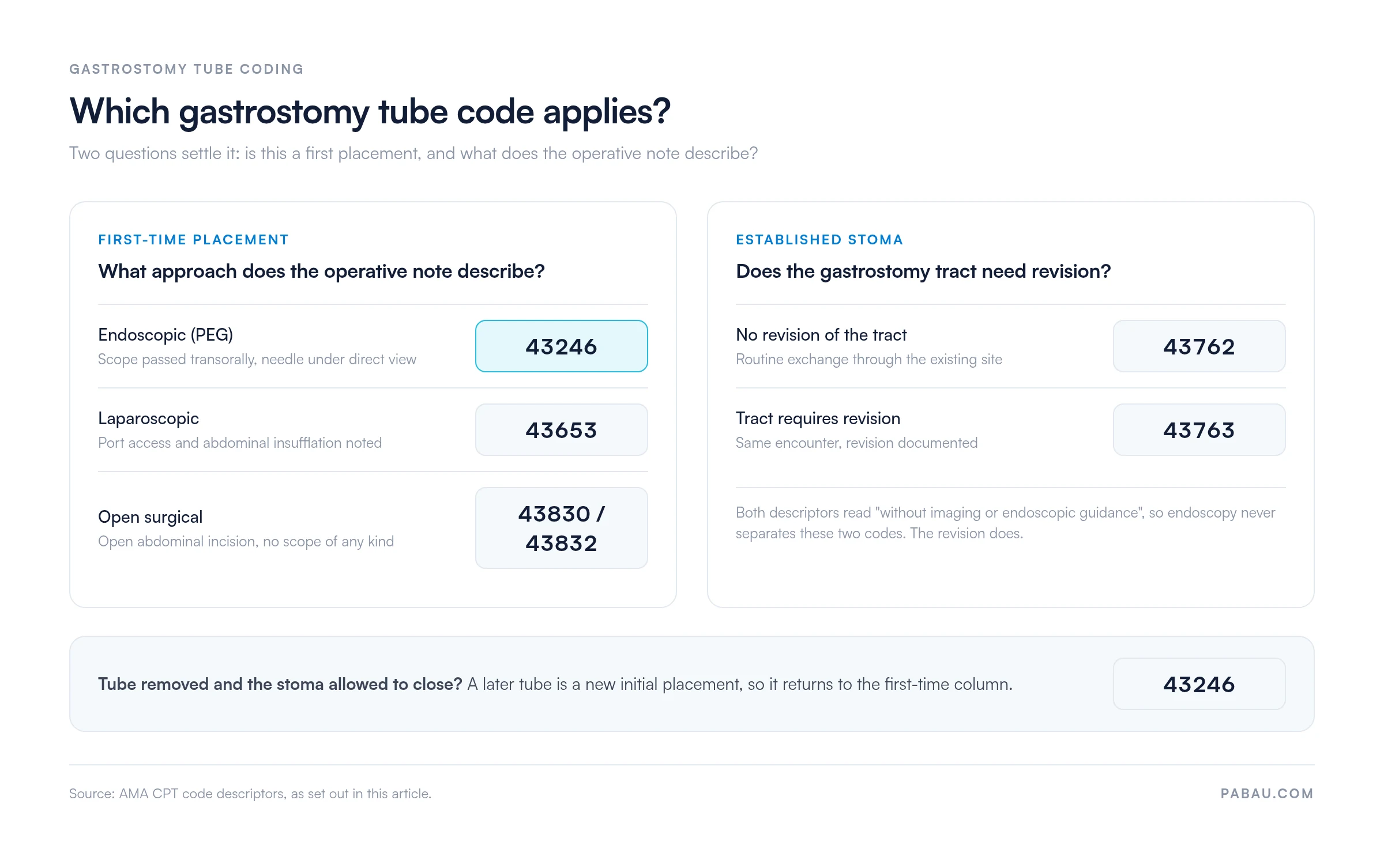
Two questions settle every gastrostomy code: whether a stoma already exists, and what the operative note describes. The diagram below runs them in order.
CMS and private payers expect specific elements in the operative or procedure note. Missing one of them is the fastest path to a medical necessity denial. Dysphagia, coded R13.10, supports most PEG placements, so the note has to establish it.
Templated notes that omit the approach statement or the extent-of-examination finding fail payer audit more often than notes with procedure-specific detail. A single denied 43246 claim typically costs $400 to $800 in reimbursement, depending on setting. That loss compounds when the same note template runs across dozens of cases.
Build a 43246-specific procedure note template with a checkbox for approach (endoscopic, laparoscopic, or open) and a mandatory field for the qualifying ICD-10 code. Any case where the approach checkbox is left blank should trigger a note review before the claim is submitted. That one workflow change removes the denial that turns up most often, where the note never states the approach.
CPT code 43246 accepts several modifiers, each with specific clinical and administrative requirements.
Medicare reimbursement for CPT code 43246 is calculated through the Medicare Physician Fee Schedule (MPFS) and differs by place of service.
Rates update annually each January 1, and the table below reflects the 2026 fee schedule structure. Confirm current amounts with the FastRVU 2026 RVU lookup tool or the CMS Look-Up tool before submitting claims.
Equipment and sedation requirements keep PEG placement out of the physician office, so facility rate billing at POS 22 or POS 24 is the norm. Submitting POS 11 for a procedure performed in a hospital outpatient department is a place-of-service error that constitutes a false claim.
Prior authorization (PA) requirements for CPT code 43246 vary by payer and plan year. Medicare fee-for-service does not routinely require PA for this code. Medicare Advantage plans set their own requirements, so check the plan’s portal before scheduling. Commercial insurers and Medicaid programs vary the most.
Payers approve PA for 43246 on a short set of clinical criteria.
Run the PA check at scheduling, against the specific plan rather than the payer in general. Missing authorization is the third most common denial reason for this code.
Medicare Advantage plans revise their PA lists every year. A payer that required no authorization last year may require one now, so check the current list rather than last year’s note.
Denials on CPT code 43246 cluster around five root causes. Each one is cheaper to address at the point of entry than at the back end of the revenue cycle.
Tracking common denial codes by procedure type shows whether 43246 rejections come from thin documentation, missed authorizations, or bundling. Fix the input that produced them instead of appealing case by case.
Run a quarterly denial analysis filtered specifically to 43246. If more than 15% of denials carry the same reason code, treat it as a workflow failure and trace it upstream. Map each denial reason to where it starts: scheduling, documentation, coding, or submission. Then fix that step rather than the appeal.
In most GI practices the check on a 43246 claim happens after the denial arrives. A coder pulls the remittance, opens the operative note, and finds that the approach was never stated or that 43235 went out alongside it.
Pabau holds the booking, the procedure note, and the claim in one record. Place of service is drawn from the facility on the appointment, so POS 11 cannot be typed over a hospital outpatient case.
The note template carries an approach field, so nobody codes the case before the approach is stated. The claim scrubber then checks the code pair against the current NCCI edits.
Coding staff spend their time on the claims that need a judgment call. The rest go out correct, and the appeals queue stops absorbing work the front end should have done.

Pabau’s built-in claims workflow validates CPT code pairs, NCCI edits, and place-of-service codes before claims reach the clearinghouse. Denials drop without adding a manual review step.

A 43246 claim is decided before it is submitted. The operative note either names the endoscopic approach or it does not, and the code pair either survives the NCCI edits or it does not.
That makes the appeal the wrong place to spend effort on this code. Put an approach field in the note template, run the code pair through a scrubber, and pull place of service from the scheduling record. The denial rate follows.
Book a demo to see how Pabau validates CPT code pairs and place of service before a 43246 claim leaves your practice.

Need to understand how claims move from submission to payment? Medical claims clearinghouse guide explains the role clearinghouses play in CPT claim validation and transmission.
Want to reduce time-to-payment on endoscopy claims? Superbill best practices covers how to structure billing documentation so CPT codes like 43246 clear payer review faster.
Looking for guidance on handling denied GI procedure claims? Pabau’s Claim.MD clearinghouse integration details how electronic submission and real-time edit checks cut denial rates on procedure-intensive claims.
CPT code 43246 is the procedure code for upper gastrointestinal endoscopy with direct endoscopic placement of a percutaneous gastrostomy (PEG) tube. Fluoroscopic guidance is included when performed. It covers initial placement only and bundles the base EGD service (43235), which must not be billed separately on the same date.
CPT 43246 applies to initial placement only, where no prior gastrostomy site exists. Tube replacement or exchange through an established stoma uses 43762 or 43763. Neither code involves imaging or endoscopic guidance. 43762 applies when the gastrostomy tract needs no revision, and 43763 applies when it does. Using 43246 for a replacement is a miscoding error that can trigger recoupment.
Laparoscopic gastrostomy tube placement is coded to 43653, not 43246. CPT 43246 is restricted to the endoscopic approach, where the endoscope guides percutaneous needle insertion transorally. Submitting 43246 when the operative note describes laparoscopic port access is an approach-based miscoding error.
Yes. When the performing physician also administers moderate sedation, codes 99152 and 99153 may be billed separately. This is payer-specific, and the provider type matters. When a separate anesthesia provider administers general or monitored anesthesia care, that provider bills under the anesthesia code family independently of 43246.
Modifier -53 applies when the procedure is started but discontinued due to a medical complication. Modifier -52 applies when the procedure is completed but with reduced services. Modifier -59 is required when billing 43246 alongside another endoscopy code (such as 43239) to establish that the second service is distinct and separately documented.
Five reasons account for most 43246 denials. The first is a wrong approach code, where 43246 is used for a laparoscopic or open procedure. The second is weak medical necessity documentation, with no qualifying ICD-10 diagnosis on the claim. The third is a missing prior authorization. The fourth is an NCCI bundling violation, such as billing 43235 or 43239 without a valid modifier. The fifth is a place-of-service error, most often POS 11 for a hospital outpatient procedure.



