

CPT Code 30801: Superficial turbinate ablation billing guide
CPT Code 30801: Official descriptor and procedure overview The American Medical ...

Last Updated: Nov 27, 2026
47100 is the CPT code for biopsy of liver, wedge. It reports an open surgical wedge excision of liver tissue, either as a standalone procedure or during another open abdominal operation.
Needle biopsies use 47000 (percutaneous) or the add-on 47001 (during another major procedure), and a laparoscopic wedge biopsy goes to unlisted code 47379. The operative note must name the wedge technique, the site, and the indication.
Let Pabau's smart automation suggest the right codes, reduce claim denials, and keep your practice compliant—effortlessly.
Automate repetitive tasks and focus on what matters most—your patients.
Reduce coding errors and ensure compliance with the latest regulations.
Clean claims, fewer denials, and faster reimbursements.
Powerful insights and reporting to help your practice thrive.
HIPAA compliant SOC 2 certified GDPR-compliant Trusted by 4,000+ clinics worldwide

CPT code 47100 reports an open wedge biopsy of the liver, while needle biopsies use 47000 or add-on 47001.
A laparoscopic wedge biopsy is not 47100 and goes to unlisted code 47379, with the approach stated in the operative note.
The operative report must document the wedge technique, the anatomic site, and the clinical indication.
Medicare applies the multiple-procedure reduction automatically, so modifier 51 matters mainly for commercial payers that require it.
When an NCCI edit pairs 47100 with the primary surgery, a distinct biopsy needs modifier 59 or an X{EPSU} modifier.
CPT code 47100 is the code for “biopsy of liver, wedge,” an open surgical biopsy of liver tissue. It sits in the Surgery / Digestive System section of the AMA’s CPT code set, which the CPT Editorial Panel maintains. The code covers only the open wedge technique. The surgeon excises a triangular or wedge-shaped sample directly from the liver surface with a scalpel or electrosurgical instrument.
The summary below covers the fields coders check first.
The code does not distinguish between a biopsy performed as the sole procedure and one taken during a larger open abdominal operation. Both scenarios use 47100 when an open wedge technique is documented. NCCI edits and payer modifier rules decide how it is reported alongside another surgery.
Use 47100 when the operative report confirms an open wedge biopsy of the liver. The four clinical contexts that most commonly support this code are:
Documentation must state the clinical indication, the technique (wedge, not needle), and the anatomic segment of the liver sampled. A note that reads only “liver biopsy performed” cannot support 47100. It cannot support 47000 either, because that code requires a documented percutaneous needle approach. The payer denies the claim or queries it for insufficient documentation.
Liver biopsy coding trips up even experienced coders because three codes cover similar territory. The technique and the billing context determine which code applies.
Critical distinction: 47001 is an add-on code. Billing it without a qualifying primary procedure results in an automatic denial. A common error is billing 47001 alone when the surgeon took a needle biopsy during an operation. The needle biopsy is still 47001, but the primary procedure code must appear on the same claim.
47100 covers the open technique only. A laparoscopic wedge biopsy is not 47100. Report it with unlisted code 47379 (unlisted laparoscopic procedure, liver), and document the approach in the operative note. Destroying a tumor in place, rather than sampling it, takes an ablation code instead, such as CPT code 47382 for the percutaneous radiofrequency route. The tree below maps each approach to its code.
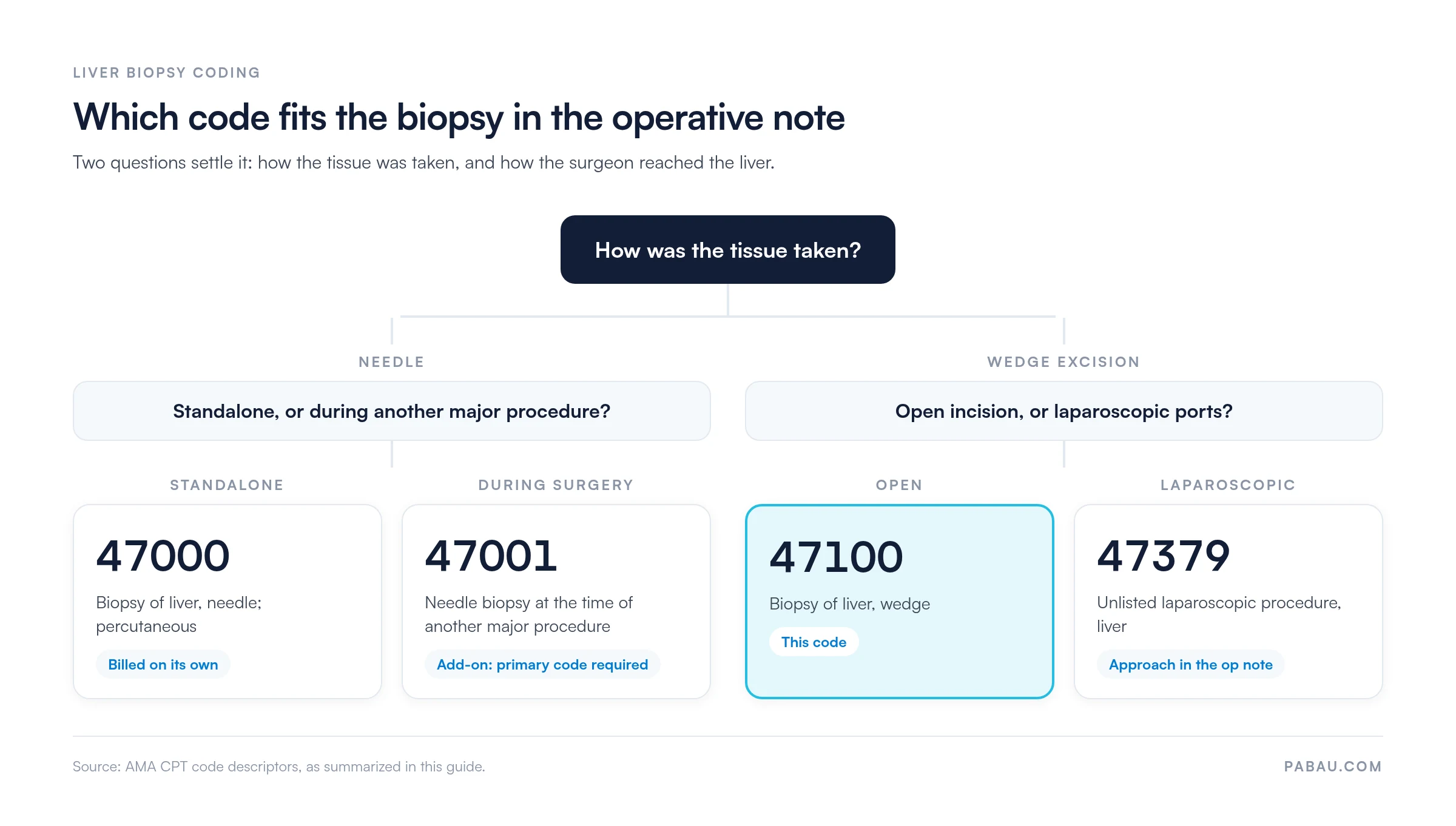
A surgeon may take a wedge liver biopsy during an open colectomy or other open abdominal procedure. 47100 is then separately reportable only if the documentation supports a distinct surgical effort. This is where most intraoperative biopsy claims get denied. If the primary surgery is laparoscopic, the wedge biopsy goes to unlisted code 47379 instead.
Four conditions must be met for 47100 to be separately reportable in this context:
National Correct Coding Initiative (NCCI) edits may bundle certain organ biopsies with the primary abdominal surgery. Check the current NCCI edit table for the specific primary code before submitting. The edits update quarterly, and a column 1/column 2 edit makes 47100 non-separately payable unless its indicator allows an NCCI-associated modifier.
Run the primary procedure code and 47100 through an NCCI edit checker before submitting a claim with both codes. If a column 1/column 2 edit exists with a modifier indicator of ‘0’, the biopsy is never separately payable with that primary code. No modifier overrides it. An indicator of ‘1’ allows modifier 59 or an X{EPSU} modifier when the note supports a distinct service. The AAPC’s Codify tool and CMS’s own edit tables are the two fastest ways to check the current quarter’s edits.
Medical necessity for CPT code 47100 is established by the accompanying ICD-10-CM diagnosis code. Payers will reject claims where the diagnosis does not logically support a liver biopsy. The table below lists codes most frequently linked to 47100 and notes their medical necessity alignment.
Use the most specific diagnosis code available. A documented cirrhosis with no named type, for example, goes to K74.60 rather than K76.9. K76.9 is acceptable when the working diagnosis is pending biopsy results, but commercial payers increasingly require a more specific code at the time of service. If prior authorization is involved, verify that the submitted diagnosis code matches the authorization approval before billing.
Three modifiers are relevant to CPT code 47100. Which one applies depends on the billing scenario.
Modifier rules differ between Medicare and commercial payers. A commercial carrier may deny a 59 override that Medicare accepts unless the clinical documentation is specific. Check the payer’s modifier policy before submitting. CPT Appendix E lists the modifier-51-exempt codes, and the CMS MPFS Relative Value Files carry the multiple-procedure indicator for 47100.
CPT 76942 (ultrasound guidance for needle placement, imaging supervision and interpretation) is the imaging code coders most often try to bill with a liver biopsy. It is a standalone code for imaging guidance of needle placement, not an add-on, and it rarely fits 47100.
For open wedge biopsies performed under direct visualization, imaging guidance is not separately reportable. The surgeon sees the biopsy site directly and places no needle under ultrasound, so 76942 has no clinical basis here. NCCI edits typically bundle imaging guidance with open surgical procedures where direct visualization is inherent to the technique.
Intraoperative ultrasound is a different service, reported with 76998. It may be separately billable when the surgeon uses it to localize a non-palpable lesion before the wedge excision. The documentation must state that ultrasound was needed to find the lesion, include the imaging interpretation, and identify the physician who performed it. Verify the current NCCI edit status for the 47100/76998 pair before submitting, as edit tables update quarterly.
Medicare reimbursement for CPT code 47100 is set annually through the Medicare Physician Fee Schedule (MPFS) and adjusted by geographic locality. CMS publishes national average rates each calendar year. They vary by whether the service is performed in a facility (hospital, ASC) or non-facility (office) setting.
The key payment components for 47100 under MPFS are work RVUs (wRVUs), practice expense RVUs, and malpractice RVUs. Each RVU is adjusted by the geographic practice cost index (GPCI) for the provider’s locality. The total is then multiplied by the annual CMS conversion factor. Use the CMS Physician Fee Schedule lookup tool and the FastRVU 2026 RVU lookup to find the rate for your MAC jurisdiction. A published national average can differ materially from your locality-adjusted rate.
Facility rates are lower than non-facility rates because CMS reimburses the facility separately for practice expenses. A surgeon billing 47100 from a hospital setting receives the facility rate. The same procedure in an office-based surgical suite bills at the non-facility rate. Document the place of service correctly on the CMS-1500 form to avoid a rate mismatch.
Understanding why 47100 claims get denied is the fastest route to a cleaner first-pass rate. The five patterns below come up most often on this code. The medical billing denial codes guide decodes the CARC and RARC codes behind them.
Effective denial management workflows catch these patterns before they recur. Tracking denial reason codes by CPT code shows whether the problem is documentation upstream or modifier assignment at charge entry. Pabau’s claims management software helps practices submit and track claims, so each 47100 denial gets worked from the same record.
The operative report is the primary document that supports or defeats a 47100 claim. Five elements must appear in it.
A well-documented operative note also protects the practice during a payer audit or RAC review. Clean claim submission starts with documentation that answers the payer’s medical necessity questions before they are asked. Across multiple surgical specialties, a consistent operative note template for liver biopsies reduces coding variability and denial rates.
Ask your hepatic surgeons to add a one-line technique attestation to their macro or dictation template: ‘Wedge biopsy technique performed; specimen submitted to pathology.’ This single addition resolves the most common denial reason for 47100 without changing operative note length or workflow.
On a 47100 claim, most of the rework happens after the surgery. The biller chases the surgeon for the technique, re-keys the claim, then waits on a remittance to learn whether it paid.
For US practices, Pabau’s claims management sends claims through Claim.MD, the clearinghouse behind our Claim.MD integration. Eligibility checks and ERA remittances run through Claim.MD too, so payment status sits on the patient’s record instead of in a separate portal.
The same record produces the superbill, so codes, modifiers, and diagnoses are entered once rather than copied between systems.
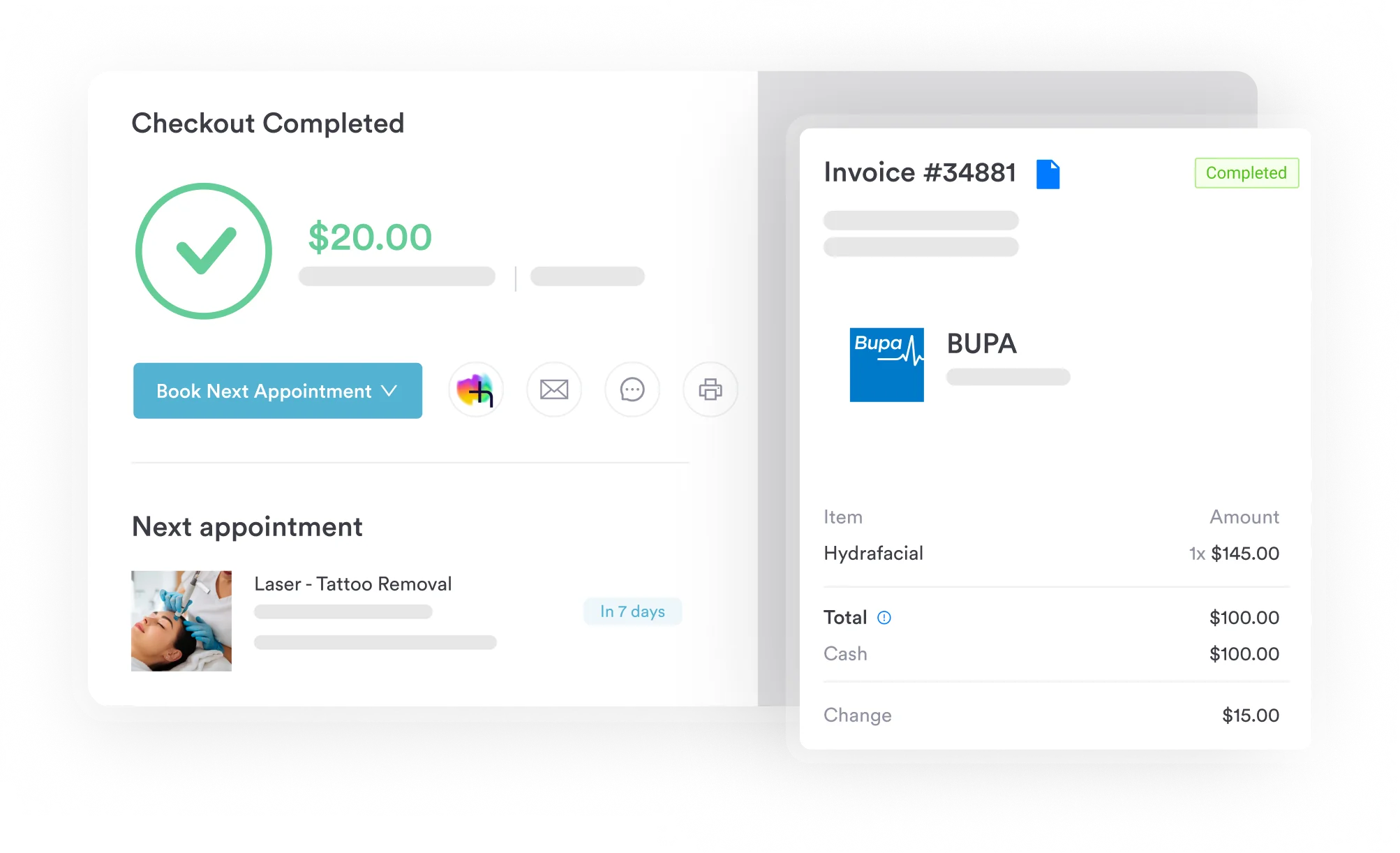

Pabau’s claims management submits US claims through Claim.MD, runs eligibility checks, and posts ERA remittances. Your billing team spends its time on exceptions instead of re-keying claims.

CPT code 47100 pays when the operative note does the coder’s work. Name the wedge technique, the hepatic segment, and the indication, and the code choice holds up on audit.
When the biopsy rides along with another open surgery, check the NCCI edit before the claim goes out. Use modifier 59 or an X{EPSU} modifier when an NCCI edit applies, and add modifier 51 only for commercial payers that require it.
The trade-off to remember is the approach. A laparoscopic wedge biopsy never becomes 47100, and its unlisted 47379 claim rests on an op note that states the approach.
Practice management software like Pabau keeps claims, eligibility checks, ERA remittances, and superbill generation on one patient record. Book a demo to see how Pabau handles surgical billing from op note to payment.

Need a clearinghouse for surgical claims? Pabau’s Claim.MD clearinghouse guide explains how the integration handles 837P submission, ERA posting, and payer enrollment for US surgical practices.
Confused by denial codes on your EOB? Denial codes in medical billing decodes the most common CARC and RARC codes that appear on remittance advices for surgical procedures.
Looking for revenue cycle context? What is revenue cycle management walks through the full claim lifecycle from patient registration to payment posting.
CPT code 47100 covers a liver biopsy performed with an open wedge technique. The surgeon excises a triangular tissue sample from the liver surface under direct visualization. It does not cover needle-based biopsies, which are coded as 47000 (standalone percutaneous) or 47001 (needle biopsy performed as an add-on to another major procedure).
47100 describes an open wedge biopsy and can be billed as a standalone procedure or alongside another surgery with appropriate modifiers. 47001 describes a needle biopsy of the liver performed at the time of another major surgical procedure. It is an add-on code that can never be billed alone. If 47001 appears on a claim without a qualifying primary procedure code, the claim will deny automatically.
Commonly accepted diagnoses include K76.9 (liver disease, unspecified), C22.0 (hepatocellular carcinoma), K74.60 (unspecified cirrhosis of liver), R16.0 (hepatomegaly), and D13.4 (benign neoplasm of liver). Use the most specific code available. Commercial payers may require a more precise diagnosis than K76.9 alone, particularly when prior authorization was obtained for a specific clinical indication.
Generally no. CPT 76942 is imaging guidance for needle placement, so it does not fit an open wedge biopsy performed under direct surgical visualization. Intraoperative ultrasound is a different service, reported with 76998. It may be separately billable when used to localize a non-palpable lesion before excision. The documentation must include an imaging interpretation and show the guidance was medically necessary. Verify the current NCCI edit for the 47100/76998 pair before billing.




