

CCSD code G5100: Bypass of duodenum billing guide
CCSD code G5100 bills a bypass that leaves the duodenum in place CCSD code G5100...

Last Updated: Oct 16, 2026
47000 is the CPT code for biopsy of liver, needle; percutaneous. A physician passes a needle through the skin and takes a tissue core from the liver. Pathology then stages the disease or characterizes a mass.
The code carries a 0-day global period, so follow-up visits stay separately billable. Medicare's 2026 total is 8.62 RVUs in the office against 2.29 in a facility, because the office absorbs the supply and staff cost. Most denials come from a diagnosis code that does not carry medical necessity, or from imaging guidance billed without its own interpretation report.
Let Pabau's smart automation suggest the right codes, reduce claim denials, and keep your practice compliant—effortlessly.
Automate repetitive tasks and focus on what matters most—your patients.
Reduce coding errors and ensure compliance with the latest regulations.
Clean claims, fewer denials, and faster reimbursements.
Powerful insights and reporting to help your practice thrive.
HIPAA compliant SOC 2 certified GDPR-compliant Trusted by 4,000+ clinics worldwide

CPT code 47000 reports a percutaneous needle biopsy of the liver, and it carries a 0-day global period.
Medicare’s 2026 total RVUs are 2.29 in a facility and 8.62 in the office, because practice expense drives the difference.
Imaging guidance codes 76942 and 77002 are separately payable only when a signed interpretation report supports them.
CPT 47001 is a different procedure, reported when the biopsy happens during another major procedure, laparoscopic ones included.
Pabau’s Claim.MD integration submits 47000 claims electronically and tracks the remittance, so unpaid claims surface early.
CPT code 47000 reports a percutaneous needle biopsy of the liver. The official American Medical Association descriptor is Biopsy of liver, needle; percutaneous.
It sits in the Surgical Procedures on the Liver section, code range 47000 to 47399. The code pays for the tissue sampling only, so imaging guidance is billed, if at all, under its own code.
The semicolon in the descriptor matters. The text before it, “Biopsy of liver, needle”, is the parent procedure. The word after it names the approach, meaning through the skin rather than through an incision. That single word is what separates 47000 from its add-on sibling, 47001.
A payer covers CPT code 47000 when the chart shows why tissue was needed. The indication belongs in the procedure note before the claim goes out, not bolted on later during an appeal.
These are the scenarios that reliably support the code:
Write the indication with specificity. “Liver biopsy” on its own, with no underlying diagnosis attached to it, is the single most common reason payers deny this code.
Relative value units, known as RVUs, decide what Medicare pays for CPT code 47000. Three components add up, covering physician work, practice expense, and malpractice. Two of them stay fixed wherever the biopsy happens. The third does not.
Practice expense does all the moving here. In a hospital or a surgery center, the facility owns the needle, the ultrasound, and the nurse who watches the patient afterward. The physician’s practice expense there drops to 0.51. In the office, the practice buys those inputs itself, and the figure climbs to 6.84.
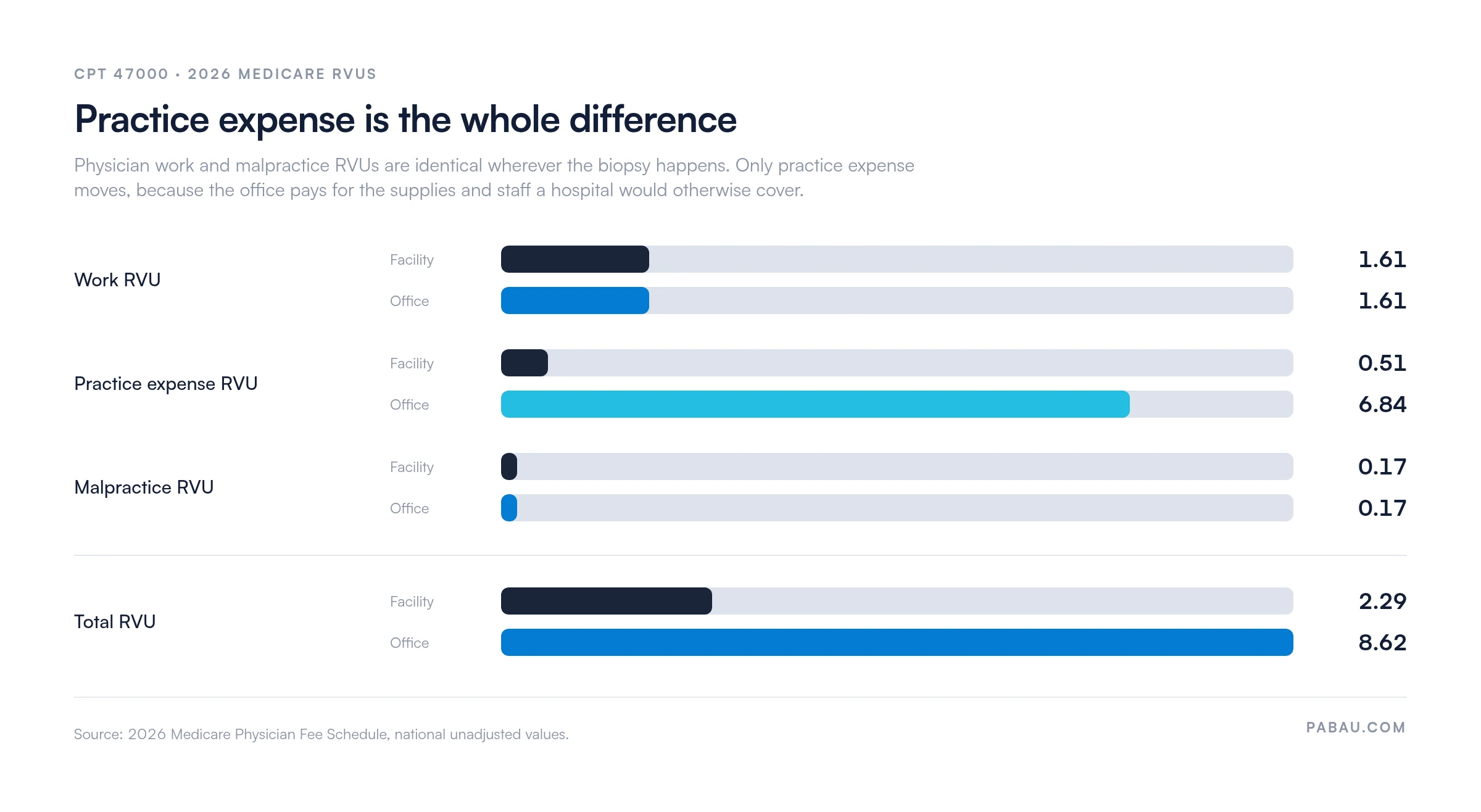
CMS republishes these values every year. Verify the current figures against the Medicare Physician Fee Schedule before you quote a number to a patient or build a fee schedule around it.
Take the total RVUs, multiply by the year’s conversion factor, then apply the geographic adjustment for your locality. That is the whole calculation.
Run it on the 2026 figures and the two settings separate fast. A facility claim built on 2.29 total RVUs lands near $75 to $80 for the professional service. The same biopsy billed in the office runs on 8.62 RVUs, which puts national payment closer to the $250 to $330 range.
Locality adjustment then moves both numbers. The CMS Physician Fee Schedule lookup returns the exact allowable for your carrier and your site of service. That is the only figure worth putting in a patient estimate.
Commercial contracts for CPT code 47000 usually sit above the Medicare allowable, often between 110% and 150% of it. The multiplier depends on your contract, your market, and the plan type. What arrives with the higher rate is a longer list of conditions.
Four of them decide whether the claim survives:
Both Medicare and commercial rates then hinge on one more variable, and it has nothing to do with the needle.
Where the biopsy happens changes two things at once. It selects the RVU set, and it decides whether the physician or the facility bills the technical component.
A claim whose place-of-service code contradicts the facility’s own record is a systematic error, not a one-off. It either overpays or underpays the physician, and both directions create exposure on audit.
A modifier explains circumstances the bare code cannot. Choose the wrong one, or skip one the payer expects, and the claim comes straight back.
Two rules cover most of the trouble. Modifier 26 and modifier TC never belong on the same claim line. And when the physician performs the biopsy on equipment they own in their own office, neither modifier belongs on the claim. Global billing already applies.
CPT code 47001 describes a liver biopsy taken during another major procedure. The AMA descriptor reads “at time of other major procedure”, which covers laparoscopic surgery as well as open surgery. A biopsy taken during a laparoscopic cholecystectomy, reported with 47562, is a textbook 47001.
A biopsy taken during an open cholecystectomy, reported with CPT code 47600, is the same 47001 scenario.
It is an add-on code. That means it never stands alone on a claim, and it never substitutes for 47000.
The two codes describe different clinical events. One goes through the skin in a procedure room. The other happens while the abdomen is already open or already insufflated. Reporting 47001 next to 47000 on the same date, with no other major procedure documented, invites audit scrutiny.
Most percutaneous liver biopsies use imaging to place the needle. Whether you can bill for that imaging is the most denial-prone question on this code. The answer turns on the payer and the current NCCI edit status.
NCCI edits decide whether 76942 can be unbundled from 47000. Where an edit applies, modifier 59 may establish the separate service, but only where the documentation genuinely supports it.
A signed, separately dictated imaging report is what makes that line defensible. Check the current edit status in the AAPC CPT code reference before you bill both.
The ICD-10-CM code you pair with CPT code 47000 is what proves medical necessity. Payers run it against their coverage policy before a human ever reads the claim. The pairing decides the outcome more often than the procedure code does.
Reach for the specific code whenever the chart supports one. K74.6 splits into exactly two options, K74.60 for unspecified cirrhosis and K74.69 for other cirrhosis, so move off K74.60 once the etiology is documented.
Primary biliary cirrhosis is not part of that pair. It carries its own code, K74.3, and coding it correctly reads as clinical precision to a payer.
Read your MAC’s Local Coverage Determination for percutaneous liver biopsy before you submit CPT 47000. MACs differ on which ICD-10 codes they accept as proof of medical necessity. A code like R94.5 often needs extra documentation showing that non-invasive testing was done first and came back inconclusive.
Documentation is what turns a denied claim into a paid appeal. For CPT code 47000, the note needs the clinical reasoning, not only the technique.
These claims carry protected health information, so send and store them through systems that meet HIPAA requirements. Keep the notes for as long as your state law and your payer contracts require, whichever period runs longer.
CPT code 47000 carries a 0-day global period. No pre-operative or post-operative work is folded into the payment beyond the day of the procedure itself.
That has two practical effects. An evaluation and management service on the same day, for a problem unrelated to the biopsy, is billable with modifier 25 on the E/M code. Visits on later days are billable too, whether the patient comes back for a bleeding check or to go through the pathology report.
Codes with 10-day or 90-day global periods work the other way and bundle those follow-ups into the procedure payment. A practice that treats 47000 like a 90-day code leaves legitimate E/M revenue unbilled, month after month.
Knowing the code is one job. Knowing where the claim stalls is another. A clean claim travels the same five steps every time, and each step has its own failure mode.
Most of those failures get caught by a two-minute review before submission. Building that check into the billing routine means fewer rejected claims and far less rework a month later.
Before you submit, confirm that:
Denials on this code repeat themselves. Five errors account for most of what comes back.
When a denial does arrive, sort it before you work it. Reading the remark against the common denial codes tells you whether the problem is technical or clinical.
Technical denials, such as a wrong POS or a missing modifier, are usually fixed on resubmission inside the filing window. Clinical denials need a written appeal with the chart attached, and they take far longer to turn around.
Most practices track 47000 claims in two places at once. The billing system holds what was submitted, and a spreadsheet holds what has not been paid. Reconciling the two is manual work, and claims age quietly while it waits.
Practice management software like Pabau closes that loop. Pabau connects to Claim.MD, so 837P claims leave the patient record directly and eligibility checks run before the biopsy is booked. The remittance advice then lands back in the same system that sent the claim.
Coding judgment stays with your team. Pabau does not suggest modifiers for you or crosswalk a CPT code to a diagnosis. What it removes is the handoffs, so an unpaid 47000 claim surfaces while there is still time to appeal it.

Pabau connects with Claim.MD to submit CPT 47000 claims electronically, check eligibility before the procedure, and match remittance advice against what you expected. Unpaid claims surface while there is still time to appeal.

CPT code 47000 is a simple procedure with a complicated claim. The errors that sink it repeat, which is exactly what makes them preventable. A wrong place of service, guidance billed without a report, and a diagnosis code that says too little account for most of the damage.
Pick the two that cost your practice most this year and build a check for each into the pre-submission routine. That is a far smaller project than overhauling denial management, and it pays back sooner.
Watching claims leave faster than the remittances come back is a workflow problem. Book a demo to see how Pabau follows a 47000 claim from submission through to payment.

Need to understand how medical claims reach a payer? Medical claims clearinghouse guide explains how 837P transactions are validated before payment.
Want to shorten time-to-payment on liver biopsy claims? Claim.MD clearinghouse overview covers how Pabau’s integration handles eligibility checks and remittance matching.
Dealing with repeat rejections on 47000? Revenue cycle management guide walks through the full workflow from eligibility to payment posting.
CPT 47100 reports a wedge biopsy of the liver, where a surgeon removes a wedge of tissue. CPT 47000 is the percutaneous needle approach, taken through the skin. The technique recorded in the note decides which code applies, not the amount of tissue sent to pathology.
Moderate sedation is not built into the descriptor for 47000. When the physician provides it and documents the intraservice time, codes 99151 to 99153 may be reported separately. Payer policy still governs the outcome, so confirm coverage before you add the line.
No. Report one unit per session, however many passes the physician needs to obtain adequate tissue. The number of cores does not change the unit count, and a second unit on the same date usually trips a medically unlikely edit.
No. Add-on codes are exempt from modifier 51, so it never belongs on 47001. Report the add-on on its own line alongside the primary procedure code and let the payer price it in full.



