CCSD code H4180: Full or partial thickness rectal biopsy
CCSD code H4180: definition and procedure scope CCSD code H4180 is listed in the...

Last Updated: Oct 22, 2026

CPT code 43281 covers laparoscopic repair of a paraesophageal hernia without mesh, and it includes the fundoplasty when one is performed.
Mesh status in the operative report is what separates 43281 from 43282.
The 2026 national Medicare payment is about $1,425, and CMS pays the same amount in an office setting.
Billing 43281 in the same session as sleeve gastrectomy (43775) or gastric bypass (43644) invites a bundling denial.
Practice management software like Pabau keeps the operative note, the procedure code, and the claim on one client record.
CPT code 43281 covers laparoscopic repair of a paraesophageal hernia performed without mesh. The descriptor also bundles the fundoplasty, when the surgeon performs one. So one fact decides the code, and that fact is mesh status. No mesh means 43281. Mesh means 43282.
Pick the wrong one and about $1,425 in Medicare payment goes into a reclassification appeal. That happens when the operative note never says whether mesh went in.
This guide covers the 2026 rates, the modifiers that survive an audit, the bariatric bundling trap, and the ICD-10 pairings.
The AMA CPT code set descriptor reads: Laparoscopy, surgical, repair of paraesophageal hernia, includes fundoplasty, when performed; without implantation of mesh. Two phrases in there do the heaviest lifting.
“Includes fundoplasty, when performed” means the wrap is part of 43281 whenever the surgeon does it in the same session. You cannot bill it separately. “Without implantation of mesh” is the selector between two codes. If mesh went in, 43281 is wrong and 43282 is right.
The code sits in the Laparoscopic Procedures on the Esophagus subsection of the CPT surgery codes. It applies whether or not a fundoplasty happened, as long as no prosthetic mesh reinforced the hiatal repair.
Mesh implantation is the only clinical variable between the two codes. Both cover laparoscopic paraesophageal hernia repair with an optional fundoplasty. Make the call from the operative report, never from the surgical schedule.
Surgeons change their minds in the room. A planned mesh repair becomes a primary suture repair once the hiatus looks better than the imaging suggested, and the reverse happens too. Only the operative report settles the final code.
The 2026 national Medicare payment for CPT 43281 is about $1,425, in a facility or an office. Rates move with your locality. Check the exact figure in the CMS Physician Fee Schedule lookup tool for your MAC jurisdiction before quoting a patient.
Geographic practice cost indices, known as GPCIs, adjust each RVU component by payment locality under the CMS Physician Fee Schedule.
A practice billing in Manhattan collects a different amount than one billing the same code in rural Arkansas. The conversion factor also changes every January, so a rate you saved last year is already stale.
Medicare builds the payment from three RVU components, then multiplies the total by one conversion factor. For 2026 that factor is $33.4009 for clinicians outside the qualifying APM track, and $33.5675 for those inside it.
Knowing the split matters when you negotiate a commercial contract off a Medicare multiple.
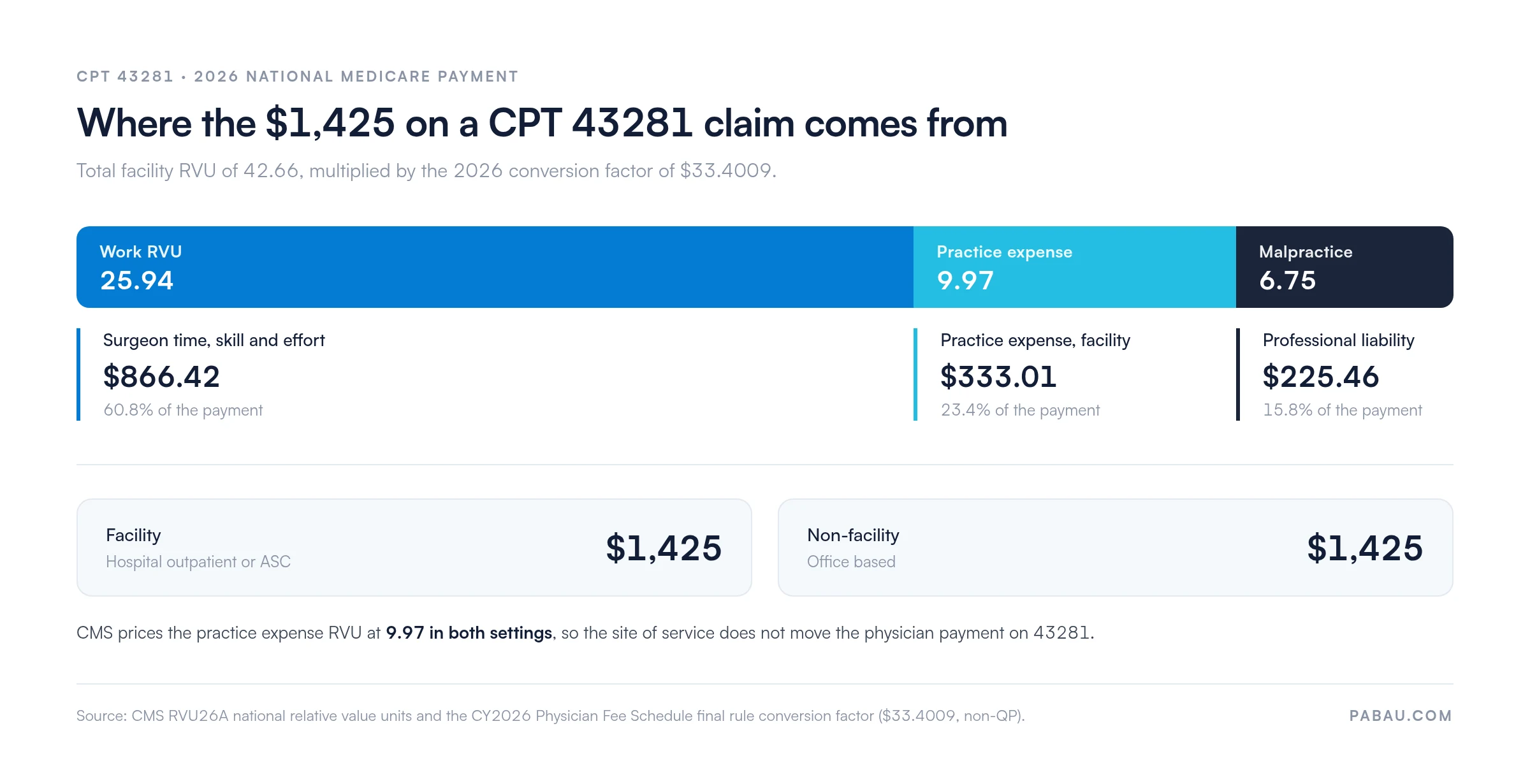
Verify the values against the CMS relative value files before you use them in a contract negotiation. The numbers above are national values, not billing documentation.
A handful of modifiers come up regularly on 43281, and each one needs its justification written into the operative note. Applying the wrong modifier, or omitting a required one, delays payment and invites an audit.
Modifier 22 is the one payers audit hardest. The note has to describe what made the case harder than average, such as dense adhesions, prior abdominal surgery, or atypical anatomy.
Without that detail, expect a reduced payment or a refund request months later.
Medical necessity carries the claim. Medicare and most commercial payers want documentation that the hernia was symptomatic, and that a laparoscopic approach suited the case.
Payers look for dysphagia, regurgitation, respiratory symptoms, or GERD that medication did not control.
Elective repair of an asymptomatic paraesophageal hernia is not universally covered, and some payers require prior authorization before the case is booked.
The riskiest 43281 scenario is a concurrent bariatric procedure. EmblemHealth and several Blues plans deny 43281 when it appears on the same operative session as sleeve gastrectomy (43775) or Roux-en-Y gastric bypass (43644).
Their reasoning is that the hernia repair is integral to finishing the bariatric procedure safely.
Catching the combination before you file saves the 45 to 90 day appeal cycle. That is the whole point of denial management in a surgical practice, and it costs one check at the point of coding.
Before billing CPT 43281 alongside any bariatric code, pull the current NCCI edit table for that code pair. The edits update quarterly, so a pair that was separately billable in the first quarter may be bundled by the third. CMS publishes the quarterly NCCI procedure-to-procedure files on its website.
A 43281 claim passes through four hands before payment lands. Three of those handoffs are where it stalls, and each one stalls for a different reason.
Coding 43281 correctly means knowing its neighbors. Each code below covers a distinct clinical scenario, and reaching for the wrong one creates audit exposure.
CPT 43280 is the code for an isolated laparoscopic fundoplication with no hernia repair. So a Nissen fundoplication for GERD in a patient with a sliding hiatal hernia is 43280, not 43281.
The hernia type and what the surgeon repaired drive the choice, not the presence of a wrap.
Diagnosis coding decides whether a correct procedure code gets paid. K44.9 is the usual principal diagnosis for elective paraesophageal hernia repair, with reflux and symptom codes in support.
Confirm each code is still valid in the CDC ICD-10-CM lookup tool before you submit.
List the GERD codes (K21.0, K21.9) as secondary when the note names reflux as part of the rationale, especially where a fundoplasty was performed.
K44.9 on its own is defensible, but it invites a medical necessity review at some payers. Our ICD-10-CM codes hub covers the diagnosis families that pair with other surgical procedures.
The operative report is the audit defense for a 43281 claim. Incomplete documentation is the usual root cause when an audit finds an overpayment, so the note needs each element below.
Run this check on every 43281 claim before it leaves the practice. It takes a minute and it removes the two denials this code attracts most.
Add a mandatory field to your paraesophageal hernia repair note template that reads Mesh placed, yes or no. Surgeons who dictate long notes often skip that detail. The coder then calls the OR or makes an assumption, and a structured field settles it at the point of care.
Plenty of surgical practices run this workflow across three systems. The operative note lives in the EMR. Codes sit on a spreadsheet or in the coder’s head, and the claim lives in a separate billing tool. Every handoff is another chance for mesh status to go missing.
Practice management software like Pabau keeps them in one place. Treatment notes, procedure codes, and patient documents all sit on the same client record. Your coder reads what the surgeon wrote rather than a summary of it. Our claims management software then submits the claim through Claim.MD, our US clearinghouse partner, and tracks its status back to that record.
The outcome is a shorter loop. When a payer denies a 43281 claim, the denial lands next to the note and the code that produced it. Your biller can answer it the same day, instead of rebuilding the case from three systems.

Pabau holds your operative notes, procedure codes, and claim status on one client record, and submits US claims through Claim.MD. See how surgical practices use it to cut rework on codes like 43281.

43281 is a well-paid code with one fragile dependency. The operative note either says mesh was not placed, or it doesn’t, and the rest of the claim follows from those few words. Fix the note template first, then worry about modifiers and NCCI pairs.
Move the check upstream, into the dictation itself, rather than catching it in the billing queue. That change costs one template field and saves a 90 day appeal.
Surgical billing gets easier when the code, the note, and the claim never leave the same record. Book a demo to see how Pabau handles 43281 claims from dictation through to payment.

Want to see how a claim gets scrubbed before it reaches the payer? Medical claims clearinghouse guide walks through validation, scrubbing, and routing.
Need the whole billing lifecycle in one view? Revenue cycle management overview covers charge capture through to payment posting.
Filing electronically and unsure what the payer receives? 837 file format guide explains the EDI transaction set behind a CPT claim.
Chasing a higher first-pass acceptance rate? Clean claim guide lists what a payer checks before accepting a submission.
Wondering how a modifier would hold up in an audit? Medical billing compliance guide covers documentation standards and audit exposure.
Usually, yes. An endoscopy used to inspect or calibrate the repair is part of the operation and is not separately reportable. A diagnostic upper endoscopy done for a distinct indication may be, with modifier 59 and its own documentation. Check the current NCCI edit for the pair first.
No. The AMA has held since 2007 that a robotic approach needs no extra CPT code or modifier. A robotic repair without mesh is still 43281. Some commercial payers accept HCPCS S2900 as an informational add-on. Medicare does not recognize S codes, so leave it off Medicare claims.
The open code, not 43281. Once the case converts, the laparoscopic descriptor no longer fits. Report the open transabdominal or transthoracic repair from the 43332 to 43337 range, chosen by approach and mesh status. Record the reason for conversion in the note.
It depends who assisted. A physician appends modifier 80, or 82 where no qualified resident was available. A physician assistant, nurse practitioner, or clinical nurse specialist uses modifier AS. The assistant bills 43281 with that modifier, and the note must name them and their role.