CCSD code H4430: Examination of rectum under anaesthetic
CCSD code H4430 pays for the examination alone CCSD code H4430 is the UK private...

Last Updated: Oct 20, 2026
43251 is the CPT code for esophagogastroduodenoscopy, flexible, transoral; with removal of tumor(s), polyp(s), or other lesion(s) by snare technique.
It covers an upper GI endoscopy in which the endoscopist loops a wire snare around a polyp or lesion and removes it. One unit covers the session, however many lesions are snared. A forceps biopsy is coded as 43239 instead, and a diagnostic-only EGD as 43235.
Let Pabau's smart automation suggest the right codes, reduce claim denials, and keep your practice compliant—effortlessly.
Automate repetitive tasks and focus on what matters most—your patients.
Reduce coding errors and ensure compliance with the latest regulations.
Clean claims, fewer denials, and faster reimbursements.
Powerful insights and reporting to help your practice thrive.
HIPAA compliant SOC 2 certified GDPR-compliant Trusted by 4,000+ clinics worldwide

CPT Code 43251 covers EGD with snare removal of polyps or lesions, which sets it apart from biopsy (43239) and diagnostic-only EGD (43235).
Bill 43251 once per session, however many lesions the endoscopist snares.
When a separate lesion is also biopsied, append modifier 59 or XS to 43239 to clear the NCCI bundling edit.
The operative report must document the snare technique (hot or cold), anatomical site, polyp size, and specimen disposition.
Pabau’s claims management software tracks EGD claim status, flags bundling conflicts, and exchanges claims and ERAs with payers through Claim.MD.
CPT Code 43251 is the AMA’s Current Procedural Terminology code for esophagogastroduodenoscopy, flexible, transoral; with removal of tumor(s), polyp(s), or other lesion(s) by snare technique. It sits in the 43235-43259 range for esophagogastroduodenoscopy procedures. The separate 43200-43206 range covers esophagoscopy only.
The code applies when the endoscopist passes the scope through the mouth into the upper GI tract. There, one or more lesions are removed with a wire snare. The snare is what separates 43251 from a biopsy with forceps (43239) and from a diagnostic-only examination (43235).
When the same snare retrieves a swallowed object rather than a lesion, the procedure is coded 43247 instead. What the endoscopist extracted decides the code, whatever instrument did the work.
An EGD with snare polypectomy begins with transoral scope insertion under moderate sedation. The endoscopist advances the flexible scope through the esophagus and into the stomach and duodenum, systematically inspecting the mucosa.
When a polyp or lesion is identified, a wire snare is deployed through the instrument channel. The snare is looped around the base of the polyp. Two techniques apply:
The hot/cold distinction matters to coders because the operative report must name the technique used. Some payers audit this detail. A note that says only “polypectomy performed” is flagged as incomplete documentation during claim review.
CPT Code 43251 bundles several services that are not separately reportable when performed by the same physician during the same endoscopic session.
Included (not separately billable):
Separately reportable (when documented):
The National Correct Coding Initiative (NCCI) bundles 43251 with 43239 when they are billed together without a modifier. It’s one of the edits upper GI endoscopy claims hit most often. Sometimes the endoscopist snares a polyp and also biopsies a separate, distinct lesion in the same session. In that case, modifier 59 (or the applicable X-modifier) overrides the edit and allows separate reimbursement.
Band ligation of esophageal or gastric varices in the same session is coded 43244. Check the NCCI edits for that pair before both lines go out on one claim.
CPT 43251 (snare polypectomy) and CPT Code 43239 (biopsy) are the two most frequently confused EGD codes. Billing them incorrectly in combination is one of the top denial triggers for gastroenterology practices. The operative technique is the dividing line.
When both are performed at separate lesions in the same session, list 43251 as the primary code and append 43239-59. The modifier signals a distinct procedural service, bypassing the NCCI edit. Without it, the claim for 43239 is denied as inclusive to 43251. The decision guide below maps each combination of findings to its claim line.
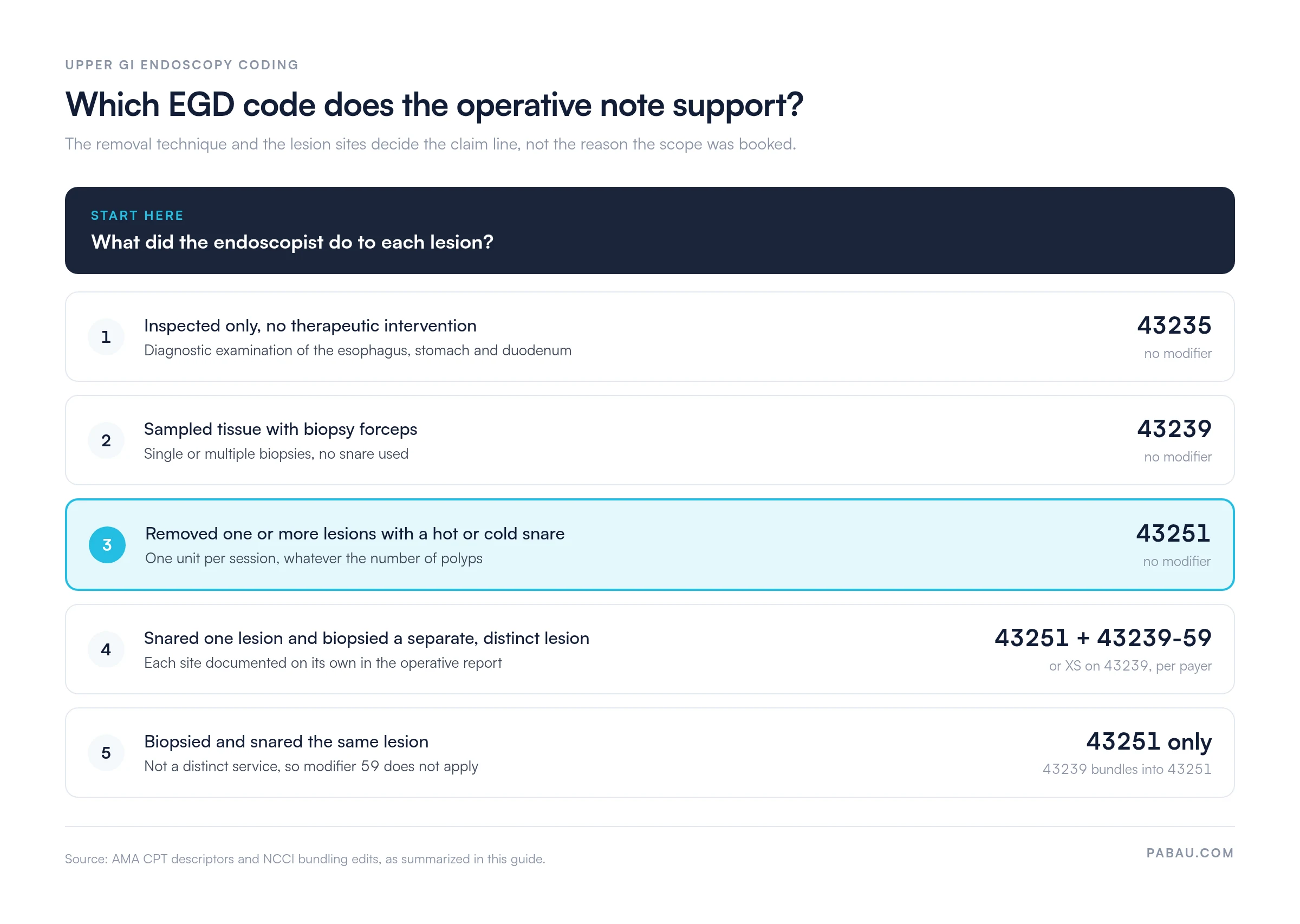
Modifier selection for CPT Code 43251 depends on the clinical scenario. Using the wrong modifier, or omitting one, leads straight to a denial or an overpayment audit.
CMS prefers the X-modifiers (XE, XS, XP, XU) over modifier 59 for NCCI edit bypass when clinically applicable. However, not all commercial payers have adopted X-modifiers. Verify payer-specific requirements before claim submission to avoid additional denials.
Always attach the operative report to claims involving modifier 59 on 43251 + 43239. Payers increasingly require clinical documentation at the time of initial submission, not only on appeal. Attach it upfront to reduce the turnaround cycle.
CPT Code 43251 carries a work RVU of 3.38 in 2026, and Medicare reimburses about $546 for it before locality adjustment. That figure is the non-facility rate, which applies when the service is performed in an office setting. Facility rates apply in hospital outpatient departments and ambulatory surgery centers.
Verify current locality-adjusted amounts using the CMS Physician Fee Schedule lookup tool or the FastRVU 2026 RVU calculator before quoting rates to payers or patients.
Both figures come from FastRVU’s 2026 EGD RVU values, which use the $33.40 conversion factor. The work RVU is the same in both settings. Locality modifiers (GPCI values) affect the final payment.
The facility rate is lower because Medicare pays the facility’s overhead separately. It does this through the Hospital Outpatient Prospective Payment System (OPPS) or the ASC payment system. Practices can review electronic remittance advice (ERA 835 files) after adjudication to confirm the applied rate and identify adjustments.
Commercial payer rates vary significantly. Most use a percentage of Medicare or a contracted fee schedule. Practice management software like Pabau submits claims through its Claim.MD integration, with real-time eligibility checks and ERA retrieval across thousands of US payers. That cuts manual rate reconciliation after payment posting.
The place-of-service (POS) code on the claim directly affects the reimbursement rate Medicare applies to CPT Code 43251. A wrong POS code is a common denial and audit trigger for endoscopy practices.
A frequent error is performing the procedure at an ASC (POS 24) but submitting it with POS 11, which inflates the claim. This triggers automated edit flags during Medicare claims processing. It also creates overpayment exposure under OIG audit guidance.
Medicare generally does not require prior authorization for CPT Code 43251 when medical necessity is clearly documented. However, commercial payer requirements vary significantly and change frequently. Blanket assumptions about authorization status create claim denials and delayed payment.
Run the authorization check at scheduling, so insurance verification is done before the procedure date is confirmed. When authorization is required and not obtained, 43251 claims are denied outright, and retrospective requests rarely succeed.
The endoscopy report is the claim’s evidentiary backbone. An incomplete operative note is one of the most preventable causes of denial for CPT Code 43251. A superbill alone is not sufficient documentation for a therapeutic endoscopy code.
The operative report must contain all of the following:
When multiple polyps are removed at separate anatomical sites in the same session, document each site with its own description. A single-sentence note that says “two polyps removed” is insufficient for an audit. Site-specific documentation protects the claim and supports medical necessity for each lesion removed.
The ICD-10-CM diagnosis code on the claim establishes medical necessity for CPT Code 43251. Payers cross-reference the diagnosis code against the procedure code. A mismatch triggers a medical necessity denial even when the procedure itself was appropriate.
Select the ICD-10 code that most precisely reflects the documented clinical finding, not the symptom that prompted the referral. Say a polyp was found incidentally during a melena workup and removed. Code K31.7 (polyp) rather than K92.1 (melena) as the primary diagnosis.
CPT Code 43251 denials tend to fall into five categories. Knowing the pattern behind each one lets billing staff prevent it when they build the claim, before a denial letter arrives.
With claims software for gastroenterology, billing teams can set pre-submission edits that flag modifier conflicts and POS mismatches. Catching these errors in-house is faster and cheaper than the denial-and-appeal cycle. Our guide to medical billing denial codes explains the CARC reason codes you’ll see on 835 remittances.
High-volume endoscopy practices stay compliant by auditing their own claims on a schedule. A quarterly review of CPT Code 43251 denial patterns by payer shows whether a carrier applies coverage criteria more strictly than its published policy.
Run a quarterly denial report filtered to CPT Code 43251 and sort by denial reason code. If CARC 97 (bundling) accounts for more than 15% of denials, build a hard stop into the billing system for 43239 + 43251 same-day claims. A manual reminder won’t hold.
These scenarios show how to build the claim line for the most common CPT Code 43251 billing situations. Each maps a clinical scenario to the correct code combination and modifier logic.
The endoscopist performs a therapeutic EGD and removes a single gastric polyp by cold snare. No separate lesion is biopsied. Bill 43251 with no modifier, diagnosis K31.7, and POS 24 if the procedure took place at an ASC. Submit the operative report with the claim to keep it clean.
The endoscopist removes a duodenal polyp by snare and also biopsies a separate, suspicious gastric mucosal lesion using forceps. Both are documented as distinct anatomical sites in the operative report. Bill 43251 as the primary code plus 43239-59, where modifier 59 overrides the NCCI bundling edit for the biopsy.
If the endoscopist lifts the lesion with a submucosal injection before snaring it, that injection is CPT 43236. Report it separately only when it is performed at a distinct site from the polypectomy.
The patient previously had abdominal surgery, and its 90-day global period is still active. A new, unrelated gastric polyp is identified and removed by snare during EGD. Bill 43251-79. Modifier 79 indicates an unrelated procedure performed during a postoperative period. Do not use modifier 79 if the EGD is related to the original surgical indication.
Authorization was obtained for a diagnostic EGD (43235). During the procedure, a polyp is found and removed by snare. Bill 43251, not 43235, because the claim reports the procedure performed rather than the one pre-authorized. Notify the payer retroactively and document the clinical basis for the upgraded code.
Some payers require updated authorization. Others accept the change with a clinical note attached to the claim.
Gastroenterology practices billing CPT Code 43251 regularly deal with NCCI edit conflicts, POS discrepancies, and ERA reconciliation across multiple payers. Pabau’s Claim.MD workflow submits 837P claims to thousands of US payers. Eligibility checks and ERA retrieval run in the same platform.
Scheduling, clinical documentation, and billing sit in one system. When an endoscopy note is completed in Pabau, the procedure codes and diagnosis codes flow directly to the claim. Pre-submission edits flag modifier conflicts and POS mismatches before the claim leaves the system.
After adjudication, the 835 ERA is matched automatically to the original claim. Your billing team spends less time on manual payment posting and more time working the denials that need a person.

Pabau integrates with Claim.MD to submit CPT Code 43251 claims to thousands of US payers, track ERA responses, and flag modifier conflicts before denial. See how it works for gastroenterology practices.

A 43251 claim is won or lost in the operative note. When the report names the snare technique, each lesion’s site and size, and the specimen’s destination, the code and any modifier follow from it.
Modifier 59 is the trade-off to watch. It recovers payment for a biopsy at a separate site, but on the same lesion it invites an overpayment audit. Review your 43251 denials by payer each quarter, and fix the note template or edit rule behind every repeat.
Book a demo to see how Pabau catches 43251 modifier and POS errors before the claim reaches the payer.

Need to understand how clearinghouse submissions work for endoscopy claims? Medical claims clearinghouse guide explains 837P file transmission, ERA responses, and payer enrollment for US practices.
Coding a diagnostic-only upper endoscopy? CPT code 43235 covers the EGD with no therapeutic intervention, and when a planned exam becomes 43251.
Want to reduce CPT 43251 denials before they happen? Denial management in healthcare shows how to track, prevent, and appeal denied claims.
New to the billing side of gastroenterology? Medical billing fundamentals covers how a claim moves from encounter to payment for outpatient procedure codes.
Billing multiple procedure codes on the same claim? Superbill documentation guide explains how to structure multi-code claims with modifiers for therapeutic endoscopy services.
CPT code 43251 is the billing code for esophagogastroduodenoscopy (EGD) with removal of tumor(s), polyp(s), or other lesion(s) by snare technique. It covers scope insertion, visualization, snare deployment, lesion removal, and specimen handling in a single upper GI endoscopy session.
43251 involves removing a lesion with a wire snare (therapeutic excision), while 43239 involves taking a tissue biopsy with forceps (diagnostic sampling). Both can be billed on the same date when performed at separate, distinct anatomical sites. Append modifier 59 or XS to 43239 to bypass the NCCI bundling edit.
The most common modifiers with CPT code 43251 are 59, 79, and the CMS X-modifiers. Modifier 59 marks a distinct service when 43239 is billed for a separate site. Modifier 79 covers an unrelated procedure during a postoperative global period. XS and XU are payer-preferred alternatives to 59. Modifier 51 applies when multiple procedures are billed on the same date.
Yes, when both a snare polypectomy (43251) and a biopsy (43239) are performed at separate, distinct anatomical sites during the same EGD session. Modifier 59 must be appended to 43239 to override the NCCI bundling edit. Billing both without a modifier results in automatic denial of the 43239 claim line.
The operative report must include the procedure indication, informed consent, scope type, and the anatomical site of each lesion removed. It also records the snare technique (hot or cold), the number and size of polyps, specimen disposition, and any complications. A superbill or charge ticket alone is insufficient for a therapeutic endoscopy code.
Traditional Medicare generally does not require prior authorization for CPT code 43251. Commercial payers vary. UnitedHealthcare requires prior authorization for therapeutic endoscopy procedures per its gastroenterology crosswalk. Medicare Advantage plans often follow commercial rather than traditional Medicare rules. Verify with each specific payer and plan before scheduling.