



HCPCS code E0198: Water pressure pad billing guide
HCPCS code E0198 is a water pad for a standard mattress HCPCS code E0198 is the ...

Last Updated: Oct 13, 2026

CPT code 43239 covers a flexible transoral esophagogastroduodenoscopy with one or more biopsies taken in the same session.
Medicare pays roughly $124 in a facility and roughly $419 in a physician office in 2026, before geographic adjustment.
Practice expense RVUs account for that difference, because the office absorbs the equipment and supply cost the facility would otherwise carry.
Pair 43239 with an ICD-10-CM code your MAC’s coverage policy accepts, such as K25.x, K29.x or K92.1.
The operative note has to state that tissue was sampled, and the pathology report has to support it.
CPT code 43239 is the billable code for an esophagogastroduodenoscopy (EGD) performed through the mouth, with one or more biopsies taken in the same session. It replaces the diagnostic code 43235 whenever tissue is sampled.
This guide covers the official descriptor, the ICD-10-CM pairings that support medical necessity, and 2026 Medicare rates. It also sets out the modifiers that apply, the bundling edits to watch for, and the documentation payers ask for on review.
CPT code 43239 is a US-specific code maintained by the American Medical Association (AMA). Every rate below applies to US payers only. Verify each one against the current CMS Physician Fee Schedule for your own locality.
CPT code 43239 describes esophagogastroduodenoscopy (EGD), flexible, transoral, with biopsy, single or multiple. It belongs to the upper GI endoscopy family, CPT 43235 through 43270. It is reported when a gastroenterologist passes a flexible endoscope through the mouth to reach the esophagus, stomach and proximal duodenum. At least one tissue biopsy is taken in the same session.
The number of specimens taken during one session does not change the code. Whether the physician takes one biopsy or ten from different sites, CPT 43239 is reported once. Biopsies from separate anatomical sites in the same session are included in that single code, so never report 43239 twice for two specimens.
Medical necessity for 43239 has to be supported by a documented clinical indication. Medicare and commercial payers require an ICD-10-CM diagnosis code that matches the covered indications in the applicable Local Coverage Determination (LCD). The table below lists the codes most often accepted. Covered indications vary by payer region, so check your own MAC’s current LCD before you submit.
Novitas Solutions, Palmetto GBA, CGS Administrators and the other MACs each publish separate LCDs for upper GI endoscopy. Confirm coverage before the procedure is scheduled, so the diagnosis that reaches the claim is one your contractor already accepts.
Incorrect modifier use is one of the top audit triggers in GI endoscopy billing. Apply a modifier only where the clinical circumstances support it. A modifier is never a routine workaround for a bundled code pair.
Modifier -59 is the most commonly misapplied modifier in GI endoscopy billing. The National Correct Coding Initiative (NCCI) issues edits quarterly. Cross-reference the current CMS NCCI tables before you apply -59, then check the payer’s own requirements separately.
Medicare pays 43239 differently depending on where the procedure is performed. The rates below are approximate 2026 national figures from CMS Physician Fee Schedule data. Check them against the CMS Physician Fee Schedule lookup tool for your own locality. Geographic practice cost indices (GPCIs) move the payment by state and ZIP code.
The difference between the two rates comes from the practice expense component of the RVU calculation. In an ASC or a hospital, the facility absorbs the equipment and overhead cost. The office practice expense RVUs are then replaced by much lower facility values. FastRVU’s 2026 RVU lookup tool shows current work, practice expense and malpractice values by locality.
RVU values are approximate and drawn from published CMS data, so verify them against the MPFS final rule for the year you are billing. The split below shows what produces the difference between the two settings.
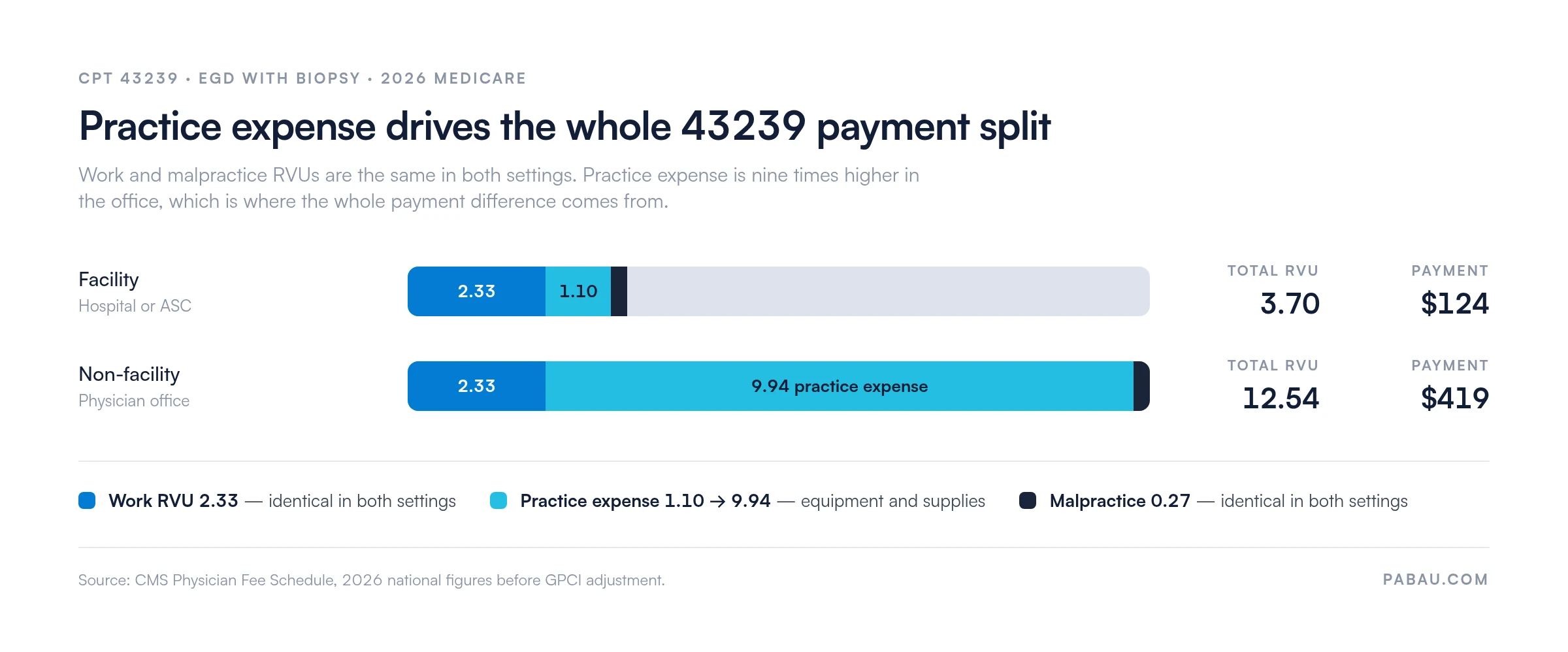
An office-based endoscopy suite carries the equipment and supply cost that the higher payment is meant to cover. A practice that sets its own fee from the facility rate will undercharge every in-office EGD it performs.
Always verify CPT 43239 reimbursement against your specific MAC locality, not national averages. Geographic Practice Cost Indices (GPCIs) can shift payment by 15-25% above or below the national figure. Run a fee schedule analysis by ZIP code before setting your practice fee for EGD with biopsy.
Thin documentation is the most common reason a 43239 claim fails on audit. The operative note has to establish that a biopsy was taken, not simply that the endoscope reached the duodenum. Without a pathology report or a note that references tissue sampling, the claim cannot be supported even though the procedure happened.
Required documentation elements for a complete 43239 claim include:
Keep the operative note and the pathology report together in the patient record. Capturing every required field at the point of care, rather than reconstructing it days later, is what keeps a 43239 claim defensible on review.
Procedure note templates in practice management software like Pabau can be set up to capture each of those fields as the physician documents. Incomplete records then surface at the point of care instead of during a payer audit.
NCCI edits govern which codes may be billed alongside 43239, including CPT 43246 for PEG tube placement. Bundling violations are a leading source of denials and overpayment demands in GI practices. The principle is straightforward. When a more comprehensive EGD code is billed, the lesser component procedures performed in that session bundle into it and are not reported separately.
Band ligation of varices carries a separate edit with 43239. NCCI typically bars CPT 43244 alongside a biopsy at the same site, so verify the current pairing before submitting both.
Common billing errors that trigger denials or audits:
A pre-submission check catches these before the claim leaves the practice. Two outcomes follow a 43239 bundling error more often than any others. CO-97 means the service is already included in another code, and CO-4 means a modifier is required. Both sit near the top of the common denial codes a GI billing team works every month.
CPT 43235 is the parent code for a diagnostic upper endoscopy performed without any additional procedure. When a biopsy is taken in the same session, 43239 is the code to report and 43235 is not. The two cannot be billed together on the same date of service.
Billing 43239 when only a diagnostic EGD was performed counts as upcoding, which is a fraud and abuse violation. The operative note and the pathology requisition have to support the biopsy. Report 43239 only where the record documents that tissue was taken.
CPT 43239 sits inside the upper GI endoscopy family. Knowing the whole family helps a coder pick the most specific code for the procedure performed, which prevents both undercoding and overcoding. The AAPC Codify CPT lookup carries the full descriptor and coding notes for each code in the range.
Only one EGD code from this family is reported per session. Where several of these procedures happen together, report the single most comprehensive code that describes the highest-level service provided. Matching the code to the work the record documents is what keeps a GI practice paid for the work it performed.
Where the note describes foreign body retrieval rather than tissue sampling, CPT 43247 is the code to report. A biopsy taken from a different site may still be reported with it, subject to the current NCCI edit.
Review your EGD charge capture process quarterly. Compare the ratio of 43235 (diagnostic) to 43239 (with biopsy) claims against your documented procedure logs. A disproportionately high rate of 43235 when biopsy documentation is routinely complete may signal a charge capture problem, leaving reimbursement on the table.
Most 43239 errors start where the clinical record and the billing queue sit in separate systems. The physician finishes the endoscopy and dictates a note. By the time the claim is built, the biopsy reference is missing or the diagnosis code does not match the MAC’s LCD. Sometimes a bundling conflict goes unnoticed until the denial arrives.
Practice management software with billing built in closes that distance at three points in the workflow:
Pabau runs that workflow through its connected claims management software. The endoscopy note and the claim live in one record, and built-in CPT and ICD-10 catalogs validate the code pairing before submission. Payment by code is reported over time, so a practice can see which commercial payers sit below the Medicare benchmark before the next contract talk.

Pabau connects the endoscopy note to claim submission in one platform. Codes are attached at the point of care, bundling conflicts are flagged before the claim goes out, and reimbursement is tracked per procedure code.

Three checks decide whether a 43239 claim is paid. The operative note has to support the biopsy, and the diagnosis code has to match the MAC’s LCD. Modifier -59 belongs on the claim only where a distinct clinical circumstance justifies it. Each one is settled in the room, not in the billing queue.
Set your own fee from the setting you bill in rather than from a national average, and audit your 43235-to-43239 ratio once a quarter. Book a demo to see how Pabau ties the endoscopy note to the claim, so 43239 leaves the practice documented the first time.

Need to understand how claims clearinghouses work for GI billing? Medical claims clearinghouses explained covers how electronic claim routing works between practices and payers.
Want to track denial patterns across your endoscopy codes? Revenue cycle management fundamentals walks through how to build a denial tracking system in your practice.
Looking at getting in-network before you schedule EGDs? Credentialing with insurance companies outlines the process of getting in-network for GI procedures.
Want fewer 43239 claims coming back for rework? What makes a clean claim sets out the checks that get a claim paid on first submission.
Capturing endoscopy charges on paper today? How a superbill works explains which fields a procedure charge slip has to carry.
CPT 43239 is the esophagogastroduodenoscopy (EGD) code for a flexible upper endoscopy performed through the mouth. It is reported when the gastroenterologist also takes one or more tissue biopsies in that same session. It covers examination of the esophagus, stomach, and proximal duodenum combined with biopsy – whether one specimen or multiple specimens are collected.
The approximate 2026 Medicare rate for CPT 43239 is $124 in a facility setting, meaning a hospital or ASC, and $419 in a physician office. Actual payment varies by locality under the CMS Geographic Practice Cost Indices. Verify the figure against the CMS Physician Fee Schedule lookup for your own ZIP code and year.
CPT 43235 is the parent diagnostic EGD code for upper endoscopy performed without any additional procedure. CPT 43239 is reported when a biopsy is performed during the same EGD session. The two codes cannot be billed together – when biopsy is performed, 43239 replaces 43235 entirely. Billing 43239 without documented biopsy constitutes upcoding.
Commonly paired ICD-10-CM codes include K25.x (gastric ulcer), K29.x (gastritis and duodenitis), K22.x (Barrett’s esophagus and other esophageal diseases), K92.1 (melena), and R13.x (dysphagia). Accepted codes vary by Medicare Administrative Contractor (MAC) – verify against your MAC’s current Local Coverage Determination for upper GI endoscopy before submitting.
Only one EGD code from the 43235-43270 family is reported per session – the most comprehensive code that describes the highest-level service performed. CPT 43239 cannot be billed alongside 43235. Modifier -59 may apply where an additional distinct procedure is performed at a separately payable site on the same date. Use it only when the clinical circumstance is documented and NCCI edit review supports it.
Five modifiers come up most often on 43239. Modifier -22 covers an unusually complex procedure, and -52 covers reduced services where the scope could not complete the planned examination. Modifier -53 applies where the procedure is discontinued because of an adverse patient condition. Modifier -59 marks a distinct procedural service at a separate anatomical site. Modifier -76 covers a repeat procedure by the same physician on the same day, with documented medical necessity.



