CCSD code F3810: Mouth lesion excision billing guide
CCSD code F3810 covers excision or destruction of a mouth lesion CCSD code F3810...

Last Updated: Oct 9, 2026

CPT Code 43235 describes flexible, transoral diagnostic esophagogastroduodenoscopy (EGD), including specimen collection by brushing or washing when performed.
The 2026 Medicare national average is about $110.56 in a facility and $322.65 in an office, before geographic adjustment.
Therapeutic EGD codes such as 43239 replace 43235 instead of adding to it, so bill only the higher-level code.
Modifier 52 covers a reduced procedure and modifier 53 a discontinued one, and mixing them up is a common denial trigger.
Practice management software like Pabau links EGD coding to electronic claim submission through the Claim.MD integration.
CPT Code 43235 is the base code for diagnostic esophagogastroduodenoscopy (EGD), a flexible transoral examination of the esophagus, stomach, and duodenum.
It includes specimen collection by brushing or washing when performed, and it carries a 0-day global period. It is one of the most frequently reported outpatient gastroenterology procedures in the US.
This reference covers the AMA descriptor, Medicare rates by place of service, and the modifiers that apply. It also sets out common ICD-10 pairings, global period rules, and the denial patterns that cost gastroenterology practices the most revenue.
Official AMA descriptor: Esophagogastroduodenoscopy (EGD), flexible, transoral; diagnostic, including collection of specimen(s) by brushing or washing, when performed.
43235 is the foundation code for upper GI endoscopy. It covers a diagnostic scope from the mouth through the duodenum, with brushing or washing already bundled into the payment.
It does not cover forceps biopsy, polypectomy, dilation, or any other therapeutic step. Holding that boundary is what prevents the most common unbundling errors in gastroenterology billing.
The gastroenterologist inserts a flexible endoscope transorally and advances it through the esophagus and stomach into the duodenum. The scope visualizes the upper GI mucosa and the note records what was seen, including ulcers, erosions, strictures, varices, and other mucosal abnormalities.
If the endoscopist bands those varices in the same session, report 43244 alone. NCCI bundles the diagnostic exam into it, so 43235 does not belong on the claim.
Most US practices perform the procedure under moderate sedation. Place of service then drives the payment. Hospital outpatient departments and ambulatory surgical centers (ASCs) are paid the facility rate, while an office-based procedure attracts the higher non-facility rate.
The 2026 Medicare Physician Fee Schedule (MPFS) pays 43235 differently depending on where the procedure happens. The figures below are national averages built on the 2026 conversion factor of $33.4009, before geographic adjustment.
Your own payment moves with the geographic practice cost index (GPCI), so verify the locality figure with the CMS Physician Fee Schedule lookup tool.
The office rate is close to three times the facility rate. It carries the practice expense relative value units for the scope, the reprocessing, and the room, all of which a hospital or ASC absorbs instead. Most EGDs happen in an HOPD or an ASC, so the facility rate applies to the majority of claims.
Commercial rates for 43235 typically run from 110% to 200% of the Medicare allowable, though that swings by payer, region, and contract tier.
Check the figures against your own contracts rather than a benchmark. The FastRVU 2026 RVU lookup tool gives Medicare-based RVU benchmarks you can use as a floor in a contract negotiation.
Modifier selection is the most consequential billing decision on an EGD claim. The wrong modifier produces a denial. A missing modifier where one was required invites a post-payment audit instead.
The 52-versus-53 decision turns on a single question. Did the physician choose to do less, or did the procedure have to stop? Modifier 52 covers the first case and modifier 53 the second, and the operative note has to say which one happened.
43235 needs a supporting ICD-10-CM diagnosis code that documents medical necessity. The CMS Medicare Coverage Database article 57414 governs covered indications for upper GI endoscopy.
The covered diagnosis has to match the clinical indication in the referring provider’s notes and in the endoscopist’s pre-procedure assessment.
Code to the highest specificity the documentation supports. If the record documents a gastric ulcer, K25.9 is the right choice and R10.10 for upper abdominal pain is not.
Payers flag that mismatch on post-payment review. Where swallowing difficulty is the documented indication, R13.10 is the code to reach for, and its own coding notes are worth reading first.
43235 carries a 0-day global period per CMS MPFS indicator data. No post-operative services are bundled into the payment. A separate evaluation and management (E/M) visit on the same day can be billed independently. It needs the right modifier and documentation behind it.
A wrong place-of-service code is a common source of payment discrepancies on this code. The POS code on the claim must match where the procedure was physically performed, not where the practice is registered.
CPT 43239, EGD with biopsy by forceps, is the code most often confused with 43235. It is a standalone code, not an add-on. NCCI bundles 43235 into 43239 and into every other therapeutic EGD code, including 43246, so the two are never reported together for one session. The grid below maps what the endoscopist did to the single code you report.
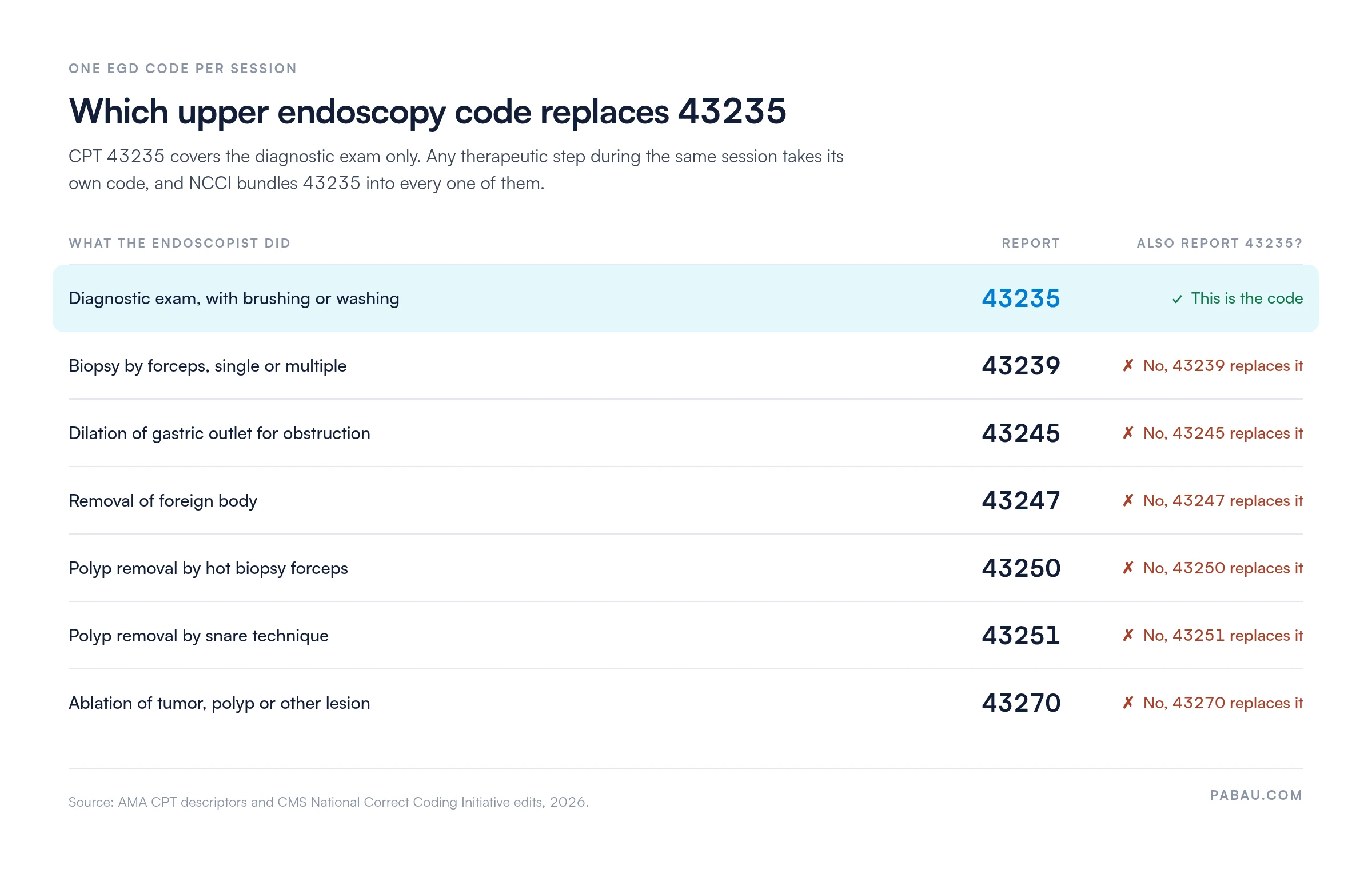
When a therapeutic step happens in the same session as the diagnostic exam, report the highest-level code that describes what was done. The diagnostic work is already built into that code. Reporting 43235 next to it is an unbundling error, and the CMS NCCI edits will reject the pair.
Foreign body retrieval follows the same rule. If the endoscopist extracted a swallowed object or an impacted food bolus, 43247 is the code to report. The diagnostic exam is already inside it.
Run an NCCI check on every EGD claim before it leaves the practice. If a coder has reported 43235 alongside 43239, the pair will reject, and the fix is to drop 43235 and keep the therapeutic code. Track how often that pair shows up in your pre-submission edits. A rising count usually points at a template in the procedure note rather than at the coder.
Documentation failures account for a disproportionate share of EGD denials and recoupments. CMS LCD article 57414 sets out the elements that have to appear in the procedure note to support both payment and an audit defense.
A procedure note that addresses all seven elements is what makes the claim defensible under pre-payment review or a post-payment audit. Practices that get the note right the first time avoid the cost of answering additional documentation requests later.
A denied EGD claim costs a practice roughly $25 in administrative work to rework, before you count the delay to cash flow. The patterns below generate the most avoidable denials.
For a reference table of specific payer codes, the medical billing denial codes guide covers CARC and RARC codes by category.
Run a monthly denial report filtered to 43235 and sort it by reason code. If modifier denials pass 5% of your EGD claims, book a coder review on the 52-versus-53 distinction and on place-of-service coding. Catching that pattern early stops it compounding across hundreds of claims.
Most gastroenterology teams code the EGD in one system, then retype the codes into a claim somewhere else. Practice management software like Pabau holds both in one record, so the codes on the procedure note are the codes on the claim.
Pabau pairs cleaner claims management software with the Claim.MD clearinghouse integration. An EGD claim moves from the procedure note to electronic submission without a separate manual step outside the practice management system.
The integration handles CMS-1500 and 837P formats, real-time eligibility checks, and electronic remittance advice processing. Your team can match remittance data against submitted claims and see which CPT codes are underpaid or denied. That turns a monthly denial report into a list a coder can work through.

Pabau connects your clinical documentation, CPT code templates, and claim submission in one place. See how practices cut EGD claim denials with integrated billing tools.

Denials on CPT Code 43235 follow a short list of patterns. The usual culprits are a wrong modifier and a wrong place of service. The other two are an ICD-10 code that misses the documented indication, and 43235 reported next to a therapeutic code that already includes it.
None of these is hard to fix once you can see it. What they need is a standing review of coded EGD claims, rather than one correction per claim after the denial lands.
Build that review around the two decisions carrying the most risk, which are modifier choice and single-code selection. Book a demo to see how Pabau moves a coded EGD from the procedure note into a submitted claim.

Need a framework for tracking claim rejections across all payer types? Denial management in healthcare covers the full lifecycle from denial identification to appeal resolution.
Want to see how EGD revenue fits into practice-wide financial performance? Revenue cycle management fundamentals explains the end-to-end billing and collections process for medical practices.
Looking for a reference on clearinghouse claim submission for US payers? Medical claims clearinghouse explains how 837P transmission, ERA processing, and payer enrollment work in practice.
Want every EGD claim to pay on the first submission? What makes a clean claim sets out the fields and checks that keep a claim from bouncing back.
Need to keep your coding and documentation audit-ready? Medical billing compliance walks through the rules, the records, and the reviews that hold up under scrutiny.
CPT Code 43235 is the base code for diagnostic esophagogastroduodenoscopy (EGD), a flexible, transoral examination of the esophagus, stomach, and duodenum. It includes specimen collection by brushing or washing when performed. It covers the diagnostic component only, so it does not include forceps biopsy or any therapeutic step.
The 2026 Medicare national average is about $110.56 in a facility and $322.65 in an office, before geographic adjustment. The office figure is higher because it carries the practice expense RVUs for the scope and the room. Confirm your locality figure with the CMS Physician Fee Schedule lookup.
No. NCCI bundles 43235 into 43239, so the pair rejects when both appear for the same session. 43239 is a standalone code that replaces 43235 rather than adding to it. Report 43239 alone and document the biopsy in the operative note.
Modifier 52 (Reduced Services) applies when the physician chose to reduce the scope of the procedure. Modifier 53 (Discontinued Procedure) applies when the procedure had to stop after initiation, for a medical complication or a patient safety concern. The operative note must document which situation occurred, because the wrong modifier is a common audit trigger.
Yes, Medicare covers CPT Code 43235 when it is medically necessary, subject to CMS LCD article 57414 for upper GI endoscopy. Coverage requires an ICD-10-CM diagnosis code from the covered indications list. It also requires documented medical necessity in the pre-procedure and procedure notes.
The global period for CPT Code 43235 is 0 days per CMS MPFS indicator data. No post-operative services are bundled into the procedure payment. A separate E/M service on the same or a later day can be billed independently, with the right documentation and modifier behind it.