CCSD code H4430: Examination of rectum under anaesthetic
CCSD code H4430 pays for the examination alone CCSD code H4430 is the UK private...

Last Updated: Oct 20, 2026
43247 is the CPT code for esophagogastroduodenoscopy, flexible, transoral; with removal of foreign body(s). It covers retrieving an ingested object or food bolus from the esophagus, stomach, duodenum, or jejunum with a flexible scope passed through the mouth.
Most denials on this code trace back to one of two mistakes. The first is billing the base diagnostic EGD (CPT 43235) alongside it. The second is an operative note that describes the scope but not the retrieval technique.
Let Pabau's smart automation suggest the right codes, reduce claim denials, and keep your practice compliant—effortlessly.
Automate repetitive tasks and focus on what matters most—your patients.
Reduce coding errors and ensure compliance with the latest regulations.
Clean claims, fewer denials, and faster reimbursements.
Powerful insights and reporting to help your practice thrive.
HIPAA compliant SOC 2 certified GDPR-compliant Trusted by 4,000+ clinics worldwide

CPT code 43247 covers a flexible transoral EGD with removal of one or more foreign bodies from the esophagus, stomach, duodenum, or jejunum.
The diagnostic EGD, CPT 43235, is already included in 43247, so billing both codes for the same session is an unbundling error.
The operative note must describe the foreign body, the retrieval technique, and how far the scope advanced. A missing retrieval technique is the most common audit flag.
Under the CY2026 Medicare Physician Fee Schedule, 43247 carries 12.76 total RVUs in the office and 4.71 in a facility, about $426 and $157 nationally.
Practice management software like Pabau tracks GI procedure claims from submission to remittance.
The American Medical Association’s CPT code set gives the full official descriptor for CPT code 43247: Esophagogastroduodenoscopy, flexible, transoral; with removal of foreign body(s). In plain terms, it is the code for retrieving an ingested object or food bolus with a flexible scope passed through the mouth. The AMA last revised the descriptor for the 2015 CPT code set, when “foreign body” became “foreign body(s)”.
The procedure begins with a flexible endoscope introduced through the mouth and pharynx. The endoscopist advances the scope through the esophagus and stomach into the duodenum, and into the jejunum where clinically appropriate. The endoscopist then identifies the foreign body, grasps it with retrieval forceps, a snare, or a Roth net, and pulls it out through the mouth with the scope.
The operative note needs to record each of those steps, which is why the documentation rules below follow the same order. Common clinical scenarios for CPT 43247 include:
Match the operative note to the code’s full descriptor before submission, rather than finding the mismatch when a denial arrives.
CPT 43247 covers the whole EGD with foreign body retrieval. Stacking it with adjacent codes reliably triggers NCCI edits, so check each pairing before you add a second code.
Included in 43247 (do not bill separately):
Not included (may support a separate code with the right modifier):
The phrase “subject to NCCI edit review” matters here. The Centers for Medicare & Medicaid Services (CMS) updates its NCCI edit tables every quarter. A pair that you could bill separately with a modifier last quarter may bundle this quarter. Check the current edit table before billing a multi-procedure EGD session.
If the endoscopist also removes a polyp by snare during that session, the removal codes to 43251 and needs the same edit check.
The 432xx EGD code family is dense. Picking the wrong sibling code, or billing two codes that form an NCCI bundling pair, is a frequent GI coding error. The table below maps the six codes billers meet most often.
Variceal band ligation is the sibling that table leaves out. If the note describes bands deployed on esophageal or gastric varices rather than an object retrieved, the session codes to 43244.
When you audit your coding logic, the AAPC Codify CPT lookup shows current NCCI column indicators alongside each code.
Billers often ask whether they can bill CPT 43247 with 43239 when the endoscopist removes a foreign body and also takes a biopsy. The answer depends on the current NCCI edit pairing. It also depends on whether the two procedures reflect distinct clinical decisions rather than parts of one retrieval.
According to the AMA CPT Knowledge Base, you may report a food bolus removed during EGD under CPT 43247. The operative note must confirm that the endoscopist identified the bolus, applied a retrieval technique, and extracted the object. If the endoscopist only pushed the bolus into the stomach with the scope tip, 43247 is not supported and 43235 applies instead.
You can bill a biopsy separately when a different finding justifies it, such as a suspicious mucosal lesion unrelated to the foreign body. Modifier 59 (distinct procedural service) or modifier XS (separate structure) may then allow 43239 alongside 43247. The governing rules:
Incomplete operative notes drive a large share of 43247 claim denials. A clean claim for this code needs the following elements in the note before it leaves your practice management system.
The retrieval technique element is where most audits flag incomplete records. An operative note that says “foreign body removed endoscopically” without naming the instrument or technique is insufficient. An EHR template that prompts for these elements catches the omission before you build the claim. Add a pre-submission note audit for GI procedures, so an incomplete note never reaches the payer.
Build a 43247 documentation template in your EHR. It should prompt for foreign body type and location, retrieval instrument, scope advancement depth, and post-retrieval mucosal inspection. Coders can then confirm each element before coding rather than requesting addenda after submission.
Medicare pays for CPT 43247 under the Medicare Physician Fee Schedule (MPFS), which values each code in relative value units (RVUs). The national payment is total RVUs times the conversion factor (CF). For CY2026, CMS set two: $33.4009 for most physicians and $33.5675 for qualifying alternative payment model (APM) participants.
The table shows CY2026 national amounts. Local rates shift with the Geographic Practice Cost Index (GPCI), so check your locality in the CMS Physician Fee Schedule lookup tool.
The office rate is 2.7 times the facility rate. The chart below shows why.
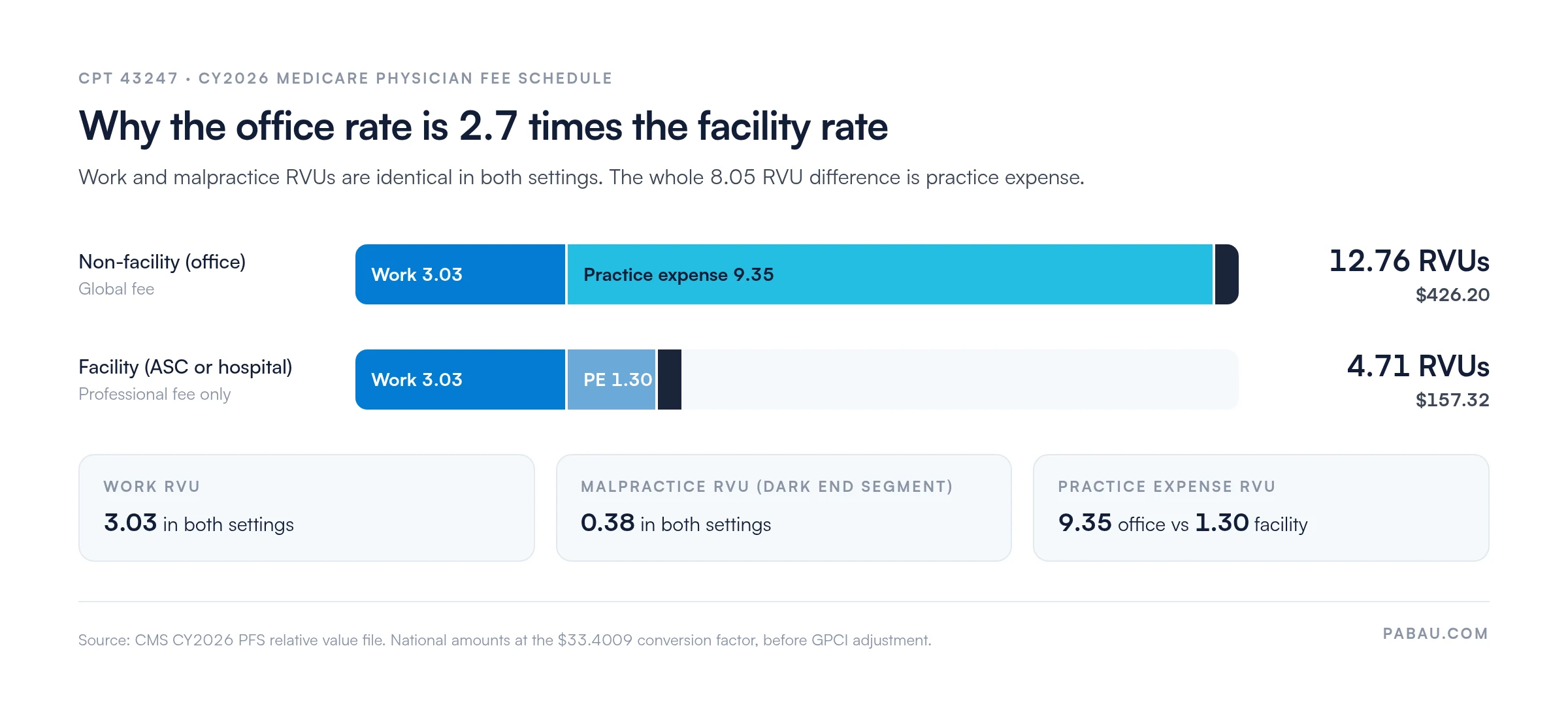
CMS assigns 43247 multiple-procedure indicator 3, with 43235 as its endoscopic base code. When Medicare pays 43247 and 43239 together, it pays the higher-valued code in full and the second at its own value minus the 43235 base.
Medicaid rates vary by state. Some states pay at Medicare parity, while others pay 60–80% of the Medicare rate, so check your state fee schedule.
Pabau integrates with Claim.MD for electronic claims to thousands of US payers, and the remittance advice (ERA/835) maps each payment back to its claim line. For superbill estimates, use the GPCI-adjusted rate for your MAC locality.
Emergent foreign body removal, such as a button battery or a sharp object at risk of perforation, is typically exempt from prior authorization. The clinical urgency outweighs administrative gatekeeping. Payers treat non-emergent cases differently.
For elective or semi-urgent cases, individual payer policies govern. Examples include a food bolus impaction without respiratory compromise or a retained object that is not sharp.
Medicare has no national coverage determination (NCD) specific to 43247. Some MACs have issued local coverage determinations (LCDs) that define medical necessity for upper GI endoscopy. Check your MAC’s LCD before scheduling elective cases in Medicare patients.
Commercial and Medicare Advantage policies vary widely. Some Medicare Advantage plans maintain medical policies for endoscopic procedures that require prior authorization for non-emergent cases. Run insurance eligibility verification at scheduling to confirm authorization requirements alongside coverage. Key steps:
Staying compliant here means treating payer authorization rules as living documents rather than one-time lookups. Payer policies update every year, so an assumption carried over from 2025 may produce a denied claim in 2026.
Denials on CPT 43247 follow a predictable pattern, which makes them preventable. The six most common causes, and the step that stops each one, are below.
Review the denial codes on your ERAs alongside their CARC reason codes to see which category drives volume at your practice. A single recurring CARC code usually points to a workflow problem rather than a one-off documentation error. That calls for a process change, not a string of individual appeals.
Run a quarterly audit of your 43247 denials filtered by CARC reason code. If the unbundling code CO-97 appears more than twice, your claim scrubber lacks the 43235/43247 edit. If CO-50 (not medically necessary) dominates, add a payer LCD crosswalk step to diagnosis code selection.
In many GI practices, a 43247 claim passes through three separate tools. The operative note lives in the EHR, the claim is keyed into a clearinghouse portal, and staff match payments by hand from the ERA.
The claims management software in Pabau keeps those steps in one system. Before each claim goes out, Pabau runs validation checks for the details insurers need, such as membership numbers and authorization codes. The claim then goes to the payer through the Claim.MD integration.
Each claim moves through five tracked stages: pending, submitted, processing, paid, or error. When the payment arrives, your team records it against the right invoice. An unpaid 43247 line shows up at the error stage instead of surfacing weeks later during reconciliation.
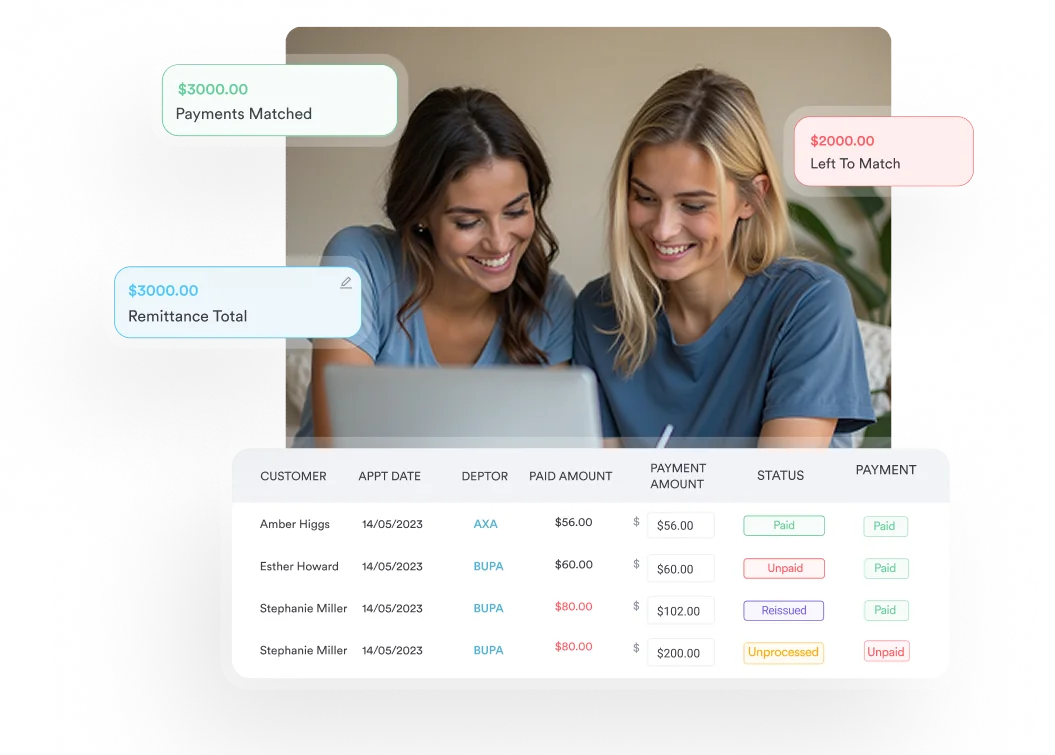

Pabau checks each claim for missing insurer details before it goes out and sends it through Claim.MD. It then tracks the claim until the payment is recorded.

The work on CPT 43247 is front-loaded. Fix the operative note template and the 43235 pairing rule once, and most of this code’s denials stop at the source.
The trade-off is a slightly longer note for every case. Naming the instrument and the depth the scope reached takes a minute, while an appeal on a denied professional fee can take weeks.
Pabau sends 43247 claims to thousands of US payers through Claim.MD and records each payment against its invoice. Your team can see at a glance which claims still need attention. Book a demo to see how that billing workflow fits your GI practice.

Need a structured approach to GI billing compliance? Medical billing compliance guidance covers the audit triggers and documentation standards that keep GI claims clean.
Unclear on how clearinghouse submission works? How a medical claims clearinghouse works explains the 837P file path from practice to payer and how rejections differ from denials.
Want to streamline multi-procedure EGD billing? Revenue cycle management fundamentals outlines the end-to-end process from scheduling through payment posting for outpatient procedure practices.
Billing a biopsy in the same session? CPT code 43239 explains how an EGD with biopsy is coded and documented.
Want fewer rejected claims? What makes a clean claim covers the fields payers check before they accept a submission.
CPT code 43247 covers upper gastrointestinal endoscopy (esophagogastroduodenoscopy) with removal of a foreign body from the esophagus, stomach, duodenum, and/or jejunum. The code includes the full endoscopic procedure and the mechanical retrieval act; the base diagnostic EGD (43235) is bundled and must not be billed separately.
Yes. According to the AMA CPT Knowledge Base, food bolus removal during EGD may be reported under CPT 43247. The operative note must show the bolus was identified and formally retrieved with an instrument. If the bolus was merely advanced with the scope tip rather than extracted, 43247 is not supported and 43235 applies instead.
The operative note must record the foreign body type and location and the retrieval instrument used, such as forceps, a snare, or a Roth net. It must also confirm how far the scope advanced (or why advancement was limited) and that retrieval succeeded. Missing the retrieval technique description is the top audit trigger for this code.
Emergent foreign body removal is typically exempt from prior authorization across most payers. Non-emergent cases may require prior authorization depending on the individual payer’s policy. Medicare does not have a national coverage determination mandating authorization for 43247, but some Medicare Advantage plans and commercial insurers do. Verify authorization requirements at the time of scheduling.