
Pabau Engage inbox

Pabau Engage is here: every patient conversation in one inbox.

Learn more
Book a demo Book a demo
☰
CPT Code

CPT code 36500 – Blood sampling venous catheterization


Code Definition

36500 is the CPT code for venous catheterization for selective organ blood sampling. A catheter is passed through a vein into one organ's venous drainage to draw blood from that organ alone.

Coders most often report it for endocrine localization, such as adrenal vein sampling for aldosterone excess and parathyroid venous sampling for an adenoma. It is not routine venipuncture (36415) or central venous catheter insertion (36555-36556). Radiologic supervision and interpretation is billed separately with 75893.

Section
10004-69990 Surgery
Subsection
33016-37799 Cardiovascular system
Code range
36000-36598 Vascular injection procedures
Billable
No
Code also known as
selective venous sampling, selective organ sampling, venous blood sampling catheter
Save time. Improve accuracy. Get paid faster.
Automate coding with Pabau

Let Pabau's smart automation suggest the right codes, reduce claim denials, and keep your practice compliant—effortlessly.

  • AI-powered code suggestions
  • Real-time compliance checks
  • Faster claims, fewer denials
Why practices choose Pabau
Save hours every week

Automate repetitive tasks and focus on what matters most—your patients.

Improve accuracy

Reduce coding errors and ensure compliance with the latest regulations.

Get paid faster

Clean claims, fewer denials, and faster reimbursements.

Grow with confidence

Powerful insights and reporting to help your practice thrive.

HIPAA compliant SOC 2 certified GDPR-compliant Trusted by 4,000+ clinics worldwide

Key takeaways

Key takeaways

CPT Code 36500 covers catheter introduction into a vein for selective organ blood sampling, not routine venipuncture or infusion catheter placement.

The code carries a 0-day (000) global period, so a same-day E/M needs modifier -25 to bill separately.

An unsupported or mismatched ICD-10 diagnosis code is the leading cause of CO-50 medical necessity denials for this code.

Radiologic supervision and interpretation for the sampling is reported separately with CPT 75893, and only that code takes -26 or -TC.

Pabau’s claims management software submits electronic 837P claims for CPT 36500, checks eligibility, and tracks remittances.

CPT Code 36500: Official descriptor and code family position

CPT Code 36500, as defined by the American Medical Association, carries the official descriptor “Venous catheterization for selective organ blood sampling.” The code sits in the Surgery section of the AMA CPT code set, within the Cardiovascular system range (33016-37799). Its subsection is Vascular injection procedures (36000-36598). It is an active code for calendar year 2026.

In practice, 36500 reports a catheter passed through a vein into one organ’s venous drainage to draw blood from that organ alone. Adrenal vein sampling and parathyroid venous sampling are the usual examples.

FieldDetail
Code number36500
Official descriptorVenous catheterization for selective organ blood sampling
CPT sectionSurgery / Cardiovascular system / Vascular injection procedures
Code familyVascular injection procedures (36000-36598)
StatusActive (2026)
Global period0 days (000) under the CMS MPFS

What the procedure involves: Clinical context for accurate coding

Venous catheterization under CPT Code 36500 involves more than a standard venipuncture needle stick. The physician or qualified clinician selects a venous access site and introduces a catheter into the vein. The catheter is advanced to a targeted location, and blood samples are drawn from that specific vascular territory.

The clinical settings where 36500 appears most often are endocrine localization studies. Adrenal vein sampling lateralizes aldosterone excess, and parathyroid venous sampling localizes a parathyroid adenoma. Documenting the indication accurately is what ties the procedure to a supportable ICD-10 diagnosis code.

  • Access site selection: The physician identifies and prepares the target vein (commonly femoral, subclavian, or jugular depending on the target organ).
  • Catheter introduction: A catheter is inserted and advanced under guidance to the target venous territory.
  • Selective sampling: Blood samples are drawn from the targeted site and labeled for the specific anatomical location.
  • Catheter removal and documentation: The catheter is removed. The procedure note records the access site, catheter path, samples taken, and patient response.

Inclusions and exclusions: What CPT 36500 covers and what it does not

Knowing the bundle boundaries for CPT Code 36500 prevents both undercoding and inappropriate unbundling. The table below sets them out, and the AMA’s parenthetical notes beside 36500 in the codebook settle the edge cases.

Included in 36500Not included (report separately)
Catheter introduction into the veinRadiologic supervision and interpretation for venous sampling through a catheter (75893)
Advancement to the target venous siteUltrasound guidance for vascular access (76937)
Blood sample collection from catheterE&M service if a separate, significant evaluation occurs (append modifier -25)
Catheter removalIntroduction of catheter into the inferior vena cava (36010, if separately performed)
Standard venous access suppliesRoutine venipuncture (36415), a plain needle stick with no catheter

Unbundling risk: Reporting 36500 and 36415 together for the same access event is an NCCI bundling edit violation. If the documentation clearly shows only a simple venipuncture occurred, 36415 is the correct code and 36500 must not be reported.

CPT 36500 vs adjacent codes: How to choose the right code

The 36000-series contains several codes that look similar but describe different procedures. Catheter type, final catheter position, and clinical purpose separate them, and three questions about the procedure note settle which one applies.
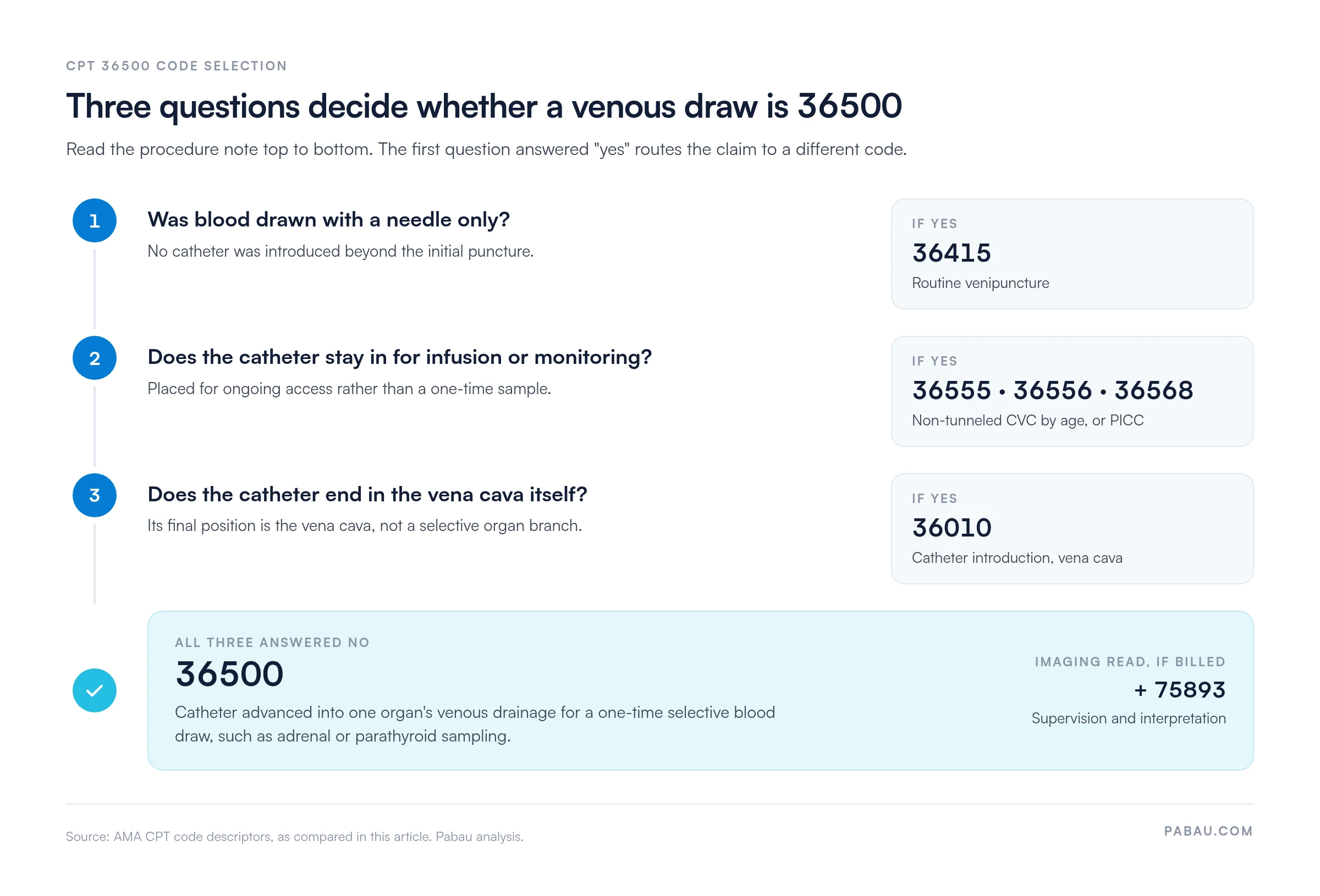
Decision path for CPT 36500
A draw reaches 36500 only after ruling out a needle stick, an indwelling line, and a vena cava position. Code descriptors follow the AMA CPT code set.

The table gives the descriptor and the clinical scenario behind each of those codes. Neighboring vascular access procedures sit in the wider CPT codes library.

CodeDescriptor (summary)Clinical scenarioKey differentiator
36500Venous catheterization for selective organ blood samplingAdrenal or parathyroid vein samplingCatheter advanced to targeted organ vein for selective sampling
36415Routine venipuncture for blood samplingStandard blood draw at peripheral veinNeedle only, no catheter introduced beyond initial puncture
36010Introduction of catheter, superior/inferior vena cavaCatheter positioned in the vena cava for access or monitoringFinal catheter position is the vena cava, not a selective organ branch
36555Non-tunneled CVC insertion, patient under age 5Central venous catheter for infusion or hemodynamic monitoringCentral placement for ongoing access, not selective sampling
36556Non-tunneled CVC insertion, patient age 5 or olderCentral venous catheter, adult patientAge-based companion to 36555; still central access for infusion/monitoring
36568PICC line insertion, patient under age 5Peripherally inserted central catheter for long-term IV accessLong-term dwell, peripherally inserted; not a one-time sampling procedure

Bottom line: If the catheter was placed temporarily for a one-time selective blood draw targeting a specific organ’s venous drainage, 36500 is correct. If the catheter stays in place for ongoing infusion or monitoring, the 36555-36568 family applies.

ICD-10 diagnosis codes that pair with CPT Code 36500

A claim for CPT Code 36500 must include an ICD-10-CM diagnosis code that establishes why selective venous sampling was medically necessary. Payers compare the submitted diagnosis against their local coverage determination (LCD) policies, and a mismatch is a leading denial trigger.

ICD-10-CM codeDescriptionClinical context
E26.09Other primary hyperaldosteronismAdrenal vein sampling to lateralize aldosterone source
E21.0Primary hyperparathyroidismParathyroid venous sampling prior to surgical localization
C74.90Malignant neoplasm of unspecified part of unspecified adrenal glandSelective sampling to characterize adrenal mass
D35.00Benign neoplasm of adrenal gland, unspecifiedFunctional adrenal adenoma workup requiring sampling

These are common pairings, not an exhaustive list. Payer LCD policies define which diagnoses are covered for each CPT code. Always verify against the applicable Medicare Administrative Contractor (MAC) for your region.

Pro Tip

Before submitting a CPT 36500 claim, run the ICD-10-CM code through your MAC’s LCD policy search. Some carriers require a specific primary diagnosis while others accept a broader range. Catching a mismatch before submission is far cheaper than working a denial and resubmission cycle.

Medicare reimbursement, RVU value, and CPT 36500 payer requirements

Medicare reimburses CPT Code 36500 at different rates depending on the place of service (POS). The non-facility rate applies when the procedure is performed in a physician office (POS 11). The facility rate applies in an outpatient hospital or ambulatory surgical center, where the physician is paid for the professional work only.

Use the CMS Physician Fee Schedule lookup tool for the current year’s locality-adjusted allowable amounts. For RVU values by code, FastRVU’s 2026 lookup provides work, practice expense, and malpractice RVU components.

MetricDetail
Work RVU (wRVU)Verify via CMS MPFS or FastRVU for current FY; locality-adjusted totals vary
Non-facility paymentHigher rate; applies to POS 11 (physician office)
Facility paymentLower rate; applies to POS 22 (outpatient hospital) and POS 23 (ER)
Prior authorizationPayer-specific; some commercial plans require prior auth for selective sampling – check payer portal before scheduling
Annual updateCMS updates MPFS rates each January 1; always use current-year fee schedule data

Pabau’s claims management software connects to the Claim.MD clearinghouse, which reaches thousands of US payers. It submits CPT 36500 claims as electronic 837P transactions and runs eligibility checks before the procedure date.

Place of service and site-of-service billing rules for CPT 36500

The POS code on a CMS-1500 claim form directly determines which Medicare payment rate applies to CPT Code 36500. Submitting the wrong POS code is both a compliance risk and a common underpayment or overpayment cause.

POS codeSettingPayment categoryNotes
11Physician officeNon-facility (higher)Practice bills for physician work and overhead
22Outpatient hospitalFacility (lower)Hospital bills facility fee separately; physician bills professional component only
23Emergency roomFacility (lower)Uncommon for elective selective sampling; document urgency if used
24Ambulatory surgical centerFacility (lower)ASC facility fee billed separately under OPPS

Modifiers for CPT Code 36500: When and how to append them

CPT Code 36500 is a global-service procedure code with no professional/technical split, so -26 and -TC never attach to it. They apply only to a separately reported imaging supervision and interpretation code such as 75893.

ModifierMeaningWhen to use with 36500
-26Professional componentNot used on 36500. Append it to 75893 when the physician bills only the supervision and interpretation.
-TCTechnical componentNot used on 36500. Append it to 75893 when the facility bills the equipment and staff portion of the imaging.
-59Distinct procedural serviceBypasses an NCCI bundling edit when 36500 is a separate, distinct procedure on the same date. Check the specific edit pair and document the distinct service first.
-52Reduced servicesThe procedure was performed but fell well short of the full descriptor, such as an attempt abandoned after catheter introduction.
-25Significant, separately identifiable E&MAppend to the E&M code (not to 36500) when a significant evaluation and management service was provided on the same date as the catheterization

Modifier -LT/-RT (laterality) may apply when the access site or target organ is lateralized and the payer’s claim system tracks bilateral procedures. Check payer-specific requirements before appending.

Global period and post-procedure billing rules for CPT 36500

CPT Code 36500 carries a 0-day (000) global period under the CMS Medicare Physician Fee Schedule. No post-operative days are bundled into the payment. The routine work on the procedure day is included, so a same-day service is billable only when it is significant and separately identifiable.

  • Same-day E&M: An evaluation and management service provided on the same day as 36500 is separately billable if it was a significant, separately identifiable service. Append modifier -25 to the E&M code.
  • Same-day repeat procedure: If 36500 is repeated on the same date at a different site or organ, append modifier -59 to the second service. The documentation must confirm the distinct clinical indication.
  • Follow-up visits: Because the global period is 0 days, follow-up visits after the procedure date are billed with the appropriate E&M code. The 36500 global window does not restrict them.
  • Post-procedure complication care: If a complication arises on the same day, document the clinical indication thoroughly. The 0-day global means the complication service may be separately billable. The documentation must distinguish it from the routine post-procedure monitoring included in 36500.

Common claim denial reasons for CPT 36500 and how to avoid them

CPT Code 36500 denials cluster around a handful of root causes. A structured denial management workflow that tags denial reason codes at intake makes it faster to spot and fix systemic billing errors before they compound.

  1. Missing or unsupported medical necessity (CO-50 / N-115): The ICD-10-CM diagnosis code does not support the procedure under the payer’s LCD policy. Fix: Verify the diagnosis-to-procedure pairing against the applicable MAC LCD before submitting.
  2. Incorrect or mismatched POS code: The claim states POS 11 (office) but the service was performed at POS 22 (outpatient hospital). Fix: Confirm POS code against the service location on the encounter form.
  3. Bundling edit with 36415 (CO-97): Both 36500 and 36415 are on the same claim for the same encounter. Fix: Use 36500 alone when a catheter was placed; remove 36415. Document clearly whether a catheter was introduced.
  4. Wrong component modifier on imaging supervision and interpretation (CO-4): 75893 was split between physician and facility without the right component modifier. The professional claim needs -26, and the technical claim needs -TC. Fix: Append the component modifier to 75893, never to 36500.
  5. No physician order on file: The payer’s pre-claim audit finds no documented physician order authorizing the selective venous sampling. Fix: Ensure the order is in the medical record and scanned to the payer file if required.
  6. Prior authorization not obtained: Commercial payer required prior auth for the procedure. Fix: Establish a pre-authorization check at scheduling for plans that list 36500 as requiring authorization.

Documentation requirements to support a CPT 36500 claim

A complete procedure note is the foundation of a defensible CPT Code 36500 claim. Submitting a clean claim requires that every required documentation element is in the record before submission, not added after a denial. The checklist below reflects what payers and MAC auditors commonly expect.

  • Physician order: Signed order indicating the clinical need for selective venous sampling, referencing the target organ or vascular territory.
  • Indication statement: A clear clinical rationale in the procedure note or pre-procedure assessment. It explains why selective venous sampling was medically necessary over a less invasive alternative.
  • Access site documentation: Name of the vein accessed (e.g., right femoral vein, right internal jugular), including any anatomical challenges encountered.
  • Catheter type and path: Catheter brand, size, and the route taken to reach the target venous territory.
  • Target organ and samples obtained: The organ whose venous drainage was sampled, number of samples drawn, and labeling of each sample to its anatomical location.
  • Patient response: Brief documentation of how the patient tolerated the procedure and any immediate post-procedure status.
  • Imaging note: A separate report or addendum for the radiologic supervision and interpretation (75893) or the ultrasound guidance (76937), whenever either is billed.
  • Prior-auth reference number: If the payer required prior authorization, the authorization number must appear on the claim form and be referenced in the chart.

For practices managing medical billing compliance across many CPT codes, standardized procedure note templates help. They keep every required element in the record and speed audit response. A well-structured superbill links the procedure code to the diagnosis, modifier, and POS on a single form. That cuts transcription errors between clinical and billing teams.

Companion codes billed with CPT Code 36500

Several codes are reported alongside CPT Code 36500 when imaging, additional catheter work, or a separate evaluation happens in the same session. Each has its own reporting requirements. The most common companion is 75893, the radiologic supervision and interpretation for venous sampling through a catheter.

Companion codeDescriptor (summary)Reporting relationshipWatch out for
75893Venous sampling through catheter, radiological supervision and interpretationSeparately reportable for the imaging read of the sampling. Takes -26 or -TC when billing is split.Needs its own imaging report. The component modifier goes on 75893, never on 36500.
76937Ultrasound guidance, vascular accessSeparately reportable when ultrasound guides the initial venous puncture; requires documented permanent image storagePayers may bundle if the note lacks permanent image documentation
36010Catheter introduction, superior or inferior vena cavaSeparately reportable if the catheter is specifically advanced into the vena cava as a distinct step beyond the selective organ accessDo not report if the vena cava is simply transited en route to the target organ vessel
E&M codes (99202-99215)Office or outpatient evaluation and managementSeparately reportable on the same date with modifier -25 on the E&M code if a significant, separately identifiable service was providedDocumentation must clearly show the E&M was separate from the routine pre- and post-procedure work included in 36500

Pro Tip

Check the current NCCI edit tables before reporting 75893 and 76937 alongside CPT 36500. NCCI edits are updated quarterly and bundling relationships can change. The AAPC Codify tool and the CMS NCCI Policy Manual are both reliable references for confirming current edit status before each claim cycle.

How Pabau keeps CPT 36500 claims moving

A selective sampling day spreads its paperwork across several systems. The order and prior authorization sit in one place, the procedure note in another, and the claim and remittance in a payer portal.

Pabau keeps that work on one patient record. Eligibility is checked before the procedure date, and the 36500 claim goes out as an electronic 837P through Claim.MD. The electronic remittance comes back to the same record, so a denial is visible as soon as it posts.

Your coders still choose the codes, modifiers, and diagnosis pointers. Pabau gives them one place to check the record behind each choice and follow the claim through payment.
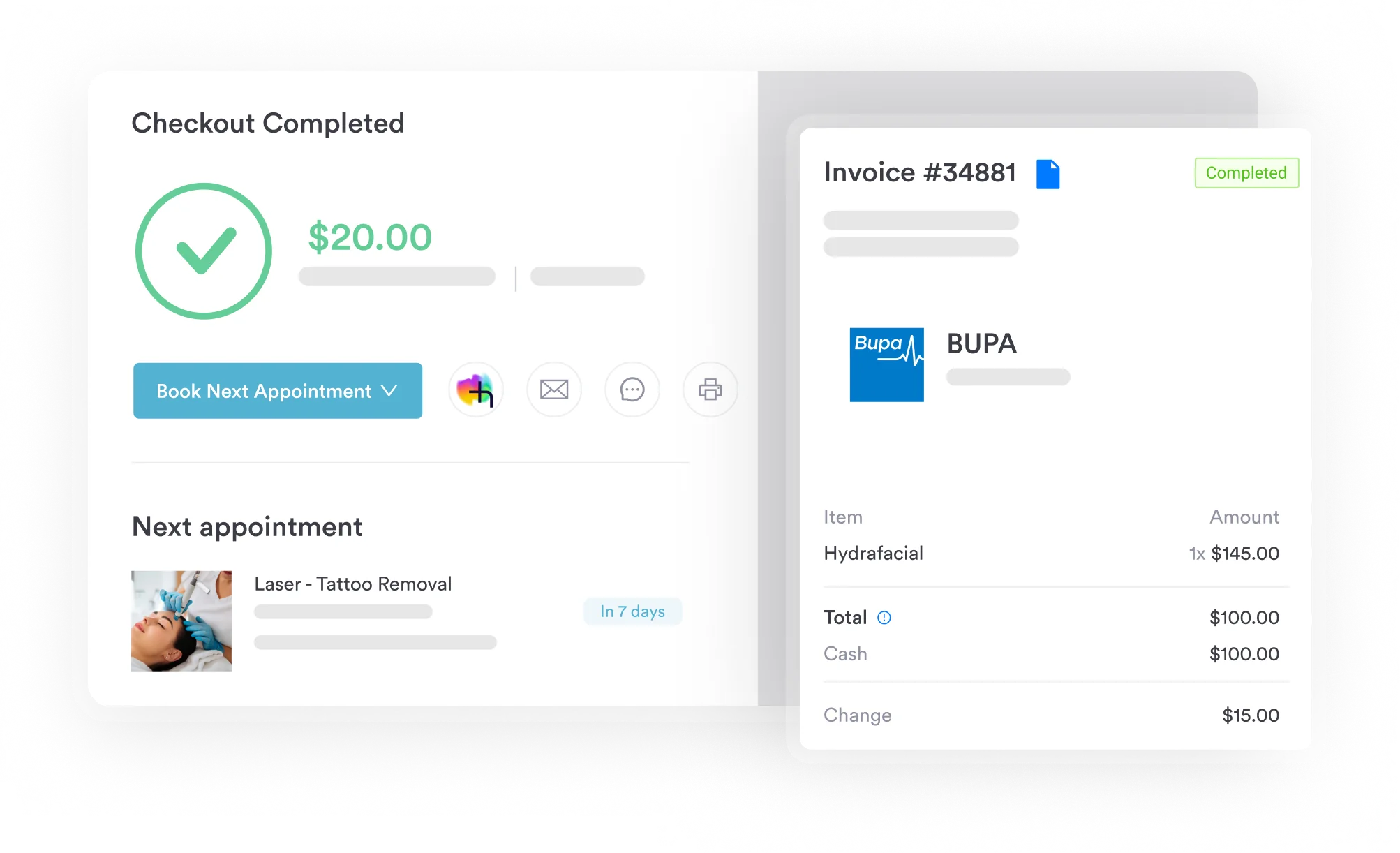

Pabau checkout screen showing a completed payment and an invoice with insurer and cash lines
Pabau’s checkout records each payment against its invoice, so the patient balance left after a 36500 claim settles is reconciled on the same record.

Submit and track CPT 36500 claims in one place

Pabau’s claims management submits electronic 837P claims, checks eligibility, and tracks remittances for every procedure you bill. The procedure note, consent, and payment stay on the same patient record.

Pabau claims management dashboard

Conclusion

CPT Code 36500 rewards the coder who reads the procedure note before the code list. A catheter that reached one organ’s venous drainage for a one-time draw is 36500, and 75893 carries the imaging read.

Build each claim around that note. Pair it with the diagnosis that justified sampling, keep -26 and -TC on the imaging code, and confirm prior authorization before the patient arrives. Those three habits stop a low-volume code from dragging on your revenue cycle management.

Book a demo to see how Pabau submits, checks, and tracks procedure claims for practices that bill selective venous sampling.

Continue your research

Continue your research

Need to understand how clearinghouse submission works for CPT codes? Pabau’s Claim.MD clearinghouse guide explains how 837P electronic claims reach payers and what happens when they don’t.

Looking for guidance on electronic remittance and payment posting? Electronic remittance advice (ERA) explained covers how 835 remittance files map back to individual CPT claims including 36500.

Want to reduce claim rejection before submission? Denial codes in medical billing breaks down the most common CO and PR codes that affect vascular access claims.

Frequently asked questions

What does CPT Code 36500 cover?

CPT Code 36500 covers venous catheterization for selective organ blood sampling. A catheter is introduced into a vein and advanced to a targeted vascular territory to draw blood from that location. It does not cover routine venipuncture (36415) or central venous catheter placement for ongoing infusion (36555/36556).

What is the difference between CPT 36500 and CPT 36555?

CPT 36500 reports a temporary catheter used to sample blood selectively from a targeted organ vein. CPT 36555 covers non-tunneled central venous catheter insertion in patients under age 5 for ongoing IV access, infusion, or hemodynamic monitoring. In short, 36500 is diagnostic sampling, while 36555 is therapeutic access.

What ICD-10 codes pair with CPT 36500?

Common supporting diagnoses include E26.09 (primary hyperaldosteronism) for adrenal vein sampling and E21.0 (primary hyperparathyroidism) for parathyroid venous sampling. C74.90 (adrenal gland neoplasm) supports an adrenal mass workup. Always verify the specific pairing against your MAC’s LCD policy, as covered diagnoses vary by payer.

Does CPT 36500 have a global period?

Yes, CPT 36500 carries a 0-day global period under the CMS Medicare Physician Fee Schedule. No post-operative period is bundled into the base payment, so follow-up services on subsequent dates are billed separately without restriction from a global window. Same-day E&M services require modifier -25 on the E&M code to bypass the automatic bundling rule.


Avatar photo
Despina Petrushevska
Content Writer

Despina Petrushevska is a content writer covering aesthetics, dermatology, and clinic operations, known for making detailed clinical concepts clear and engaging. Outside of work, she enjoys photography, weekend getaways, and finding inspiration in everyday experiences.
×

