CPT Code 62284: Injection procedure for myelography
CPT Code 62284: official descriptor and procedure overview The American Medical ...

Last Updated: Oct 19, 2026
V5247 is the HCPCS Level II code for hearing aid, digitally programmable analog, monaural, bte (behind the ear). It covers one behind-the-ear aid, fitted to a single ear, whose analog sound processing is adjusted by computer programming.
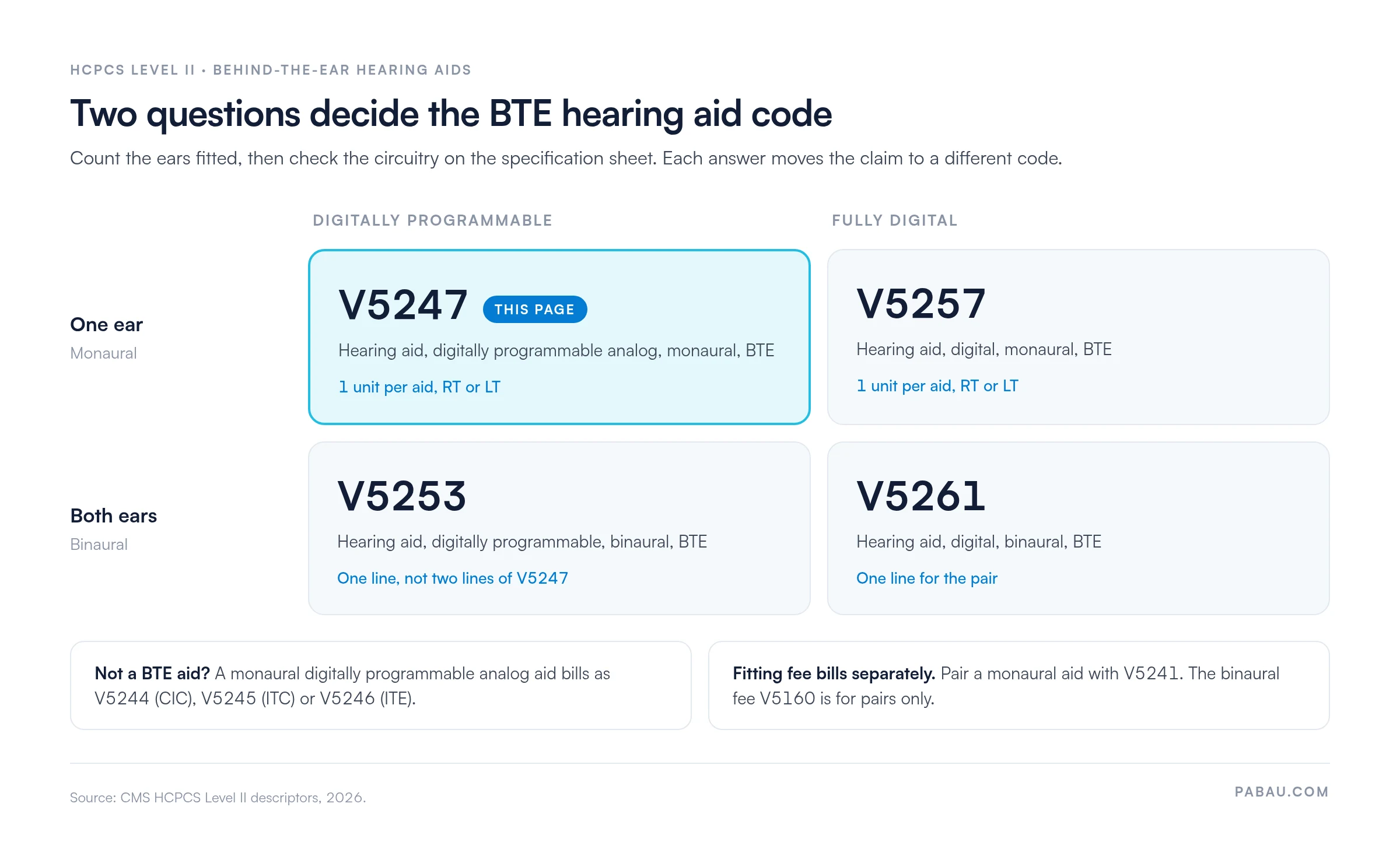
The code turns on ear count and technology. A binaural fitting of the same device bills as V5253, while a fully digital monaural BTE aid bills as V5257.
Let Pabau's smart automation suggest the right codes, reduce claim denials, and keep your practice compliant—effortlessly.
Automate repetitive tasks and focus on what matters most—your patients.
Reduce coding errors and ensure compliance with the latest regulations.
Clean claims, fewer denials, and faster reimbursements.
Powerful insights and reporting to help your practice thrive.
HIPAA compliant SOC 2 certified GDPR-compliant Trusted by 4,000+ clinics worldwide

HCPCS code V5247 covers one digitally programmable analog hearing aid worn behind the ear and fitted to a single ear.
V5247 is billed per ear with the RT or LT modifier. A binaural fitting of the same device type bills as V5253 instead.
A fully digital BTE aid is not V5247. It bills as V5257 for one ear or V5261 for both ears.
Medicare Part B excludes hearing aids under Section 1862(a)(7) of the Social Security Act, so payment comes from Medicaid, Medicare Advantage or commercial plans.
Pabau, the practice management platform we build, stores the audiogram, device specifications and PA number on one patient record. Each V5247 claim then goes out complete.
HCPCS code V5247 is the Level II code for a single digitally programmable analog hearing aid worn behind the ear (BTE). It sits in the V5120-V5267 hearing aid range maintained by the Centers for Medicare and Medicaid Services (CMS). The official descriptor is Hearing aid, digitally programmable analog, monaural, BTE (behind the ear).
Each part of that descriptor narrows the code. Digitally programmable analog means the aid processes sound through analog circuitry, while an audiologist adjusts its settings by computer. Monaural means one aid for one ear. BTE means the case sits behind the ear, with sound delivered through tubing or a receiver wire.
The table below lists the attributes billers need to confirm before submitting a claim.
V5247 applies when an audiologist or hearing instrument specialist dispenses one BTE aid with digitally programmable analog circuitry to one ear. Three facts must all be true: one ear, BTE style and digitally programmable analog technology. If any of them changes, the code changes too.
Analog circuitry alone does not make a claim V5247, because the aid must also be digitally programmable. A conventional analog aid with no programming capability takes a different code, such as V5243 for a monaural in-the-canal fitting.
Clinical situations that typically support a monaural V5247 fitting include:
These scenarios fall outside V5247 and need a different code:
The contralateral routing codes have changed before. CMS deleted V5220, the behind-the-ear BiCROS code, on January 1, 2019, and replaced it with style-specific binaural routing codes.
The style and the ear count sometimes change together. When a patient receives programmable ITE aids in both ears, the fitting bills as V5252 rather than two lines of V5246.
The costliest V5247 errors come from picking a code one attribute away. Billers swap in the binaural code, the fully digital code or the wrong style. The table below maps the neighbors that coders most often confuse with V5247.
Check the technology before the ear count. Most hearing aids dispensed today are fully digital, which makes V5257 far more common than V5247. Confirm the circuitry on the manufacturer’s specification sheet before coding, and keep that sheet with the fitting record. The AAPC hearing aid code range lists every descriptor in the family. For behind-the-ear aids, the grid below reduces the choice to those two questions.
Whether V5247 gets paid depends on the payer type, so verify current plan benefits before dispensing.
Per-ear caps matter more for V5247 than for a binaural code. When a plan pays a fixed amount per ear, a monaural claim draws on one ear’s allowance only. That leaves the other ear’s allowance available if the patient needs a second aid later.
Many state Medicaid programs and commercial plans require prior authorization (PA) before paying a V5247 claim. A missing PA number is one of the most preventable denials in hearing aid billing. Confirm insurance eligibility and PA status before you book the fitting appointment.
Typical PA criteria include:
State the ear and the technology in the PA request itself, for example “one digitally programmable analog BTE aid, left ear.” An authorization issued for a binaural or fully digital fitting will not match a V5247 LT claim line.
Every V5247 claim needs a contemporaneous record that proves medical necessity and confirms the aid was dispensed. Work through this checklist at the fitting appointment, while the patient is still in the office.
A superbill built for audiology encounters helps staff capture these fields before the patient leaves. Add a required “ear fitted” field so laterality is never left to memory.
V5247 is billed as one unit per aid, on its own claim line, with the RT or LT modifier. Audiology claims management software that checks modifiers and units before submission catches most setup errors before the payer does.

Follow the payer’s own billing manual when it differs from these defaults. A few Medicaid programs publish code-specific instructions for laterality and dispensing fees. Provider eligibility also varies, since some states let hearing instrument specialists bill and others enroll only audiologists or DME suppliers.
Supplies take their own claim lines as well. A battery dispensed with the aid bills as V5266, never inside the V5247 device allowance.
Most V5247 denials are predictable. The table below maps the leading causes to their fixes. For the remittance side, cross-reference each adjustment reason against the medical billing denial codes.
Replacement rules decide how often a patient can receive a new aid under their coverage. Because V5247 covers one ear, the benefit clock usually runs per ear, not per pair. Replacing one lost aid from a pair bills as V5247 with that ear’s modifier, not as a binaural code.
For an early replacement, the record must state the clinical reason and the ear affected. A new audiogram showing a threshold shift carries far more weight than a chart note saying the aid was lost. For theft, attach the police report.
V5247 is active and unchanged for 2026. The 2026 hearing aid changes added new CPT codes for hearing aid services, while the HCPCS V-codes for the devices stayed the same.
Reimbursement for V5247 is set payer by payer and changes at least once a year. Pull current amounts from each payer’s published fee schedule rather than relying on last year’s figures.
Schedule an annual fee-schedule check each fall for every payer you bill. Record the V5247, V5253 and V5257 rates side by side, so staff can spot a mis-coded technology type from the payment alone.
A V5247 claim depends on details that often sit in different places. The ear fitted is in the chart notes, the device specification is in a supplier email and the PA number is in a payer portal. When one of them is missing, the claim goes out with the wrong modifier or code.
Pabau keeps those details on one patient record. Digital forms capture the order, the device details and the ear fitted before the appointment ends. The audiogram and PA approval are stored against the same record, so staff can find them when the claim is built.
Pabau’s claims management then submits the claim electronically and tracks its status. Your billing team can see where each V5247 claim sits and follow up on a denial before the appeal window closes.

Pabau keeps the audiogram, device details and PA number on the patient record. It then submits and tracks each hearing aid claim, so denials get caught early.

V5247 is only the right code when three facts line up: one ear, a BTE aid and digitally programmable analog circuitry. Confirm all three from the specification sheet at the fitting, and most wrong-code denials disappear.
The ear is the detail that trips teams up most. Record it in the chart, put it in the PA request and carry it onto the claim as RT or LT. When both ears get the same device, switch to V5253 rather than billing V5247 twice.
If your team still matches fitting notes to payer rules by hand, one patient record removes that step. Book a demo to see how Pabau keeps hearing aid documentation and claims together for your audiology practice.

Need to understand how clearinghouses process hearing aid claims? Medical claims clearinghouse guide explains how HCPCS claims move from practice to payer.
Looking to reduce hearing aid billing denials at the source? Denial management in healthcare covers denial tracking and root-cause analysis for specialty practices.
Want every hearing aid claim to pass on the first submission? What makes a clean claim outlines the pre-submission checks that prevent common HCPCS rejections.
Billing the hearing aid assessment before the fitting? HCPCS code V5010 explains assessment billing and the 2026 CPT hearing aid service codes.
HCPCS code V5247 is the Level II code for one digitally programmable analog hearing aid worn behind the ear. It is a monaural code, so it covers a single aid fitted to one ear.
V5247 is billed per ear, one unit per aid, with the RT or LT modifier. When the patient gets the same device type in both ears, most payers expect one line of V5253 instead.
Both codes cover one behind-the-ear aid for one ear. V5247 is for digitally programmable analog circuitry, while V5257 is for a fully digital aid. Check the manufacturer’s specification sheet, because most aids dispensed today are fully digital.
No. Original Medicare Part B excludes hearing aids under Section 1862(a)(7) of the Social Security Act, so V5247 claims are denied as non-covered. Some Medicare Advantage plans cover hearing aids as a supplemental benefit.
Many state Medicaid programs do. Requirements vary by state and plan year, so check the provider manual and confirm PA status before the fitting appointment.
A monaural fitting usually pairs V5247 with V5241, the dispensing fee for a monaural hearing aid of any type. Check whether the payer pays the fee separately or bundles it into the device allowance.
No. V5247 remains an active HCPCS Level II code. The 2026 hearing aid changes added new CPT codes for hearing aid services, and the device V-codes stayed the same.