

CPT Code 30801: Superficial turbinate ablation billing guide
CPT Code 30801: Official descriptor and procedure overview The American Medical ...

Last Updated: Nov 27, 2026
30115 is the CPT code for excision, nasal polyp(s), extensive. It covers polyp removal that is bilateral, deeply situated or too extensive for an office, typically performed in an operating room or ambulatory surgical center.
Many 30115 denials trace back to operative reports that don't show what makes the procedure extensive. Clean claims depend on knowing where 30115 ends and 30110 begins, and which modifiers apply to bilateral cases. Billers also need to know why place of service is one of the most common triggers for denial.
Let Pabau's smart automation suggest the right codes, reduce claim denials, and keep your practice compliant—effortlessly.
Automate repetitive tasks and focus on what matters most—your patients.
Reduce coding errors and ensure compliance with the latest regulations.
Clean claims, fewer denials, and faster reimbursements.
Powerful insights and reporting to help your practice thrive.
HIPAA compliant SOC 2 certified GDPR-compliant Trusted by 4,000+ clinics worldwide

CPT 30115 covers extensive excision of nasal polyps, performed in an operating room or ambulatory surgical center rather than an office.
Report 30115 instead of 30110 when the procedure is extensive, whatever the exact polyp count.
Endoscopic polyp removal is reported with CPT 31237, not 30115.
Billing 30115 with place of service 11 (office) is a common denial trigger, so report POS 21, 22 or 24.
Pabau, a practice management platform, tracks prior authorizations on the case and sends US claims through Claim.MD.
CPT code 30115 is the procedure code for “Excision, nasal polyp(s), extensive.” AAPC’s otolaryngology coding alert notes that 30115 is traditionally reserved for polypectomy in an outpatient facility setting. The code sits in the nose section of the AMA’s CPT code set (codes 30000-30999).
30115 covers polyps that are bilateral, deeply situated, or too extensive to remove safely in an office. The word “extensive” in the descriptor is a clinical qualifier, not a polyp count. A single large polyp requiring general anesthesia and significant tissue manipulation can support 30115. A handful of small, easily accessible polyps removed with local anesthesia in a clinic room cannot.
30115 belongs to a two-code family for nasal polypectomy. Its neighbor, 30110, covers simple excision. The split drives reimbursement, because 30115 carries a much higher work RVU and payment rate. Payers audit the boundary between the two closely.
CPT 30115 covers excision of nasal polyps from the nasal passages when the procedure involves extensive resection of sinonasal tissue. This includes bilateral removal and polyps extending into the middle meatus or beyond. It also includes cases where disease burden requires prolonged surgical time and general or deep sedation anesthesia.
What 30115 covers: The code fits these cases.
What 30115 does not cover: Separate sinus surgeries and any diagnostic nasal endoscopy are not part of 30115. Check NCCI edits before billing them together. These procedures take their own codes:
When 30115 and a FESS code are performed in the same session, check the National Correct Coding Initiative (NCCI) edits before billing both. Some FESS codes bundle with 30115, and billing both then needs a modifier where the edit allows one. If the polyps came out through an endoscope, the claim moves to CPT 31237 instead.
Report CPT 30115 instead of 30110 when the procedure is extensive, regardless of exact polyp count. The clinical complexity of what the surgeon did decides the code, not the number of polyps removed.
Picture a procedure that ran 45 minutes under general anesthesia in a hospital OR. A coder who reports 30110 because “only a few polyps” came out has undercoded it. Billing 30115 for a quick office snare polypectomy of two small polyps is upcoding, and a denial risk.
The choice runs in two steps, approach first and extent second, and the answer also sets the place of service.
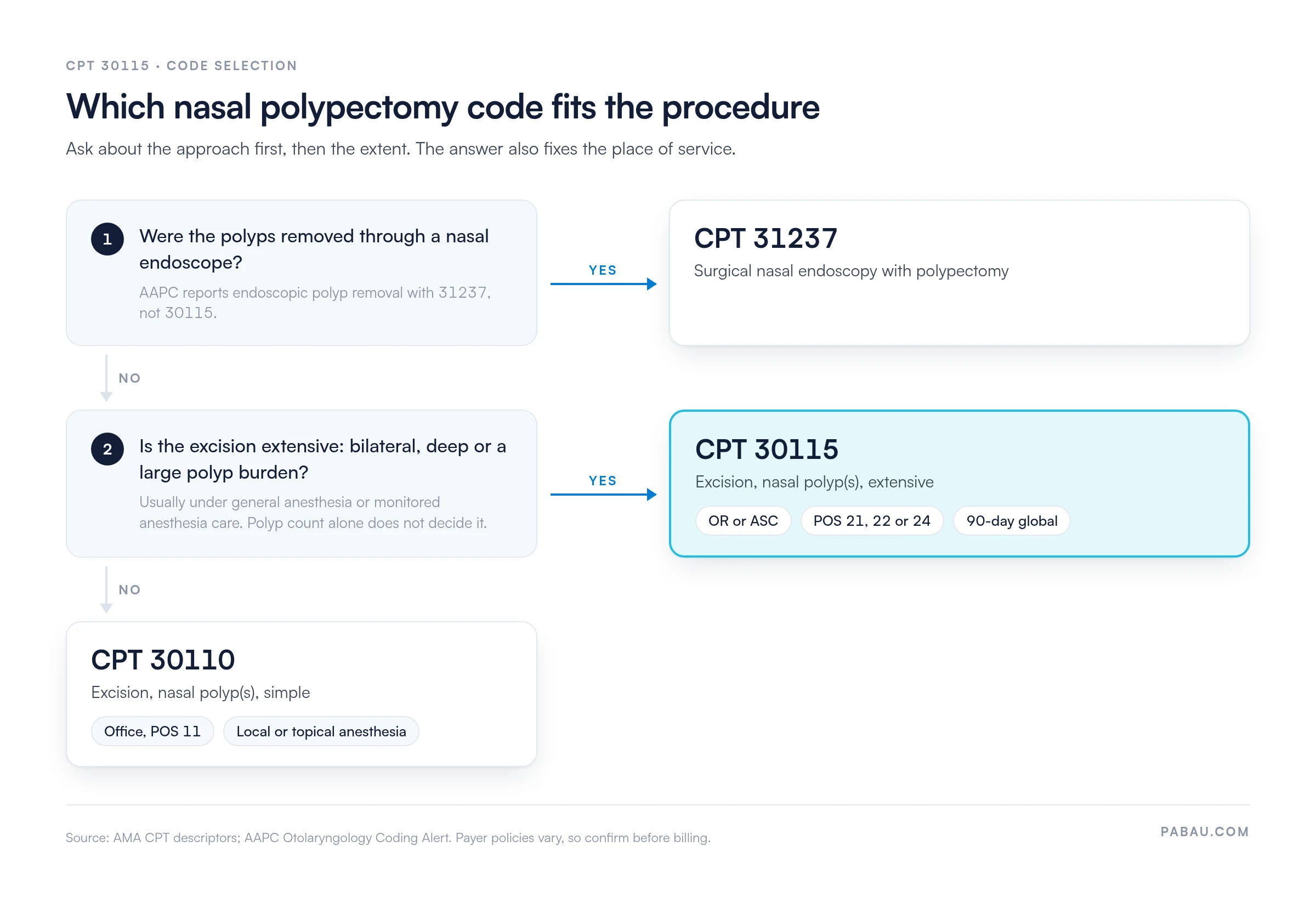
For a non-endoscopic excision, each factor below points the operative record toward one code.
Documentation is what separates an approved 30115 claim from a denial. The operative report has to do more than name the procedure. It has to show the complexity behind the “extensive” qualifier.
Payer medical reviewers look for specific language. An operative note that reads “bilateral nasal polypectomy performed without complication” gives them nothing to work with. These elements must appear:
Structured operative note templates help here. Mandatory fields for polyp extent, laterality, anesthesia type and instruments produce notes that support 30115 with fewer review requests.
No. CPT 30115 should not be billed for in-office nasal polyp removal, and an office place of service is a commonly flagged denial trigger. 30115 is typically performed in a facility setting (OR or ASC), and AAPC advises against reporting it for in-office removal. The code describes an extensive procedure that needs anesthesia support and surgical resources.
The correct place-of-service codes for 30115 are:
If a claim for 30115 is submitted with POS 11 (Office), expect denials from many payers. Confirm the place-of-service code during pre-billing review, before the claim leaves the practice.
Run a weekly pre-submission audit filtering for CPT 30115 claims with POS 11. Even one misfiled claim per month adds up to meaningful lost revenue and rework time. Build the POS check into your billing workflow as a mandatory step before electronic submission.
A wrong or missing modifier can sink a 30115 claim as surely as a wrong code. These modifiers matter most for nasal polypectomy billing:
For bilateral cases, confirm whether your payer processes modifier -50 as two line items or as a single line. Medicare generally pays 150% of the unilateral rate for bilateral procedures. Commercial payers vary. Some pay the full bilateral rate, and others apply their own -50 policy.
CPT 30115 carries approximately 4.33 work RVUs (wRVUs), reflecting the operative complexity of an extensive nasal polypectomy. Verify the current-year figure in the CMS Physician Fee Schedule lookup tool, since RVU values are updated annually and payment varies by locality. The FastRVU 2026 lookup tool provides a quick cross-reference for work, practice expense, and malpractice RVU components.
The 90-day global period means routine post-operative visits for nasal polyp follow-up are bundled into the 30115 payment. A separate E&M visit in this window needs a modifier and documentation of an unrelated condition. Without both, expect a denial.
Most commercial payers and many Medicare Advantage plans require prior authorization for CPT code 30115. Medicare fee-for-service does not require it for this procedure. Requirements vary by payer and region, so check each payer’s policy rather than assuming one rule applies.
Before submitting a prior auth request, confirm insurance eligibility verification and gather these elements, which payers consistently require:
When authorization is denied on first submission, a common reason is thin documentation of failed medical management. An appeal with a physician letter stating the duration, dosage and response to conservative therapy often resolves it.
Most 30115 denials trace back to a small set of repeatable errors. Fixing them at the source cuts rework for practices billing nasal surgery.
Effective denial management workflows and consistent clean claim submission catch many of these issues before claims reach the payer.
Track the medical billing denial codes in your electronic remittance advice by code and reason category. The pattern shows which workflow step is breaking down.
Build a 30115-specific denial tracker that records the payer, denial reason code, and resolution time for every rejected claim. After 90 days you will have enough data to identify whether your denials cluster around place of service, documentation, or modifier issues. Then you can fix the right step.
ENT practices billing nasal surgery carry a specific documentation load. Each 30115 claim depends on an operative note that ties clinical complexity to code selection, plus an authorization that matches the planned date and setting. Inferior turbinate ablation works the same way: a note that never states the ablation depth leaves the claim at CPT 30801.
Pabau’s claims management tools support direct clearinghouse submission (US claims run through Claim.MD) and eligibility checks. That cuts the manual steps between surgery and claim submission. Claim.MD connects to thousands of US insurance payers, including Medicare and major commercial carriers.
Prior authorizations sit on the patient’s case, with the auth code, dates and sessions tracked and a warning when one is missing. For practices managing revenue cycle management across several providers or locations, central claim tracking shows 30115 denial patterns before they compound.
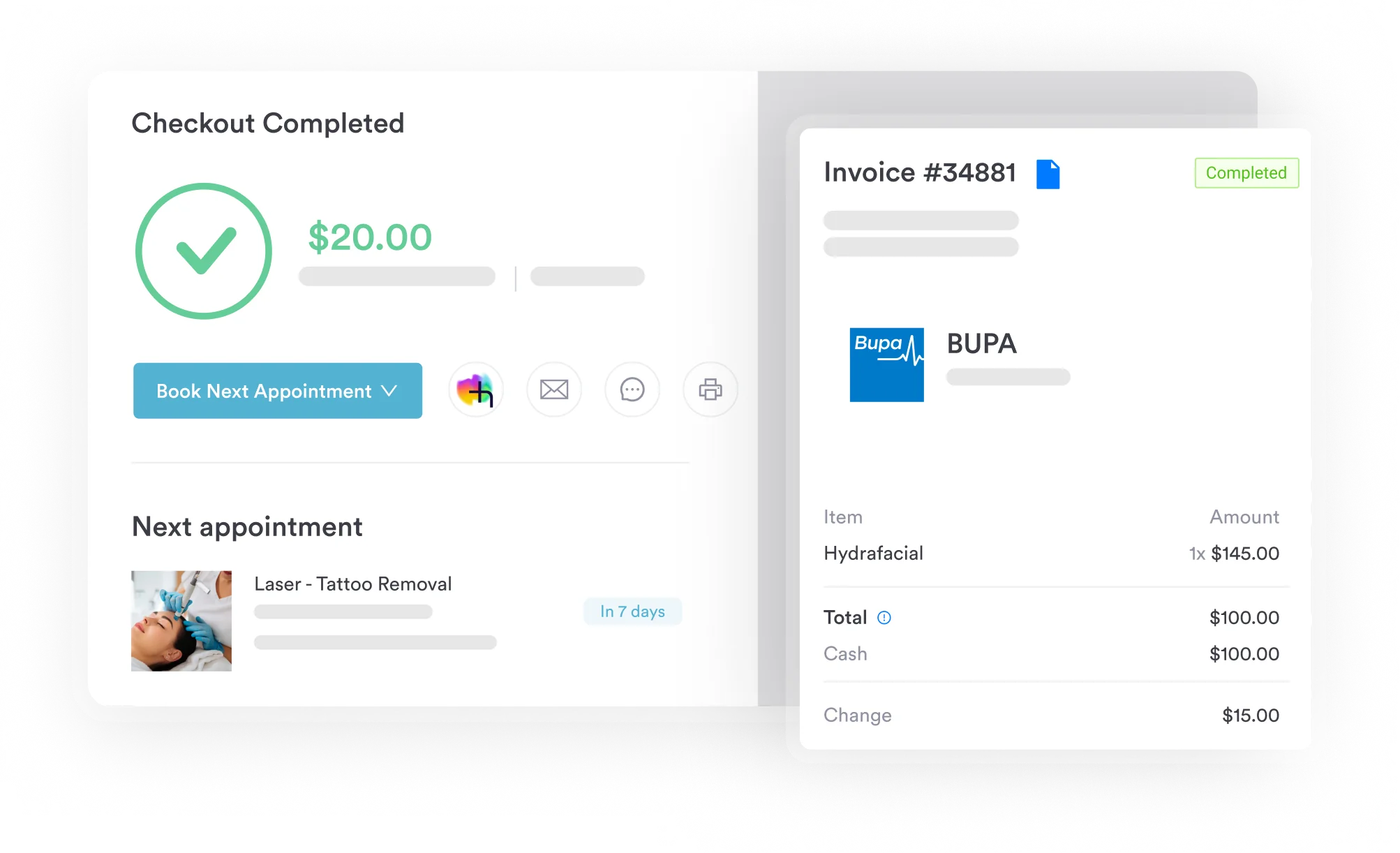
Claim.MD also returns ERA remittances, so payments and denials come back into Pabau rather than a separate portal.

Pabau tracks prior authorizations on the patient’s case, checks eligibility and sends US claims through Claim.MD. See how it works for ENT and surgical practices.

CPT 30115 pays for complexity, so the claim stands or falls on whether the record shows it. Code the procedure the surgeon performed rather than the polyp count, and send it with a facility place of service.
The trade-off is a few extra minutes of documentation in the OR against rework later. A structured operative note is cheaper than an appeal on a denied 30115 claim.
To see how Pabau tracks authorizations and sends 30115 claims for ENT and surgical practices, book a demo.

Removing polyps endoscopically? CPT code 31237 covers surgical nasal endoscopy with biopsy, polypectomy or debridement.
Trying to reduce denied surgical claims? Denial management in healthcare covers systematic approaches to tracking and reversing claim rejections.
Want to understand what ERA responses are telling you? Electronic remittance advice explains how to read 835 remittance files and identify denial patterns.
Checking coverage before the OR date? Insurance eligibility verification walks through confirming coverage before a procedure is scheduled.
CPT code 30115 is the AMA procedure code for “Excision, nasal polyp(s), extensive.” It covers surgical removal of nasal polyps in an operating room or ambulatory surgical center when the polyp burden is too complex for an office. It is distinct from CPT 30110, which covers simple nasal polypectomy.
CPT 30110 covers simple nasal polyp excision, typically performed in an office with local anesthesia. CPT 30115 covers extensive polypectomy requiring a facility setting, general or monitored anesthesia, and greater operative complexity. Clinical complexity decides the code, not polyp count. When the procedure is extensive, report only 30115 regardless of how many polyps were removed.
No. CPT 30115 belongs in a facility setting, either a hospital (POS 21 or 22) or an ambulatory surgical center (POS 24). AAPC advises against reporting it for in-office removal, and many payers deny 30115 billed with place of service 11 (office). Office-based simple polypectomy belongs under CPT 30110.
Modifier -50 (bilateral procedure) is the standard modifier when extensive polypectomy is performed on both sides in the same session. Some payers prefer modifier -LT and -RT reported on separate lines. Medicare typically pays 150% of the unilateral rate for bilateral 30115 claims. Always check the specific payer’s bilateral policy before submission.
Prior authorization requirements vary by payer. Most commercial plans and Medicare Advantage programs require prior auth for CPT 30115. Medicare fee-for-service generally does not. Submit documentation of nasal polyposis diagnosis, CT imaging findings, and at least 12 weeks of failed intranasal corticosteroid therapy to support authorization requests.
Medicare reimbursement for CPT 30115 is locality-dependent and updated annually under the Medicare Physician Fee Schedule. The code carries approximately 4.33 work RVUs. Total payment is total RVUs multiplied by the annual conversion factor, adjusted by the Geographic Practice Cost Index. Use the CMS fee schedule lookup for your locality.




