CCSD Code F3400: Tonsillectomy guide for ENT practices
What is CCSD Code F3400? CCSD Code F3400 is the Clinical Coding and Schedule Dat...

Last Updated: Oct 22, 2026

CPT code 31237 describes nasal/sinus endoscopy, surgical; with biopsy, polypectomy or debridement (separate procedure). ENT practices use it for diagnostic tissue sampling, polyp removal, and post-FESS debridement.
31237 is designated a ‘separate procedure’ in the AMA CPT codebook. It cannot be billed alongside a more comprehensive sinus endoscopy at the same session unless a valid exception applies.
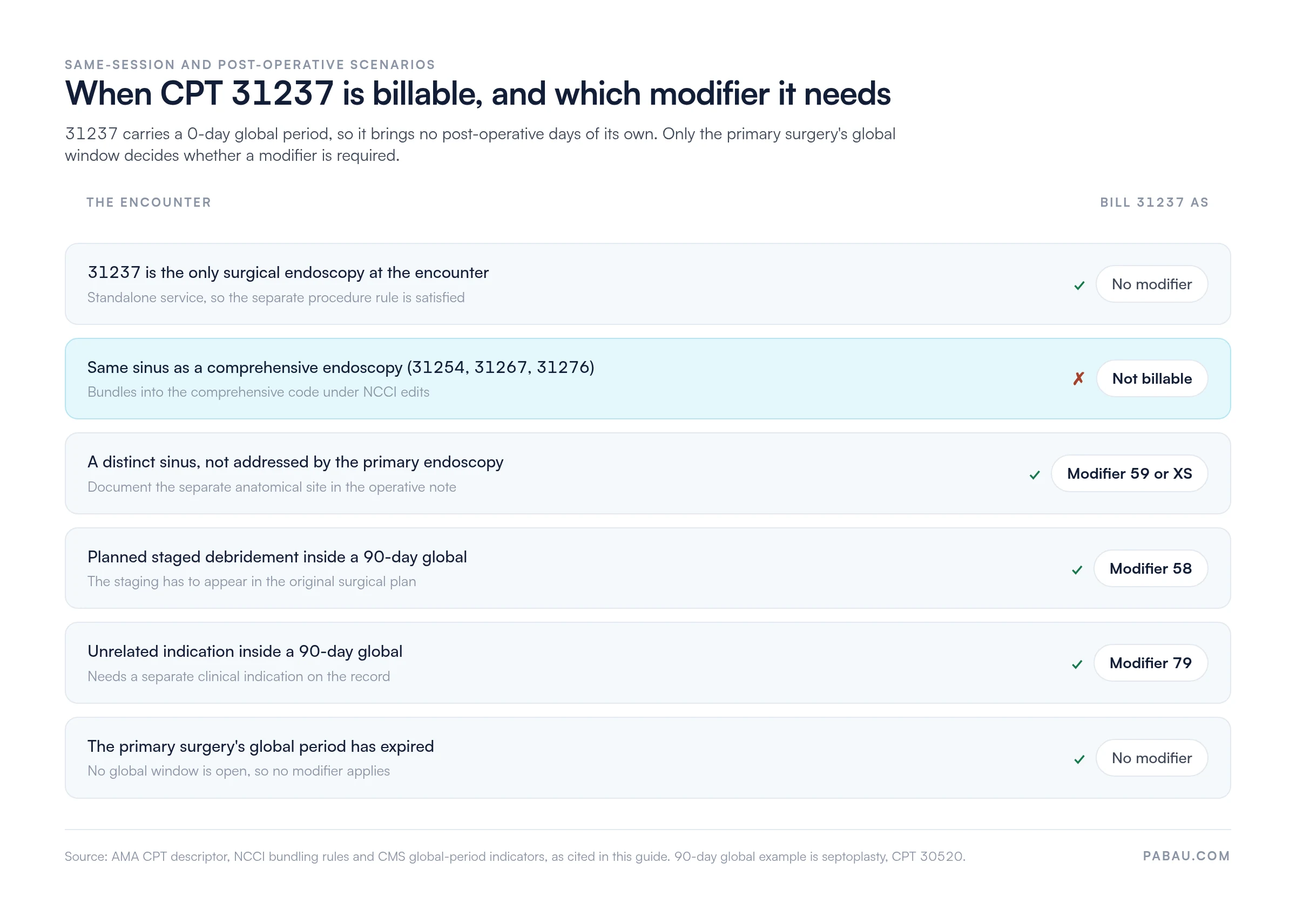
31237 itself carries a 0-day global period, so only the primary surgery’s global window governs whether a modifier is needed.
The most common billing error is submitting 31237 inside a related surgery’s global period without the correct modifier. OIG audits flag this pattern, so use modifier 79 for an unrelated procedure and 58 for a staged one.
Pabau, a practice management platform with built-in claims management, submits ENT claims electronically through Claim.MD to thousands of US payers.
CPT code 31237 carries the following official AMA descriptor: Nasal/sinus endoscopy, surgical; with biopsy, polypectomy or debridement (separate procedure). The code sits within the Endoscopy Procedures on the Accessory Sinuses section of the AMA CPT codebook, alongside the 31231-31294 nasal and sinus endoscopy family.
Three distinct procedures fall under this single code. A biopsy involves removing tissue from the nasal cavity or a paranasal sinus (maxillary, ethmoid, frontal, or sphenoid) for pathological analysis. A polypectomy removes nasal polyps via endoscopic visualization. Debridement clears crusting, fibrin, and debris from the sinus cavity, most commonly in the weeks following functional endoscopic sinus surgery (FESS).
The “separate procedure” parenthetical in the descriptor carries weight. It is the AMA’s signal that the code is normally integral to a more comprehensive service. Bill it independently only as a standalone procedure, or when a recognized exception applies.
The separate procedure designation creates the most billing complexity around CPT code 31237. Under NCCI (National Correct Coding Initiative) bundling rules, 31237 bundles into a more comprehensive surgical endoscopy of the same sinus. That applies when both are billed for the same date of service through the same surgical approach.
Take a surgeon who performs a maxillary antrostomy (CPT 31267) and debrides the same maxillary sinus in the same session. In that case 31237 bundles into 31267, because the debridement is integral to the more comprehensive procedure.
Billing 31237 with a total ethmoidectomy under CPT 31255 in the same session is conditional. The biopsy must be separately identifiable from tissue removed during the ethmoidectomy, and modifier 59 is required.
Partial ethmoidectomy under CPT 31254 follows the same rule. A debridement in that session is separately reportable only when it addresses a sinus the ethmoidectomy did not enter.
Three scenarios allow separate billing of 31237, according to AAPC guidance and AAO-HNS coding resources:
CPT code 31237 carries a 0-day global period under CMS classification, shown as global indicator 000. The code brings no bundled postoperative days of its own, so routine follow-up after 31237 is not automatically included in its payment.
Coders run into trouble with the global period of the primary surgery instead. Septoplasty (CPT 30520) carries a 90-day global period. A patient returning for post-septoplasty debridement within those 90 days needs a modifier on the 31237 claim. Without one, the payer treats the debridement as part of the septoplasty’s global services.
Correct modifier use is an OIG audit trigger for this code family. The table below outlines the modifiers most commonly applied to CPT code 31237, with guidance on when each is appropriate. Check the payer’s own policy before billing, since some plans set modifier requirements that differ from Medicare defaults.
Modifier 59 is increasingly scrutinized by CMS. Where available, use the more specific X{EPSU} modifiers: XE (separate encounter), XP (separate practitioner), XS (separate structure), or XU (unusual non-overlapping service). These provide greater specificity and are less likely to trigger pre-payment review.
Which modifier applies depends on the encounter, not on the code alone. The six scenarios below cover what an ENT coder meets with 31237 in practice.
Reimbursement for CPT code 31237 varies by setting, payer, and geography. The CMS Physician Fee Schedule (MPFS) sets the Medicare baseline. Commercial payers usually reimburse at a percentage of that baseline, set by contract. ENT practices should verify current rates annually, as CMS updates the MPFS each January 1.
For 2026 RVU values, the FastRVU 2026 lookup tool breaks out Work, PE, and MP RVUs by code. The table below shows representative Medicare figures based on CMS MPFS data.
Actual payments shift with the geographic adjustment factor (GAF) and the practice expense component in your locality. Always verify against the official CMS fee schedule before submitting claims.
The difference between facility and non-facility payment is large. An ENT practice performing 31237 in the office receives materially more per claim. The same procedure in a hospital outpatient department or ASC pays less. Non-facility practice expense (PE) RVUs explain the split, since they compensate the physician for overhead carried outside a facility.
Commercial payers typically negotiate rates above Medicare. Many ENT practices see commercial reimbursement in the range of 110-160% of Medicare, though this varies widely by market and contract. Confirm payer-specific rates with your contract manager or revenue cycle team.
For practices managing electronic claim submission, routing the workflow through a clearinghouse simplifies the reconciliation side. Pabau submits electronic claims through Claim.MD, which connects to thousands of US payers. Claims for 31237 go out with a real-time eligibility check, and the ERA comes back into the same ledger.
Check your payer contracts for sinus endoscopy-specific carve-outs before assuming Medicare rates apply. Some regional payers and Blue Cross plans hold separate fee schedules for ENT endoscopy codes, which can pay above MPFS. Your revenue cycle team should audit contract rates annually for the 31231-31294 family.
Medical necessity for CPT code 31237 must be supported by a documented diagnosis that justifies the specific procedure performed. Linking the wrong ICD-10 code to the procedure, or failing to link any diagnosis at all, is a top denial driver.
The codes below represent the most common pairings, drawn from ICD-10-CM crosswalk data. All claims require documentation supporting the diagnosis in the medical record.
When debridement is performed as a post-FESS follow-up, many coders add Z48.810 as a secondary diagnosis to clarify the encounter type. The primary diagnosis should still reflect the underlying condition, such as J32.0 for chronic maxillary sinusitis, rather than the aftercare code alone.
CPT code 31237 sits within the broader sinus endoscopy code family, which spans diagnostic and surgical endoscopies across the nasal cavity and paranasal sinuses. When the removed tissue is a pneumatized middle turbinate, the code is 31240, which bundles 31237 at the same site. Understanding the hierarchy helps coders select the most appropriate code and avoid both under-coding and upcoding.
The AAPC Codify CPT lookup is a useful reference for browsing the full 31231-31294 range with code descriptors and bundling notes.
Adhesions between a turbinate and the septum can follow sinus surgery, and the surgeon divides them endoscopically. UK private practices bill that division under CCSD code E0440 rather than a CPT code.
A technically correct code selection still produces a denial if the operative note doesn’t support it. For CPT code 31237, the operative documentation must address four elements to withstand payer review.
Practices using digital operative note templates paired with a superbill documentation workflow capture these elements consistently. Manual, free-text operative notes leave out elements that coders must catch before the claim goes out. That adds review time and raises denial risk.
Diagnosis linkage works differently once you leave the operative setting. Medicare judges coverage for K0868 on whether the patient can perform mobility-related activities of daily living inside the home, not on the diagnosis alone.
Most denials for CPT code 31237 trace back to five recurring errors. Tracking them by code shows which one is most frequent in your practice, and where coder education pays off.
Running a checklist against each 31237 submission before it leaves the practice lowers first-pass denial rates. The clearinghouse scrub stage is the last place to catch a modifier or diagnosis linkage error cheaply. Reviewing common denial reason codes for surgical endoscopy also helps coders read remittance advice and resubmit accurately.
Track your 31237 denial reasons by CARC (Claim Adjustment Reason Code) for at least 90 days. If CO-97 (benefit included in allowance for another service) is the top denier, your bundling documentation needs attention. If CO-4 (modifier missing) leads the list, modifier education for your ENT coders is the priority.
Most ENT practices catch a 31237 modifier problem after the denial arrives. The operative note lives in one system, the claim in another, and the coder reconciles the two by hand before every submission.
Pabau is practice management software built for specialty practices, and it keeps the note and the claim in one patient record. Its claims management software submits 31237 electronically through Claim.MD, runs the eligibility check first, and files the returned ERA against the same invoice.
Denials come back grouped by code and CARC. You can see whether 31237 is losing money to modifier choices, bundling edits, or thin documentation. That turns a recurring ENT denial into a fixable coding decision.

Pabau’s claims management software handles ENT endoscopy billing end to end, from eligibility verification to electronic claim submission and ERA reconciliation. See how ENT practices use Pabau to reduce denials and get paid faster.

Almost every 31237 denial comes down to one question the operative note has to answer. Was this service separate from the more comprehensive procedure, or part of it? Answer that in the note, pick the modifier that matches, and the claim holds.
The trade-off worth remembering is the setting. 31237 pays materially more in the office than in a facility, while the modifier work stays the same. Where the procedure happens is a business decision. Whether the note supports the claim is not.
Book a demo to see how Pabau tracks 31237 modifiers, denials, and ERAs for an ENT practice.

Need to understand how claims move from submission to payment? Medical claims clearinghouse explained covers how clearinghouses validate, route, and return claims for ENT and other specialty practices.
Struggling with payer enrollment for your ENT practice? Getting credentialed with insurance companies walks through the enrollment process for specialty providers.
Want to benchmark your ENT billing against best practices? Best medical billing software for US practices compares the top platforms for ENT revenue cycle management.
CPT code 31237 is the procedure code for nasal/sinus endoscopy, surgical; with biopsy, polypectomy or debridement (separate procedure). ENT practices use it when an endoscopic intervention involves tissue sampling, polyp removal, or post-operative sinus debridement. It applies when no more comprehensive surgical endoscopy is performed at the same session.
Yes, CPT 31237 can be billed for postoperative debridement, but only with the correct modifier. If the debridement is unrelated to the primary surgery, use modifier 79. If it is a planned staged service, use modifier 58. Billing 31237 during a 90-day global period without a modifier will result in denial.
CPT code 31237 carries a 0-day global period under CMS classification, shown as global indicator 000. It has no bundled postoperative days of its own. A primary procedure like septoplasty (CPT 30520) carries a 90-day global, and that window is what governs modifier use.
Non-facility (office) rates for CPT 31237 are approximately $230-$290 nationally under Medicare, while facility (hospital or ASC) rates are approximately $130-$170. The difference reflects the higher practice expense RVUs reimbursed to the physician when overhead costs are not covered by a separate facility payment.
Billing CPT 31237 on the same day as CPT 30520 is only appropriate with a modifier that justifies it as a separate service. If the debridement is performed during the same surgical session and is integral to the septoplasty, it bundles. If performed on a distinct anatomical site with a separate clinical indication, modifier 59 or XS may apply.
Medicare reimbursement for CPT code 31237 averages roughly $230-$290 in a non-facility setting and $130-$170 in a facility setting. Both figures are national averages, subject to geographic adjustment. Verify current rates using the CMS Physician Fee Schedule search tool, as rates are updated annually on January 1.