CPT Code 62284: Injection procedure for myelography
CPT Code 62284: official descriptor and procedure overview The American Medical ...

Last Updated: Oct 19, 2026
29130 is the CPT code for application of finger splint; static. It covers a clinician applying a prefabricated or custom-fabricated splint that holds one or more fingers in a fixed position.
The code sits in the CPT 29000-29799 casts and strapping section. Its most common billing error is confusion with CPT 29131, the dynamic finger splint code. When the payer allows it, the splint supply is billed separately with an HCPCS L-code.
Let Pabau's smart automation suggest the right codes, reduce claim denials, and keep your practice compliant—effortlessly.
Automate repetitive tasks and focus on what matters most—your patients.
Reduce coding errors and ensure compliance with the latest regulations.
Clean claims, fewer denials, and faster reimbursements.
Powerful insights and reporting to help your practice thrive.
HIPAA compliant SOC 2 certified GDPR-compliant Trusted by 4,000+ clinics worldwide

CPT 29130 covers the clinical application of a static finger splint, not a dynamic one (use 29131) and not supply-only billing (use HCPCS L-codes).
Documentation must record the anatomical digit, splint type (static), diagnosis, and provider attestation of application to survive audit.
Modifier 59 is required when 29130 is billed the same day as a related procedure that triggers an NCCI bundling edit.
Pabau, the practice management platform we build, checks CPT and diagnosis pairings before a 29130 claim goes to the clearinghouse.
CPT code 29130 is defined by the American Medical Association (AMA) with the official descriptor: Application of finger splint; static. The code covers the clinician’s act of applying a prefabricated or custom-fabricated static splint to one or more fingers in a clinical setting.
It belongs to the musculoskeletal system subsection of CPT (codes 29000-29799), which governs casting, strapping, and splinting procedures across the body.
The key word in the descriptor is static. A static finger splint immobilizes the digit in a fixed position. It does not allow controlled motion. That single distinction separates 29130 from its paired code, 29131, and is the first thing coders must confirm before selecting the code.
The code covers the clinical service of applying a static finger splint during a face-to-face patient encounter. The provider must physically apply the splint, not merely hand it to the patient or provide instructions. Supply-only transactions do not qualify.
Included services:
Excluded services (do not bill 29130 for these):
CPT 29130 and CPT 29131 are a direct pair, differentiated solely by the mechanical action of the splint applied. Selecting the wrong code when applying a dynamic splint is among the most audited errors in hand and orthopedic billing. Consult AAPC Codify for descriptor cross-checks when preparing claims.
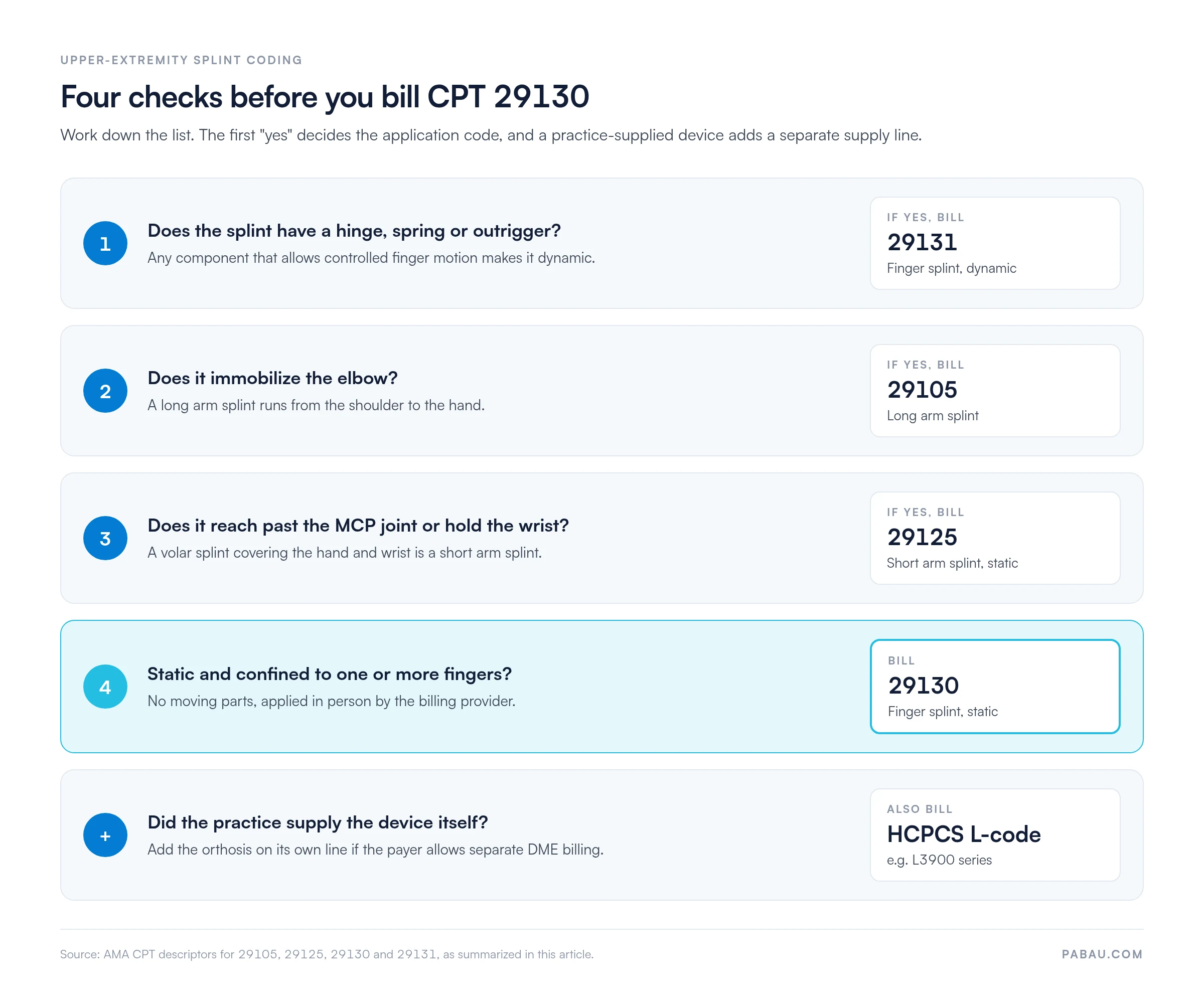
Check the splint’s product sheet or prescription order before selecting between 29130 and 29131. If the device has any articulating component, spring mechanism, or outrigger allowing controlled digit motion, the correct code is 29131. That holds even when the splint looks simple.
Beyond the 29130/29131 pair, coders at physical therapy and hand rehabilitation practices often meet adjacent codes for upper-extremity splinting. The deciding factor is always anatomical level: Finger, wrist, or arm.
A common error: Applying a volar splint that covers the entire hand and wrist, then billing 29130. If the device extends proximal to the metacarpophalangeal joint or immobilizes the wrist, 29125 is the correct code. Bill 29130 only when the orthosis is confined to a single digit or multiple isolated digits. The checks below settle the choice in order.
Strong documentation protects the claim through audit and establishes the medical necessity most payers require. It starts with the diagnosis the splint treats.
Every 29130 claim needs an ICD-10-CM diagnosis that supports the splint, and our ICD-10-CM reference for coders lists the full code set. Common pairings include S63.6xx (sprain of interphalangeal joint of finger), S62.6xx (fracture of middle or proximal phalanx), and M20.0xx (deformity of finger).
Capture each of these elements in the procedure note:
When 29130 is billed alongside an evaluation and management (E/M) code on the same day, CCI edits may bundle the two services. If the splinting is separate and distinct from the E/M, modifier 25 on the E/M signals a separately identifiable service. Modifier 59 on 29130 is not the fix here.
Document the distinct reason for the E/M visit separately from the splinting procedure note.
Modifier selection for CPT code 29130 depends on three scenarios: Repeat application, bilateral application, and unbundling from a same-day service. Billing without the correct modifier in each scenario is a leading cause of denials.
Medicare and many commercial payers do not require digit-level FA-F9 modifiers for 29130, but workers’ compensation carriers in states such as Texas often do. Confirm payer-specific modifier requirements in the payer’s provider manual before submitting. The NCCI Policy Manual, published by CMS, lists the current bundling edit pairs; check the current quarter’s version because edit tables update quarterly.
Medicare reimbursement for CPT code 29130 is calculated from the Medicare Physician Fee Schedule (MPFS) using relative value units (RVUs). The CMS Physician Fee Schedule lookup tool provides the current year’s payment rates by locality. Rates change annually on January 1, so always verify before quoting patients or setting contracted rates.
The splint supply is not included in the Medicare payment for CPT 29130. If the practice provides the splint and the patient’s plan covers DME, bill the orthosis separately to the DME benefit. Use the appropriate HCPCS L-code for the device. Verify with each payer whether they bundle the supply into the procedure payment or allow separate L-code billing.
CPT code 29130 is generally considered a low-cost, straightforward procedure that rarely triggers prior authorization across commercial payers. Most major insurers cover it when billed with a supported diagnosis code, but specific rules vary by plan year and payer.
Medicare: Covered under Part B when medically necessary. No prior authorization required as a standalone code. The procedure must be performed by a physician or qualified non-physician practitioner (NP, PA) billing under their own NPI. Incident-to rules may apply in supervising-physician scenarios.
Commercial payers (BCBS, Aetna, UnitedHealthcare): Coverage is typically included in the musculoskeletal benefits. BCBSIL and BCBSTX include CPT 29130 on their covered PT/OT procedure code lists, effective January 1, 2025. Check whether this listing triggers prior auth for your specific plan product or is a covered-service-only listing without auth requirements.
Workers’ compensation: CPT 29130 is reimbursed under most state workers’ compensation fee schedules for occupational hand injuries. Texas Division of Workers’ Compensation (DWC) schedules reference 29130 in the context of hand and finger injuries.
State-specific rules govern whether the treating provider or a separate DME supplier bills for the splint device. Verify the current state fee schedule before billing, as rates and rules differ by jurisdiction.
Medicaid managed care: Coverage and reimbursement rates vary significantly by state and managed care organization. Always confirm active coverage with a real-time eligibility check before the appointment rather than relying on previous authorizations.
CPT code 29130 generates a predictable set of denial patterns. Most are preventable with consistent coding habits and one check before each claim leaves the practice. A clean claim, with complete documentation and the right modifiers, is the goal.
Build a pre-submission checklist for CPT 29130 claims: (1) Confirm static vs dynamic splint type. (2) Verify laterality modifier RT/LT is appended. (3) Check for active NCCI edit pairs if another procedure was billed the same day. (4) Confirm the ICD-10-CM diagnosis code maps to finger/digit pathology. (5) Confirm splint supply is on a separate HCPCS L-code line if applicable.
For diagnosis pairing, the same principle applies: Every CPT procedure code on the claim needs a diagnosis that justifies medical necessity for that service. A mismatch between the procedure and the diagnosis is as damaging as a wrong modifier.
Most 29130 denials trace back to a check nobody ran before submission. The usual culprits are a missing RT or LT modifier and a splint supply folded into the procedure charge.
Pabau, the practice management platform we build, runs those checks inside its claims software for coders. Claims go through Claim.MD, our US clearinghouse partner, which validates codes against current payer edits before they leave the practice. The same workflow handles eligibility checks before the visit and ERA (electronic remittance advice) posting after it.
The outcome is a billing team that spends its week on new claims. Reworking denials on a low-value code like 29130 drops down the list.

Pabau checks modifiers, diagnosis pairings and payer edits on every CPT 29130 claim. Errors surface before the claim leaves your desk, not after a denial.

CPT code 29130 is simple once its scope is understood precisely: It covers the clinical application of a static (immobilizing) finger splint, and only that.
That makes the procedure note the deciding document. A note that names the digit, the side and a device with no moving parts defends the code choice at audit.
The trade-off is small but constant. A minute spent confirming the splint type and the supply line costs less than reworking a denied claim. Book a demo to see how Pabau checks splinting claims before they reach the payer.

Need to understand how clearinghouse claim validation works? Pabau’s Claim.MD clearinghouse guide explains the electronic claims pathway, payer edits, and ERA posting in plain language.
Billing splinting codes alongside physical therapy CPT codes? Our revenue cycle management overview covers how to structure multi-code claims without triggering NCCI bundling issues.
Need a broader view of denial prevention across your CPT claims? Denial codes in medical billing breaks down the most common CARC denial reason codes and how to respond to each one.
Want claims to pay on first submission? What is a clean claim in medical billing? explains what a payer needs to see on a claim before it pays the first time.
Dealing with denials after they land? Denial management in healthcare walks through how practices find, fix, appeal and prevent denied claims.
CPT code 29130 is the billing code for application of a static finger splint, as defined by the American Medical Association. It covers the clinical act of applying an immobilizing (non-articulated) orthosis to one or more fingers by a qualified provider in a face-to-face encounter. It does not cover dynamic splints (those use CPT 29131) or the cost of the splint device itself (billed separately via HCPCS L-codes).
CPT 29130 applies to static finger splints that immobilize the digit with no movement. CPT 29131 applies to dynamic finger splints with springs, hinges, or outrigger mechanisms that allow controlled motion. The splint’s mechanical action, confirmed by the product documentation or prescription order, determines which code is correct.
Yes, Medicare Part B covers CPT 29130 when the service is medically necessary and performed by a qualifying provider billing under their own NPI. No prior authorization is required. Rates change annually on January 1. Verify the current Medicare Physician Fee Schedule (MPFS) payment rate with the CMS MPFS lookup tool at cms.gov.
Yes, but with conditions. If the E/M service is a separately identifiable encounter, append modifier 25 to the E/M code. Modifier 59 does not go on 29130 in this case. The documentation must support two distinct services: A history, exam, and medical decision-making note for the E/M, plus a separate splint procedure note.
The splint device is billed separately from CPT 29130 using an appropriate HCPCS Level II L-code, typically from the L3900 series for finger orthoses. Which L-code applies depends on the specific device and the payer’s policy. It also depends on whether the practice bills the device as DME or the payer bundles the supply into the CPT payment. Confirm payer-specific rules before submitting an L-code alongside 29130.
Yes, most state workers’ compensation fee schedules include CPT 29130 for occupational hand and finger injuries. Reimbursement rates and modifier requirements vary by state. Some carriers, including Texas DWC, may require digit-specific FA-F9 modifiers on top of the standard RT/LT laterality modifiers. Always verify the current state fee schedule and the employer’s carrier-specific requirements before billing.