

ICD-10 code S61.201A: Open wound of left index finger without nail damage
ICD-10 code S61.201A covers a left index finger wound of unstated type ICD-10 co...

Last Updated: Oct 16, 2026
Billable Code Specific Code
S62.644B is the billable ICD-10-CM code for nondisplaced fracture of proximal phalanx of right ring finger, initial encounter for open fracture.
It applies while the provider is actively treating a fracture with broken skin over it. Category S62 doesn't split open fractures by Gustilo type, so any open fracture at this site is coded S62.644B. A closed fracture takes S62.644A, and follow-up visits move to a D, G, K or P code for the healing stage. Assignment turns on the note stating open status, the digit, the phalanx level and displacement.
Let Pabau's smart automation suggest the right codes, reduce claim denials, and keep your practice compliant—effortlessly.
Automate repetitive tasks and focus on what matters most—your patients.
Reduce coding errors and ensure compliance with the latest regulations.
Clean claims, fewer denials, and faster reimbursements.
Powerful insights and reporting to help your practice thrive.
HIPAA compliant SOC 2 certified GDPR-compliant Trusted by 4,000+ clinics worldwide

ICD-10 Code S62.644B is billable for a nondisplaced proximal phalanx fracture of the right ring finger at the initial encounter for an open fracture.
Category S62 does not split open fractures by Gustilo type, so any open fracture at this site takes B, and a closed one takes S62.644A.
Documentation must state laterality, digit, phalanx level, open or closed status, and displacement, because missing status defaults to closed and displaced.
Pabau’s claims management software integrates with Claim.MD to submit and track open-fracture claims across thousands of US payers.
ICD-10 Code S62.644B is an active, billable ICD-10-CM code for a nondisplaced fracture of the right ring finger’s proximal phalanx.
It’s reported at the initial encounter when the fracture is open. It has been valid since FY 2016 and remains in the FY 2026 code set. Here’s the core reference data to check before you select it.
The parent code S62.644 is not billable, so a claim that stops at six characters will reject. Always report the full seven-character code. Confirm each new fiscal year’s validity in the CDC ICD-10-CM lookup tool before you submit.
Each position in S62.644B encodes one clinical or administrative fact. A wrong character anywhere produces a different code, and the 7th character is where most errors land. The same structure runs through every fracture code in category S62.
The proximal phalanx is the finger bone closest to the hand. It meets the metacarpal at the MCP joint and the middle phalanx at the PIP joint. “Nondisplaced” means the fracture line is present but the fragments haven’t shifted out of alignment. A nondisplaced fracture can still be open, which is exactly the case this code covers.
S62.644A covers this injury at the initial encounter for a closed fracture, with the skin intact. S62.644B covers the same injury at the initial encounter for an open fracture, where the skin over the fracture is broken. The two codes aren’t interchangeable, and the note has to support whichever one you report.
Here’s where many coding references go wrong. Some fracture categories split open fractures by Gustilo-Anderson type. Forearm (S52), femur (S72) and lower leg (S82) codes use B for type I or II and C for type III. Category S62 has no such split, so every open fracture of this finger bone takes B, whatever its Gustilo type.
The Gustilo grade is still worth recording, because it guides antibiotics and surgical planning. It just doesn’t change the diagnosis code here. What the coder needs is an explicit statement that the fracture is open. If the note doesn’t say whether the fracture is open or closed, the ICD-10-CM Official Guidelines default to closed, which points to S62.644A. Query the provider when the wound is described but its link to the fracture isn’t.
The 7th character in category S62 records two facts. It shows the encounter type (initial, subsequent or sequela), and at the initial encounter it shows whether the fracture is open or closed. The full set for S62.644 looks like this.
Encounters during active treatment take A or B as the 7th character. Once the patient moves into healing or rehabilitation, switch to D, G, K or P to match the healing status. The decision runs in the order shown below.
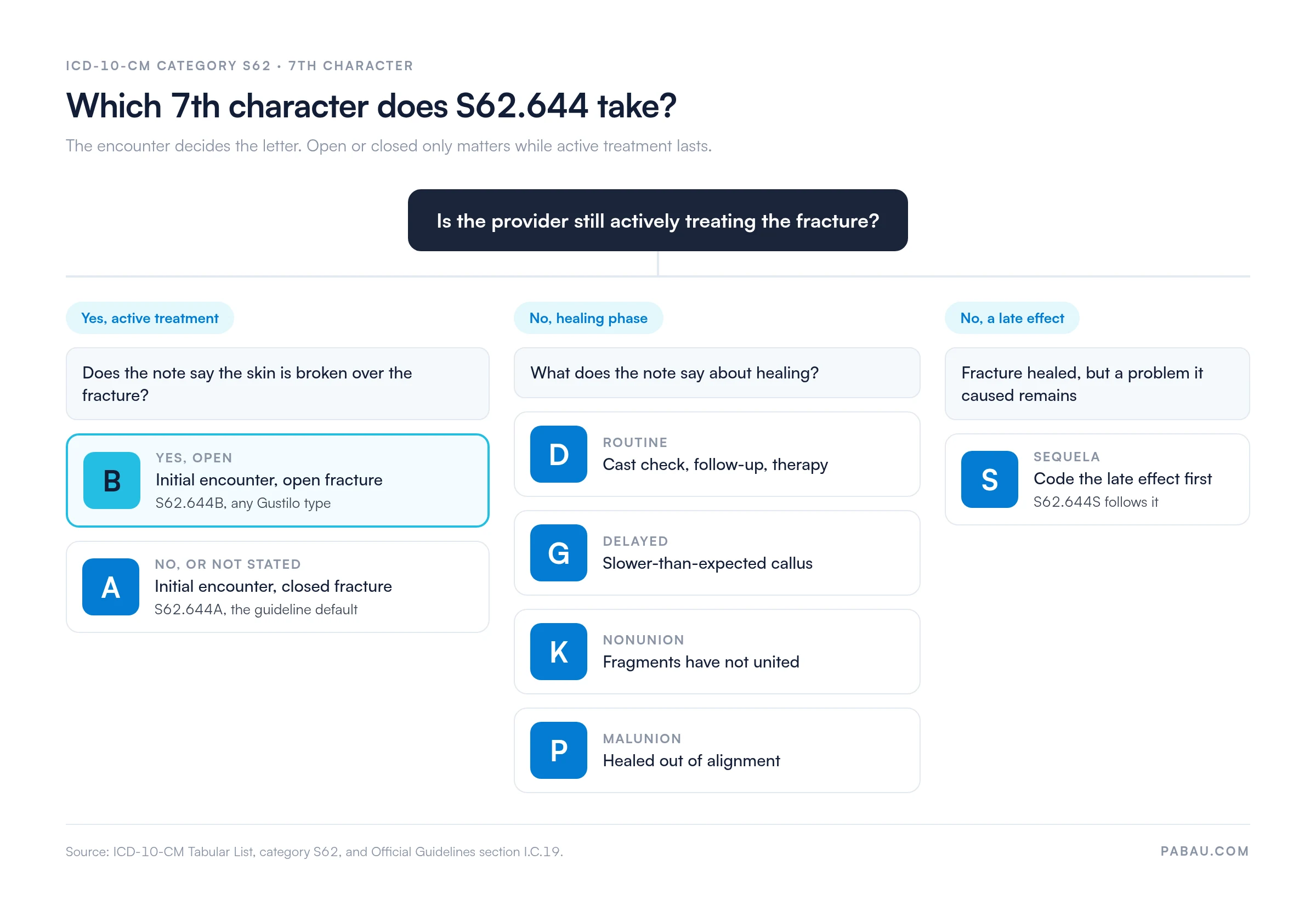
Reporting B at every follow-up visit is a common audit finding. It tells the payer the patient is still in active treatment for a new open fracture, which the notes won’t support.
Check the encounter type before you pick the 7th character. If the provider is still actively treating the fracture (reducing, splinting, operating or managing the wound), A or B applies. Once the note shifts to monitoring, with language like “fracture healing well”, switch to D.
Nondisplaced and displaced fractures of the same bone use different codes. The ICD-10-CM guidelines say a fracture not documented as displaced or nondisplaced is coded as displaced. So if the note is silent on alignment, the default is S62.614B, not S62.644B.
The X-ray report is the usual source for alignment status, so check that it says “nondisplaced” or “no displacement” in words. When imaging isn’t available at the first visit, the provider’s own note must state that the fracture is nondisplaced. Without that statement, the code falls back to the displaced default.
Coding S62.644B cleanly takes documentation of five clinical facts. Missing any one of them is a common reason clean claim submission fails on the first pass.
An ED note that reads “right ring finger open fracture, proximal phalanx, nondisplaced on X-ray” covers all five facts. A note that reads “right hand fracture, open wound, treated with washout” leaves out the digit, the phalanx level and the displacement status.
CPT fracture codes describe the treatment, not the fracture. CPT guidelines state that an open or closed fracture has no coding link to open, closed or percutaneous treatment. So an open fracture that is washed out and splinted is still reported with a closed-treatment code. Check payment rules for each code in the CMS Physician Fee Schedule.
The treatment code should match what the operative or ED note describes, and the debridement depth should match the tissue documented. Payer policies on bundling debridement with fracture care vary, so confirm them with each carrier before submission.
Finger fracture claims tend to deny for predictable, preventable reasons. The denial codes attached to S62.644B claims usually trace back to one of the causes below. Find the root cause before you draft an appeal.
Workers’ compensation claims add a layer. The provider’s note must connect the fracture to a specific workplace event, not just describe the injury. Workers’ comp carriers also set their own timely filing limits, so check the carrier’s deadline before you submit a corrected claim.
Once active treatment of the open fracture is complete, B no longer applies. Later visits take a different 7th character, based on the healing status documented at that visit. Practices that follow fracture care through therapy meet this switch often.
Payers and auditors look for initial-encounter codes repeated across a long episode, and they read it as a documentation problem. A quick check of the 7th character at each follow-up visit keeps the episode consistent from the ED visit to discharge.
Category S62 and subcategory S62.6 carry Excludes1 and Excludes2 notes that set the code’s boundaries. On a complex hand injury, confirm that none of them changes your code choice before you finalize S62.644B.
An Excludes1 note is a hard stop, meaning the two conditions can’t be reported together. An Excludes2 note means the excluded condition isn’t part of this code, so both codes may appear when both conditions exist. For the full note text, check the ICD List code reference against the current tabular list.
Most practices code an open finger fracture from the ED note and key the claim into a separate billing tool. A wrong 7th character often surfaces weeks later as a denial. Every correction means finding the note again and resubmitting by hand.
Practice management software like Pabau keeps that work in one place. Its claims management software pre-fills each claim with patient, treatment and insurer details straight from the patient record. It also runs validation checks in the background each time you send a claim.
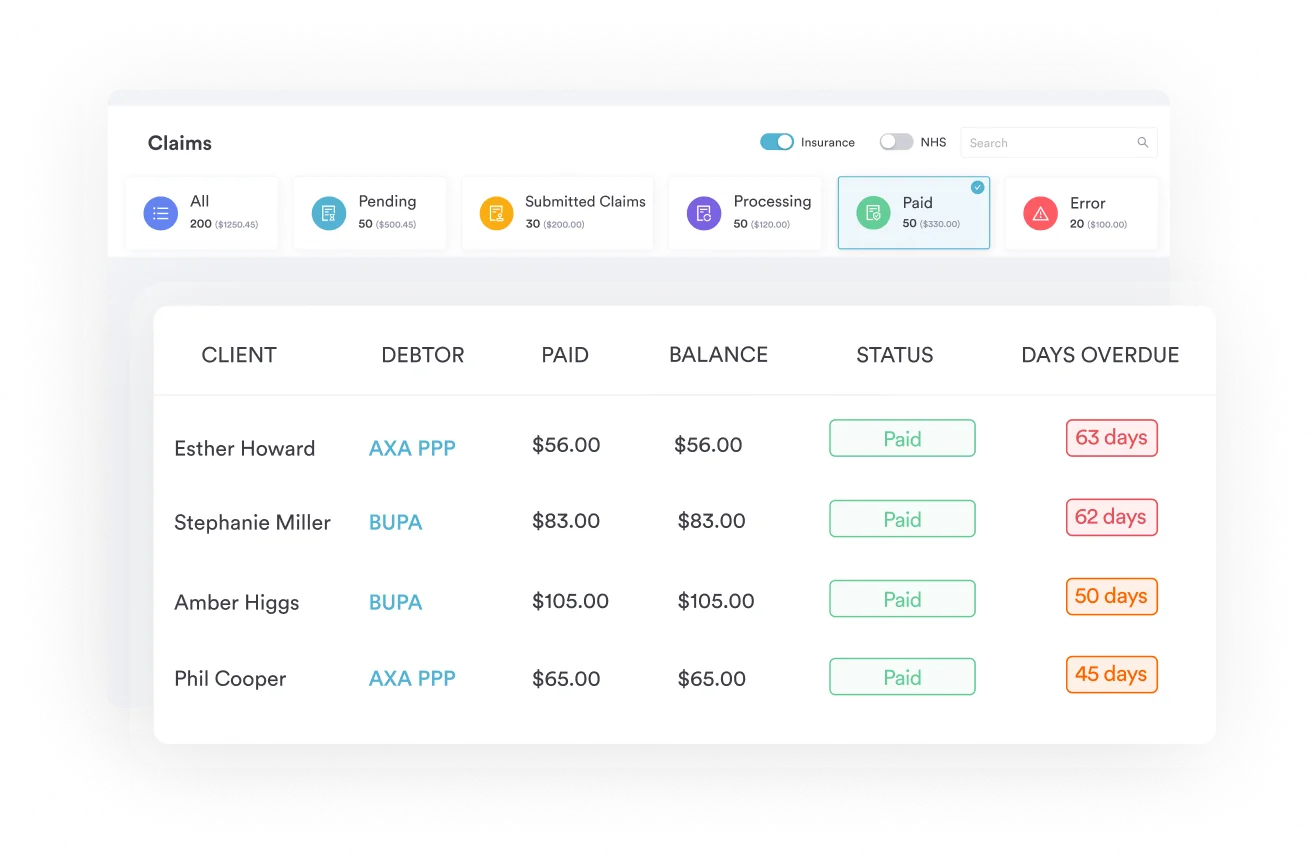
In the US, Pabau integrates with Claim.MD, which lets you run real-time eligibility checks and submit claims across thousands of US payers. ERA remittances post back into Pabau, so a denied fracture claim shows up against the patient with its reason attached. Your billing team corrects the 7th character and resubmits without chasing paperwork.

Pabau integrates with Claim.MD to submit and track claims across thousands of US payers. Catch 7th character errors early and keep S62.644 coding consistent across the episode of care.

For S62.644B, the note settles most of the coding before you open the code book. If it says the skin over the fracture is broken and the fragments are aligned, B is correct at the first encounter. The Gustilo grade doesn’t change that. If it’s silent on either point, the defaults push you to a closed or displaced code instead.
So the fix sits upstream, in the ED and operative notes, not in the appeal. Build a short documentation check into your fracture workflow, and switch to D at the first routine follow-up. That trade of a minute per chart saves the rework on every denial it prevents.
Pabau’s Claim.MD integration submits and tracks these claims across thousands of US payers, so errors surface before they cost you weeks. Book a demo to see how Pabau keeps fracture claims accurate from the first visit to the last.

Want clearinghouse checks before a fracture claim goes out? Claim.MD clearinghouse overview explains how Claim.MD handles eligibility, claim submission and remittances.
Building a compliance routine for injury claims? Medical billing compliance guide covers documentation standards and payer requirements.
Dealing with a run of fracture denials? Denial management in healthcare walks through finding root causes and preventing repeat denials.
Need to read what the payer sent back? Electronic remittance advice explained shows how to read ERA reason codes and act on them.
ICD-10 Code S62.644B is the billable code for a nondisplaced proximal phalanx fracture of the right ring finger, initial encounter for open fracture. It applies when the skin over the fracture is broken and the provider is still actively treating it. Category S62 doesn’t split open fractures by Gustilo type, so any open fracture at this site takes B.
Yes, S62.644B is a billable, leaf-level ICD-10-CM diagnosis code, valid from FY 2016 through FY 2026. The parent code S62.644, without a 7th character, isn’t billable and will reject at claim edit. Always submit the full seven-character code.
S62.644A covers the injury at the initial encounter for a closed fracture, with the skin intact. S62.644B covers the same injury at the initial encounter for an open fracture, where the skin over the fracture is broken. If the note doesn’t say whether the fracture is open or closed, the guidelines default to closed, which means S62.644A.
S62.644B applies while the provider is actively treating the open fracture. S62.644D applies at later visits where the provider is monitoring routine healing, such as cast checks, wound checks and follow-up imaging. Once active treatment ends, switch from B to D.
Common pairings are 26720 for closed treatment without manipulation, 26727 for percutaneous fixation and 26735 for open treatment with internal fixation. CPT 11010 covers debridement at an open fracture site, and 73140 covers finger X-rays. CPT treatment codes don’t depend on whether the fracture is open or closed, so choose the one that matches the treatment documented.
Common causes are the non-billable parent code S62.644, a B code without a documented open wound, and B codes repeated at follow-up visits. Missing external cause codes and a wrong phalanx level also lead to denials. Each one is fixed by correcting the code against the note and resubmitting.
The laterality sibling is S62.645B, for the left ring finger. The displaced counterpart is S62.614B, for a displaced proximal phalanx fracture of the right ring finger. S62.654B covers the middle phalanx of the right ring finger, and S62.646B covers the proximal phalanx of the right little finger.



