CPT Code 62284: Injection procedure for myelography
CPT Code 62284: official descriptor and procedure overview The American Medical ...

Last Updated: Oct 19, 2026
CPT code 21040 covers excision of a benign tumor or cyst of the mandible by enucleation and/or curettage. In plain terms, the surgeon shells out or scrapes away a non-cancerous lower jaw lesion without cutting through the bone.
That last detail decides the claim. If the operative note records an osteotomy, the same lesion moves to 21046 or 21047, and a 21040 claim no longer matches the record. Jaw surgery also sits between dental and medical benefits, so where the claim goes matters as much as the code on it. Get the approach and the benefit right, and the rest of the claim follows.
Let Pabau's smart automation suggest the right codes, reduce claim denials, and keep your practice compliant—effortlessly.
Automate repetitive tasks and focus on what matters most—your patients.
Reduce coding errors and ensure compliance with the latest regulations.
Clean claims, fewer denials, and faster reimbursements.
Powerful insights and reporting to help your practice thrive.
HIPAA compliant SOC 2 certified GDPR-compliant Trusted by 4,000+ clinics worldwide

CPT code 21040 covers removal of a benign tumor or cyst of the mandible by enucleation and/or curettage, with a 90-day global period.
A benign mandibular lesion that needs an osteotomy moves to 21046 (intra-oral) or 21047 (extra-oral with partial mandibulectomy).
Malignant mandibular tumors use 21044 or 21045, and benign maxillary lesions use 21030, never 21040.
Pair 21040 with a specific jaw diagnosis such as D16.5, K09.0, M27.49 or M27.1, confirmed by the pathology report.
Bill 21040 on a CMS-1500 under the medical benefit, because a claim routed to a dental plan fails on the first edit.
CPT code 21040 describes “excision of benign tumor or cyst of mandible, by enucleation and/or curettage.” The American Medical Association places it in the Musculoskeletal System chapter, Head subsection (21010-21499).
The surgeon reaches the lesion and shells it out whole (enucleation) or scrapes it from the bony cavity (curettage). The wound is then closed, and the specimen goes to pathology to confirm the lesion is benign.
Three facts decide whether 21040 applies. The lesion is benign, it sits in the mandible (lower jaw), and enucleation or curettage removes it. If the surgeon has to cut through bone with an osteotomy, the claim moves to 21046 or 21047.
CPT code 21040 applies to benign pathology inside the mandibular bone that can be removed by enucleation or curettage. Coders see it most often with these diagnoses:
Locally aggressive lesions, such as many ameloblastomas, often need an osteotomy for complete removal. In that case the approach, not the diagnosis, moves the claim to 21046 or 21047.
The steps bundled into 21040 include anesthesia, flap elevation, access to the lesion, enucleation or curettage, irrigation of the cavity, and primary closure. Don’t report those steps separately.
The most common coding error in this family is choosing 21040 when the operative note supports a different code. Malignant pathology leaves the benign family entirely and moves to 21044 or 21045. This table shows where 21040 ends and its neighbors begin.
The chart below turns the same rules into three questions, answered in order from the pathology report and the op note.
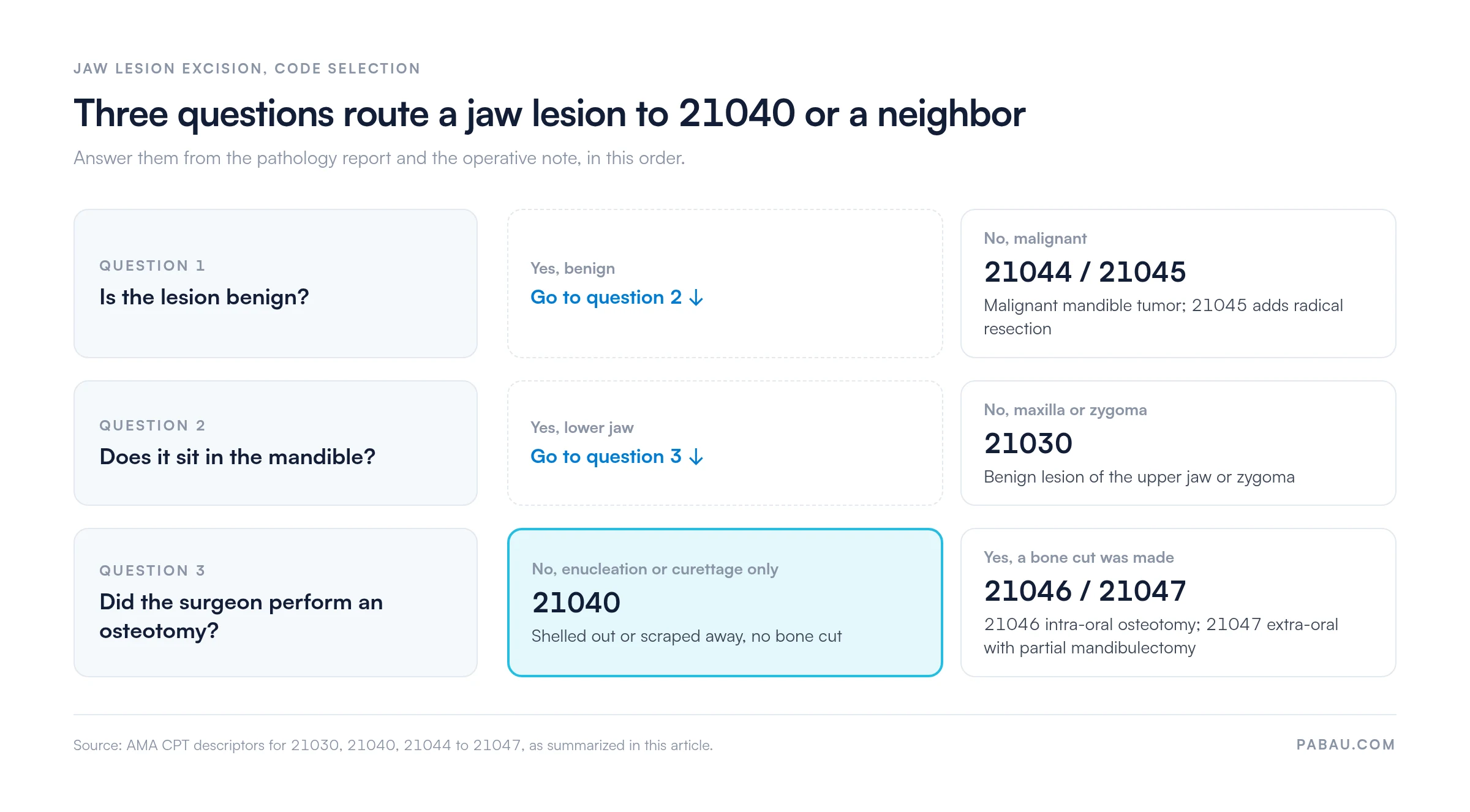
Say the op note reads: dentigerous cyst, left posterior mandible, enucleated through a buccal window, no osteotomy. That’s 21040, paired with K09.0.
Now change one detail. If the surgeon cut bone from inside the mouth to clear a destructive lesion, the claim moves to 21046. An external approach with partial mandibulectomy moves it to 21047.
Whichever code you choose, the operative report must name the approach and state whether an osteotomy was performed. Without that language, a 21046 or 21047 claim can’t be defended on audit.
Once the approach is settled, the diagnosis has to back it up. Diagnosis code specificity is a leading reason CPT code 21040 claims are denied. Payers check the ICD-10 code against the procedure to confirm medical necessity.
The CDC/NCHS ICD-10-CM tool confirms the current-year status of each code below.
Match the code to the final pathology, not the pre-op impression. A lesion read as a central giant cell granuloma, for example, pairs with M27.1 rather than a general jaw cyst code.
Always check pairings against the current-year ICD-10-CM tabular list before submission. Some payers require the diagnosis code to match the pathology report exactly.
An incomplete operative note is the fastest route to a denial on CPT code 21040. The record must show the lesion was benign, sat in the mandible, and came out by enucleation or curettage. The operative report needs to document:
A missing element gives the payer grounds to request more records or deny the claim. Payers look hard at pre-operative imaging, because it shows the lesion was confined enough for enucleation.
Build an operative note template for jaw lesion excisions with fields for the surgical approach, osteotomy status, specimen submission and pre-op imaging. Each field maps to a question the payer asks before paying 21040.
Prior authorization rules for CPT code 21040 vary by payer and plan year. Commercial insurers often require prior auth for elective jaw surgery.
Medicare Part B does not list 21040 for prior authorization. Coverage can still fail if the claim routes to a dental benefit administrator instead of the medical plan.
When you submit a prior authorization request, include the following:
Confirm each payer’s requirements during the eligibility check. Policies change every year, so a procedure that needed no auth last year may need one now.
Modifier selection for CPT code 21040 follows standard surgical modifier rules. The wrong modifier, or a missing one, causes payment delays or denials. The AAPC’s CPT code reference lists modifier guidance alongside descriptor lookups.
Modifier -22 needs the most caution. Payers review -22 claims manually and reduce routine cases labeled complex without support. Reserve it for atypical cases, such as a recurrent cyst with prior surgical scarring that extended operative time.
Medicare pays CPT code 21040 using relative value units (RVUs) from the CMS Physician Fee Schedule. RVUs change every year, so check current figures in the CMS lookup tool before quoting rates.
CPT code 21040 carries a 90-day global surgical period. One payment covers the pre-operative visit the day before, the procedure, and related follow-up visits within 90 days.
A separate visit within that window for a related complication is bundled and denied. Modifiers -24 (unrelated E/M), -25 (significant, separate E/M on the same day) and -79 (unrelated procedure) allow separate billing. Use them only when the record supports a distinct service.
Most 21040 procedures take place in an ambulatory surgery center (ASC, POS 24) or outpatient hospital (POS 22). Office-based excision (POS 11) is less common.
The place of service changes payment. At a facility, the practice expense RVU is lower because the facility bills its own overhead. In the office, the physician payment is higher to cover the practice’s overhead.
CPT code 21040 claims sit at the boundary of dental and medical billing, which drives extra denials. Practices with proactive denial management catch these patterns before they compound. These five scenarios cause the usual 21040 rejections.
When a denial arrives anyway, the denial reason code on the payer’s response points to the fix. Read it before you resubmit, so the second claim corrects the right field.
Some insurers route every jaw-related claim to their dental benefit administrator by default, even when the pathology is medical. The dental benefit expects CDT codes, so a CPT claim fails on the first edit.
Bill deliberately on the medical side. Use the CMS-1500 form, not the ADA dental claim form, and pair the CPT code with a medical ICD-10 diagnosis such as D16.5.
Address the claim to the medical plan administrator. If a misrouted claim is denied, the appeal should cite the insurer’s medical policy for jaw surgery. Include the operative note and pathology report with it.
A 21040 claim moves in a fixed order. The surgeon dictates the op note, pathology confirms the lesion, the coder picks the codes, and the claim goes to the medical plan. An error at the first step carries through to the last, so check the record before the form:
For the fields every claim needs, such as member IDs and provider details, our clean claim checklist covers the rest.
In many oral surgery practices, a coder reads the dictated op note and keys the claim into a separate billing system. A missing approach detail or a dental routing error only surfaces when the denial arrives.
With Pabau, the practice management platform we build, claims management catches errors before a 21040 claim leaves the practice. Claim scrubbing flags missing or invalid fields, and the CMS-1500 goes out through Claim.MD.
Eligibility checks before surgery show whether the patient’s medical plan covers the procedure. Claim tracking then shows where each claim stands, so your team can spot a stalled or denied 21040 claim early.
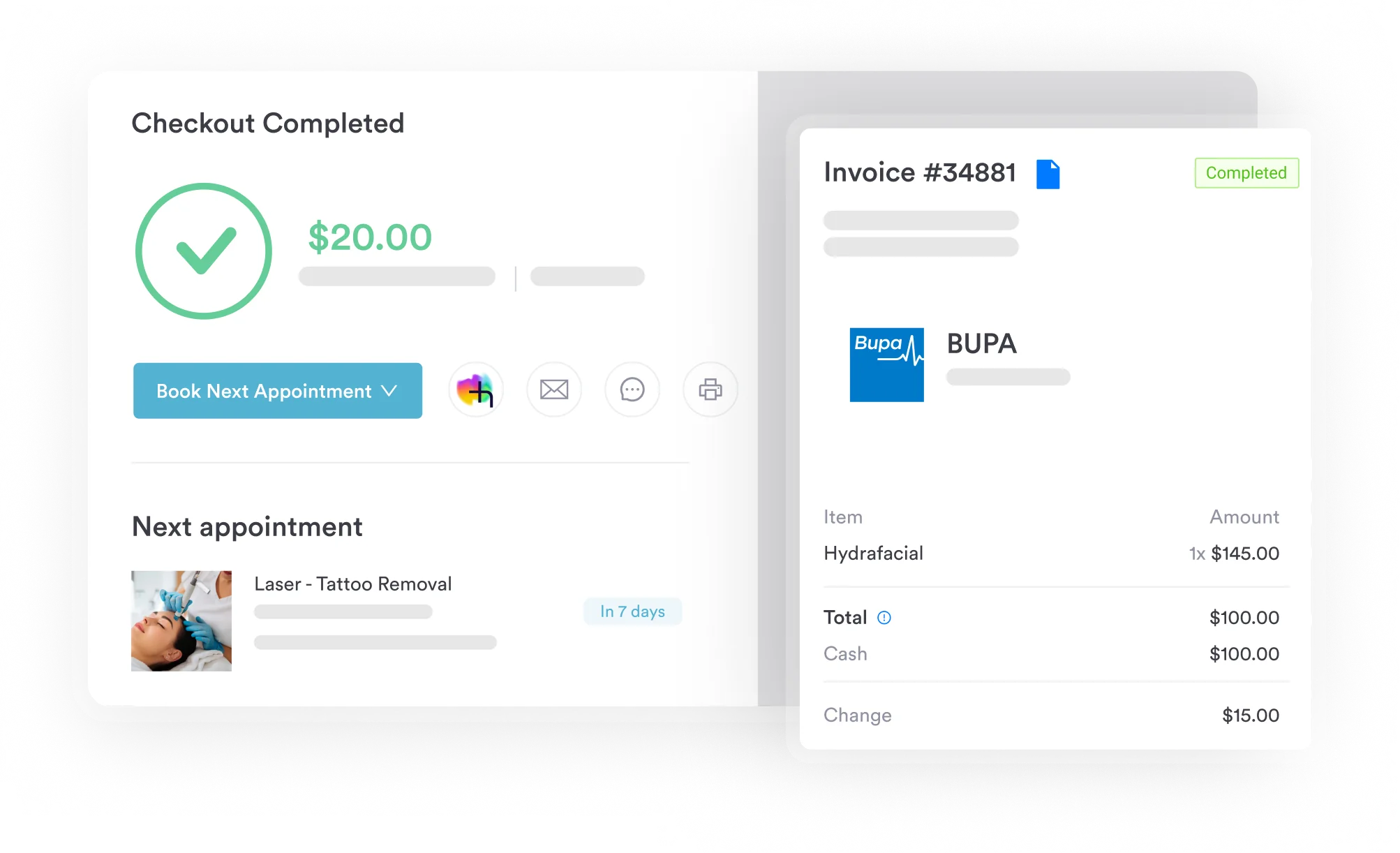

Pabau sends CMS-1500 claims through Claim.MD. Claim scrubbing, eligibility checks and claim tracking help your 21040 claims go out clean.

Treat 21040 as an approach decision before it becomes a coding decision. An op note that names enucleation or curettage, with no osteotomy, makes the code defensible on audit. If the approach is unclear, query the surgeon before the claim goes out.
That query takes a few minutes today. Skipping it can cost a denial and an appeal on a code whose 90-day global period also governs every follow-up visit. Book a demo to see how Pabau checks jaw surgery claims before they reach the payer.

Need to track denial patterns across your OMS claims? Denial codes in medical billing explains CARC reason codes and how to action them systematically.
Want to understand how claims reach payers? Medical claims clearinghouse guide covers how electronic claim routing works and what can go wrong.
Coding a benign lesion of the upper jaw instead? CPT code 21048 covers benign maxillary lesions that need an osteotomy.
New to the claim cycle? Medical billing fundamentals covers the end-to-end claim lifecycle from code selection to payment posting.
CPT code 21040 covers excision of a benign tumor or cyst of the mandible by enucleation and/or curettage. It applies when the lesion comes out without an osteotomy, and the tissue goes to pathology.
Dental plans use CDT codes instead of CPT. D7450 and D7451 cover benign odontogenic cysts or tumors up to 1.25 cm and over 1.25 cm. D7460 and D7461 apply the same size split to nonodontogenic lesions.
No. 21040 pays for the surgeon’s excision. The pathologist bills the specimen examination separately, using a surgical pathology code from the 88300 to 88309 range.
Yes, when the medical plan covers the lesion as medical pathology. Submit it on a CMS-1500 with a medical ICD-10 diagnosis, such as D16.5 or K09.0, and the surgeon’s NPI.
The surgical approach separates them. 21040 covers enucleation or curettage alone. 21046 adds an intra-oral osteotomy, and 21047 adds an extra-oral osteotomy with partial mandibulectomy.