CCSD code S1500: Biopsy of skin or subcutaneous tissue
CCSD code S1500: Definition and clinical scope CCSD code S1500 is the code the C...

Last Updated: Nov 10, 2026
21030 is the CPT code for excision of a benign tumor or cyst of the maxilla or zygoma by enucleation and curettage. It covers bony lesions of the upper jaw and cheekbone that pathology confirms as benign.
The AMA places 21030 in the Head subsection (21010-21499) of the Musculoskeletal System section. A malignant tumor at the same site bills under CPT 21034, and a benign mandibular lesion under 21040.
Let Pabau's smart automation suggest the right codes, reduce claim denials, and keep your practice compliant—effortlessly.
Automate repetitive tasks and focus on what matters most—your patients.
Reduce coding errors and ensure compliance with the latest regulations.
Clean claims, fewer denials, and faster reimbursements.
Powerful insights and reporting to help your practice thrive.
HIPAA compliant SOC 2 certified GDPR-compliant Trusted by 4,000+ clinics worldwide

CPT code 21030 covers excision of a benign tumor or cyst of the maxilla or zygoma, never a soft-tissue or mandibular lesion.
Pair it with D16.4 for a benign bone tumor, K09.0 for a developmental odontogenic cyst, or M27.49 for another jaw cyst, as pathology confirms.
Claims are most often denied for missing pathology confirmation, a wrong ICD-10 pairing, or prior authorization that a commercial payer required but nobody obtained.
Medicare’s CY2026 work RVU for 21030 is 4.79, and the national rate is about $338 in a facility and $478 outside one.
Pabau’s practice management software submits 21030 claims through Claim.MD and warns when a required prior authorization code is missing.
CPT code 21030 describes “excision of benign tumor or cyst of maxilla or zygoma by enucleation and curettage.” The code covers surgical removal of bony lesions. The lesion must originate in, or be attached to, the cortical or trabecular bone of the maxilla (upper jaw) or zygoma (cheekbone). It does not apply to lesions arising in the adjacent soft tissue of the dentoalveolar structures.
The two anatomical sites covered are distinct from a billing standpoint. Maxillary lesions are the more common case, typically odontogenic cysts or benign ossifying tumors. A developmental odontogenic cyst takes ICD-10-CM K09.0 rather than a neoplasm code. Zygomatic arch lesions are less frequent and may involve fibrous dysplasia or giant cell tumors. Both sites fall under 21030 as long as the pathology confirms benign status.
“Benign” in this context is a pathology-confirmed designation, not a clinical assumption. The operative note must reference intent to excise a bony lesion, and the pathology report must confirm the absence of malignancy. Without that confirmation, payers may deny the claim as lacking medical necessity documentation.
Understanding where 21030 begins and ends prevents the most common upcoding and downcoding errors in oral and maxillofacial surgery billing.
Payers reviewing a CPT 21030 claim look for a clear chain from pre-operative imaging through to pathology confirmation. The documentation decides whether the claim holds up.
A maxillary or zygomatic lesion excision typically runs through these steps:
The operative note does not need a paragraph per step. It must name the site, the approach, and the technique used.
Most commercial and Medicare plans ask for the same documentation on a CPT 21030 claim. An operative note template with required fields for site, approach and technique stops the note from being signed without them.
The ICD-10-CM pairing for CPT code 21030 depends on the bony site in the operative note and the histologic type pathology confirms. Using a soft-tissue diagnosis code when the lesion is bony is the most frequent pairing error on these claims.
Verify every ICD-10-CM code against the CDC/NCHS ICD-10-CM web tool for the current fiscal year before submission. Codes are updated annually, and a code valid in FY 2025 may carry a different description in FY 2026. A Stafne defect, or latent bone cyst, codes to M27.0, and other oral-region cysts not classified elsewhere fall to K09.8.
The excision codes around 21030 cover a narrow anatomical and clinical range. Code selection turns on three questions: which bone, whether the lesion is benign or malignant, and how it was removed. The mandibular twin, 21040, is the code coders swap with 21030 most often. The guide below walks through the three questions in order.
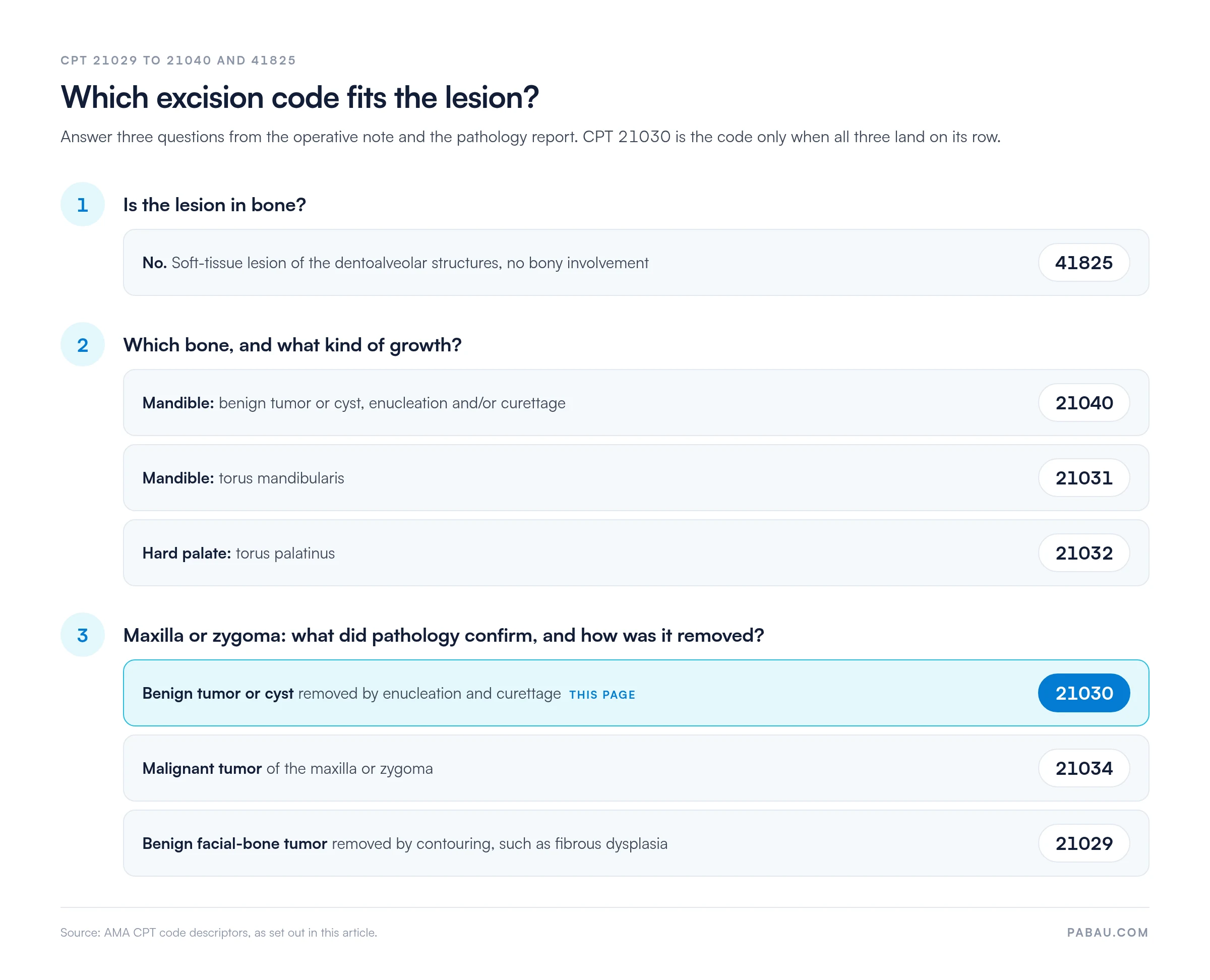
The table below sets out each code’s descriptor, site, and the detail that separates it from 21030.
When the operative note documents bony and soft-tissue lesion removal in one session, check whether both 21030 and 41825 apply. Then decide whether Modifier 51 belongs on the claim. Payers handle this pairing differently, so check the specific plan’s bundling rules before submitting.
The modifiers that apply to CPT code 21030 fall into two groups. Modifiers 22, 50 and 51 change how the claim is priced. LT/RT and Modifier 59 describe where and how the work was done without changing the base payment.
Medicare pays CPT code 21030 from the relative value units (RVUs) in the Medicare Physician Fee Schedule (MPFS). The total RVUs are multiplied by the conversion factor and adjusted by the Geographic Practice Cost Index (GPCI). For CY2026 the work RVU is 4.79, and the national rate is about $338 in a facility and $478 outside one. Your allowed amount will differ by Medicare Administrative Contractor (MAC) locality.
These values come from the CMS CY2026 relative value file (RVU26D, October 2026 release). For your locality’s rate, use the CMS Physician Fee Schedule lookup tool. The FastRVU 2026 RVU lookup applies GPCI by ZIP code if you want a quicker estimate.
Commercial payment for CPT code 21030 varies widely from the Medicare rate. It depends on the contract you hold with each payer.
Medicare does not require prior authorization for CPT code 21030 in an office or outpatient surgical setting, as of this writing. Confirm against the CMS prior-authorization lists before you schedule. Commercial payers are a different story.
Many commercial and managed care plans require prior authorization for surgical excision codes in this range. That applies most often in an ambulatory surgical center or hospital outpatient setting. The specific requirement depends on the patient’s plan. No single answer covers every plan, so verify with the specific payer before scheduling.
When prior auth is required, the documentation package typically includes:
Some plans also require a letter of medical necessity from the treating surgeon. A medical billing compliance protocol for surgical codes gives the practice one prior auth workflow to follow.
When authorization is denied, the appeal generally needs more clinical evidence from the surgeon. Failed conservative treatment or documented growth of the lesion over time are typical examples. Local Coverage Determinations (LCDs) published by your MAC may add medical necessity criteria beyond the CPT descriptor. Check the applicable LCD before you submit the auth request.
CPT code 21030 claims are denied for predictable reasons. Each one has a corresponding prevention action that can be built into the pre-submission workflow.
Structured denial management workflows catch these patterns before they repeat across claims. A denial log sorted by reason code shows which workflow step fails most often. The denial codes guide maps each CARC to its usual fix.
Run a quarterly audit of all 21030 claims by denial reason code. If wrong ICD-10 pairings make up a large share of denials, the fix belongs at the coder-to-chart handoff. Add a site check to chart review before coding starts.
Surgical excision codes like CPT code 21030 have more moving parts than a standard E/M claim. Pathology confirmation, site verification, modifier selection, and prior auth tracking all happen before submission. A missed step at any point can produce a denial that takes weeks to appeal.
Pabau’s claims management software submits 21030 claims electronically through Claim.MD as CMS-1500/837P claims. It runs eligibility checks before the visit and handles secondary claims. ERA remittances return to the patient record, so each denial code sits next to the claim that triggered it.
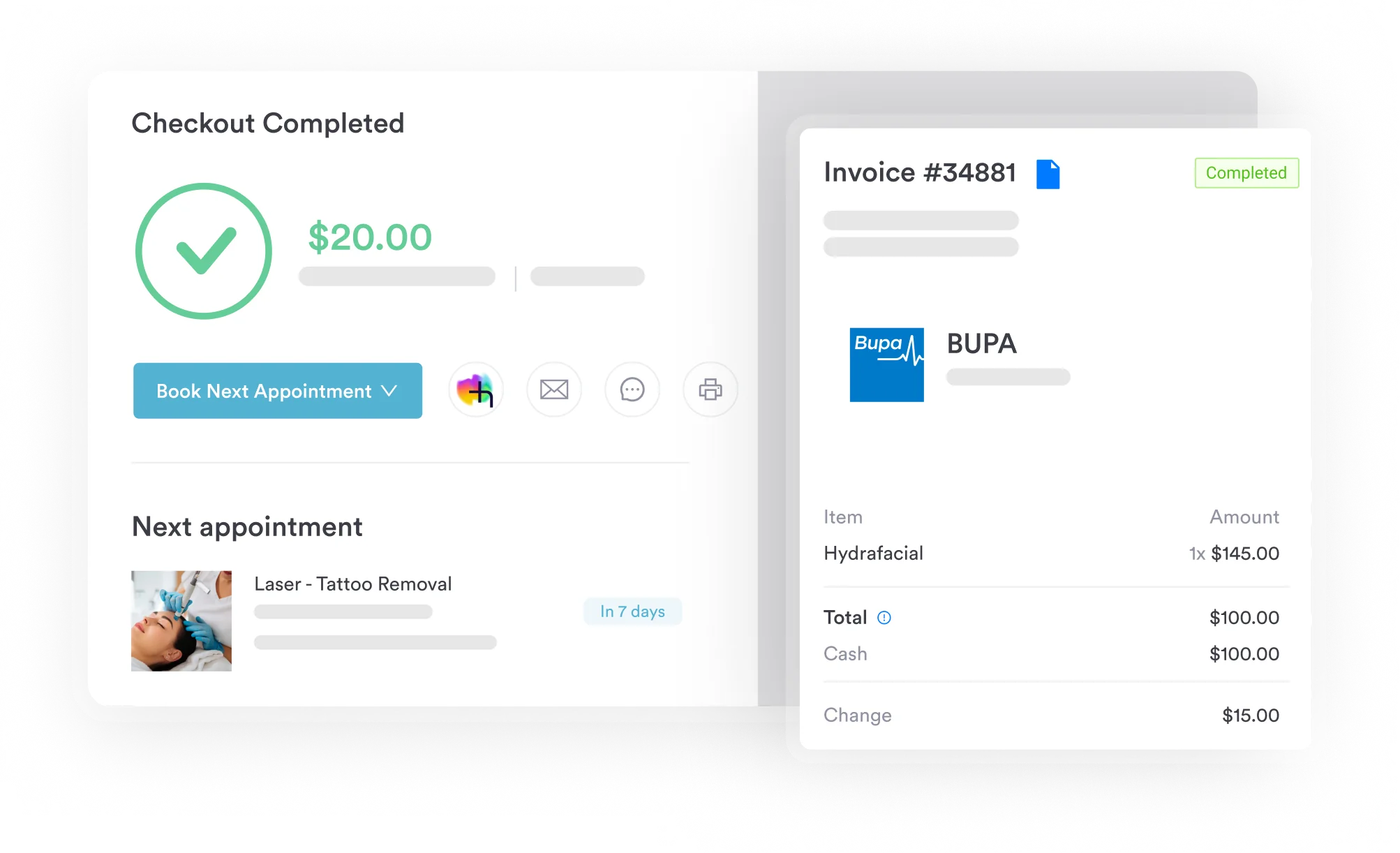
Prior authorization gets the same treatment. Pabau tracks the authorization code, dates and sessions on the case and warns when one is missing. That flags a missing auth before the claim goes out, not after the denial comes back. Pair it with sound medical billing fundamentals and a clean claim checklist covering pathology, site and modifiers.

Pabau submits CPT 21030 claims through Claim.MD, runs eligibility checks, and brings ERA denial codes into the patient record. It also tracks prior authorization codes and warns when one is missing.

CPT code 21030 pays cleanly when four facts line up in the record. The lesion is benign, the site is the maxilla or zygoma, the pathology report is attached, and the ICD-10 code matches it. Put the site and pathology checks into chart review, before coding starts, and most of the rework on this code stops.
Pabau’s integrated clearinghouse billing tracks prior auth status and brings ERA denial codes into one place. The patterns behind repeat 21030 denials then show up early enough to fix. Book a demo to see how it handles surgical excision claims in your practice.

Need to understand how clearinghouse billing works for surgical codes? Medical claims clearinghouse guide explains how clearinghouses validate, route, and report on claims before they reach the payer.
Getting denials with CARC codes you don’t recognise? Denial codes in medical billing breaks down the most common CARC and RARC codes and what each one means for your appeal.
Want to see the full 837P claim lifecycle for surgical procedures? 837 file guide covers how the electronic claim file is structured and what payers validate at each stage.
CPT code 21030 covers excision of a benign tumor or cyst of the maxilla or zygoma by enucleation and curettage. It applies only to bony lesions at those two anatomical sites confirmed as benign by pathology. Soft-tissue lesions of the same region are billed under different codes, and mandibular lesions use CPT 21040.
CPT 21032 covers excision of a torus palatinus, a bony outgrowth on the hard palate, not a tumor or cyst. CPT 21034 covers excision of a malignant tumor of the maxilla or zygoma, with a wider surgical scope and malignancy confirmed by pathology. Use 21030 when the lesion is benign and located on the maxilla or zygomatic bone.
The work RVU for CPT 21030 is 4.79 in the CY2026 Medicare Physician Fee Schedule. Total RVUs are 10.08 in a facility and 14.25 outside one. CMS updates the values each January, so check the current relative value file before you quote a figure.
Modifier 22 applies when the procedure takes substantially more time and effort than a typical 21030 case. A large or multi-lobed lesion, scarring from prior surgery, or difficult access can qualify. The operative note must document the factors that increased difficulty. A cover letter explaining the added work is recommended. Reimbursement adjustment is payer-discretionary and not guaranteed.