


CPT Code 30801: Superficial turbinate ablation billing guide
CPT Code 30801: Official descriptor and procedure overview The American Medical ...

Last Updated: Nov 27, 2026
CCSD code XR585 is the UK private billing code for a percutaneous gastrostomy done as a sole procedure. Coders often read the XR prefix as plain-film X-ray, but the CCSD schedule files XR585 under Chapter 17, Gastrointestinal. In practice, that means a feeding tube placed through the abdominal wall, usually by an interventional radiologist.
CCSD also bars three codes from the same claim as XR585: G3400, G3440 and XR590. Pick the wrong code or pairing, and the insurer can send the invoice back unpaid. The sections below cover scope, those three codes, documentation and the denials worth preventing.

CCSD code XR585 describes a percutaneous gastrostomy as sole procedure, filed under Chapter 17, Gastrointestinal.
The XR prefix marks an image-guided procedure here, so XR585 has no link to plain-film X-ray billing.
CCSD lists G3400, G3440 and XR590 as unacceptable combinations with XR585 on the same claim.
Pre-authorization, fees and acceptance vary by insurer, so check each insurer’s current schedule before the procedure.
A clean claim rests on notes that name the percutaneous route, the guidance used and the tube placed.
XR585 bills a gastrostomy tube placed through the skin, with no other procedure in the same episode. The “as sole procedure” wording matters. It tells you the code stands alone, not as an add-on to a larger operation.
The XR codes in the CCSD schedule include interventional radiology work, not only imaging. XR585 sits in sub-chapter 17.10.0, next to other gastrointestinal procedures. So a radiology department may perform it, but the claim describes a procedure on the stomach. The urinary section of the same chapter holds procedure code XR650, percutaneous pyelolysis, a kidney procedure done through the skin. Chapter 17 also holds XR565, percutaneous dilatation of a biliary stricture under imaging control.
The full code page on the CCSD site needs a login. Check the current entry there, or in your insurer’s code search, before you bill. To compare XR585 with related entries, browse our CCSD codes library.
Think of XR585 as one tube, placed once, through the skin into the stomach. CCSD codes usually cover the steps that belong to the procedure itself. Confirm the exact bundling rules against CCSD guidance and your insurer’s schedule.
Usually part of an XR585 episode:
Outside XR585:
These four codes share a patient group, so they get mixed up. The table shows what sets each one apart. The last column is the line insurers check first.
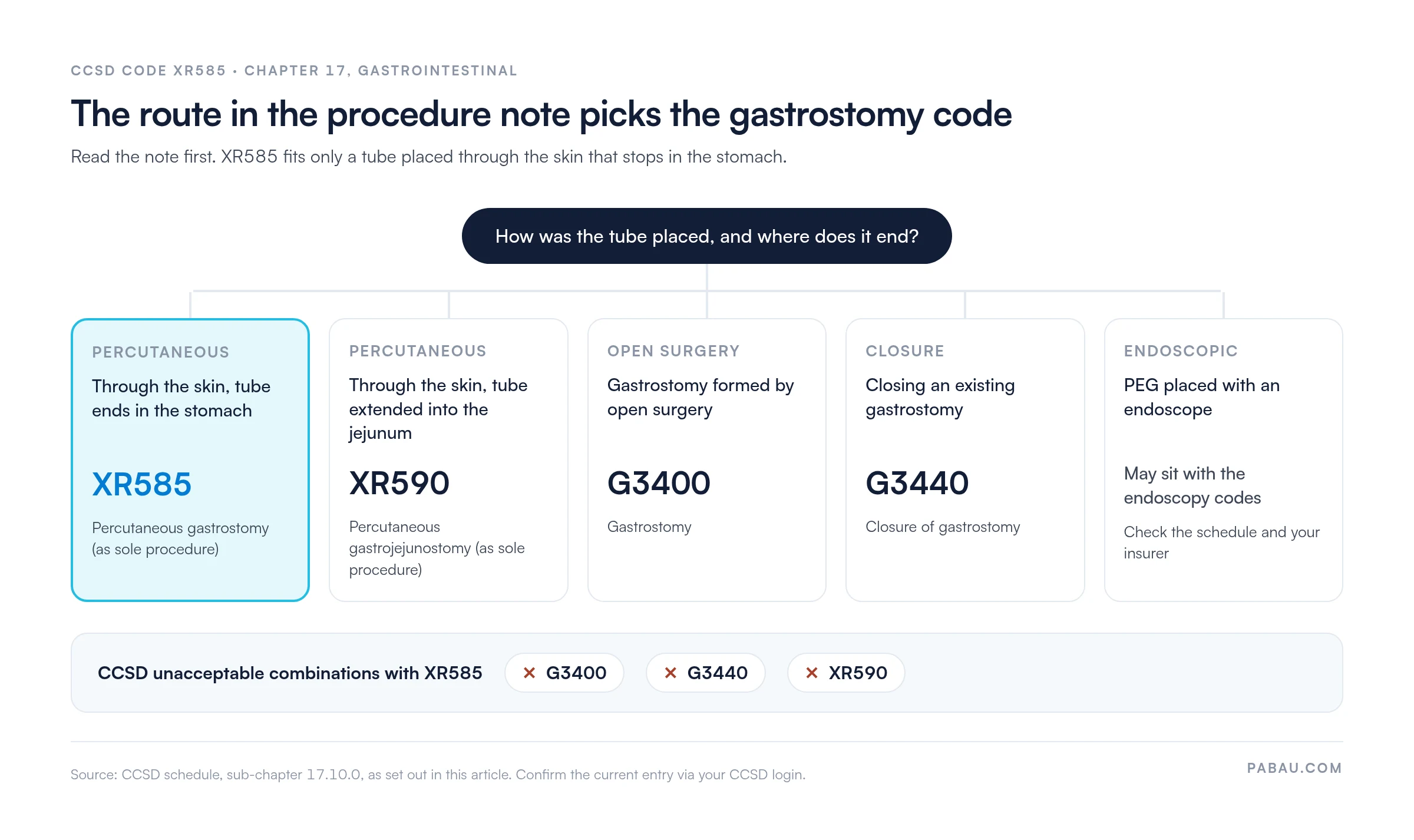
Here’s a quick example. A radiologist plans a gastrostomy, then extends the tube into the jejunum because of reflux risk. Code XR590 alone. Adding XR585 would bill the same access twice.
The diagram below turns that check into one question you can ask of every procedure note.
For the other codes in detail, see our guides to CCSD code G3400 and CCSD code G3440.
CCSD keeps a list of codes that cannot appear together on one claim. For XR585, that list holds G3400, G3440 and XR590.
Each pairing would describe the same stoma twice, or open and close it in one episode. CCSD calls its principles guidelines, so individual insurers may apply them differently. Check each insurer’s current rule before you assume a pairing will pass.
Before you code, ask one question: did the tube stop in the stomach or go on into the jejunum? That single answer decides between XR585 and XR590, and it should be written in the procedure note.
Here’s the usual path for an insured patient in UK private practice. Each step leaves something the insurer can check later.
Insurers compare the invoice with the clinical record. If the note and the code disagree, the claim stalls. Make sure the record shows:
No single rule covers every insurer. Each one decides whether XR585 needs pre-authorization, what it pays and which codes it accepts together. Check each insurer’s current schedule or rule before the procedure, not after.
These provider tools are a good place to start:
A negotiated agreement with an insurer can change the fee you receive. For a wider view of one insurer’s list, see our Bupa CCSD codes guide.
Most rejections trace back to a few causes. Each one has a fix you can apply before the claim leaves.
These errors start inside the practice, long before a claim reaches the insurer.
In many practices, the procedure note lives in one system and the invoice in another. A coder then copies codes and membership numbers across by hand, and errors creep in.
Pabau, a practice management platform with built-in claims management, keeps both on the patient record. UK claims go out through Healthcode and Bupa. Before a claim sends, Pabau checks that required fields like membership numbers and authorization codes are filled in.
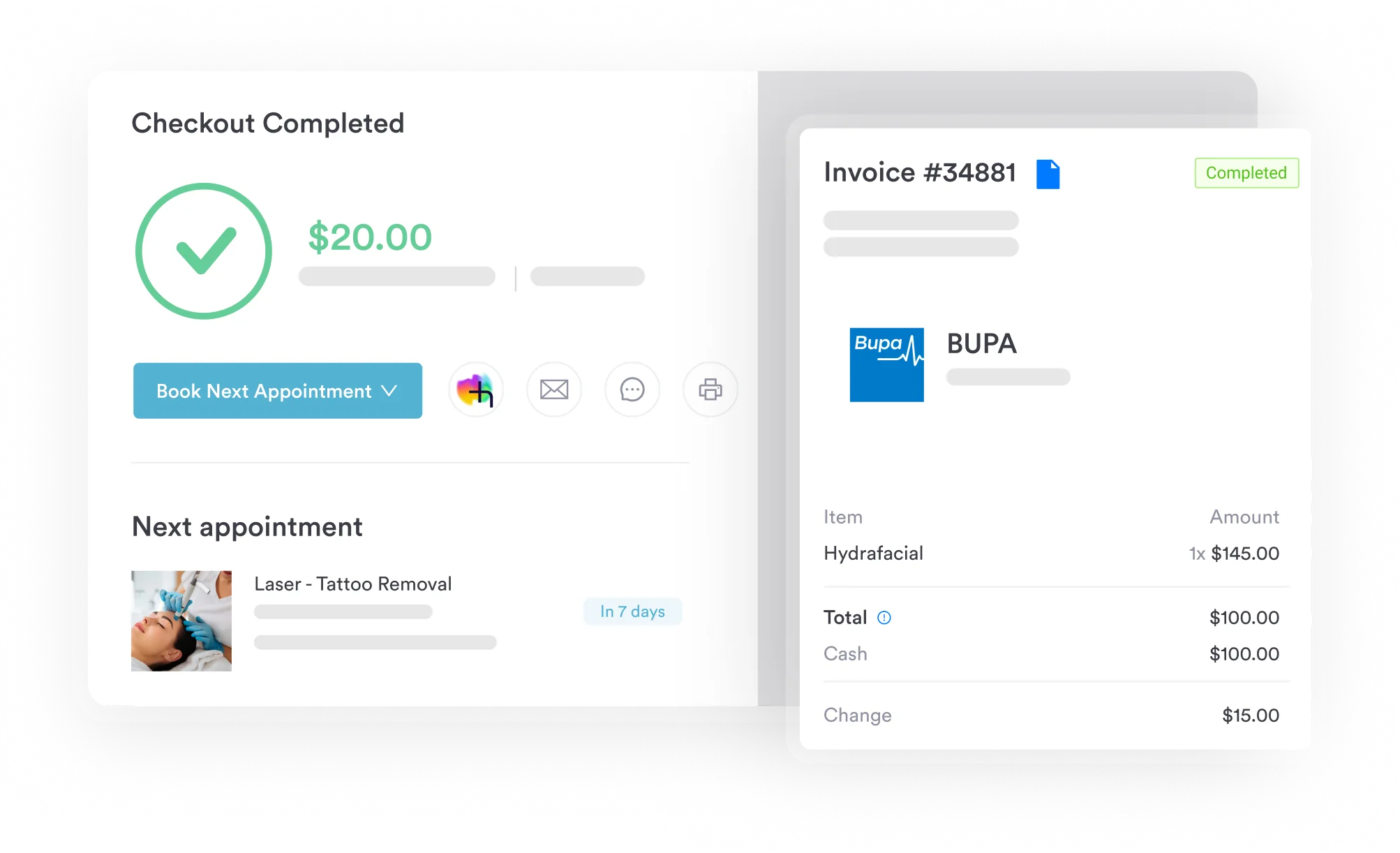

Pabau sends UK claims through Healthcode and Bupa from the patient record, and checks required claim fields before submission. See how it works for your practice.

XR585 claims go wrong when the code is read as imaging rather than a stomach procedure. Once you treat it as a percutaneous gastrostomy, the rest follows. The note names the route, and G3400, G3440 and XR590 stay off the claim.
The trade-off is a few extra minutes at the coding desk. That time costs far less than a returned invoice and a second submission. Book a demo to see how Pabau keeps gastrostomy notes and Healthcode claims on one record.

Billing a surgical gastrostomy instead? CCSD code G3400 covers the gastrostomy code that cannot share a claim with XR585.
Closing a gastrostomy later on? CCSD code G3440 explains how closure of a gastrostomy is billed.
Coding other image-guided procedures? CCSD code XR917 walks through PICC placement under X-ray guidance.
Retrieving a foreign body under imaging? CCSD code XR940 sets out the documentation and combination rules for that XR code.
Need a wider insurer code list? Bupa CCSD codes covers how Bupa uses the CCSD schedule for UK private practice.
Yes, in most cases. A radiologically inserted gastrostomy (RIG) is a percutaneous gastrostomy placed under X-ray guidance. It suits patients who can’t have an endoscope passed safely, for example because of a narrowed esophagus.
It means the code applies when that procedure is the only one performed in the episode. If it forms part of a larger operation, check CCSD guidance for how to code the whole episode.
Not always. A PEG is placed with an endoscope, and the endoscopy section may hold its code. Code from the route in the procedure note, and confirm it in the CCSD schedule.
Usually an interventional radiologist, working with a nurse and a radiographer. Dietitians and speech and language therapists often help decide whether the patient needs a tube.
It varies by tube type and care. Balloon-retained tubes are often changed every few months, while other designs last longer. Each change is billed as its own episode.




